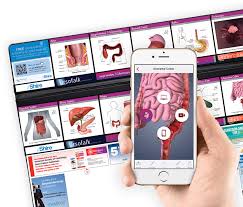
Augmented reality goes by many names and has many different faces. Most people use a form of augmented reality every day without realizing it, from Snapchat to Pokemon Go, AR is a thriving technology which offers a plethora of diverse learning opportunities. Although AR creates an engaging, immersive and entertaining environment within the gaming atmosphere, AR is coming to the forefront in education, healthcare and healthcare education. To achieve more situational experiences within healthcare, we are starting to see the use of simulations through an AR lens, as AR creates a unique learning environment. Unlike virtual reality, the AR user does not lose touch with reality, therefore “it puts information into eyesight as fast as possible” (Augmented Reality In Healthcare Will Be Revolutionary, 2014), which allows this software to become a force to be reckoned with in the future of medicine.
I have had some experience with AR in the form of learning modules and training scenarios through my time with Alberta Health Services, as well as my current role at Bow Valley College and both were completely different from each other. From an educational standpoint, I found it informative and insightful as the simulation went through possible learning outcomes and lesson plans for instruction. From a nursing lens, I found I was a little more overwhelmed because a simulation can pose options, but one can never be prepared for a person’s true reaction or the ramifications of what would happen from bad practice or lack of knowledge. Research of AR within healthcare does exist, but because research within this field is still in the infancy stage (Zhu, 2014), it can be hard to see what all the benefits and positive outcomes are.
The research that is available shows that participants readily accept AR as a learning technology, which improves learning effectiveness by “acquisition of skills and knowledge, understanding of spatial relationships and medical concepts, enhancing learning retention and performance on cognitive-psychomotor tasks, providing material in a convenient and timely manner that shortens the learning curve, giving subjective attractiveness, and simulating authentic experiences” (Zhu, 2014). I would like to examine what varieties of AR are offered in the healthcare field, specifically when using tele-health/tele-medicine, and what the outcomes are from a patient perspective. If it offers all the great benefits mentioned, it should be readily available to everyone. It is easy for me to throw on my nursing hat and say how beneficial I found AR scenarios by learning therapeutic approaches and appropriate nursing protocols, but how does this relate to patients and how they feel they were treated? During this pandemic, we are beginning to see a growth of phone consultations with Doctors and Specialists, but is there a more advanced technology that could be applied? What barriers would there be to introducing AR for patient health and education?
If a patient were to be going in for surgery, would it not be best to enter an AR simulation, opposed to googling the procedure and potentially being too scared or nervous to attend? Exhibiting symptoms and going through a checklist could make someone overwhelmed, but hearing or seeing what the actual ailment is, could ease their mind. If we continue to offer AR for the advances in healthcare education: “the benefit that AR can bring to the healthcare industry can be groundbreaking and we are just witnessing the beginning of what is to come from AR in the field of medicine” (Sanchez, n.d), would it not be beneficial to offer a form of this to the general public?
References
Augmented Reality In Healthcare Will Be Revolutionary: 9 Examples. (2019). Retrieved from: https://medicalfuturist.com/augmented-reality-in-healthcare-will-be-revolutionary/
Sanchez, J. (n.d.). Augmented Reality in Healthcare. Retrieved from https://www.plugandplaytechcenter.com/resources/augmented-reality-healthcare/
2014. Augmented reality in healthcare education: an integrative review. PeerJ 2:e469 https://doi.org/10.7717/peerj.469
April 23, 2020 at 10:32 am
Hi Kerry,
It’s great to see you opening out some of the possibilities of AR in healthcare, from both professional and patient perspectives. You also interestingly point out some of the challenges, including how the limitations of the options available in AR compared with the endless variety of potential responses that patients can give in specific situations. It will be helpful for your study to clarify the differences between AR and VR a little more (you’ve already made a good start here) and, if you focus on VR, what it actually might look like or more detailed examples of how patients might use it in the scenarios you provide.
April 24, 2020 at 11:04 am
Hi Irwin,
Thank you so much for the feedback. I wanted to focus on one technology specifically and was cautious to avoid mixing AR and VR in one melting pot, so this is good to know. My paper/learning plan focuses on the digital divide with the issue of having access to wifi/internet/technology, so I wanted a jumping off point of using a certain technology. Thank you for the heads up and the tips, I will be sure to incorporate those elements.
Regards,
Kerry
April 24, 2020 at 7:59 pm
Hi Kerry,
Augmented reality coupled with the digital divide is such an interesting topic.
I can certainly see promise for augmented reality to expand and develop within healthcare and healthcare education sectors. It shows exciting benefits to students and patients. Your blogpost sparked additional questions for me. Will this technology be available to all in the future? If this technology becomes a useful tool in saving the lives of patients, will the cost of the technology allow only some hospitals to make use of its benefits? If countries where healthcare isn’t universal, will only some patients be able to afford it?
On a side note, as someone that was a part of the Pokémon Go initial rush, there were a lot of articles that came out shortly after the debut of the game that warned about privacy issues. A great topic to consider in the future would be data security. How is personal AR data protected? Who sees what the user sees? The list of questions to explore goes on!
April 26, 2020 at 9:15 pm
Hi Sanjay,
Thank you for your comments, I hope you are well. I thought it would be challenging, but really interesting and I too came up with so many questions when I started researching the topic. Awesome questions Sanjay:
Will this technology be available to all in the future?
It would be ideal and amazing to have the technology reach everyone in the future. Due to the digital divide and cost, I am not sure if it would be realistic, however there is money allocated from the Government of Canada for a “Broadband fund”, which is allocated to close the digital divide. You can find some of that info here: https://crtc.gc.ca/eng/internet/internet.htm
Will it be enough? I don’t think so, but it would be great to have the adequate funding for all.
If this technology becomes a useful tool in saving the lives of patients, will the cost of the technology allow only some hospitals to make use of its benefits?
I would hope not, but I understand where you are coming from. AHS reaches through all of Alberta and if a simulation or technology is implemented in one hospital, it has to be accessed for all as part of their “we are one” initiative. I will have to do more research into the rest of Canada, but rural hospitals would always be a concern.
If countries where healthcare isn’t universal, will only some patients be able to afford it?
It bothers me so much that healthcare is not universal everywhere, but it is a truth that I understand exists. There is always push back when it comes to implementing technology with governments (taxpayers) footing the cost and we can’t please everyone. With that being said, I would hope it would become an App (similar to a What’sApp platform) where people can download to their personal device (free of charge) to communicate with Dr’s, specialists, therapists… Because Dr’s bill the Government for people with universal healthcare and use an HMO in places like the States, I would want people without this to still have access. I will have to think this one through when designing.
Interesting that you were part of the original Pokémon Go rush, are you interested in the Jurassic Park game? Yes, I have been keeping privacy issues in the back of my mind, hence avoiding platforms like Zoom and going more towards a What’sApp model for privacy.
Thank you so much for the suggestions and topics to consider. I am with you regarding the questions going on and on…as soon as you pull on the thread, the whole sweater comes unravelled. I will for sure keep all your throughts as I push through.
Kindest regards,
Kerry
May 5, 2020 at 11:32 am
Hi Kerry,
This is such an interesting and timely subject! It seems like your past experience as a nurse can be extremely valuable for this project, especially from the perspective of a health provider.
In my personal experience as a patient, I have had a physiotherapist using software to explain different muscle groups and layers to me in order to improve the outcomes of my therapy. It has completely changed my perception and understanding and I definitely felt more engaged after that. While it was not really an AR technology, I can see similar applications and the benefits for a patient!
I am curious if educating a patient in order to empower him or her to be an active and engaged participant in their health care, rather than a passive receiver of it can be another benefit of the AR? I would love to hear your opinion on this!
Looking forward to seeing your final project!
Marta