In the spirit of sharing

I was thinking about Lynda Barry (brilliant cartoonist, if you don’t know of her) and a conversation that she had with Tom Power on CBC. She talked about the opportunity she had to write a book, and how hard it was to get any momentum with it. Finally she said to herself (and I’m paraphrasing), “what would this look like if I were to do it?” Then laughed to herself, because, of course she was the one doing it.

Well. I kind of feel that way about this blog.

In one of my other lives, I’m a visual note-taker and graphic recorder. My note-taking is not linear, and much as I love the structure of taking notes in a spreadsheet, I struggle with it.

So, in the spirit of sharing, I offer some notes from this past course. Transformative Pedagogy 1 and 2.


Thanks for indulging me.

Reference:

Slavich, George M., and Philip G. Zimbardo. 2012. “Transformational Teaching: Theoretical Underpinnings, Basic Principles, and Core Methods.” Educational Psychology Review 24(4):569–608.

Reflections on leadership

This course has been unexpectedly timely. Our cohort has looked at our own experiences with leadership, learned about leadership styles and theories while watching local and world leaders navigate health care and associated crises brought on by the COVID-19 virus.

I’m looking through new lenses, thinking about leadership from new angles with a better understanding of the attributes of effective leaders. While I still have deep appreciation for Reflective leadership (Castelli, 2016) with its grounding in values and flexibility in looking to the future, I’m gaining a better working understanding of distributed leadership (Julien, Wright, and Zinni 2010) as the institution where I work (like many) is thrust into an online-only course delivery model.

Within the distributed model, leadership is thought to lie within every member of the community, and that when it is their time and space to emerge as leader, they do. When their time is over, someone else emerges as leader. This most closely resembles the relay-like passing of the baton that is happening within my work spaces currently. Instructors are consulting with instructors from different schools in silo-breaking collaboration. Groups of faculty are working with traditional, hierarchical leadership to brainstorm and build new initiatives that will enable our students to complete the programs they are currently in. Everyone is bringing their own strengths to bear in problem-solving, and willingly sharing their resources. The multiplicity of change that we’re navigating together is benefiting greatly from a better understanding of the complexity of our organizational systems (Weiner 2009), and how one change within the system has cascade effects to other parts of the system.

Within my work spaces the traditional leadership has been clear and communicative of the day-to-day things we have needed to know to navigate the rapid changes over the past few weeks. It is interesting to note that Sheninger’s (2019) first pillar, Communication, is central to effective leadership at this time. Communication is being done through a variety of digital media simultaneously in an effort to reach as many people as possible with good, reliable information. We’re watching digital communication methods for work proliferate daily as all people, not just leaders, explore the flexibility and efficacy of digital communication.

While the timing couldn’t be better for our cohort to participate in and observe leadership through these new lenses, it’s been a difficult time to implement planning and project management as many changes are being rolled out without planning, but out of necessity. There simply hasn’t been time to create the scale of change that we’ve undertaken with any forethought. It’s times like these where the strength of our leadership is what makes and breaks the changes. We have to have trust in our leaders as they ask us to implement change. We have to trust in our own ability to be leaders when it is our turn.

References:

Castelli, P. A. (2016). Reflective Leadership Review: A Framework for Improving Organisational Performance. The Journal of Management Development; Bradford 35(2):217–36. doi:10.1108/JMD-08-2015-0112
Julien, M., Wright, B., & Zinni, D. (2010). Stories from the Circle: Leadership Lessons Learned from Aboriginal Leaders. The Leadership Quarterly 21(1):114–26. doi:10.1016/j.leaqua.2009.10.0009
Sheninger, E. (2019). Pillars of Digital Leadership. International Center for Leadership in Education. Retrieved February 1, 2020 (https://leadered.com/pillars-of-digital-leadership/).
Weiner, B. J. (2009). A Theory of Organizational Readiness for Change. Implementation Science 4(1):67. doi:10.1186/1748-5908-4-67

Assignment 2 LRNT 525 Group E: An Empathy Driven Approach to Overcoming Resistance

Group E, comprised of myself, Sandra Kuipers, Leigh McCarthy, Mark Regan and Lorne Strachan are happy to present our toolkit for change. Please take a few moments to view the video above (thanks, Mark!) and the linked document below (thanks, Sandra!).

LRNT 525 Group E Change Management Toolkit

Thank you for taking time to view. We appreciate any and all feedback.


Project Management – reflections on the ShelterGuides project

About 10 years ago I became involved in the ShelterGuides project. Our 6 person team was carefully composed through a variety of metrics (including the Myers-Briggs Type Indicator and Edward de Bono’s 6 Thinking Hats). The project was intended to become an accessible, blended delivery training to ensure the safety and quality of life of individuals with disabilities in the new expansion of home share as a housing option in BC.

We (the team) had, at the outset, a sense of urgency in line with Kotter’s Leading Change method (Al-Haddad & Kotnour, 2015), knowing that this housing change was coming into practice without home share providers undergoing comprehensive training.

Home Share is a residential option for adults under the care of CLBC in which the individual shares a home with a Home Share provider who provides ongoing, individualized support. … The individuals within the home not only share their living space, but also their lives (John Howard Society, BC)

Devastatingly, the worst can happen if people aren’t trained, or if agencies leave vulnerable people with someone who does not care for them appropriately. A shattering example was in the news recently, with Florence Girard dying this past October of malnutrition. Her caregiver is now being charged with criminal negligence causing death (CBC article). She was living in a home share setting.

Knowing what we wanted to accomplish, we commenced working in an adaptive leadership style (Khan, 2017) conducting focus groups to understand the scope of what we should include in the course.

Development followed the Leading Change Method steps right through to delivery of pilot, rewrite, re-delivery (Kotter’s steps Consolidate Improvements and Produce More Change, Institutionalize More Changes as cited in Al Haddad & Kotnour, 2015). The final product after 2 years of development was a blended delivery course with three face-to-face days (beginning, middle and end) with the bulk of the content delivered online.

We had full cohorts initially, with current home share providers and interested people taking the course. By student response, the course was a success. By community response, the course was a success. People who didn’t previously have jobs got jobs caring for people in their home and existing home share providers who took the course told us that they learned things that were improving their lives daily.

And yet – no one past the initial offerings took the course.

Why?

We missed some key stakeholders at the outset. We had done focus groups of individuals needing support, and of people already providing home share services. Missing from that table were the licensing bodies and the governmental agencies that require (or in this case, don’t require) training.

The simple fact is, that people with very few qualifications are granted contracts to do home share. They are well-meaning, kind people, possessing clear criminal record checks. They participate in a series of intake interviews, learn some basic non-violent communication skills and basic first aid. Our focus group interviews with home share providers had shown that people felt overwhelmingly under prepared on welcoming someone to live with them, and that more training would have prepared them better for the realities of the lifestyle of home share.

In retrospect, data would have been useful. Relevant data would include the statistics of placement breakdown as relates to training levels. These data would have allowed us to approach different contract-granting bodies to ask that the training become mandatory.

A factor that would have promoted success would have been to have agreements with contract-granting bodies before or during the development of the course to  ensure that our course would have ongoing enrollment.

While there were many successes in the construction of the course (looking at it today, it still reflects best practices in the field), the biggest obstacle has consistently been motivating people to take it. Without government or agency mandating training, people do not see the value taking the time to learn new skills. Lesson learned? Ensure there’s an audience for the project. Anyone can build a beautiful, useful and relevant, thing, but if there’s no end user the project itself gathers dust.

References:

Al-Haddad, S., & Kotnour, T. (2015). Integrating the organizational change literature: A model for successful change. Journal of Organizational Change Management, 28(2), 234-262. Retrieved from https://doi-org.ezproxy.royalroads.ca/10.1108/JOCM-11-2013-0215\

Khan, Natalie. 2017. “Adaptive or Transactional Leadership in Current Higher Education: A Brief Comparison.” The International Review of Research in Open and Distributed Learning 18(3).


Leadership for Change in Digital Environments

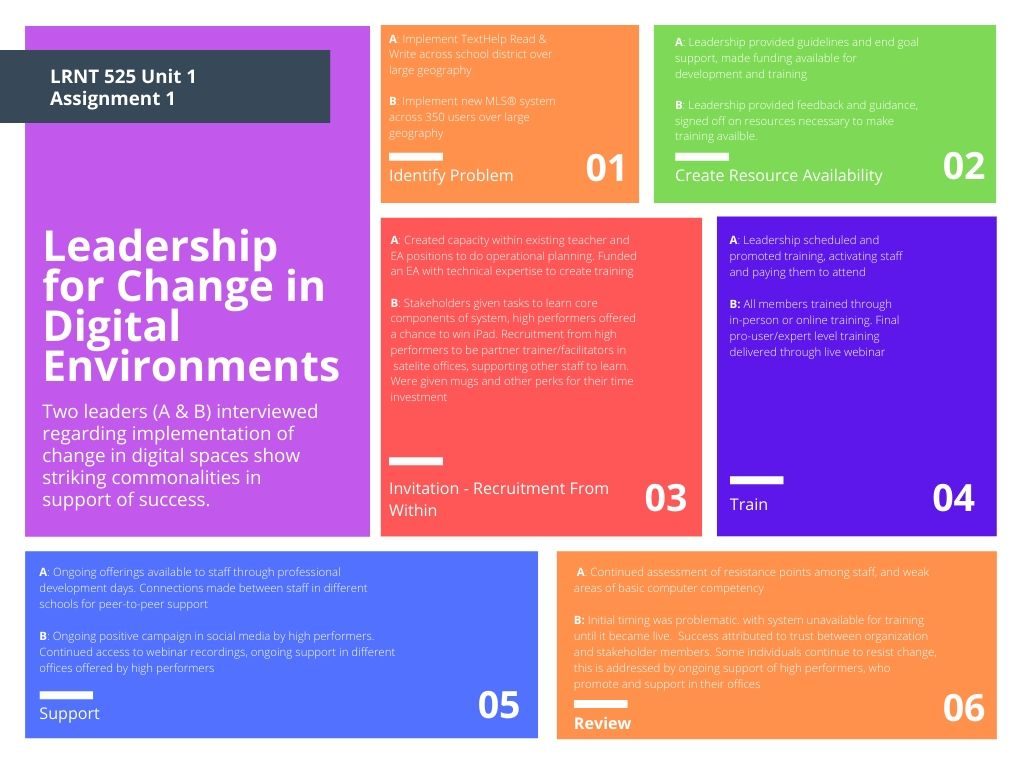
Six common areas were identified through consultation with two colleagues (A & B) about successful change in digital spaces. The commonalities have parallels in Lewin’s Method (1946), Luecke’s Method (2003) (as cited in Al-Haddad & Kotnour, 2015) and the Change model (Biech, 2007). The commonalities (identify problem, create resource availability, invitation, train, support and review) can be used to guide change in digital contexts, and are illustrated in the diagram Leadership for Change in Digital Environments (figure 1).

The colleagues (D. Leeming, personal communication, February 20, 2020; J. Lavack, personal communication, February 19, 2020) consulted are in different fields, both implementing different digital tools into the daily use of large numbers of stakeholders over large geographic areas. Colleague A (A) was part of the implementation of a tool for student use (TextHelp Read&Write plugin to Google Chrome) across School District 8 (SD8). SD8 has 5,314 students and a large geographic footprint, at 15,000 square km (School District 8, n.d.). Colleague B (B) facilitated the adoption of a new Multiple Listings System® by 350 REALTOR® members and stakeholders over a geographic area which spans from Rock Creek to the Alberta border and from Golden to the American border (Kootenay Association of REALTORs®, 2019). A & B both responded via email to the questions:

  1. Can you provide an example of an organizational change related to digital learning that was successfully implemented?
  2. What role did leadership play and what were some important steps that a leader or leaders took within the process?
  3. what challenges did they (or you) need to overcome?

To understand the parallels between their experiences, I created a table and populated it with information they provided. Next, the table was cross referenced with change management theories and methods, having the most in common with Lewin’s Method (1946), Luecke’s Method (2003) (as cited in Al-Haddad & Kotnour, 2015) and The Change model (Biech, 2007). It became evident that none of these were a point-for-point fit, but that the two experiences had common themes at different points in the process. From this grew the diagram Leadership for Change in Digital Environments (figure 1) with six areas: identify [the] problem, create resource availability, invitation, train, support and review.

No change process can be planned successfully without first identifying the institutional gap that needs to be addressed. A works as a technology teacher and librarian in SD 8, and is on the vanguard of local districts in the implementation of Chromebooks and Google Classroom. His familiarity with Chrome tools was instrumental in the decision to use Read&Write throughout SD8 to support students at all levels of learning. Adoption of Read&Write supports students with learning disabilities, giving them fluency in a tool that promotes their independence, will be available to them after graduation, all while reducing stigma (by having it available for all students, no students are singled out as deficient). For B, the challenge was shifting the whole population of REALTORs® from a set of old, individual softwares to a new, all-encompassing, completely integrated system. This first commonality, identify problem, has parallels in Lewin’s (1946) unfreeze, Luecke’s (2003) mobilize energy and commitment by jointly identifying problems & solutions, and develop a shared vision of how to organize (Al-Haddad & Kotnour, 2015), as well as challenge the current state (Biech, 2007)

The second commonality, Create resource availability, is a leadership-based step with parallels in both Luecke’s (2003) identify the leadership (Al-Haddad & Kotnour, 2015) and Biech’s harmonize and align leadership and guide implementation (2007) and overlaps somewhat with the following commonality, discussed below. Both A & Bs contexts needed financial and human capital resources made available to address the change. In the case of A, leadership aligned with the change made funding available and shifted job expectations for teachers and EAs to accommodate the building of the training. In B’s experience, the leadership made funding available and offered guidance and feedback, creating capacity in the existing staff to build the training. It was at this point in both processes that the training itself was developed.

Both A & B shared that an important success factor in the change was their recruitment of high-level users of the software distributed across multiple locations to become champions of the change. In B’s case, these users were offered perks (mugs, chance to win an iPad) for their advocacy. Both A & B consulted with their stakeholders to gain understanding of the technological capacities of multiple schools/offices, who would be natural supports within each site, and who should be offered early, more comprehensive training to become champions. This commonality, Invitation – recruitment from within, overlaps somewhat with the previous commonality.

The next part in each A & B’s process was the large-scale training of stakeholders, train, with parallels to Lewin’s (1946) act and move (Al-Haddad & Kotnour, 2015), and Beich’s guide implementation. With A, training was done primarily in face-to-face sessions. With B, training was done sequentially: home study, face-to-face training, and live webinar. The success of this piece relied heavily on the groundwork laid previously. Weiner (2009) in his paper about organizational readiness for change, discusses the complexity of organizational change in which stakeholders must have both “shared resolve to implement a change (change commitment) and shared belief in their collective capability to do so (change efficacy)”(p. 1). The first three commonalities are how organizational capacity was built, how individuals were aligned with the change and grew the resolve to make it happen. Both A & B attribute this groundwork as leading to large-scale adoption of each change with success.

The fifth commonality is support, which parallels with Lewin’s (1946) refreeze, Luecke’s (2003) instil success through policies, procedures and systems (Al-Haddad & Kotnour, 2015), and Beich’s evaluate and institutionalize the change (2007). For both A & B, this is about ensuring the institutional change is implemented on an ongoing basis. For A, in addition to peer mentorship, SD8 will have ongoing offerings of training on professional development days, ensuring that as new Education Assistants are hired and existing ones need refreshment that training is available. For B, the ongoing support of champions in various offices around the region will offer peer support, and online training will continue to be available.

The sixth commonality, while not having parallels with any of the previous theories or methods, was identified by both respondents as being important. Review has allowed both parties to see gaps in their planning and circumstances where unanticipated problems arose. Both respondents pointed to individuals with low computer competency skills as challenging throughout their training process. B shared that a large challenge for them was the system they were changing to being unavailable for testing until roll-out, necessitating all users being trained at the same time. Both respondents identified individuals who are resistant to change or technology as needing extra support throughout the change and on an ongoing basis, but that these are edge cases.

These two successful change processes, while in disparate fields, had six commonalities with each other and many with Lewin’s Method (1946), Luecke’s Method (2003) (as cited in Al-Haddad & Kotnour, 2015) and the Change model (Biech, 2007). Leadership in both situations was involved at a high level, in guidance of the processes, provision of financial and human capital, and at an interpersonal level in the creation of peer mentors and office champions. Both situations saw preparation within the organizations before the training was implemented, preparation that helped create change commitment and change efficacy (Weiner, 2009). Through preparation, planning and careful implementation, both organizations brought about change that is sweeping and successful.

References:

Al-Haddad, S., & Kotnour, T. (2015). “Integrating the Organizational Change Literature: A Model for Successful Change.” Journal of Organizational Change Management 28(2):234–62.

Biech, E. (2007). Thriving through change: A leader’s practical guide to change mastery. American Society for Training and Development.

Kootenay Association of REALTORs®. (2019). “Contact Us.” KAR. Retrieved February 23, 2020 (https://www.kreb.ca/contact-us).

School District 8. (n.d). “Board of Education.” School District 8 Kootenay Lake. Retrieved February 23, 2020 (https://www.sd8.bc.ca/board).

Weiner, Bryan J. 2009. “A Theory of Organizational Readiness for Change.” Implementation Science 4(1):67


Image of six areas of leadership for change in digital contexts: identify the problem, create resource availability, invitation, train, support, review

Change Management in Educational Contexts

Change is everywhere in education right now, especially as relates to technology use, online course development and availability. Each individual change case is unique with different stakeholders and contexts. Both Al-Haddad & Kotnour (2015) and Weiner (2009) make a case for ensuring that organizations undergoing change have alignment with the change process that they undertake, and stakeholder engagement in order to ensure higher levels of success. Al-Haddad & Kotnour share a startling statistic, that <30% of change processes are unsuccessful. Al-Haddad & Kotnour discuss the idea that superimposition of change from above is less effective than the engagement of stakeholders, who then become the drivers of change. Weiner refers to this engagement as the change valence, with the individuals seeing that the change is needed, important and worthwhile and themselves then becoming the drivers of change.

Change is less successful when it is imposed from the top down. Currently, we in BC are watching Ontario’s recently announced mandatory online course requirements for secondary school students. This is a top-down change imposed without talking to the stakeholders (teachers, students, administrators) about what will work for them, leaving the people who are going to be responsible for the change disenfranchised and angry. At this time, the provincial government of Ontario has mandated that each student will complete at least 2 online courses during their high school career, starting in grade 9. This change was announced before public engagement (CBC News, 2019) and before a framework was created for how the change will be implemented, without consultation of e-learning specialists, or a plan for how vulnerable learners will be included. I’m finding it hard to imagine how this can be a successful change (and how that will be measured) when the main change enablers (Weiner, 2009) are not aligned in support of the change: the content, the people and process.

I work in a post-secondary context in which our staff is experiencing change at many levels (managerial, faculty, and individual). As a college we are currently transitioning from old, siloed digital systems for tracking student records, finance, staff recruitment, and various other systems to a fully integrated, unified application portal that will allow us to do all previous tasks through a single sign-in. The leadership in our school has shown from the outset that this has been a thoughtful and systematic change that began with participatory action research (French, 1969; Helmich and Brown, 1972; Schein, 1969, Tichy, 1974 as cited in Al-Haddad and Kotnour, 2015), moved to ongoing development, and continues in semi-incremental cycles (Miller, 1982, as cited in Al-Haddad and Kotnour, 2015) as each new piece is rolled out. The leadership in this case appears to be aligned with a reflective model of leadership (Castelli, 2015) in that the environment is a safe one, promoting trust and confidence, there is ample opportunity for two-way communication, that the changes connect to the strategic plan commitments, and that there is training available to ensure the growth of individual staff members and the building of individual capacity with the new system. The change valence in our organization is high.

Leadership at our college has several roles within the change, not all of which can be captured here. They are responsible for building the framework of what change looks like in our context, and having the larger vision to see where we are going and why. Our leadership is in place to manage the process, look to the constituents to understand how well the change is progressing,  and to take and incorporate feedback. In our school in particular there is an emphasis within the culture on Dweck’s (2007) concept of growth mindset. The leadership is responsible for building and finding ways to maintain and direct the culture and identity of the school, and creating an environment in which innovation, growth mindset and risk tolerance are part of the culture, creating a context that is more receptive to change (Weiner, 2009).

I recognize that they are not the same scale or category of change, but can’t help but compare the two change scenarios somewhat. I wonder at the Ontario government’s seeming lack of planning and engagement, what I see as a lack of leadership around mandatory 2 online course requirement. I am pleased when I look at our little community college, at the way our leadership is striving for best practices, doing what they can to keep the staff involved and motivated for this change that most of us believe will be in our best interest. It’s obvious to me that our college has a plan, whereas it appears that the situation in Ontario will plunge forward regardless of plan.

References:

(please note: I’ve tried to reformat the references but they keep showing up without spaces between them on publishing. My apologies.)

Al-Haddad, S., & Kotnour, T. (2015). Integrating the organizational change literature: A model for successful change. Journal of Organizational Change Management, 28(2), 234–262. https://doi.org/10.1108/JOCM-11-2013-0215
CBC News, November 21, 2019 2:55 PM ET | Last Updated:, & 2019. (2019, November 21). Ontario high school students must take 2 mandatory online courses before graduation | CBC News. CBC. https://www.cbc.ca/news/canada/toronto/high-school-students-mandatory-online-courses-graduation-1.5368305
Dweck, C. (2007). Mindset: The New Psychology of Success (2nd ed.). Ballantine Books.
Weiner, B. J. (2009). A theory of organizational readiness for change. Implementation Science, 4(1), 67. https://doi.org/10.1186/1748-5908-4-67

Some of Sheninger’s Pillars in Action

In my experience, the most important attributes of a leader working in digital learning environments reflect the Seven Pillars listed in  Sheninger’s Pillars of Digital Leadership (2019) primarily because of the emphasis put on communication. My workspaces have spanned private for-profit, public non-profit, and education spaces from kindergarten to post-secondary, each space having a different set of attitudes, expectations, and willingness to adopt and use technology for learning. In many cases those attitudes, etc., are based on personal biases and experiences or popular culture, not on factual study or evidence. Sheninger’s Pillars, with the inclusion of communication, public relations, branding and student engagement and learning, most comprehensively address the varying attitudes of potential users with strategies to assist stakeholders in understanding why implementation is necessary, what it can look like, and how it can positively affect users. When communication is done capably through implementation of these pillars, users are better able to connect the institutional adoption and development of digital learning spaces with their own growth and greater competency in their work or learning.

While there are two spaces in which leadership in digital learning environments is relevant for me personally, I’ve chosen to concentrate on one for the purposes of this blog post. I work for a large music festival in the summer, and last year implemented an online digital learning platform (Moodle).

The music festival was looking for a way to pre-train their 2000+ employees and volunteers before they arrive on site for the show. Everyone must undergo a mandatory safety orientation, done in previous years as workers arrive. Historically, this meant delivering the information to large groups in batches (the bulk of those 2000 people arrive over two days) and having the workers sign off on their participation. Workers participating in the safety orientation is non-negotiable as it part of the festival’s WorkSafe BC compliance. Human Resources (HR) staff was extremely stretched during the days that workers arrived, wanting to orient all employees quickly, and with less strain on HR.

As senior management, our solution was to create a Moodle shell and short Moodle course (the safety orientation) and short quiz. The link to the course was sent out with the employee or volunteer acceptance letter, with an explanation that their work at the festival was conditional on their completing and passing the online safety orientation quiz. Workers went to a link that showed a short (five minute) video, with a randomly generated five question quiz. Competency was set at mastery (all five questions answered correctly), and once completed, HR was notified that the person had completed their orientation and could be accepted to work on site.

Our initial expectation for uptake in the first year was that 30 – 40% of workers would complete the orientation ahead of time, with many returning workers expecting to do the orientation on site as they had in previous years (we had the old version of the orientation available as a back up). We were delighted to find that 89% of workers did their orientation online ahead of time through the Moodle (numbers generated by HR as part of report-out after the festival).

The festival has a very active social media presence. While the bulk of people were accessing the Moodle course, social media threads included explanations and screenshots of how to create an account and log in for the course. Dialogue was lively and engaged between potential workers and the moderators of the social media platforms, and soon we saw that potential workers were troubleshooting for each other and offering help to get each other get into Moodle.

Sheninger’s (2019) pillar of communication explains some of why our initial roll-out was a success. The HR team was actively engaged in two-way communication through a variety of different digital channels, (email, online conferencing and social media) to help workers understand the benefits (shorter processing at arrival on site) completing the orientation online had, and working with them to ensure that the experience was as barrier-free as it could be. The pillars of public relations and branding help to explain success through our ability to control the narrative somewhat (through our social media presence), avoiding negative rhetoric through good customer service, in line with our overarching customer service philosophy and inclusive community philosophical underpinnings.

The initial roll-out of the safety orientation was successful enough that other departments of our festival (Harm Reduction, Medical, and Equipment Usage) have been developing their own courses to deliver to their workers before coming to site. I’ve been working with them to ensure that the pillar of student engagement and learning is explored and implemented effectively throughout the development phase with different methods of delivering information and assessing learning.

As an organization, we will take what we learned about effective communication and build on it for this year to push the reach of this program further in hopes that our workers come to experience a more streamlined arrival to site, and better prepared to do their work.

References:

Sheninger, E. (2019, December 19). Pillars of Digital Leadership. International Center for Leadership in Education. https://leadered.com/pillars-of-digital-leadership/