Developments for DLRCP

This last revision cycle brought several different changes to pieces of my DLRCP Final Proposal document.

Early on, gamification did not feel like the right fit for the theoretical framework, and somewhat complicating. Had the DLRCP and the OER that I’m proposing have some other focus than explicitly teaching games, it might have been clearer to think and write about. As it was previously, I was, in the writing, ongoing trying to clarify whether any/and/or each game reference was about the framework of gamification, or about the OER and games themselves. I persisted with gamification as the framework until the initial round of revision due to inexperience and being unwilling to make what I was perceiving to be a large change. Initial revision with my Advisor (thanks, Jordanne!) gave the permission I needed to change the framework to that of place-based learning.

Place-based learning (Gruenewald, 2014) is a better fit as a framework as all the pieces of this project relate to and can be understood in that context. I would have liked to have included some Indigenous perspective around place-based learning in the proposal itself, but found myself unsure as to what might be inappropriate use of that knowledge and worldview, and did not incorporate it in the end. The beautiful thing is that in trying to understand whether/how it would fit meant that I’ve spent the last two weeks or so reading about Indigenous issues in academia, worldviews, connection to place and research methodologies (particularly Kovach [2009], Meyer [2013], Shawanda [2020], and Simpson [2014]). It’s been a wonderful reason to have some very enlightening conversations with colleagues and friends, and has helped me uncover more understanding of my own colonial ways of thinking, and how endemic colonialization is in this culture (and our schools). I’m getting better at seeing in terms of relationship, but it is taking time. Each thing I read gives a new perspective, a better understanding and peels back another layer to reveal clearer thinking.

The unfortunate side effect is that Indigenous worldviews and sense-making continue to be erased in my own work due to my own discomfort with including it poorly.

Through conversation with Jordanne, and growing understanding of methodology, I made a shift from modified action research to that of exploratory research (Stebbins, 2001). Because of the timelines and goals in my project, I’ll not really get to go through a cycle of action research, and the project I’m building is not one that would be implemented in my own workspace, but in an adjacent one. Exploratory research, particularly innovative exploratory research keeps the focus narrow, with the purpose of creation of a product (in my case, a [hopefully] effective OER).

Finally, the methods by which I hope to do the primary research piece have shifted from survey into semi-structured interview. Survey was, after further consideration, a limiting way of gathering the kind of information that I’m after. Semi-structured interview allows for more generative conversation, hopefully mitigating my own limitations and allowing the participants to expand the data in ways that I could not have foreseen.

I’m excited about this next piece, getting into the gathering and building aspects of the project.

Cheers.

References:

Gruenewald, D. A., & Smith, G. A. (2014). Place-based education in the global age: Local diversity. Routledge.

Kovach, M. (2009). Indigenous methodologies : Characteristics, conversations, and contexts. ProQuest Ebook Central. https://ebookcentral.proquest.com/lib/ubc/detail.action?docID=4672931

Meyer, M. A. (2013). Holographic Epistemology: Native Common Sense. China Media Research, 9(2), 94–101. http://ezproxy.library.ubc.ca/login?url=https://search.ebscohost.com/login.aspx?direct=true&db=ufh&AN=88863314&site=ehost-live&scope=site

Shawanda, A. (2020). Baawaajige: Turtle Island Journal of Indigenous Health, 1(1), 37–47. https://doi.org/10.33137/tijih.v1i1.34020

Simpson, L. B. (2014). Land as pedagogy: Nishnaabeg intelligence and rebellious transformation. Decolonization: Indigeneity, Education & Society, 3(3). https://jps.library.utoronto.ca/index.php/des/article/view/22170

Stebbins, R. A. (2001). What is exploration. Exploratory research in the social sciences, (pp, 2-17). Thousand Oaks, CA: SAGE Publications, Inc.

LRNT 528 3-2-1 Blogpost

The timing for this course is remarkable – perfect to be taking a deeper dive into the nuts and bolts of facilitation just as the preparation for the Fall semester is ramping up.

The 3 thoughts or ideas that I have about digital facilitation are pretty practically based right now. (1) My goal is to work within a hi-flex framework, attempting to keep student need and availability at the core of my thinking, (2) finding my ‘voice’ as a digital facilitator, and (3) the desire to ensure that the teaching role (Vaughan et al., 2013) is available to be taken on by different students in different circumstances. This is the challenging one, as there are power and system pieces inherent in schooling that need to be approached to make this real.

The 2 main questions I have about digital facilitation currently are that, (1) I’m wondering about ways to create group cohesiveness within a predominantly asynchronous context. I know several ways in theory, and am interested to see how these play out in my own and my colleagues classrooms. And (2), as I’m working with first-year students who have a variety of skill levels with technology, I’m curious about how to make sure that the learning curve of learning the technology does not overshadow the learning of the content itself (Weller, 2020).

My simile about facilitation:

I’m seeing it like a garden. We (as instructors) create the soil conditions (preparing the course materials and planning) and plant the seeds (students learning). A lot of the growth happens out of our sight, but we need to believe it is happening and to look at the way the visible plant is developing to get hints at what is happening under the surface. We can control the watering (more information), the pruning (formative feedback), but we can’t control the weather (COVID, student life circumstances, etc). We can put row cover on for protection (support students through flexibility and through connections to student services) when there are adverse circumstances in students lives. We can recognize that they (students) each bring their own knowledge and background, and that even though we think we are planting carrots, a beautiful, vibrant and productive squash plant might grow.

References:

Vaughan, N., Cleveland-James, M., & Garrison, D. R. (2013). Teaching in Blended Learning Environments—Creating and Sustaining Communities of Inquiry. AU Press, Athabasca University. http://www.irrodl.org/index.php/irrodl/article/view/751
Weller, M. (2020). 25 Years of Ed Tech. Athabasca University Press. https://doi.org/10.15215/aupress/9781771993050.01

Reflections on leadership

This course has been unexpectedly timely. Our cohort has looked at our own experiences with leadership, learned about leadership styles and theories while watching local and world leaders navigate health care and associated crises brought on by the COVID-19 virus.

I’m looking through new lenses, thinking about leadership from new angles with a better understanding of the attributes of effective leaders. While I still have deep appreciation for Reflective leadership (Castelli, 2016) with its grounding in values and flexibility in looking to the future, I’m gaining a better working understanding of distributed leadership (Julien, Wright, and Zinni 2010) as the institution where I work (like many) is thrust into an online-only course delivery model.

Within the distributed model, leadership is thought to lie within every member of the community, and that when it is their time and space to emerge as leader, they do. When their time is over, someone else emerges as leader. This most closely resembles the relay-like passing of the baton that is happening within my work spaces currently. Instructors are consulting with instructors from different schools in silo-breaking collaboration. Groups of faculty are working with traditional, hierarchical leadership to brainstorm and build new initiatives that will enable our students to complete the programs they are currently in. Everyone is bringing their own strengths to bear in problem-solving, and willingly sharing their resources. The multiplicity of change that we’re navigating together is benefiting greatly from a better understanding of the complexity of our organizational systems (Weiner 2009), and how one change within the system has cascade effects to other parts of the system.

Within my work spaces the traditional leadership has been clear and communicative of the day-to-day things we have needed to know to navigate the rapid changes over the past few weeks. It is interesting to note that Sheninger’s (2019) first pillar, Communication, is central to effective leadership at this time. Communication is being done through a variety of digital media simultaneously in an effort to reach as many people as possible with good, reliable information. We’re watching digital communication methods for work proliferate daily as all people, not just leaders, explore the flexibility and efficacy of digital communication.

While the timing couldn’t be better for our cohort to participate in and observe leadership through these new lenses, it’s been a difficult time to implement planning and project management as many changes are being rolled out without planning, but out of necessity. There simply hasn’t been time to create the scale of change that we’ve undertaken with any forethought. It’s times like these where the strength of our leadership is what makes and breaks the changes. We have to have trust in our leaders as they ask us to implement change. We have to trust in our own ability to be leaders when it is our turn.

References:

Castelli, P. A. (2016). Reflective Leadership Review: A Framework for Improving Organisational Performance. The Journal of Management Development; Bradford 35(2):217–36. doi:10.1108/JMD-08-2015-0112
Julien, M., Wright, B., & Zinni, D. (2010). Stories from the Circle: Leadership Lessons Learned from Aboriginal Leaders. The Leadership Quarterly 21(1):114–26. doi:10.1016/j.leaqua.2009.10.0009
Sheninger, E. (2019). Pillars of Digital Leadership. International Center for Leadership in Education. Retrieved February 1, 2020 (https://leadered.com/pillars-of-digital-leadership/).
Weiner, B. J. (2009). A Theory of Organizational Readiness for Change. Implementation Science 4(1):67. doi:10.1186/1748-5908-4-67

Musings on Innovation

I’ve spent the last three days reading and re-reading Dron’s (2014) chapter in Online Distance Education, thinking about innovation, technology and education. It’s so tremendously rich with ideas I’d not known about previously, or had only thought about in different contexts than education technology.

Some of what keeps me going back to this chapter is the myriad of ways that we, within Western culture, use the word innovation, and the multiplicity of ways that it is used in this chapter. Merriam Webster (n.d.) defines innovation as:

  1. the introduction of something new
  2.  a new idea, method or device

While I’ve certainly used innovation in this way, it would seem that in our cultural context it means more – there’s an implication to the word that suggests technology, and useful technology.

Innovation is something we talk about regularly in my household, as my partner is a prototyper and inventor.  Our conversations about innovation and innovating often center around the use of ideas or objects, their ability to simplify and make life better in one way or another.

The Dron (2014) chapter discusses the adoption of new technologies (innovations) through several models. I investigated each of them, from Roger’s innovation diffusion theory (Rogers, 1995 as cited in Dron, 2014, p. 243) to UTAUT (Venkatesh, Morrris, Davis, & Davis, 2003, as cited in Dron, 2014, p.244) and had several conversations with my partner as we looked at what fit with our own experiences and observations. Ultimately, looking to understand educators in particular, I found  this metaphor (the image is hyperlinked to the original page):

Image of a pencil in which the parts are made analogous to educators adoption of ed tech. The hangers on don't do anything, the erasers undo what is done by the leaders, the leaders take on initial adoption and enthusiastically share their learning, the sharp ones grab the best of what the early adopters have done, the wood represents people who would use the technology if someone managed it all for them and the ferrules are the people who hand on too tightly to what they already know and do not change unless well convinced.


The pencil metaphor echoes most closely my experience of working with school populations (from K to post-secondary) as to how educators respond to new introductions of technology in the pedagogical or andragogical space.

The ferrules being the corrolary to Roger’s laggards, the leaders parallel to Roger’s innovators. The piece that this (rather un-academic) model has that is missing from the other ones is the erasers and hangers-on, who, in my experience, are as big a barrier to adoption of new technology as the ferrules. They are the architects of or the believers in the hard system, the non-responsive context. It is no wonder that, as Dron points out, adoption of new technologies and change happens most expeditiously in contexts that are tolerant of and promote diversity (Seely Brown & Duguid, 2000, as cited in Dron, 2014), as change happens in places that can entertain a variety of viewpoints.

I’d love to wrap this post up into a tidy bow, but that’s not possible yet. I want to pause with this rich chapter – to not feel rushed to have a final understanding of the richness that is in it. I’ll continue exploring other pieces, as well as digging deeper into some of the technologies that Dron (2014) discusses – some that are already defunct, and others that look promising for possible classroom work.


References:

Dictionary by Merriam-Webster: America’s most-trusted online dictionary. (n.d.). Retrieved December 17, 2019, from https://www.merriam-webster.com/
Dron, J. (2014). Chapter 9: Innovation and Change: Changing how we Change. In Zawacki-Richter, O. & T. Anderson (Eds.), Online distance education: Towards a research agenda. Athabasca, AB: AU Press.
The Pencil Metaphor: How Teachers Respond To Education Technology. (2014, August 28). Retrieved December 17, 2019, from TeachThought website: https://www.teachthought.com/technology/pencil-metaphor-how-teachers-respond-to-education-technology/

Activity 3: Application of readings to my context

Lesson from the past that I can apply to my work:

The quality of media use matters. Reiser (2001, p. 58) identifies that much of the reason that instructional television began to lose its momentum as an educational media was that the instructional quality was poor. Poorly designed materials are poorly designed materials, no matter how expensive, interesting, modern or cutting edge the delivery method is. Shoehorning poor pedagogy or andragogy into a new delivery method will not make a good lesson.

Really this is very relevant in my work. As instructors, we need to remember that the first thing in the 1994 Association for Educational Communications and Technology definition of field categories for Education Technology is design. Taking time to first design a lesson, prioritizing the learning outcomes over the media through which we are working with students is paramount to finding ways to use technology effectively. My current strategy is to think through, “what are the things I need the students to come away with?” Then to look at the educational media tools at my disposal to see which one best delivers the information and allows for student input and feedback.

Lesson from the past that conflicts, contradicts, or causes problems with my work:

Reiser (2001, p.59) talks about how the early work done in computer-assisted instruction from the 1950s did not change the way the information was being delivered to students, and that education practices remain the same – just that tech has become the media through which that teaching happens. I’d like to see that, at my institution, we can move beyond replicating the classroom experience to the virtual realm, to do more than videotape and post lectures. I am currently part of a committee that is developing a course, and much of the suggestion has been around filming in-class to create video lectures, enabling us to translate the course from a face-to-face setting to an online setting. My concern is that there is no room in this model for student feedback and relationship to the material. There is a prevailing attitude that putting it online is easy, that additional development does not need to be done. I would argue that 1950s attitude about what educational media can do for us and our students is still prevalent in my post-secondary institution today.

Reference

Reiser, R. A. (2001). A history of instructional design and technology: Part I: A history of instructional mediaEducational Technology Research and Development49(1), 53-64.

Thoughts from a virtual Q&A with George Veletsianos

It had the distinct pleasure of meeting George briefly several years ago at an Open Textbooks conference held at TRU at which he was keynote speaker and I was graphic recorder. I was impressed at the time at his understanding and use of social media as a means to communicate with his students, and at his understanding of how contemporary students communicate, and what it takes to meet people where they are at.

Our group asked him about snowball sampling – something that was completely new to me.  My parents are both scientists. Growing up, my family looked at things from a very quantitative angle. My anecdotal understanding of research was that it was always large study groups, wide-ranging, random subjects, and that everything could be boiled down to numbers in tables. My Dad referred to human services as ‘soft sciences’ and pointed to the problems that qualitative data had, in his opinion, inherently, such as difficulty with self-identifying mental or physical states. He would ask, “how do I know that my 3/5 pain is the same as yours, or someone else’s?” His view on this has always stayed with me. I’ve really always thought of quantitative data as ‘hard’ data and qualitative data as ‘soft’ data, and that ‘soft’ was not in a flattering way, not like real science.

This course has challenged a lot of biases that I wasn’t aware that I had when it comes to research and data. It has been useful to move through the course and unpack each of these little internal resistances that I’ve felt as we’ve moved along. While I still have a long way to go, it was helpful to have a mirror held up to my ways of thinking, to allow my horizons to expand around this.

Our group’s question was:

Do you find that using snowball sampling allows for a varied enough sample group for the types of research you are doing? When is it more or less appropriate to implement this as a way of finding participants?

George described snowball sampling as identifying participants who then identify further participants. He shared with us that it is appropriate when looking for groups of subjects who share certain characteristics. This makes sense with the type of research he is doing, where he is looking to speak to a specific demographic of people about their experience.

I had to do some work around his answer – are data valid if they are from a narrow demographic? The answer, of course, is yes! It was my bias that was keeping me from seeing how this way of finding participants has value.

This all connects so beautifully with the way he answered the question asked by Team Four regarding biases – that to work in a team is an important part of the research. He said that other people in the team are there to help challenge each other’s biases. I like the idea of working in a team of people that have strong boundaries set and are comfortable enough that they can challenge each other’s biases without jeopardizing the work relationship. I see, too, how this ties back into the teamwork we are doing in an ongoing way in our cohort, having the opportunity to practice these skills, over and over again.

I’m looking forward to having dinner with my parents later this week, to talk about some of the things that have come up during the course, to learn more about their experience in research, both in their work and when they were in University. I’ll share with them the discovery and exploration of my own biases and hope to explore some of their thoughts and experience around biases, too.

Activity assignment paper about academic writing to share

As part of our Unit 1, Activity 2 feedback, some of us were asked to share our papers to be resources for others. I’ve included my paper below, and would be happy to answer any questions about it.tabletop with several people's hands holding a pen on different pieces of paper. Other items on the table include eyeglasses, 3 books, a laptop and coffee mugs. Photo credit Startup Photos from Pexels.

Please note that there are a few formatting differences demanded by the blog environment. I included my name on the title line as we were not using title pages for this paper. Other formatting differences are as follows: this is missing a running head, page numbers (upper right-hand corner), hanging indent for the resources, and double spacing throughout (with no extra spacing between paragraphs). The image above was not included in the paper and would have had to be directly related to the content of the artcile and included using APA style as a figure (American Psychological Associaltion, 2010, p. 151)

Reflection on my Academic Writing to Date by Lisa A. Gates

After careful review of the Royal Roads Academic Writing resources (RRU Library, n.d., Paragraph Section), the Publication Manual of the American Psychological Association (American Psychological Association, 2010), along with my own papers and instructor feedback to date, I believe that there are specific places I can make improvements in my academic writing practices. I will address three issues in this paper: recognition of the difference between information that is self-evident and that which needs to be backed up with citation, which pieces of my analysis can be deepened, and places in which I could be using American Psychological Association (APA) Style writing more effectively – specifically around punctuation in citation and references. The first two issues are quite complex, the third much less so.

In APA Style (American Psychological Association, 2010) it is expected that any idea that comes from reading another’s work should be correctly cited and included in the reference list (p. 169). At this time, I am sometimes unsure as to which pieces of information are necessary to be cited, and what might be considered self-evident. I am gaining understanding of context in this new (to me) Masters’ level student role. My background is in teaching and writing curriculum for online courses and digital work (including managing social media, working online in groups, blogging, website building, and more). This varied background has left me with a set of skills and opinions that I am unsure where they originated from – whether the opinions developed are through years of reading, through experience, or some combination of the two is occasionally difficult to discern. LRNT521 dealt with digital learning environments, the power and social constructs that occur within them, and how that interplays with the work of teaching and learning. While I learned a vast amount in that course (I’ll probably read Teaching Crowds [Anderson & Dron, 2014] twice more), there were ideas in it that were not new to me. Teasing out which ones I should be crediting to these authors that I’m becoming acquainted with and which ideas are accepted as part of the general understanding of this field is an ongoing challenge, one that I welcome more feedback about. At this time, my intention is that, if I find an idea in the literature that supports my work, I will cite

As I’m developing my understanding of academic writing, I struggle to see the places in which I might be able to deepen or broaden the exploration of some points. In an assignment writing about specific actions that I’ll be taking this fall to facilitate my own students’ meaning making through group activities (Anderson & Dron, 2014, p. 39), the feedback from the instructor of LRNT521 was: “Unpacking this a bit more would deepen this section and allow you to see and reflect on the actions you are undertaking” (E. Childs, personal communication, June 27, 2019). I believe it will take more experience with writing to understand which pieces need further development. Going forward, I will endeavor to choose a limited number of points to make in my writing and try to expand on each within the constraints of the assignment. My hope is that, with fewer points, each will be more relevant to the topic, allowing for greater discussion.

Gaining better facility with the mechanics of APA Style (2011) writing is going to take practice and reading. Referring to feedback from previous papers, I’ve learned some specific places in which my punctuation can be improved. For example, in one of the early assignments, I was consistently putting a period in the wrong place in my citations when they fell at the end of sentences. This was easy to fix once it was brought to my attention. It changed the way that I read the APA Style guide – now I read it slowly, with much more care. In order to improve my overall understanding of this style, I am currently reading a chapter a week of the physical book, along with looking up specific cases on an as-needed basis both in the book and online.

The first two tasks of improving my writing are quite complex in that they depend on the context, the topic, and my ongoing learning of the writing process to improve on. The learning of APA Style will be simpler, but a continuing task. I’ll endeavour to keep the strategies outlined above in mind as I move into new writing throughout the next two years.

References

American Psychological Association. (2010). Publication manual of the American Psychological Association (6th ed.). Washington, DC: Author.

Anderson, T., & Dron, J. (2014). Teaching Crowds: Learning and Social Media. https://doi.org/10.15215/aupress/9781927356807.01

APA Style. (n.d.). Retrieved July 7, 2019, from https://apastyle.apa.org website: https://apastyle.apa.org/index

Paragraphs | RRU Library [University]. (n.d.). Retrieved July 7, 2019, from Royal Roads University Writing Centre website: https://library.royalroads.ca/writing-centre/writing/structure/paragraphs

LinkedIn – A Limited Digital Network Visualization

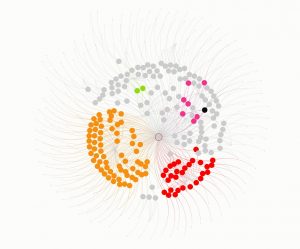
A visualization map of my LinkedIn connections showing my work contacts  since 2002How am I connected digitally with others? What would a visual map of my connections look like? I’ve been online in resident capacity (White & LeCornu, 2011)  as long as online connection has been an option.  I chose to use LinkedIn for this visualization exercise as it was easy to download a .csv from, to import and modify the data for use with Kumu, and it looked primarily at professional connections. The exercise of creating the map proved to stretch my understanding of the network and my place in it in new ways, as well as allow me to work on my own digital competency skills.

Downloading the .csv was not difficult. Learning the Kumu software took time, allowing me to practice some of the digital learner profile proficiencies as described by Helen Beetham, specifically ICT proficiency, data literacy, and digital creation (Beetham 2015).

My LinkedIn network consists of connections that have been made primarily through face-to-face work or virtual work encounters, but also includes those made with promotional, strategic connection in mind (on my side, or on the other side of the connection). While modifying the data – especially to denote the ‘strength’ of connection – it came clear that assigning a connection the attribute of strong, mid, or weak, was arbitrary. I had to consider both how I would rate the connection as well as how the other person would rate it (without the benefit of the other’s input). LinkedIn is the only network that I accept connections from people I’ve not physically met – assigning a strength to those connections was particularly challenging, as there are people in my network that I’ve worked with for years without having ever met in person.

My network diagram can be viewed here. There are 206 contact nodes depicted, based on my ‘connections’ in LinkedIn. I added nodes to represent hubs: communities of practice, or goal-oriented communities of interest (Veletsianos, 2016). The hubs were companies that I’ve been part of as represented by those connections: Selkirk College, Shambhala Music Festival, Insightful Ink, School District 8, and Quilting (I used to own a business),  followed by the Personal and Family communities.

I made different visualizations. One based on the ‘strength’ of connections, one on the companies that I am connected to. I found that the way that I viewed the network changed the implication of the network. When viewed from a strength of connection point of view, the network was a map of the pathways into each of the groups, of my closest working colleagues. When viewed as connection to companies, the visualization was more of a map of my employment itself, resembling a visual resume. The one I’ve linked to this blog is the latter.

The process of mapping revealed two things in particular to me: hidden connections, and connections over time.

There are parts of the network that I can’t create an accurate visualization of, as many of the nodes within my network are connected with other nodes (outside of my connection with them). I attempted to begin putting in some of those cross-connections, but found it to be a futile exercise, as I don’t know all of those connections. The visualization and my understanding of the network is limited by my perception of it.

While modifying the data to fit Kumu and considering each of the connections (when I met or worked with them, how strong the connections were) it occurred to me that the strength of the connections had nothing to do with how long I’ve had them. It brought up these two questions over and over again: Is the connection still relevant? Is it useful? Surely these connections were all relevant at the time of connection. Whether the connections are still relevant or useful speaks to the flexible and ever changing nature of networks. I did not go through and prune nodes from the network, but it did occur to me that doing so would make the network more effective and streamlined.

While only a small piece of my online network is represented by the connections in LinkedIn, the exercise of mapping was useful and illuminating. Paired with the current readings, the mapping exercise allowed me to practice some of the competencies described by Helen Beetham in the Jisc model (Beetham, 2015), and better understand my part in creation and participation of groups, networks and communities (Veletsianos, 2016).

References:

Beetham, H. (2015, Nov 10). Building capability for new digital leadership, pedagogy and efficiency [blog post].

White, D. S., & LeCornu, A. (2011). Visitors and residents: A new typology for online engagementFirst Monday, 16(9).

Veletsianos, G. (2016). Digital learning environments. In N. Rushby & D. Surry (Eds), Handbook of Learning Technologies (pp. 242-260). UK: John Wiley & Sons.

Reflections on the Virtual Symposium

This first week of MALAT LRNT521 was an immersive step into the field our cohort will be learning about for the next two years. As students, we are bringing different skills, experiences, and resources. For myself, I come from a background in all levels of education locally (from early elementary to college level) and have been part of designing several online classes over the past 8 years. I was especially struck with the depth of information each of the presenters brought to their topic. Taking in each of the presentations allowed me to assess my own knowledge and experience – especially bringing awareness to where gaps are.

There are a few things that I’ve implemented in my classroom facilitation work over the years that were mentioned either in the video conversations (Liberating Structures in the Carolyn Levy talk (Levy, 2019, 54:28)) or in the text we are using for reference (how to write a reflective paper ‘what-so what-now what’ (Laurier University, 2019)). I found that there is a name for what I’m doing with one of the courses that I deliver: OPM or Online Program Manager; the difference being that I’m not paid 60% of tuition for course delivery (Carey, 2019).

Ongoing issues that come up in my own work were articulated, too, such as how do we, as course designers also build the framework for talking about the subject matter with our client-partners (Levy, 2019, 17:15), and how we find ourselves in change management-type roles (Levy, 2019, 20:11) . Seeing that others experience the tension between ‘will this course make money’ (generally from the point of view of the funder or institution) and ‘will this course engage learners to learn’ (from the point of view of teachers) (Bates 2019, 13:58) was validating of my experience of development and delivery.

I’m fully aware that, at this emergent state of comprehension, I’m not ready to draw any large conclusions from the symposium this week. I experienced many moments of resonance, rather than moments of synthesis. This will change once I’ve built a better internal framework in which to understand and synthesize the information being presented in the course. There are, however, pieces that I will add to my own practice such as: to create a term of reference list with Subject Matter Experts (SMEs) (Levy, 2019, 25:44),

Carosel horse in the sky with bird flying over
Everyone can aspire to fly.

and to open a conversation with my students about skills vs. competencies in order to encourage life-long learning and critical thinking (Bates, 2019, 37:40). I’ll try incorporating more Liberating Structures into both my face-to-face and online learning environments. I’ll be tuning in to the CHEdR podcast out of Oregon State University to learn more about the work of the Ecampus Research Unit (Forssman, 2019, 36:06). My intention is that, through these actions and further reading, I can start to address some of the gaps identified this week in my own practice and, ultimately, be able to offer something fresh and new in reflection.


References

Bates, Tony (2019, April 16). Rethinking the Purpose of Online Learning (video file). Retrieved from https://ca.bbcollab.com/collab/ui/session/playback

Carey, K. (2019, April 1). The Creeping Capitalist Takeover of Higher Education. Huffpost, p. 2019. Retrieved April 17, 2019, from https://www.huffpost.com/highline/article/capitalist-takeover-college/?src=longreads

Forssman, Vivian (2019, April 17). National Survey Results – Online Education in Canada (video file). Retrieved from https://ca.bbcollab.com/collab/ui/session/playback

Levy, Carolyn (2019, April 15). Designing Learning Encironments for a Global Context (video file). Retrieved from https://ca.bbcollab.com/collab/ui/session/playback

McCandless, K. L. (2002). Libereating Structures. Retrieved April 16, 2019, from Liberating Structures: Including and Unleashing Everyone: http://www.liberatingstructures.com/

Oregon State University. (n.d.). Ecampus Research Unit: “Research in Action” podcast. Retrieved April 19, 2019, from Oregon State University: https://ecampus.oregonstate.edu/research/podcast/about/

Wilfrid Laurier University. (n.d.). Reflective Writing Section B: How Can I Reflect? Retrieved April 19, 2019, from Writeonline.ca: http://writeonline.ca/reflective-essay.php?content=section2