
I realize that I’m a little late to this party – life has been rather large the past few weeks.
I’ve appreciated the time to really dig into one particular Problem of Practice (PoP) and to dig a little deeper in this course. My particular PoP is:
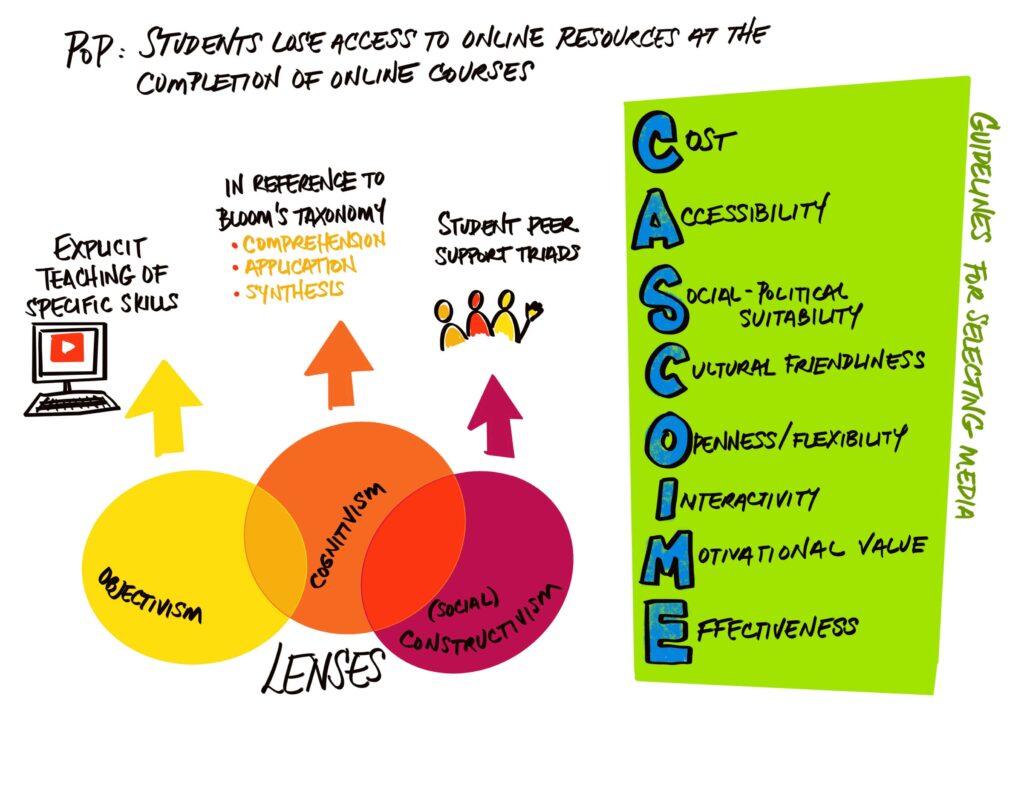
Students lose access to online resources at the completion of online courses.
This has been an ongoing problem expressed by students over time in our department. I teach in a first-year certificate program, and many students are returning from other careers, not having attended school in (sometimes) decades. They are simply not equipped with the executive functioning organizational skills needed to identify, evaluate, organize and develop an index space for the online resources they will want to have continued access to. Part of the solution to this is the explicit teaching of skills and the building of a customizable framework by introducing students to this in the first few weeks of their school experience.
I worked through the Bates (2015) chapter The nature of knowledge and the implications for teaching and, as good readings tend to do, it changed my thinking about what I’m doing. Originally I expected to come into this using Merrill’s (2002) Principles of Instruction. Working though the chapter reminded me that really, we aren’t using any one of these lenses exclusively, but combinations of them most of the time. It makes sense in my context with these students to do the explicit skill teaching in a more objectivist (Ertmer & Newby, 2013) manner. This will give the students the raw skills to build and expand on as they create their own resources. They’ll be placed in triads as peer support/accountability partners, which will have both the benefit of creating initial social bonds within the student groups, and setting the stage for some of the social constructivist (Ertmer & Newby, 2013) learning that will come later.
Once the students are acquainted with the basic skill set they will need, they’ll be supported to use and expand on those skills in different contexts and courses. I’ve been working with colleagues to design what this can look like.
And, although it didn’t make it into the diagram, Cognitive Load Theory is one of the lenses that I’ll be building this through, as well. Getting them started with discrete, targeted videos allows them to jump in at their knowledge level and not be overwhelmed by both learning how to use the utilities they will need AND using those utilities at the same time.
I was drawn to the CASOCOIME model (Patsula, 2002) of guidelines for selecting media as it includes some pieces that are more targeted towards international and cultural suitability. There are often international and indigenous students in our cohorts, and paying attention to what will work for them will be an important contributor to the success of this Digital Learning Resource.
References: