By Lisa Gates and Sandra Kuipers
At first blush, looking up a recipe for paneer (a soft cottage cheese) seems like a simple task, yielding straightforward results. While finding a good paneer recipe is easy, the task is more complex and involving than simply learning how it is made. The internet is abundantly full of information: recipes, regionality, commonality with other cuisines’ soft cheeses, and the history and etymology of paneer, making it a great example of a topic for life-long learning.
To explore the idea of abundant content online, we picked the topic of “how to make paneer”. We’re both passionate cooks, and paneer is something neither of us had made before and were both interested to learn more about. I (Sandra) love to make curries, but living in Asia it’s difficult to buy dairy products. Paneer is a “rich source of high quality animal protein, fat, minerals and vitamins” (Khan & Pal, 2011), so learning to make paneer would be a great way to add a healthy source of protein to my vegetarian curries. Paneer is delicious on its own and is often used as an ingredient in other dishes. Many of the initial recipes revealed have similar ingredients and methods, and a quick look at Wikipedia (“Paneer,” 2019) will show that there are many kinds of fresh cheeses that would be similar, if not the same as, paneer but from different places throughout the world.
Inspired by the availability of recipes, I (Lisa) decided to gather the ingredients and make a batch of paneer for dinner. Making paneer ended up taking much less time than looking for information about it did. Exploring paneer had me looking at a map of India to better understand parts of the country that my students are from, to find regionally specific recipes. I chose a recipe from Punjab that I may bring to a class potluck. Taking the learning and making it relevant to my life, with real world application and emphasis on learner construction (taking information and making one’s own meaning), including the shift from theoretical to practical experience (Ertmer & Newby, 1993) plants this exercise firmly as Constructivist in nature.
In the case of making paneer, online instructional content appears particularly well suited for short procedural tasks, such as a cooking recipe. Paneer can be made in 30 mins to 1 hour, something we didn’t know before starting this activity. The short duration of the learning process, as well as relatively few steps involved, suggests that using an online source of instruction would likely have a high degree of success. We wondered if longer more involved learning process may not see the same level of success, given the possibility of missing a step, or misunderstanding an instruction.
Our research into how to make paneer suggests that the availability of content online is a boon for life-long learning. Weller (2011) emphasizes that “learners need to be able to learn throughout their lives and to be able to learn about very niche subjects” (p. 228). In the case of learning how to make paneer, the abundance of content online makes it easy for someone interested in expanding their culinary repertoire to learn a new cooking process. They could be a professional looking to continuously improve their craft, or an individual interested in replicating their favourite dish. In each case, the availability of content outside of a formal learning setting enables individuals to engage in “innovative explorations, experimentations, and purposeful tinkerings” (Seely-Brown & Adler, 2008, as cited in Weller, 2011). These opportunities for informal exploration support the pursuit of life-long learning by providing just-in-time instructional content.
The knowledge of how to make paneer could be thought of as human knowledge, rather than academic knowledge or corporate knowledge. It is thought to originate in the Kusana and Saka Satavahana periods AD 75-300 (Khan & Pal, 2011), and may have begun as an oral body of knowledge, passed from family to family. The wide availability of recipes for how to make paneer online reflect this human origin: there is no copyright or patent that could be applied to this knowledge. We would confidently label this as “abundant content” based on Weller’s (2011) characteristics of a “pedagogy of abundance” (p. 229): content is free, abundant, and varied; sharing is easy and socially based; and content is user-generated. However, and abundance of content doesn’t guarantee success in learning.
Abundant content online can also be overwhelming. Weller (2011) expresses that an “excessive abundance constitutes a challenge” (p. 234), and requires different teaching and learning strategies. Learners facing an abundance of content need the skills to search and evaluate the material they find, such as general digital literacy skills and the ability to gauge the relevance of information found in searches. Basic digital literacy skills involve navigating the online environment, including the generation of relevant keywords for searches. Information evaluation, while not particularly challenging in the search of paneer recipes, can prove extremely important in other realms such as learning about science, geopolitical issues, or other life-long learning topics. The ability to discern real, well researched, peer-reviewed information can be paramount to one’s ability to navigate and understand the real world recognizing and avoiding the rabbit holes of conspiracy theories and junk science. Anderson and Dron (2014) emphasize that “there is a concern that ‘popular’ is not necessarily equal to ‘useful’”. They state:
Content is often curated, mashed-up, re-presented, and constructed or assembled by those in the network. This is a wonderful resource when seen as a co-constructed and emergent pattern of knowledge-building, but without the editorial control that a teacher or guide in a group provides, it can lead to network-think, a filter bubble in which social capital rather than pedagogy becomes the guiding principle. (p.140)
In our exploration of abundant content, we were easily able to find recipes for how to make paneer, and were even successful in creating a batch of paneer from scratch. However, throughout this exploration, we remain conscious of the different types of knowledge available online, and the possible pitfalls of abundant content. Some learning, such as short recipes and step-by-step instructions, may be better suited to online instruction than other types of learning. Our findings in this activity suggest that it’s important to understand Weller’s (2011) “pedagogy of abundance” (p. 229) when approaching learning online, and not make the assumption that abundant content automatically leads to successful learning.
References:
Anderson, T., & Dron, J. (2014). Teaching Crowds: Learning and Social Media. https://doi.org/10.15215/aupress/9781927356807.01
Ertmer, P., & Newby, T. (2013). Behaviorism, Cognitivism, Constructivism: Comparing critical features from an instructional design perspective. Performance Improvement Quarterly, 26(2), 43-71.
Khan, S. U., & Pal, M. A. (2011). Paneer production: A review. Journal of Food Science and Technology, 48(6), 645–660. https://doi.org/10.1007/s13197-011-0247-x
Weller, M. (2011). A pedagogy of abundance. Spanish Journal of Pedagogy, 249, 223–236.
Additional Information Sources:
Additional Information Sources:
Step-by-step Videos
How To Make Paneer At Home – YouTube https://www.youtube.com/watch?v=GbYRKRZIVV8
Personal recipes
How to Make Paneer (Easy Step-By-Step Guide) | Healthy Nibbles – https://healthynibblesandbits.com/how-to-make-paneer/
Professional recipes
How to make and use paneer | Jamie Oliver – https://www.jamieoliver.com/features/how-to-make-and-use-paneer/
Discussion forums
Indian paneer – English Forum Switzerland – https://www.englishforum.ch/food-drink/114063-indian-paneer.html
Social media hashtags
#paneer hashtag on Twitter – https://twitter.com/hashtag/paneer?lang=en
#paneer hashtag on Instagram – https://www.instagram.com/explore/tags/paneer/?hl=en
Peer-reviewed Articles
Khan, S. U., & Pal, M. A. (2011). Paneer production: A review. Journal of Food Science and Technology, 48(6), 645–660. https://doi.org/10.1007/s13197-011-0247-x
Paneer Wikibook
Cookbook:Paneer – Wikibooks, open books for an open world – https://en.wikibooks.org/wiki/Cookbook:Paneer
Historical articles
Paneer and the origin of cheese in India – The Hindu – https://www.thehindu.com/news/cities/mumbai/Paneer-and-the-origin-of-cheese-in-India/article14516958.ece

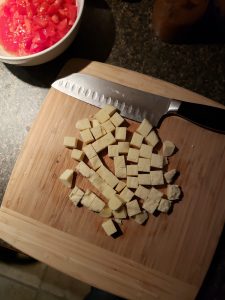
 Inspired by the availability of recipes, I (Lisa) decided to gather the ingredients and make a batch of paneer for dinner. Making paneer ended up taking much less time than looking for information about it did. Exploring paneer had me looking at a map of India to better understand parts of the country that my students are from, to find regionally specific recipes. I chose a recipe from Punjab that I may bring to a class potluck. Taking the learning and making it relevant to my life, with real world application and emphasis on learner construction (taking information and making one’s own meaning), including the shift from theoretical to practical experience (Ertmer & Newby, 1993) plants this exercise firmly as Constructivist in nature.