Theory Informed Learning Design and Evaluating Digital Learning Resources

I realize that I’m a little late to this party – life has been rather large the past few weeks.

I’ve appreciated the time to really dig into one particular Problem of Practice (PoP) and to dig a little deeper in this course. My particular PoP is:

Students lose access to online resources at the completion of online courses.

This has been an ongoing problem expressed by students over time in our department. I teach in a first-year certificate program, and many students are returning from other careers, not having attended school in (sometimes) decades. They are simply not equipped with the executive functioning organizational skills needed to identify, evaluate, organize and develop an index space for the online resources they will want to have continued access to. Part of the solution to this is the explicit teaching of skills and the building of a customizable framework by introducing students to this in the first few weeks of their school experience.

I worked through the Bates (2015) chapter The nature of knowledge and the implications for teaching and, as good readings tend to do, it changed my thinking about what I’m doing. Originally I expected to come into this using Merrill’s (2002) Principles of Instruction. Working though the chapter reminded me that really, we aren’t using any one of these lenses exclusively, but combinations of them most of the time. It makes sense in my context with these students to do the explicit skill teaching in a more objectivist (Ertmer & Newby, 2013) manner. This will give the students the raw skills to build and expand on as they create their own resources. They’ll be placed in triads as peer support/accountability partners, which will have both the benefit of creating initial social bonds within the student groups, and setting the stage for some of the social constructivist (Ertmer & Newby, 2013) learning that will come later.

Once the students are acquainted with the basic skill set they will need,  they’ll be supported to use and expand on those skills in different contexts and courses. I’ve been working with colleagues to design what this can look like.

And, although it didn’t make it into the diagram, Cognitive Load Theory is one of the lenses that I’ll be building this through, as well. Getting them started with discrete, targeted videos allows them to jump in at their knowledge level and not be overwhelmed by both learning how to use the utilities they will need AND using those utilities at the same time.

I was drawn to the CASOCOIME model (Patsula, 2002) of guidelines for selecting media as it includes some pieces that are more targeted towards international and cultural suitability. There are often international and indigenous students in our cohorts, and paying attention to what will work for them will be an important contributor to the success of this Digital Learning Resource.
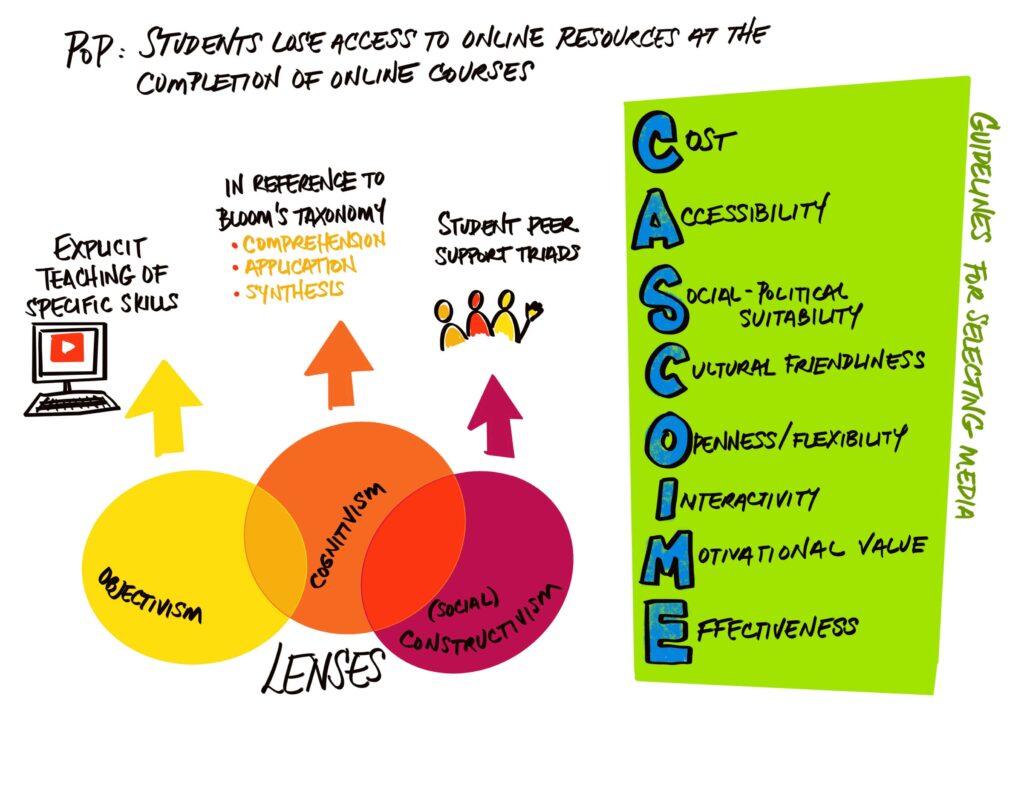
Image showing venn diagram with objectivism, cognitivism and constructivism. This is connected to student activities, and the CASCOIME framework for evaluating digital tool use.

References:

Bates, A. W. (2015). Chapter 2: The nature of knowledge and the implications for teaching. In Teaching in a Digital Age. Tony Bates Associates Ltd. https://opentextbc.ca/teachinginadigitalage/part/chapter-2-the-nature-of-knowledge-and-the-implications-for-teaching/
Ertmer, P. A., and Newby, T. J. (2013). “Behaviorism, Cognitivism, Constructivism: Comparing Critical Features From an Instructional Design Perspective.” Performance Improvement Quarterly 26(2):43–71.
Merrill, M. D. (2002). First principles of instruction. Educational Technology Research and Development, 50(3), 43–59. https://doi.org/10.1007/BF02505024
Patsula, P. (2002). “Practical Guidelines for Selecting Media: An International Perspective.” Useableword Monitor. Retrieved from http://www.patsulamedia.com/usefo/usableword/report20020201_mediaselection_criteria.shtm).


Understanding and Preventing Stress

Blog post created by Lisa Gates and Caroline Monsell

In Activity Two we participated in the Stanford d.School design process (2016) in partners.This experience led us to the development of a prototype for a blended online course consisting of three modules, one of which we developed into a set of lessons. Our partnership, consisting of Caroline Monsell and Lisa Gates, worked through each of the steps, learning about the individual parts of the process and each other’s student groups. 

The first steps of the design process asked us to focus on the problem, which took learning about each other’s student population and their needs through the process of empathetic design (Mattelmäki, Vaajakallio, & Koskinen, 2014). Caroline works in an Ontario municipality with a client group that spans working positions in a variety of locations, in disparate jobs (everything from public works workers to highly educated engineering staff). Her student base brought challenges in terms of use of technology; within that group are confident users and virtually non-users. Lisa’s students are all in Human Services Programs at a BC Community College. The courses that these students participate in are blended delivery or online delivery. Students come to college with different backgrounds, including students for whom English is an additional language. These students all have at least an emergent level of computer use.

Through the exercise, strong commonalities were discovered which led to the development of three separate problem statements in Step 4 (d.School, 2016):

    1.   Students are new to technology and sharing information with others for the purpose of learning or self benefit.
    2. Students are feeling overwhelmed by workload and in need of both stress management and time management skills and strategies to feel positive about their workplace, ensure attendance and take fewer sick days.
    3. Students are in need of strong interpersonal skills and conflict resolution for the purpose of collaboration and workplace competency.

We saw that each of the three problem statements could be its own module in a course, and settled on developing the second problem statement into a module to help our student groups to cope with work stress and time management.  

Through Step 5, Ideate (d.School, 2016), we determined that students would need to understand time and stress management strategies before delving deeper into interpersonal communication skills. The lesson plan of the module is here: (Please click this link to view the CANVA). Activity sequencing in the module reflects the five design principles as discussed by Merrill (2002).  Utilizing Crichton & Carter’s (2017) suggestions, meaningful play and exploration through time mapping and self assessment strategies were built in, encouraging intellectual risk taking while working autonomously and in a team to find and solve problems related to work life balance.  

Through these activities, students were encouraged to take intellectual risks. Given the different student populations, our partnership added pieces to the earlier module to focus on peer-to-peer mentoring, fostering connection and the creation of a sense of safety so that students could take risks that create engagement . This reflects the early stages of Tuckman and Jensen’s model for group development, forming and norming (Tuckman & Jensen, 1977).

Our partnership is interested in learning ways that we can:

  • Ensure that our students are taking appropriate levels of intellectual risk and are engaged throughout the process.
  • Understand and apply other lenses/theories to the work we are developing so that we are sure to make the work relevant to the students.
  • Apply this course to understand and prevent burnout at work with other audiences, in other fields.

Our partnership is interested in your thoughts moving forward. We will respond to feedback until Tuesday, December 3, 2019. Thank you for your time. **edited** – We will respond to feedback until evening PST, Wednesday, December 4, 2019. Thank you!

References:

Crichton, S. & Carter, D. (2017). Taking Making into Classrooms Toolkit. Open School/ITA

Mattelmäki, T., Vaajakallio, K., & Koskinen, I. (2014). What Happened to Empathic Design? Design Issues, 30(1), 67–77. https://doi.org/10.1162/DESI

Merrill, M. D. (2002). First principles of instruction. Educational Technology Research and Development, 50(3), 43–59. https://doi.org/10.1007/BF02505024

Tuckman, B. W., & Jensen, M. A. C. (1977). Stages of Small-Group Development Revisited. Group & Organization Studies, 2(4), 419–427. https://doi.org/10.1177/105960117700200404

Stanford University Institute of Design. (2016). A Virtual Crash Course in Design Thinking — Stanford d.school [Website]. Retrieved from https://dschool.stanford.edu/resources-collections/a-virtual-crash-course-in-design-thinking

Activity 4 – Reflections on my theoretical and pedagogical stance

Through reading Ertmer & Newby’s article Behaviourism, Cognitivism, Constructivism: Comparing critical features from an instructional design perspective, it became clear that I am working primarily from Cognitivism as my theoretical centre when teaching online and more from a Constructivism centre when teaching in the classroom.

Declaring an alignment with a particular theoretical stance for all of my work is not really possible because my work occurs in a variety of different contexts, for a variety of reasons.

I instruct and facilitate in Human Services programs, teaching primarily support strategies courses in the classroom and interpersonal communication online. The classroom work is dynamic, students have full access to each other and are encouraged to bring their own wisdom and experience to bear on the activities we do. Human Services is messy, unpredictable work, and students are given many opportunities to research, understand, discover and practice the skills that will be required in a variety of real-world scenarios (Ertmer & Newby, 2013, p. 57). The work is relational, so teaching a cut-and-dried set of procedures will not help students once they are in the work force. In order for them to be best equipped, I give them messy, ill-structured problems and as that they work individually and in groups to understand their relationship to the problem, their possible solutions, and how others might solve the problem differently, but with equal validity. Students are regularly asked to reflect on how they came to the conclusions they did, to examine personal experiences and biases that brought them to those conclusions, and the cultural context in which it all occurred (Ertmer & Newby, p. 56). Students complete their credential with practicum placements, which firmly places the learning in the realm of Constructivism.

The interpersonal communication course that I teach online has very different parameters. This is somewhat due to the constraints of the LMS (Learning Management System) we are working within, somewhat because of the constraints of working within a standardized course. There are several different instructors teaching this particular course and we endeavour to have some consistency (standardization) across all the classes and delivery methods. The constraints of the LMS make it difficult to have students practice their interpersonal skills with each other (curricular things such as eye contact, and open body language), and the institutional constraints make it difficult to introduce other applications for this practice (video conferencing software) as we are cognizant of privacy laws and student use of 3rd party applications. Within this course, I structure the environment of the course to have explanations, demonstrations and examples to guide students. We talk about how learners encode information, and work with a variety of study skills that are designed to support their learning through activating their prior information, connecting the new information to it, practicing or demonstrating this new information, and ongoing rehearsal of the information as a way of ensuring that it is encoded in memory (Ertmer & Newby, 2013, p. 52). Students are expected to demonstrate that they can apply the new information in a variety of contexts (transfer) through different assignments and class discussions in the forums. Coaching the students to use appropriate learning strategies is in line with a Cognitivism theoretical base (Ertmer & Newby, p. 52).

Due partly to the different contexts of the courses I teach and the different expectations of the courses, my role in the classroom is much more of facilitator (which I see as in line with Constructivism) and of instructor online (more in line with both Behaviourism and Cognitivism). Students in my online courses will all come away with the same set of skills and information, but the students in my face-to-face classes will come away from the course with learning that is meaningful to them.

Resources

Ertmer, P., & Newby, T. (2013). Behaviorism, Cognitivism, Constructivism: Comparing critical features from an instructional design perspectivePerformance Improvement Quarterly26(2), 43-71.