Unit 3, Activity 2 – Visual Network Mapping
Image 1: My Network Colour-Coded By Application Type
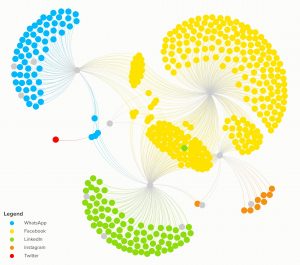
Image 2: My Network Colour-Coded By Where/How We Met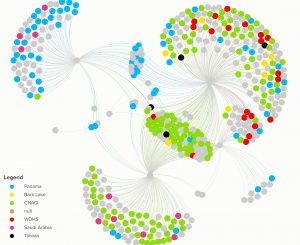
I created a visual of my network by creating an Excel spreadsheet and importing it into Kumu. In doing this activity, I discovered that I am connected with others in specific online networks and in very specific ways depending on where and how we met. The vast majority of people in my networks are people I first met as work colleagues offline.
As my visual illustrates, I am firmly situated in Facebook and LinkedIn (yellow and green in image 1). The majority of the people in these networks are people I met as work colleagues over the last 15 years – in Qatar, Panama and Saudi Arabia – but primarily in Qatar (green in image 2) where I worked at the same college from 2005 to 2013. This was no surprise to me because it is the longest I have spent in a country (or a job) and all my colleagues were Canadian, like me, so there was a connection with shared culture and a shared language which I have not had in subsequent work experiences. I visited my colleagues in Qatar for a week last December and I was reminded then how important these people are to my network. In fact, it was in reconnecting with these members that I finalized my decision to apply to the MALAT program.
There is an obvious division between my WhatsApp network and my Facebook and LinkedIn networks. Despite the large number of ex-colleagues from Qatar in my Facebook and LinkedIn, only 2 are in my WhatsApp network. I wasn’t using WhatsApp in 2013 and have interestingly not carried members over to this ‘new’ network. My WhatsApp network is very large, however. It is the network I use most often to speak with those family members and friends geographically close to me and who are part of my day-to-day plans. The majority of people in my WhatsApp network (many of whom were not included in the data for this map), however, are students and colleagues from my current employment in Saudi Arabia and local businesses in Panama as this is the network they prefer to use.
Instagram and Twitter are networks I have never developed despite having joined Twitter in 2011 and Instagram in 2017. I quickly amassed over 80 followers on Instagram when I started posting upon moving to Panama (and baking creative sourdough bread), but when I moved to Saudi Arabia, I didn’t have the time (or an oven) and I rarely posted or even opened the application to comment. I found that the people I was following often posted the same content to both Instagram and Facebook, so I found it redundant.
Although very small in number, I was interested to see that I still have people in my networks whom I have known longer than 15 years – from high school (WDHS), my undergraduate degree, my job in Taiwan, and other experiences pre-2005. These people are long-time friends with whom I still share similarities of interest.
As I reflect on this activity, I see that I have not kept up regular, direct contact with many of the members of my network and, as such, I may be missing great learning opportunities. “As, seemingly, everyone is potentially connected to everyone else by a very small chain of network nodes and edges (Watts, 2003), it appears that someone not too distant from you in network terms may turn out to be the world’s leading expert on what you wish to know.” (Anderson & Dron, 2014, p. 147). It is, therefore, my plan to immediately start reconnecting, maintaining and expanding my network relationships.
In conclusion, this activity reiterated that I have unique and diverse networks and communities that stretch across the globe for which I am exceptionally grateful. This activity also made it clear, however, that I need to work on maintaining and expanding my network to maximize my learning opportunities. I know I have some experts in my immediate and not-so-distant networks and it would be a detriment not to embrace those opportunities to the fullest.
References
Anderson, T., & Dron, J. (2014). Teaching Crowds: Learning and Social Media. https://doi.org/10.15215/aupress/9781927356807.01