
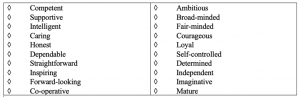
I was recently asked to put a list of leadership attributes in order of importance, first individually and then in a team of four. Individually, I listed my top three attributes as: (1) competent, (2) intelligent, and (3) caring. As a team, our top three were: (1) competent (2) supportive, and (3) intelligent. Kouzes and Posner (2011) state, in a table of characteristics of admired leaders, that the top three characteristics selected by the highest percentage of people in 2010 were: (1) honest, (2) forward-looking, and (3) inspiring (Table 1.1). Competent was fourth; intelligent was fifth.
In my opinion, many of the listed attributes are connected or overlap, or can be interpreted in multiple ways. For example, being caring involves showing support and being fair-minded. Also, someone who is ambitious is determined. Someone who is straightforward is honest. Certainly, the semantics of each attribute is open to interpretation.
Semantics aside, everyone places leadership attributes in varying orders of importance depending on one’s culture, environment, and life experiences. Even individuals from the same family with similar life experiences may disagree on the order of attributes that make a great leader.
Regardless of how we order the list individually, I believe it is more important to consider the collective values of the team or group. One cannot be a leader without followers. As such, an effective leader must unite all members’ values. A teacher, to be a good leader, must consider the values of his/her students. A president of a company (or country), to be a good leader, must consider the values of his/her employees (or citizens), customers, and other stakeholders.
Thus, the challenge for leaders is to understand their followers’ values, to help guide their team to effectively attain the goals that the team set out to achieve. This is unlikely to be easy or simple as “not all people share the same values…. [People] want different things, and that is the source of the disagreement, conflict, and misdirection that is rife in the world” (O’Toole, 2008, p. 2). Acknowledging these differences, O’Toole (2008) identifies that the role of a leader is, therefore, “to create conditions in which people with different agendas can unite behind a common purpose” (p. 2).
Most of my experience as a leader, both in face-to-face and digital environments, has been in multicultural settings. I have been a teacher and teacher trainer in multicultural schools around the globe. Multicultural teams appear to be increasingly common as many organizations become more culturally diverse and globalization increases. Digital environments have promoted multicultural teams to work together across the globe. I was, therefore, pleased to read that Castelli (2015) states that two of her six key practices of reflective leadership are respecting diverse cultures and customs, and challenging beliefs and assumptions (p. 225). In a multicultural setting, a good leader needs to understand and be open to his/her followers’ individual values, as well as the values of the followers’ cultures. This may include an understanding of language, even among countries that speak the same language as word definitions and idioms can vary widely. It may also include consideration of what and how to share on team collaborative tools, as well as social cues and expectations in synchronous settings.
Leadership in a face-to-face environment is challenging, but that challenge is heightened in a digital environment as teams often work in asynchronous environments without cues such as body language, tone of voice, and intonation. I agree with Castelli (2015) that “focusing on external characteristics of leaders [such as knowledge, experience and intelligence] provides only a partial view of leadership” (p.218) and “internal characteristics such as critical thinking, long-term planning and finding innovative ways to solve problems with an equal force on people and profit” (p. 218) is invaluable to effective leadership. Castelli states that reflective leadership “has seemingly been downplayed and oftentimes ignored in the realm of leadership and management” (p. 220). This is unfortunate as it appears to fit well in our increasingly global and digital world. Reflective leadership is defined as “the consistent practice of reflection, which involves conscious awareness of behaviours, situations and consequences with the goal of improving organizational performance” (p. 217). A leader who looks beyond sales targets, spreadsheet numbers, or achievement outcomes to consciously reflect on the bigger picture of behaviours, situations, and consequences, appears to offer a more thoughtful and effective approach to our ever-changing, complex world.
References
Castelli, P. A. (2015). Reflective leadership review: A framework for improving organisational performance. Journal of Management Development, 35(2), 217-236. DOI:10.1108/JMD-08-2015-0112
Kouzes, J. M., & Posner, B. Z. (2011). Credibility: How leaders gain and lose it, why people demand it. San Francisco: Jossey-Bass.
O’Toole, J. (2008). Notes toward a definition of values-based leadership. The Journal of Values-Based Leadership, 1(1). Retrieved from https://scholar.valpo.edu/jvbl/vol1/iss1/10/