The company I work for was established eighteen years ago, and has had tremendous success. It has gained its reputation by providing high quality education and delivering phenomenal results. I have been employed with the company for three years, however it wasn’t until I joined the MALAT program about a year ago, that I realized how much potential the company has moving forward when it comes to technology and digital learning spaces. Up until January of this year, every aspect of our teaching was done in a face-to-face environment. Even though we have faced numerous challenges making the shift to a digital learning environment due to Covid-19, this abrupt and necessary change has set us up to utilize digital aspects moving forward when we return to our physical classrooms. Before our shift to online learning, many of our teachers were digital visitors who lacked the confidence and skills to work digitally, however after being forced to teach in digital spaces, they have proven that they have the ability and willingness to embrace technological developments, therefore why should we not reap the benefits of said technology moving forward? Seelig (2013) advises us that one way to assist in finding solutions is to re-examine the questions we are asking to instill imagination when creating possible solutions. Through surveys and mini-interviews, I have been able to identify several issues within my organization that can be solved by creating a portal as a digital learning resource for both teachers and students alike, while at the same time I was able to reframe my question into researching how we can keep the digital learning wave going now that our instructors are becoming increasingly comfortable with technology.
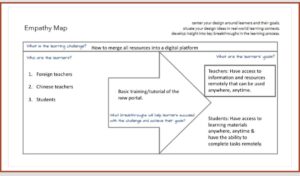
As I move forward with my design, I need to maintain that I am making a tool in hopes that it will meet the needs of both teachers and students (the users) and that being said, Kouprie and Visser (2009) state that empathic design can be separated into two components; affective (having an effective response to the user), and cognitive (seeing, hearing, and understanding the user) and that by creating a balance between the two, I can achieve true empathy. Kimbell (2012) reminds us that design is an ongoing task that always has room for improvement. IDEO (2015) notes that there is an assortment of methods we can choose from when undergoing a human centered design approach, and that the value comes from listening to our users. I have kept all of these factors in mind while completing my empathy map designed by Brecher Cook and Worsham (2018) and my mini-manifesto.

References
Brecher Cook, D., & Worsham, D. (2018, April). Let’s Build Something! (The Toolkit). A Rapid-Prototyping Instructional Design Workshop. Retrieved from https://ucla.app.box.com/v/build-something-toolkit
IDEO. (2015). Design Kit – Methods. Retrieved from https://www.designkit.org/methods
Kimbell, L. (2012). Rethinking design thinking: Part II. Design and Culture, 4(2), 129-148. Retrieved from https://doi.org/10.2752/175470812X13281948975413
Kouprie, M., & Sleeswijk Visser, F. (2009). A framework for empathy in design: stepping into and out of the user’s . Journal of Engineering Design, 20(5), 437-448. DOI: 10.1080/09544820902875033
Seelig, T. (2013). How reframing a problem unlocks innovation. Fast Company.
Retrieved from https://www.fastcompany.com/1672354/how-reframing-a-problem-unlocks-innovation

June 30, 2020 at 3:12 pm
Hello Susan, thank you for a great post about your context and ideas related to empathy and solving your problem of practice (PoP) for both teachers and students. Good empathy indeed. I really enjoyed reading your mini-manifesto and especially the last point, “make use of all my current resources.” I often forget those around me that might contribute to something I am struggling with. They are resources! The more I talk about a project with unusual others (those that are not inside my academic bubble), the more I find unusual solutions related to a problem I’m trying to solve. You might consider pulling parents into the consultation mix. Trickier at the moment with Covid issues, but not impossible. Students are also resources and often highly creative when it comes to digital problem-solving. Great work. I know that you will create a strong-start solution to your PoP that will
July 1, 2020 at 11:45 am
I also found Seelig’s point of re-visiting the question in order to find the solution intriguing. I often fall into the trap of being faced with a problem and needing a solution immediately, that I do no take the time to consider the question. Hopefully, this course will break me of this habit!
Empathy seems to be a buzz word around my organization right now (maybe it is the same everywhere), but it is not something that come naturally to most people. It takes time to truly work with empathy in mind. I am looking forward to seeing your resource develop.
July 3, 2020 at 7:45 pm
Hi Susan,
I really enjoyed your reference to the digital visitor / resident typology as that is exactly how I would describe the faculty that I work with. It made me smile when I considered my Pre-COVID co-worker conversations to my post (current) COVID conversations. How far we have all come; collectively working together to develop a residency mind set.
With that said, I wanted to comment on your intention to create your digital learning resource with both learners AND faculty in mind. This is a consideration I had not even thought of, that faculty may find a benefit in the resource in the same capacity as the learners.
Thank you for prompting me in this direction as now that I consider your suggestion, the more it makes sense to me. I am the only one that has any practical experience and formal learning in my chosen field, and it would make sense that other instructor may find value in the resource.
This has opened a whole new direction for me and identified yet another stakeholder group that I would have otherwise left out of the design.
Much appreciated,
Owen