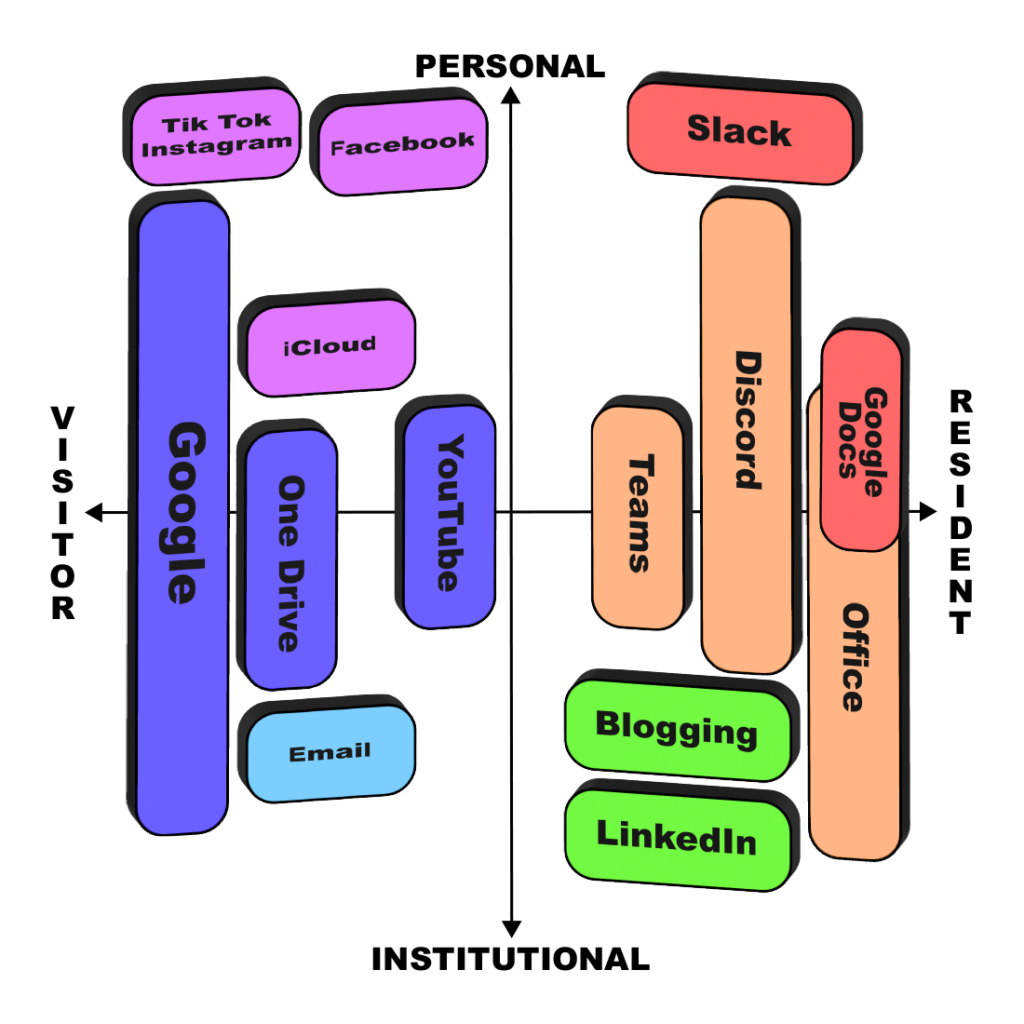
I was recently asked to develop a map that represents my digital presence in terms of visibility and motivation. The method that resulted in the grid you see above was presented to me in a video posted on YouTube by Dave White (2013). The grid represents a cross-section of continua. Those entries on the far right, labeled “resident”, represent the platforms upon which I’ve left some kind of evidence accessible to others… those on the far left, labeled “visitor” are those platforms I use frequently but have not added to the publicly available content. The vertical continuum, represents the difference between those platforms I use for my own motivations, labeled “personal”, and those I use either for work or my digital academic identity, labeled “institutional”.
After completing this activity I was surprised by the number of platforms upon which I create content quite frequently. I don’t really think of myself as someone who has much of a digital footprint. While I make use of social media quite often, I treat it more as a source of entertainment than as a method of interacting with people. However, I do see that if one were to make an effort to look for evidence of my interactions online, there would be a fairly significant footprint. With that in mind, I’m more motivated to consciously manage my identity online and to present a more consistent image to the public.
Recently I was fortunate enough to participate in Royal Roads’ Virtual Symposium where students, faculty, and guest speakers discussed the impact of ed tech and instructional design in today’s education industry. There were a ton of great talks and the sharing of some fascinating research projects. It was a thrill to learn with and from these brilliant people.
I was particularly struck by the ingenuity of my classmate, Patrick Guichon, as he navigated the ethical challenges presented by his thesis project (Childs, 2022). Patrick has recently completed data gathering in a research project where his own students are the participants. This presents a significant ethical dilemma in what the Tri-Council Policy Statement refers to as a dual role (Canadian Institutes of Health Research, Natural Sciences and Engineering Research Council of Canada, & Social Sciences and Humanities Research Council of Canada, 2018), meaning, in Patrick’s case that he is acting as both the research and the instructor for these participants. This dual role presents a conflict of interest that has the potential to “create conflicts, undue influences, power imbalances or coercion” (Canadian Institutes of Health Research et al., 2018, p. 96). With this in mind, Patrick was careful to create an environment in which he was in no way privy to the identities of his participants and was not physically present when the data collection occurred. This would have required significant planning in advance and coordination with collaborators in his organization to make the research possible. Patrick’s efforts are commendable and I look forward to seeing the results of his analysis.
Another presentation that I enjoyed was that of Christina Jones (2022), as they described their process in the execution of their applied research project. The was a particular aspect of the research that I hadn’t considered before and found surprising. Christina’s research is focused on the use of simulation to improve learning, particularly in a military context. When I’ve thought about the benefits of simulation in the past, I’ve mostly considered safety as the paramount, but Christina shared additional benefits. Particularly in a navy application and the training of the navigation of large warships, one of the main challenges is the replication of a particular set of conditions. Warships are exceptionally complex. The navigator has to consider the unique crew and weather patterns which are near impossible to replicate. In a simulation, however, all these conditions are easily repeatable, allowing trainers to put their learners into very specific conditions to test their learning. This was eye opening for me and presented a benefit of the application of simulation training I hadn’t previously considered.
Finally, a presentation I found particularly engaging was a panel discussion on the nature of instructional design in a post-COVID-19 environment (Royal Roads University, 2021). Panel members Elizabeth Childs, Irwin DeVries, Melanie Meyers, and George Veletsianos discussed how the recent global pandemic has influenced how educators value instructional design in an online environment and how this will impact its role in the future. I completely agree with DeVries position that instructional designer should have a more influential position in education moving forward. Now that most educators in Canada have been exposed to the nature of online learning, I hope that there’s a newfound respect for the uniqueness of online pedagogy, the challenges it presents, and the need for specialized training to make the most of the platform. I hope for greater collaboration between educators and instructional designers going forward and that this partnership becomes routine, with a hope of developing more effective learning spaces for our students.
References
Canadian Institutes of Health Research, Natural Sciences and Engineering Research Council of Canada, and Social Sciences and Humanities Research Council of Canada, Tri-Council Policy Statement: Ethical Conduct for Research Involving Humans, December 2018. https://ethics.gc.ca/eng/documents/tcps2-2018-en-interactive-final.pdf