I had one last quick opportunity to work in a team as a student in the MALAT program at Royal Roads University. My esteemed teammates were Kristin Beeby and Sandra Norum. Together, we explored the impact digital learning has had on teachers in recent history. To present our findings, we developed the above Genial.ly presentation. To learn more about each subject, click on the plus icon next to a given title… and don’t forget to check our references… there’s some gold in there!
I’d love to hear your thoughts on what we’ve included. Have an awesome day!
I will soon be coming to the end of my time with Royal Roads University (RRU), and so I’m beginning to look at the next stage of my learning journey. With that in mind, my goal is to build my own learning network, contribute content, and exert a positive influence in that space.
I was exceptionally nervous about starting a master’s program, but the whole experience has been outstanding. Difficult… and stressful… but also extremely rewarding. The whole experience has rekindled my love of learning and I’m looking to continue. Since Garrison et al. (1999) argued that a community of learners is valuable for higher order thinking, I aim to develop one of my own to both contribute to and benefit from.
Following a series of readings this week, I’ve come to the conclusion that the platform upon which this network exists is less important than the people who make it up. Anderson and Dron (2014) asserted that learning networks are defined by the needs of the participants such as “task performance, learning, advice, or interpersonal support” (p. 149) rather the physical or virtual space. So, what matters to me is the way in which I interact with people and communicate, and less about where those interactions occur. This idea reminds me to stay on brand with communications no matter the platform and be mindful of how the individuals in my network perceive my contributions.
Finally, I was inspired to participate in the conversation online, despite some of my misgivings regarding possible negative consequences of that interaction. I’ve been reading a lot of content from my classmates recently about backing away from platforms they find toxic, and I completely respect their point of view. But, Cormier (ALT, 2019) made an extremely good point when he presented the idea that if reasonable people turn away from the internet as a result of their fatigue with the culture, then the quality of the culture of the internet will only diminish as a result of their absence. Now, it’s a little arrogant of me to argue that my content will be a positive influence on the culture of the internet, but that certainly is my goal. Whether I achieve it or not, I suppose, remains to be seen.
References
Anderson, T., & Dron, J. (2014). Teaching Crowds: Learning and Social Media. In Teaching Crowds: Learning and Social Media. Athabasca University Press. https://doi.org/10.15215/aupress/9781927356807.01
Association for Learning Technology [ALT]. (2019, April 24). #OER: The participatory open: Can we build a pro-social / pro-societal web? [Video]. YouTube. https://www.youtube.com/watch?v=1D4tg1FnE_s&t=1223s
Garrison, D. R., Anderson, T., & Archer, W. (1999). Critical inquiry in a text-based environment: Computer conferencing in higher education. The Internet and Higher Education, 2(2–3), 87–105. https://doi.org/10.1016/S1096-7516(00)00016-6
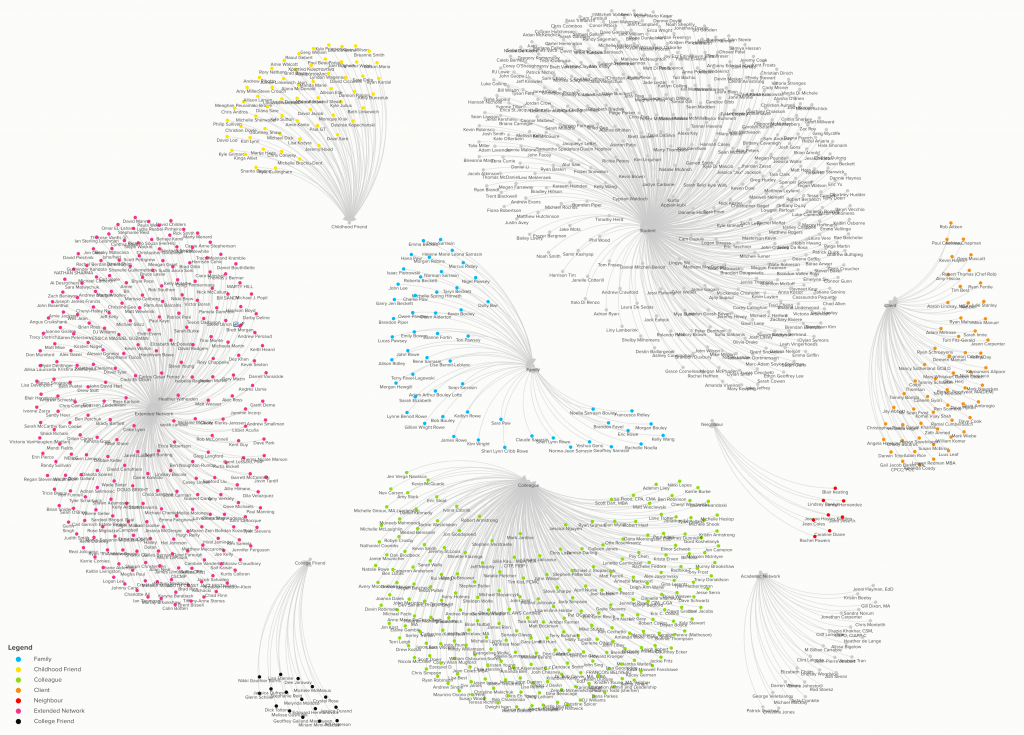
The graphic above is a visualization of my personal network. It’s a relatively simple visualization and doesn’t represent the interconnectedness of these various networks. In order to keep the time associated with developing this graphic manageable, each connection is limited to a single type. In reality however, the majority of these individuals would fall into several categories and there is a significant amount of overlap in their connections. However, I do like the way this is represented, to show the networked resources at my disposal, depending on the need at any given time.
It’s a fairly large group of people, representing an immense wealth of knowledge and experience. As I’ve mentioned on this platform before, I haven’t spent much time or energy leveraging this network or being an active contributor to the pool of knowledge, but I look to change that in the near future. Over my time in the learning and technology program at Royal Roads University, I’ve developed a self directed approach to learning. This acquisition of meta-learning is what Anderson and Dron (2014) observed as an essential skill for networked learning. As I continue to learn on my own, post-graduation, in an ill-structured environment, it will fall to me to cut through the significant noise online to pursue truth.
I look forward to the experience, and hope to bring you with me!
Reference
Anderson, T., & Dron, J. (2014). Teaching Crowds: Learning and Social Media. In Teaching Crowds: Learning and Social Media. Athabasca University Press. https://doi.org/10.15215/aupress/9781927356807.01
As I approach the end of my time in the MALAT program at Royal Roads University, I’ve begun to think about the next step. Over the past couple of years, much to my surprise, I’ve enjoyed blogging from an academic perspective. As a result, I plan to continue to do it following my completion of the program. I look forward to developing a professional digital presence following my time at Royal Roads as it can benefit my continued learning and career, but I need to be cautious of how it will be interpreted by the community who consumes it.
Why Should I Continue to Contribute?
My experience writing blog posts during my time with Royal Roads has given me confidence to contribute to the academic community. As Watters (2015) described, providing students with their own digital space provides them with an opportunity to have more control over how they present themselves to the world. Now, moving forward, I look to engage with the larger community and build my reputation as a source for valuable insight on the topic of educational technology. During my professional career, I’ve developed what Boyd (2010) labeled a networked public, described in their own words as “the imagined collective that emerges as a result of the intersection of people, technology, and practice” (p. 1). However, up to this point, I’ve done little to contribute to that network outside of the occasional pleasantries.
Now, with my newfound confidence, I plan to be more active in the discourse amongst like-minded people to continue my own learning and develop a more impactful digital presence. I hope to share my own thoughts and in return, learn from those people in the community who also contribute. To describe this reciprocity of contributions, Jenkins used an analogy of a group coming together to create a quilt (Edutopia, 2013). In this group, there is no leader or expert, but everyone comes together to share their knowledge in what he described as “a social mode of production” (1:47). I’ve always considered myself a life-long learner and look forward to continuing in that regard.
In addition to my continued learning, I also look to build my reputation with a hope of having my participation lead to a positive impact on my professional career. To do this I will need to post relatively frequently and draw attention to my contributions. Anderson and Dron (2014) argued that those people who contribute the most “see their contributions giving them authority and prestige within that community and across their networks” (p. 19). However, to benefit from any potential authority and prestige, I’ll need to encourage my network to consume my content.
How Will I Spread the Word?
The good news is, that drawing attention to things is a strength of mine. I’ve been working in the media and marketing industry for the majority of my professional career and know a thing or two about promoting content in a digital environment. Without going into too much detail here, lest this post become far too long, my plan will involve developing a digital identity based in consistency. Consistency in rhetoric, consistency in frequency of posts, and consistency of subject. This consistency is required to develop loyalty in an audience and develop an expectation of content delivery. I plan to support this content delivery with promotional material driving traffic to my blog on platforms such as LinkedIn, Twitter, Instagram, and Tik Tok. This is the part of the process that concerns me the least, as I can rely on my strengths for success. I will track the analytics on all of the platforms in addition to WordPress and make adjustments to my plan based on that feedback.
I’m not too concerned at the moment regarding determining a specific threshold that would indicated success. Right now, my main objective is to contribute to the greater learning community and benefit my own learning. Perhaps, in the future, I may develop more quantitative goals, but that is not currently a priority for me.
Long Term Impact
What does concern me, however, are the possible implications of my content creation in the long term. The content that I post online will likely outlive me and I should keep its long term impact in mind and how that might reflect on me and my family. White and Le Cornu (2011) brought attention to the fact that the online artifacts developed by content creators continue to impact their audiences long after the creators move on. As described by Boyd (2010), the persistence of online content can outlive the context in which it was written. Additionally, as I will likely have only tenuous connections with the majority of people who read my content online, I need to be wary of possible misinterpretations due to a difference in perspective and context. This combination of temporal and perspective context shift can lead to misinterpretations of the content I’ve written. While there’s little I can do about most of these possible misinterpretations, I suspect I’ll be able to prevent some percentage if I’m cognitive of the possibility of its occurrence.
Regardless of any long term negative implications, I think it’s most likely that the good will outweigh the bad. And besides, I’ll enjoy it.
References
Anderson, T., & Dron, J. (2014). Teaching Crowds: Learning and Social Media. In Teaching Crowds: Learning and Social Media. Athabasca University Press. https://doi.org/10.15215/aupress/9781927356807.01
Boyd, D. (2010). Social network sites as networked publics: Affordances, dynamics, and implications. In Z. Papacharissi (Ed.), A Networked Self: Identity, Community, and Culture on Social Network Sites (pp. 39–58). Routledge. https://doi.org/10.4324/9780203876527-8