For this course, LRNT 525, I have been asked to investigate models for change, in particular for digital learning environments. In one of the primary articles for the course, Al-Haddad and Kotnour (2015) summarizes a number of systematic change methods from reviewing previous literature studies. These change methods describe the approach and process of implementing change in organizations. Many of these systematic change methods, such as: Planning by Lippitt (1958), TQM by Juran (1986), and Six Steps by Beer et al. (1990). These change models reminded me of instructional design models such as ADDIE (Molenda, 2003). In order to apply the change models in an educational context, I have created a model that combines the elements of the change model from Six Steps of Change (Beer et al., 1990) and the ADDIE model for instructional design.
Beer et al. (1990) described six steps of effective change that have been included in the model shown in Figure 1. Step 1: “Mobilize commitment to change through joint diagnosis of business problems” (p. 7) has been included as “Diagnose” in the model. This aligns well with the “A” from ADDIE which stands for “Analyze”. This step is about clearly defining the problem. Step 2: “Develop a shared vision of how to organize and manage for competitiveness” (p. 8), included as “Vision” aligns with the “Design” from ADDIE. This step is for designing and planning a new solution to the problem with a “task-aligned vision of the organization” (p. 8). Step 3: “Foster consensus for the new vision, competence to enact it, and cohesion to move it along” (p. 8) is included in the model as “Consensus” along with “Develop” from ADDIE. This step is for creating the proposed solution with consideration of those affected as part of the decision process. Steps 4 and 5: “Spread revitalization to all departments without pushing it from the top” (p. 9) and “Institutionalize revitalization through formal policies, systems, and structures” (p. 10) have been combined as “Revitalize” and added to “Implement” of ADDIE. This step is for putting the plan into action with the cooperation and consideration of those affected by the change. Step 6: “Monitor and adjust strategies in response to problems in the revitalization process” (p. 10) is included as “Monitor” along with “Evaluate” from ADDIE. This final step is for observing the new change(s) and to assess their effectiveness.
Figure 1
A model for change in an educational context.
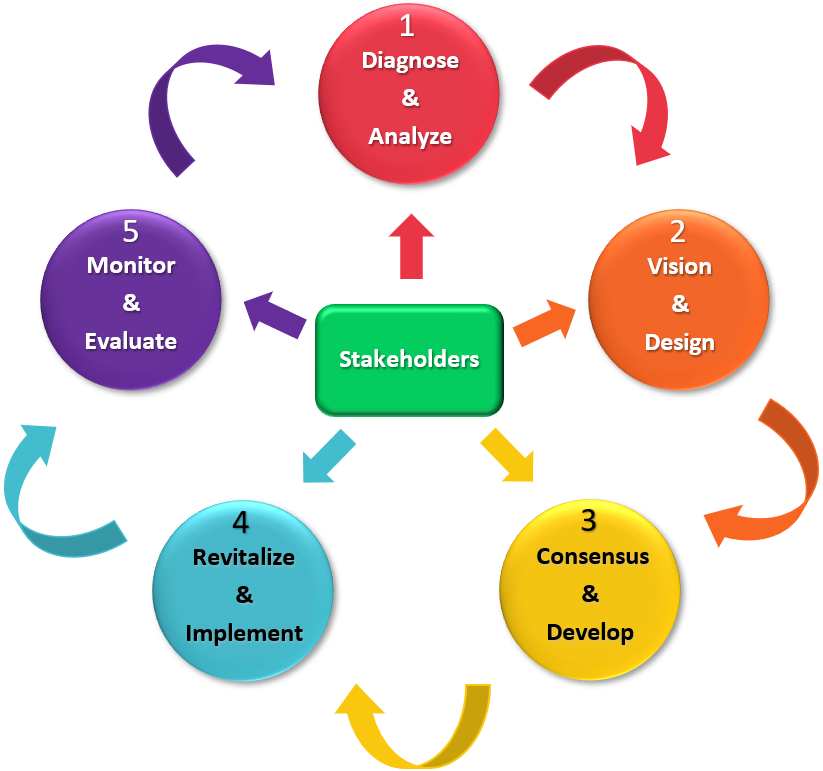
Note. The model represented here is based on the Six Steps to Effective Change by Beer et al. (1990) and the ADDIE instructional design model (Molenda, 2003). It also emphasizes the importance of including stakeholders throughout the process for approval, feedback, and solidarity.
Regardless of which change model you adopt for your change management process, it is important to consider your stakeholders. In business, not considering all stakeholders can have unintended consequences and result in the failure of the project (Freeman et al., 2018). Al-Haddad and Kotnour (2015) explain the importance of the stakeholders because projects are successful if they are “completed within the predetermined objectives (i.e. completed within budget, within schedule, conforming to customer requirements and satisfies the main stakeholders)” (p. 251). For education the stakeholders that most readily come to mind are the students, the instructors, and the potential employers (Kenny & Desmarais, n.d.). But upon further research should be broadened to include: administrators, governments, content providers, technology providers, accreditation bodies (Li et al., 2020; Wagner et al., 2008; Worthington et al., 2017). When interviewing a colleague, the conversation regarding change revolved around changing learning outcomes for courses, since we both participated in a recent curriculum committee meeting. My colleague and I discussed how there are often more stakeholders in changing learning outcomes than either of us had originally considered. We discussed, that in our previous meeting we became aware of other stakeholders such as: other institutions for transferability and course credit; other departments within the institution for alignment between programs; and other instructors that teach the same course into other programs. We also discussed that without the approval of those stakeholders, proposed changes to learning outcomes would be rejected.
In a second interview with another instructor, we discussed some of the consequences of not having a consensus among the stakeholders involved with a change to teaching methodologies. This other instructor’s experience was that their teaching androgogies were incompatible with other instructors at that institution and this caused a toxic work environment. This instructor attempted to use modern authentic teaching techniques while the other teachers in the department were unwilling and unable to change their traditional approaches. Without this consensus and a shared vision on the teaching approach, this instructor’s changes were met with hostility and contempt.
Stakeholder-like language is repeated throughout the Six Steps of Change as described by (Beer et al., 1990). For instance, in step 1: “helping people develop a shared diagnosis” (p. 8); in step 2: “shared vision” (p. 8); in step 3: “foster consensus… and cohesion” (p. 8); steps 4 and 5: “coordination and teamwork” and “task-aligned teams” ; step 6: “monitoring the change process needs to be shared” (p. 10); and finally in the conclusion: “When stakeholders become committed to a vision, they are willing to accept a new pattern of management” (p. 11).
In summary, the systematic process of change involves analyzing your goal, implementing your changes, and evaluating the effectiveness of this change, but none of these changes will take shape and remain in place without the unity of the stakeholders involved.
References
Al-Haddad, S., & Kotnour, T. (2015). Integrating the organizational change literature: A model for successful change. Journal of organizational change management, 28(2), 234-262. https://doi.org/10.1108/JOCM-11-2013-0215
Beer, M., Eisenstat, R. A., & Spector, B. (1990). Why change programs don’t produce change. Harvard business review, 68(6), 158-166.
Freeman, R. E., Harrison, J. S., & Zyglidopoulos, S. (2018). Stakeholder theory: Concepts and strategies. Cambridge University Press.
Juran, J. M. (1986). The quality trilogy. Quality progress, 19(8), 19-24.
Kenny, N., & Desmarais, S. (n.d.). A guide to developing and assessing learning outcomes at the University of Guelph. Retrieved January 17, 2021 from https://www.uoguelph.ca/vpacademic/avpa/pdf/LearningOutcomes.pdf
Li, G., Shcheglova, I., Bhuradia, A., Li, Y., Loyalka, P., Zhou, O., Hu, S., Yu, N., Ma, L., & Guo, F. (2020). Large-scale international assessments of learning outcomes: balancing the interests of multiple stakeholders. Journal of Higher Education Policy and Management, 1-16.
Lippitt, R. (1958). Dynamics of planned change: A comparative study of principles and techniques. Harcourt, Brace, New York, NY.
Molenda, M. (2003). In search of the elusive ADDIE model. Performance improvement, 42(5), 34-37.
Wagner, N., Hassanein, K., & Head, M. (2008). Who is responsible for e-learning success in higher education? A stakeholders’ analysis. Journal of Educational Technology & Society, 11(3), 26-36.
Worthington, P., Dewancker, A., LaRush, N., Lackeyram, D., & Dawson, J. F. (2017). Engaging student stakeholders in developing a learning outcomes assessment framework. Discussions on University Science Teaching: Proceedings of the Western Conference on Science Education, 1(1).
Featured Image: “Key Person” by ProSymbols, US from the Noun Project
Recent Comments