As part of LRNT 521 I have been asked to rank my use of technology and how it represents my digital identity.
White and Le Cornu (2011) proposed a metaphor for ones engagement with online technology as either being like a visitor or like a resident. You can map out your technology use and help identify your public digital identity by listing all the technologies you use regularly and by giving them a rank on the scale from visitor (your use of the technology leaves little trace of your identity publicly) to resident (where the use of the technology shares a part of yourself for others to see). In his video, White (2013), maps out his digital presence using the visitor/resident scale on the x-axis and whether the technology is used for personal or professional use on the y-axis.
Below is my technology use mapping.
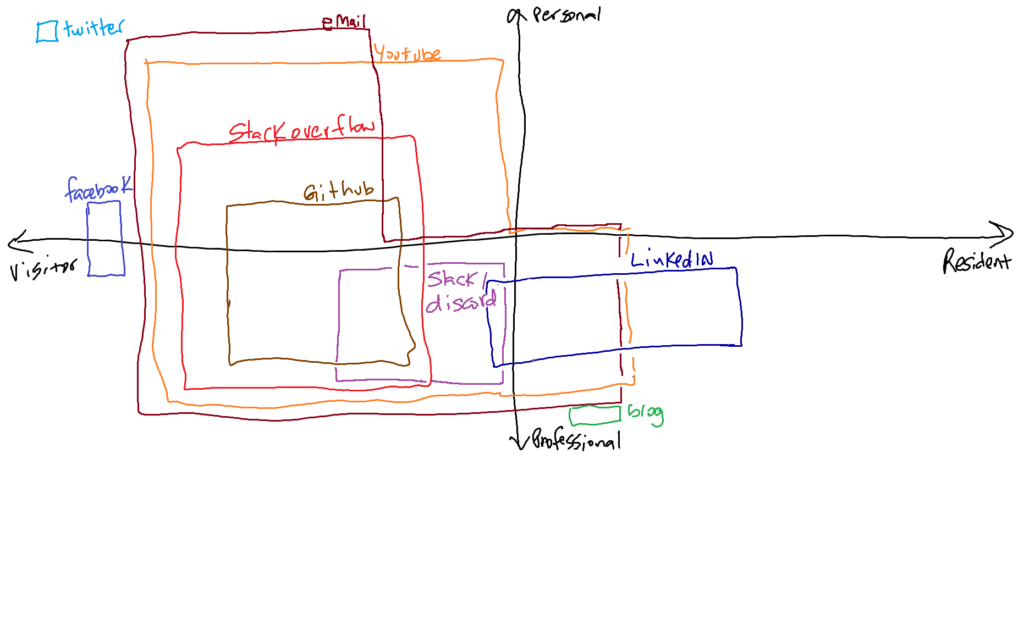
There are a few technologies that are commonly known as social media (“Social Media,” 2022) that did not make it on the mapping above, since I currently do not have an active account on those platforms:
- TikTok
- Snapchat
- Pintrest
- Twitch
It is important to note that during this mapping process, I focused on how people could publicly find information about me and my digital identity from one of these platforms. For example, even though I use email extensively for personal and professional use, you can’t obtain any information about myself, so I ranked it in the visitor category. I notice when doing this mapping that I currently have few technologies which show my personal identity short of my LinkedIn profile. Overall, I would say, despite the fact that I use many online technologies, I remain mostly a visitor.
Social media. (2022, April 23). In Wikipedia. https://en.wikipedia.org/w/index.php?title=Social_media&oldid=1084249100
White, D. S. (2013). Just the Mapping. https://www.youtube.com/watch?v=MSK1Iw1XtwQ
White, D. S., & Le Cornu, A. (2011). Visitors and Residents: A new typology for online engagement. First monday. http://firstmonday.org/article/view/3171/3049
Featured Image:
“Home” by Mada Creative from the Noun Project
“Trowel” by Erwin Smith from the Noun Project
“Range” by Arthur Shlain from the Noun Project
April 25, 2022
Patrick, I liked how you though about “visitor” as not leaving a trace of your identity for others to find. I had a difficult time deciding whether I was really more of a “visitor” or a “resident”. I am curious, why you are not that active on social media? Which platforms did you find that you have more of digital presence on?
April 25, 2022
I probably have the most presence on LinkedIn, as it’s the only real profile that’s searchable on google and provides any information about me (my job and education experience). I definitely see myself as a visitor, since I don’t use other forms of social media, so there is little information about me publicly.
I am cautious about oversharing on social media, since I don’t really want people to know exactly where I live, don’t want people to know about my family. I think it’s mostly for a protection point of view. Also, I’m careful of what I say online, because once you’ve said it, you can’t take it back.
April 25, 2022
Hi Patrick! Great map. In what ways do you think the MALAT program has shaped your map over the past 2 years?
April 25, 2022
Well the MALAT has encouraged me to have a blog, which I never did before.
I would like to get to know more about my students who I connect with on LinkedIn after they graduate from the program I teach into so that I can learn about what they found beneficial for finding and working in their jobs.
LRNT 521, is making me consider contributing to some open-source projects related to programming and database.
Other than that, I still feel like I need to be cautious about how much I make public about my identity.
April 28, 2022
Hi Patrick, thanks for posting your map. I have a question:
If you were to become more of a creator than a consumer with any of the platforms you’ve indicated in your map, which three platforms would you like to give your attention to? For example, would you like to create videos for YouTube?
April 29, 2022
Great question Bart! This will probably come up in my Digital Identity Digital Presence Plan that I create for the 521 course. I hope to create some videos on youtube that are worthy of sharing to a general public, right now they are, in my opinion, low quality recordings from classroom settings so they need some editing and revisions. I would also like to find some open-source computer programming projects to contribute to. For LinkedIn, I’d like to use it more to connect with previous graduates to see their experiences with finding a job and the skills they learned or didn’t learn in school that helped them in their new jobs.
May 2, 2022
The overlapping and concentric arrangement of much of your digital engagement is fascinating, Patrick.
I also found I struggled with the two-dimensional map, because I found that there were places where I felt I was “resident” and had plenty of online presence and digital footprint, but for a curated audience (Facebook), or within a closed network. So I added a third axis of Public/Private to allow me to place my own engagements in places where I thought they made more sense on the Resident/Visitor and Personal/Institutional matrix, but also whether I was Public or Private in my engagement and the traces left behind.
This of course meant that I needed to simplify my tracking somewhat, and there are incidental parts of my digital media presence that I omitted for the sake of clarity.
I did not consider any kind of media consumption (YouTube, Netflix, etc.) as part of my digital footprint, because I don’t engage with content on YouTube (and use it not signed in 90% of the time), and Netflix is a one-way medium with no real affordance for interaction, although I’m sure my digital traces and viewing habits there are no doubt being mined for insights.
May 2, 2022
I really did enjoy looking your digital map with your third axis of public versus private. I think this is the reason I have so few things in the residents category, because I viewed a resident as being public.
I do interact a lot with many technologies and thing I am really comfortable with them, but only in a private setting.
I’ve never used that spline.design tool you did for your map, but looks very cool. How long did you take to use create your 3d tech map?