
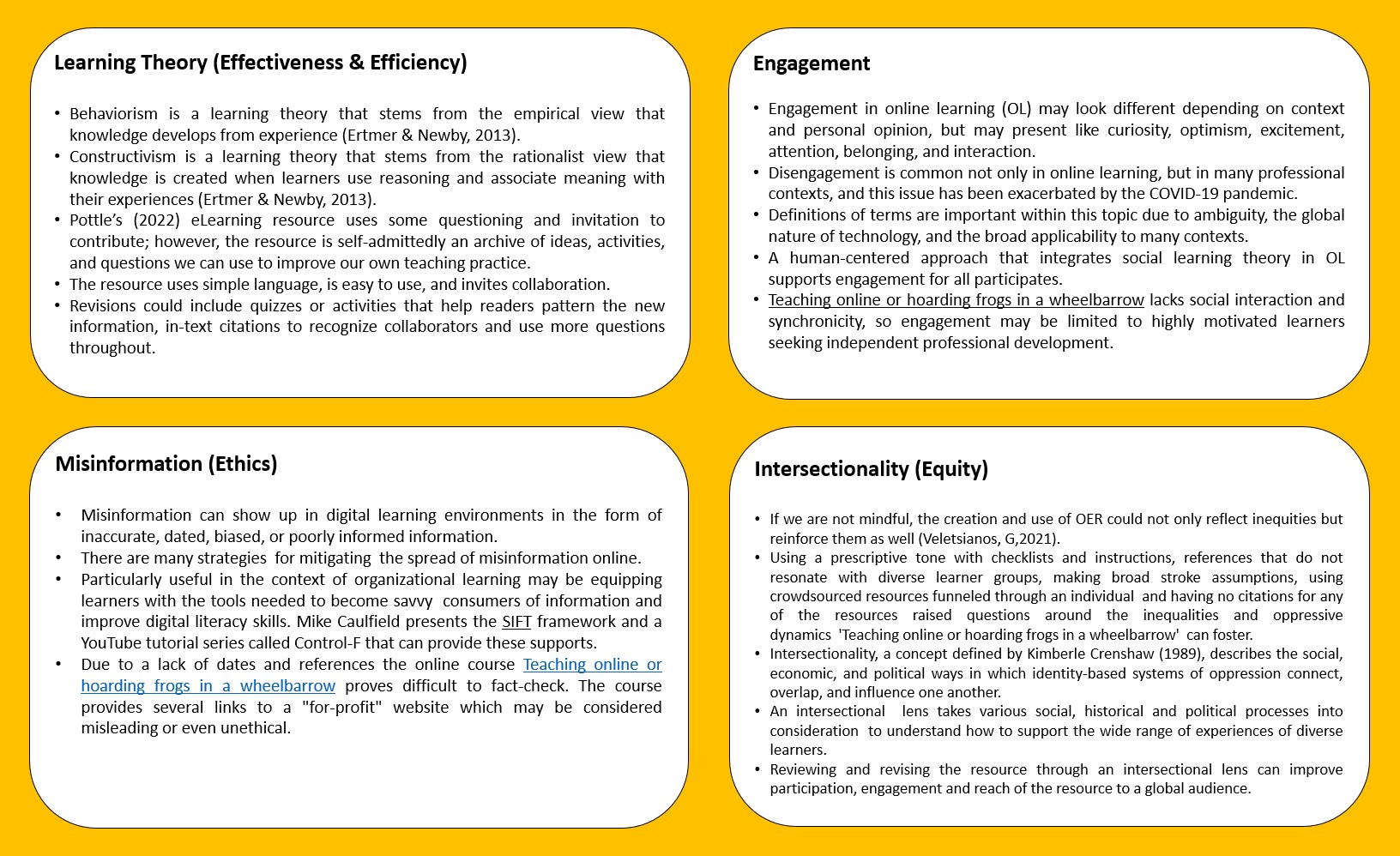
Team 4 analyzed Pottle’s (2022) eLearning teacher resource, Teaching online or hoarding frogs in a wheelbarrow, with an appreciation for Veletsianos’s (2021) four tenets of online and blended learning environments. The infographic below showcases each team member’s assessment of the eLearning’s efficiency & effectiveness, ability to engage, and systemic awareness of ethics and equity. The image following it represents the interconnected nature of our inquiry.
- May 4 Presentation Slidedeck & Recording
- May 15 Presentation Script & Recording
Helping students, and even teachers, for that matter, understand new material and patterns of behaviour is a challenge even in the best learning environments. Our infographic represents how different learners are and what topics they find interesting. Incorporating these ideas into our MALAT experience represents a combination of social learning theory (Kondrostami & Seitz, 2021), group discourse to explore new perspectives, and an appreciation for intersectionality (Crenshaw, 2015) in learning in our current academic environments.

Caulfield, M. (June 19, 2019). SIFT (The Four Moves). Hapgood. https://hapgood.us/2019/06/19/sift-the-four-moves/
Ertmer, P., & Newby, T. (2013). Behaviourism, Cognitivism, Constructivism: Comparing critical features from an instructional design perspective. Performance Improvement Quarterly, 26(2), 43-71.https://go.openathens.net/redirector/royalroads.ca?url=https%3A%2F%2Fdoi.org%2F10.1002%2Fpiq.21143
Kordrostami, M., & Seitz, V. (2021). Faculty online competence and student affective engagement in online learning. Marketing Education Review, Aug 2021, P1. https://web.s.ebscohost.com/ehost/pdfviewer/pdfviewer?vid=1&sid=839076ae-d6eb-4d6c-8961-fb532295f543%40redis
Pottle, T. (2022). Teaching online or hoarding frogs in a wheelbarrow. OELC. http://oelc.ca/frogs/index.html
Veletsianos, G. (2021, May 31). Effectiveness, Efficiency, Engagement and Equity in Online and Blended Learning settings. Congress of the Humanities and Social Sciences – Open/Technology in Education, Society, and Scholarship Association (OTESSA) [Online Keynote Session], University of Alberta, AB. https://www.veletsianos.com/2021/05/31/otessa-2021-congress-keynote-effectiveness-efficiency-engagement-wheres-equity/
Veletsianos, G. Open educational resources: expanding equity or reflecting and furthering inequities? Education Tech Research Dev 69, 407–410 (2021). https://doi.org/10.1007/s11423-020-09840-y
Hi Ben
I think your particular piece explores the learning theories as it relates to your chosen tech right? I am super curious what you are finding. I landed in this place at the near end of my paper where I still have questions about the nature of learning within connectivism in massive participatory networks. Wondering if there is overlap in your work that speaks to this.
Thanks!
KM
Upon taking a closer look at your infographic v1, I was drawn to your section on Learning Theory and the other on Engagement. I am looking at extended realities and what they can offer my TV News students in terms of adding another layer to storytelling or how XR can support learning; is XR more engaging, can it add to a students’ future outcomes – after graduation, can XR reinforce learning or offer new opportunities for growth, for teaching, for the industry (TV News)? Part of my exploration has lead me to learning-by-doing and how that may play a part, most likely a critical part, in my final paper.
Your infographic section on Engagement mentions how your learning event may not be engaging, perhaps because it does not integrate social learning theory. “Teaching online or hoarding frogs in a wheelbarrow lacks social interaction and synchronicity, so engagement may be limited to highly motivated learners seeking independent professional development” (Chaddock, Hadley, Miller & Vijayann, 2022). Engagement has been at the forefront of most of the literature I have read so far and to me, your infographic emphasises how critical engagement is. In my own readings, I came across an article by Aguilera-Hermida (2020) where the author discuss how COVID could be an impetuous for change within education and the use of technology, in my case, XR. “Technology, if used effectively, allows students and teachers to mutually engage and collaborate”. Can XR further student engagement, student experience, student learning and retention and therefore increase student success?
Regarding learning theory, you write about Ertmer & Newby, 2013 and how knowledge develops from experience. That is at the core of my critical reflection. I then decided to check out the reference itself and there is a tonne of information which is in step with my research; particularly when the authors look at Schunk’s (1991) definitive learning theory questions.
1) How does learning occur?
2) Which factors influence learning?
3) What is the role of memory?
4) How does transfer occur? and
5) What types of learning are best explained by the theory?
6) What basic assumptions/principles of this theory are relevant to instructional design? and
7) How should instruction be structured to facilitate learning?
Those questions are at the core of my paper and to see them so succinctly written is brilliantly helpful. There are so many directions I could go in, I feel that these questions will help guide me forward as I try to create a cohesive and comprehensive critical reflection. My critical issue could boil down to instructional design. In that case, exploring how humans learn could be key; how do I effectively teach or use XR in my context and what difference would it make? “Just as a doctor cannot prescribe an effective remedy without a proper diagnosis, the instructional designer cannot properly recommend an effective prescriptive solution without an accurate analysis of the instructional problem” (Ertmer & Newby, 2013).
Great infographic. Thank You!
References
Aguilera-Hermida, P. (2020). College students’ use and acceptance of emergency online learning
due to COVID-19. International Journal of Education Research Open. Vol 1.
https://doi.org/10.1016/j.ijedro.2020.100011
Chaddock. B, Hadley. A, Miller. M & Vijayann, S. (2022). 526 – Assignment 2 (Team 4 Summary). https://malat-webspace.royalroads.ca/rru0206/
Ertmer, P., & Newby, T. (2013). Behaviourism, Cognitivism, Constructivism: Comparing critical features from an instructional design perspective. Performance Improvement Quarterly, 26(2), 43-71.
Katia –