
(Figure 1)
For the latest entry on our blogs, we were asked to work in small groups and discuss how digital learning has impacted fake news and misinformation (our chosen topic). According to Farmer (2019), the term fake news refers to “misleading news”, which has been created to misinform for several reasons, including to “gain power or influence” (p. 223). While misinformation and fake news are not new phenomena, the way people receive it, their frequency, and the networks they share it have increased (Auberry, 2018).
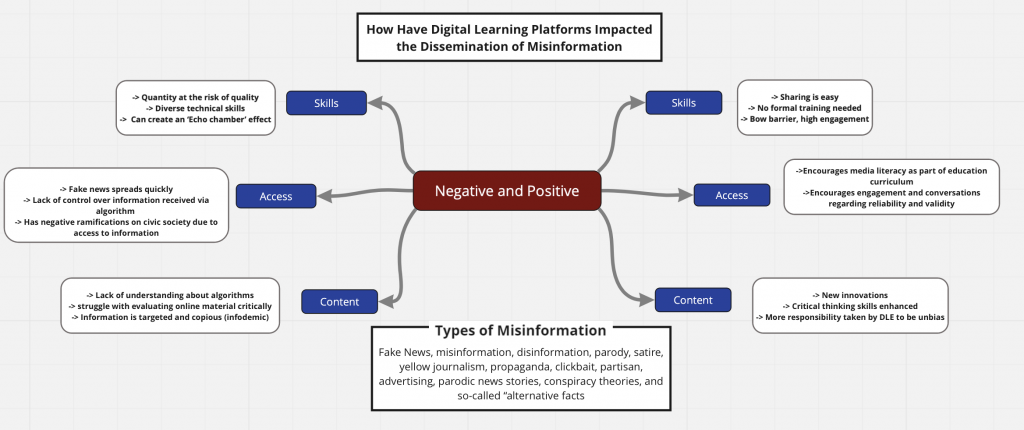
The impact of digital learning on misinformation and fake news comes from it being primarily shared on social media outlets such as Twitter and Facebook (Auberry, 2018). Social networking platforms like Twitter are networks which exist in digital learning environments (DLEs) (Veletsianos, 2016); thus, the dissemination of misinformation and fake news can be through DLE networks. We have categorized the impact of DLEs on misinformation and fake news into three talking points access, skills and content (Figure 1) because of how they affect both students and educators. The aim of this task for each person in our triad (Marion, Nicole and I) is to discuss the positive and negative impacts of access, skills and content. I will be discussing access.
Access to fake news and misinformation has increased, and the quickest way this information is transferred is through social media (Parthenis, n.d.). As we noted above, social media sites like Twitter are networks which live in DLEs (Veletsianos, 2016); thus, in this respect, the DLEs impact the spread of misinformation and fake news and facilitate access to these materials, and the sheer volume of content people receive. It is noted that the spread of misinformation and fake news is more robust on informal and anonymous accounts compared to official institutional accounts (Kouzy et al., 2020, cited in Hartley & Vu, 2020). This means that the spread of misinformation and fake news on a university social media account is less than on a private account; however, students and educators have quick access to other accounts to read and share. The spread and access of misinformation and fake news can negatively impact people and society when readers believe and share false claims through social media. The information consumption can affect voting decisions (Sydell, 2016 as cited in Auberry, 2018) and help fuel civil unrest such as the Capital Riots in Washington DC in January 2021 or the Freedom Convoy of 2022 in Canada.
The platforms also facilitate access to unverified content by grabbing headlines that help spread untruths (Auberry, 2018). It becomes difficult in a DLE where we encourage students to use media tools to decipher what is truthful when the content they receive is filtered through an algorithm based on their search behaviour (Farmer, 2019). This reminds me of a heated argument in my ethics class this past winter over fake news circulating about the Ukrainian war. A large portion of the international students was pro-Russia, gathering their news and sourcing through Chinese news sources, and others were pro-Ukraine, getting their sourcing through western media. There was misinformation and fake news on both sides based on their algorithm. Still, it did bring about a large conversation about validity and reliability while forcing me to include media literacy more explicitly in the lessons.
I would not say there is a solid pro-argument for the access to misinformation and fake news because of its divisiveness and the negative impacts we have seen across the globe. The list is endless if we begin to cite examples; however, as educators, I think the one positive effect is that the increased access, presence and spread of misinformation and fake news has forced educators to think about and integrate media literacy as part of the curriculum in a manner that was not introduced when I was in school (or likely most of you). The skills that help build media literacy, such as “active inquiry and critically thinking about media” (Farmer, 2019, p. 225), were not encouraged when I was in school, and I wish they had been.
References
Auberry, K. (2018). Increasing students’ ability to identify fake news through information literacy education and content management systems. The Reference Librarian, 59(4), 179–187. https://doi.org/10.1080/02763877.2018.1489935
Farmer, L. (2019). News literacy and fake news curriculum: School librarian perceptions of pedagogical practices. Open Information Science, 3(1), 222–234. https://doi.org/10.1515/opis-2019-0016
Hartley, K., & Vu, M. (2020). Fighting fake news in the Covid-19 era: Policy insights from an equilibrium model. Policy Sciences, 53(4), 735–758. https://doi.org/10.1007/s11077-020-09405-z
Parthenis, D. (n.d.). Chapter 9: To what extent does fake news influence our ability to communicate in learning organizations. In Ethical use of digital learning environments: Graduate student perspectives. University of Alberta; Creative Commons. https://openeducationalberta.ca/educationaltechnologyethics/chapter/to-what-extent-does-fake-news-influence-our-ability-to-communicate-in-learning-organizations/
Veletsianos, G. (2016). Digital learning environments. In Handbook of learning technologies (N. Rushby & D. Surry ed., pp. 242–260). UK: John Wiley & Sons.