As a Learning and Development Consultant, I specialize in enhancing organizational performance through comprehensive training and development strategies. My expertise extends to various industries, including a significant focus on medical aesthetic spas. In collaboration with a Medical Aesthetic Business, one of my esteemed clients, I am instrumental in identifying their unique training needs and designing bespoke learning solutions. This collaboration involves developing and implementing innovative training programs that enhance staff competencies in medical aesthetics and foster a culture of continuous professional growth and teamwork. My role is critical in ensuring that the spa’s practitioners are well-equipped to meet the challenges of a rapidly evolving industry, thereby maintaining operational excellence and achieving the highest levels of client satisfaction. Through my work, I contribute significantly to the spa’s commitment to offering top-tier treatments and promoting an environment of continuous learning and collaboration.
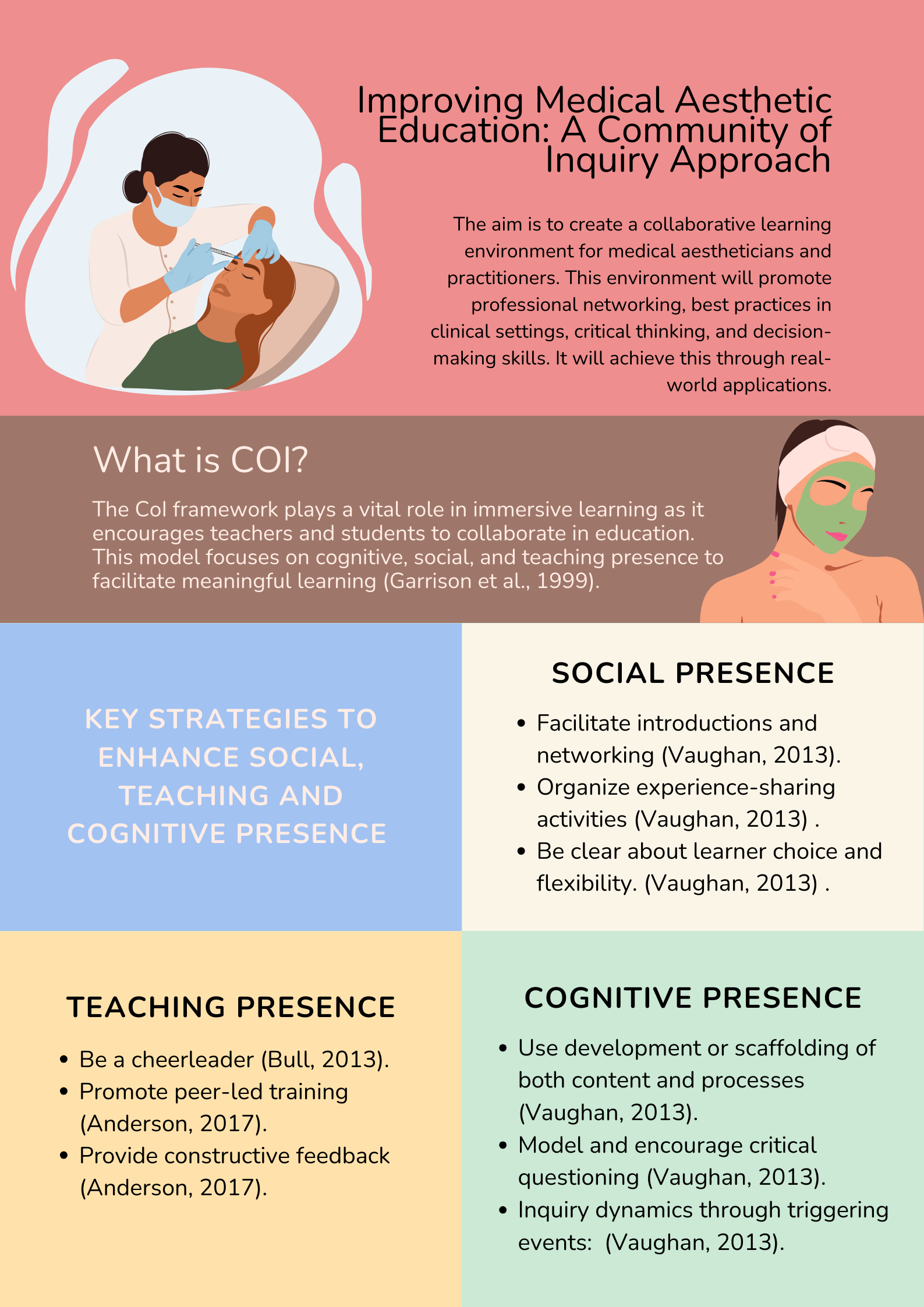
The purpose of this infographic is to cultivate a collaborative learning environment for medical aestheticians and practitioners. It aims to promote knowledge sharing and the development of critical thinking and decision-making skills. The Community of Inquiry (CoI) framework is pivotal in creating an immersive learning experience by fostering collaboration between educators and students. This model emphasizes cognitive, social, and teaching presence, resulting in meaningful and impactful learning opportunities (Garrison et al., 1999).
Social Presence
Social presence enables individuals to authentically connect in communication mediums, particularly in online settings (Fiock, 2020).
- Encourage initial introductions and ongoing social interaction: Leverage platforms like the spa’s social media or internal communication systems to introduce new team members or treatments, fostering a vibrant community (Vaughan, 2013).
- Promote activities for instructors and students to share experiences and support each other: Organize activities where medical aestheticians and practitioners can exchange experiences and offer mutual support (Vaughan, 2013).
- Provide clear choices and flexibility for learners: Offer flexibility in online training, allowing staff to choose modules or webinars that align with their learning preferences (Vaughan, 2013).
Teaching Presence
Teaching presence orchestrates cognitive and social processes in a learning environment to support educational outcomes (Fiock, 2020).
- Cheerleader: Actively engage as a cheerleader and advocate for employees, fostering a social presence through celebration of achievements, and virtual chats (Bull, 2013).
- Promote peer-led training: Facilitate sessions where team members educate their peers about the nuances of their roles (Anderson, 2017).
- Foster constructive feedback: Implement robust feedback mechanisms and encourage staff to provide feedback to one another, especially in collaborative scenarios (Anderson, 2017).
Cognitive Presence
Cognitive presence involves constructing and validating meaning through reflection, comprising four phases: triggering event, exploration, integration, and resolution (Fiock, 2020).
- Scaffold both content and processes: Introduce new treatments or protocols in a layered manner, starting with foundational concepts and gradually introducing complexities (Vaughan, 2013).
- Model and encourage critical questioning: Facilitate digital platforms like monthly “town halls” for staff to discuss current processes or industry trends (Vaughan, 2013).
- Trigger inquiry dynamics through events: Leverage the continuous evolution of treatments and technology as opportunities for staff learning. Present new treatments or significant operational changes as problems or questions, encouraging teams to explore solutions collaboratively (Vaughan, 2013).
References
Anderson, T. (2017). How Communities of Inquiry Drive Teaching and Learning in the Digital Age | teachonline.ca. Teachonline.ca. https://teachonline.ca/tools-trends/how-communities-inquiry-drive-teaching-and-learning-digital-age
Bull, B. (2013). Eight roles of an effective online teacher. Faculty Focus. https://www.facultyfocus.com/articles/online-education/eight-roles-of-an-effective-online-teacher/
Fiock, H. (2020). Designing a Community of Inquiry in Online Courses. The International Review of Research in Open and Distributed Learning, 21(1), 134–152. https://doi.org/10.19173/irrodl.v20i5.3985
Garrison, D. Randy., Anderson, T., & Archer, W. (1999). Critical inquiry in a text-based environment: Computer conferencing in higher education. The Internet and Higher Education, 2(2-3), 87–105. https://doi.org/10.1016/S1096-7516(00)00016-6
Vaughan, N. D., Cleveland-Innes, M., & Garrison, D. R. (2013). Facilitation. In Teaching in blended learning environments (pp. 45–61). Athabasca University Press. https://read.aupress.ca/read/teaching-in-blended-learning-environments/section/43261c4a-6d4c-44cf-8c7f-60bc306eb03a