
Final Reflections

In my initial post at the beginning of this course, I shared my thoughts on the essential leadership traits that make a successful leader. As the course progressed, my perspective evolved and expanded, especially regarding the leading change in digital learning environments. In this final reflection, I will focus on three key leadership traits that are crucial for effective leadership in digital spaces: digital literacy, adaptability, and transformative vision.

Digital Literacy: A Must-Have Skill for Digital Leaders

In today’s fast-paced digital world, leaders must possess a certain level of digital literacy to keep up with the rapid changes and seize potential opportunities. My initial post emphasized self-awareness, mindfulness, and personal wisdom as important leadership qualities. However, I now realize that digital literacy is just as vital for leaders in digital environments. Self-aware leaders who recognize their digital literacy strengths and weaknesses can work on honing these skills, ensuring they remain effective and relevant in their digital leadership roles.

Adaptability: The Key to Navigating the Digital Landscape

As I delved deeper into the course material, I realized adaptability is indispensable for leaders in digital environments. Kane et al. (2019) highlighted the importance of open-mindedness, flexibility, and the ability to learn quickly and adopt new methods and processes. Rapid changes are the norm in the digital world, and leaders must stay on their toes to navigate these ever-evolving landscapes. Embracing adaptability enables leaders to remain agile, respond effectively to challenges, and capitalize on new opportunities as they emerge. It also helps them support their teams through change, fostering a resilient and innovative work culture.

Transformative Vision: Anticipating and Shaping the Future

In addition to digital literacy and adaptability, having a transformative vision is crucial for leaders in digital environments. This involves anticipating future trends and developments, understanding the digital landscape, and possessing a deep knowledge of emerging technologies and trends. Leaders with a transformative vision can guide their organization in making strategic decisions, preparing for and shaping the future, and staying ahead of the competition.

As a result of this course, my understanding of leadership traits has evolved, particularly in digital learning environments. As a leader in my current role, I can apply these insights by promoting digital literacy within my team, fostering adaptability and resilience, and keeping a forward-looking mindset. By doing so, I can help lead change within my organization and contribute to a more innovative, responsive, and successful future.

In conclusion, effective leadership in digital learning environments requires a unique blend of skills, including digital literacy, adaptability, and transformative vision. As digital technology continues to reshape our world, leaders must stay ahead of the curve by embracing these traits, fostering a culture of continuous learning, and leading their organizations toward a bright digital future.

References
Kane, G. C., Anh, N., Copulsky, J., & Andrus, G. (2019). How Digital Leadership Is(n’t) Different – ProQuest. Www.proquest.com. https://www.proquest.com/docview/2207927776/abstract/70BA63B9D8FC452BPQ/1?accountid=8056

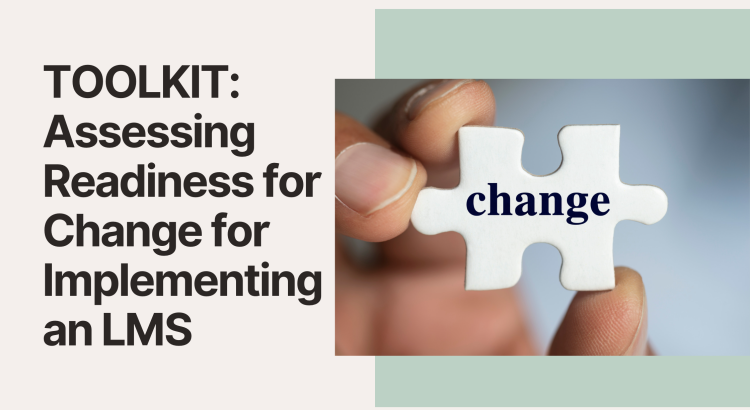
Toolkit: Assessing Readiness for Change

In this assignment, we, Team B, focused on creating a toolkit to facilitate change in the medical field by evaluating an organization’s preparedness for implementing a learning management system (LMS) to train its employees. A toolkit is a set of resources that guide users through a process, comprising activities, templates, methods, and directed steps, to help them navigate the planning process, regardless of its linearity.

Our toolkit comprises six steps that provide practical considerations and activities to assist managers in making decisions during the change process. These steps have been adapted from Kotter’s Leading Change Method of 1996, which emphasizes creating urgency, developing a vision for change, empowering others, creating short-term victories, consolidating gains, and anchoring new approaches in the organizational culture. We acknowledge that these steps are not necessarily linear and may require concurrent implementation or re-evaluation based on the organization’s analysis or unique circumstances.

Although our toolkit was designed specifically for management in medical settings implementing LMS systems, its principles can be applied to any organization that plans to adopt an LMS system. It is critical to remember that our toolkit only covers phase one of the implementation process, which focuses on readiness assessment.

Leading Projects

Based on my experience implementing an LMS within an organization a few years back, our primary goal was to transition all in-person training onto an online platform. However, we faced opposition from select stakeholders who needed convincing that the online platform was the best option for our organization despite clearly communicating the intended outcome. Our project involved several individuals, including employees who would use the LMS for training, franchisees who would train their employees using it, and executives responsible for approving the project’s budget and allocation of resources.

Although we had a project plan, it needed more comprehensive planning to ensure successful execution. As Watt (2014) highlighted, project planning is an essential aspect of project management that involves identifying goals, objectives, and deliverables. Poor planning led to missed deadlines and misallocated resources. To avoid this in the future, we could have created a more detailed project plan that accounted for all necessary resources and assigned specific roles and responsibilities to team members.

Looking back, there were several measures we could have taken to ensure the success of the LMS implementation project. For example, we could have created a comprehensive project plan that identified all necessary resources and assigned specific roles and responsibilities to team members. Watt (2014) emphasizes that effective resource planning is critical in project management as it ensures projects are completed within budget, on time, and with the desired level of quality. In addition, the project team can anticipate potential resource conflicts and develop strategies to optimize resource utilization by developing a well-defined resource plan. This can help minimize the risks of missing deadlines and mismanaging the project budget. Therefore, investing time and effort in resource planning is crucial as it can significantly contribute to a project’s success.

To increase the success rate of our project, we could have interacted with stakeholders more effectively by giving them updates regularly and addressing their concerns beforehand. Furthermore, if we had carried out a pilot test before launching the platform, we would have been able to make necessary changes and boost the chances of succeeding. This experience taught me the significance of proper planning, efficient communication, and stakeholder involvement in successfully executing a project. For upcoming projects, I intend to adopt a more structured approach that involves detailed planning, frequent stakeholder communication, and risk management techniques. I also plan on implementing agile project management strategies to deal with changes or obstacles during execution flexibly.

 References:

Watt, A. (2014, August 14). Project Management – The Open Textbook Project provides flexible and affordable access to higher education resources. Opentextbc.ca; Pressbooks. https://opentextbc.ca/projectmanagement/

External Scan

To be successful in digital learning environments, executives need to possess the expertise and aptitude to manage transformation effectively. This model centers on having a clear vision, organizational preparedness, and strategic planning. Although various components must be aligned for successful change, proper organization is essential. Nevertheless, according to Al-Haddad and Kotnour (2015), the success rate of change initiatives in organizations is low, with only 30% being successful. To better understand the challenges faced when implementing change within organizations, I spoke with a former colleague who is a Senior Operations Manager in a franchise organization who wishes to remain anonymous.

During the interview, we discussed how to effectively manage change within the organization, particularly about a recent project that shifted from in-person to virtual training. Unfortunately, this project experienced slower progress and more negative outcomes than initially anticipated. This was partially attributed to inadequate communication from the leadership team regarding the project’s intended objectives. Conner (1998) argued that effective change management requires competent leaders who can articulate a clear vision and plan for the project to team members. Jones (2022) further elucidated how crucial clear communication and capable leadership are for successful change management. It facilitates collaboration, creates a shared understanding of a vision, and enables more efficient goal attainment. Thus, organizations must have leaders who can espouse their vision and plan to team members, promote collaboration, and establish an action plan to navigate change more proficiently.

Additionally, many of her team members have had positions within the organization for a long time and have offered in-person training for several years. The transition process took longer than expected as personnel were not keen on embracing the amendment due to their familiarity with the existing systems. Lewin’s three-stage model of change explains that this attitude necessitates “unfreezing” pre-existing perspectives and inspiring a desire for change. This requires effective communication, leadership, and a clear vision for the future. Additionally, Biech (2007) backs up Lewin’s concept of “unfreezing” views by suggesting using the CHANGE model to cease old habits and even erase them. By recognizing and dealing with the need for “unfreezing,” organizations can navigate change more easily and reach their desired outcomes. Organizations can use the CHANGE model or similar approaches to help their employees conquer their aversion to change and attain a smoother transition to new systems and processes.

The interviewee’s experience highlighted how crucial thorough preparation of personnel and effective communication between stakeholders is for successful change management. One of the challenges faced was the need for more communication and planning from upper management. Ackoff and Emery (1972) emphasized the need for systematic reasoning when dealing with human behaviour. Kotnour et al. (2017) state the importance of strategy, clear roles, and alignment of processes, resources, and personnel for meaningful organizational change. To ensure successful implementation, a comprehensive plan should be developed outlining the responsibilities of each team member regarding the initiative’s objectives. Additionally, organizations must make critical decisions such as setting definite goals and implementing performance metrics (Gunasekaran & Kobu, 2007; Ittner & Larcker, 1998; Wouters & Sportel, 2005) to achieve their strategies. Performance metrics provide valuable data for decision-making by evaluating how organizational goals and operational management are being met.

Organizations should have clear communication, strong leadership, and a well-thought-out plan when changing the digital learning environment. Studies have shown that these elements are necessary for successful change management. Even though there might be challenges and delays along the way, carefully planning and executing can help increase the chances of success. Lewin’s three-stage and CHANGE models can help navigate people through the changes. Good leadership requires overcoming existing attitudes, generating enthusiasm for change, and setting clear goals. By focusing on these aspects, organizations can move through changes more easily and achieve their goals more quickly. To sum it up, leaders need to be strategic thinkers who plan meticulously and communicate effectively to manage organizational change successfully.

References

Al-Haddad, S., & Kotnour, T. (2015). Integrating the organizational change literature: a model for successful change. Journal of Organizational Change Management 28(2), 234-262. https://doi.org/10.1108/JOCM-11-2013-0215

Biech, E. (2007). Models for Change. In Thriving Through Change: A Leader’s Practical Guide to Change Mastery. https://ezproxy.royalroads.            ca/sso/skillport?context=22651

Jones, C. (n.d.). Interview with Christina Jones: Unique Challenges, Issues to Consider [Audio Podcast]. In Voices. Welcome to LRNT 525 – Leading Change in Digital Learning.  https://malat-coursesite.royalroads.ca/lrnt525/schedule/voices/   

Weiner, B. J. (2019). A theory of organizational readiness for change. Implementation Science4(1). https://doi.org/10.1186/1748-5908-4-67

Leadership Reflections

In activity one, we were asked to rank 20 leadership characteristics. In the first task, we were asked to evaluate and rank 20 essential leadership traits according to their importance in determining a successful leader. The objective was to identify the key attributes that are considered most vital for leaders to possess. It was fascinating to see how my team members ranked the traits differently from my own perspective and how there were many similarities across the team.  

Our individual experiences with leaders, whether positive or negative, shape what qualities we admire in leaders. A reflective leader aligns with my values. Castelli (2016) states that a reflective leader has self-awareness, mindfulness, and personal wisdom. These traits positively affect teams, promoting motivation and collaboration and creating a safe and inclusive work environment. Now, would these traits be as impactful in digital environments? We know that the digital world is constantly evolving at a fast pace. Leaders in digital environments should still possess self-awareness, mindfulness, and personal wisdom. However, a leader in digital environments should possess digital literacy, adaptability, and be forward-looking.

Digital Literacy

It may be assumed that leaders in digital spaces must possess digital literacy skills; however, this is not always the case. Kane et al. (2019) indicate that “Leaders who lack digital literacy skills may have difficulty keeping up with the rapid changes occurring in the digital world and miss out on potential opportunities and risks” (p. 36). Therefore, it is vital for those leading within digital learning contexts to possess an adequate level of digital literacy. In addition, self-awareness is also a key component of successful leadership in these environments. Self-aware leaders tend to be aware of their own capabilities and limitations, including their level of digital literacy. Through self-awareness, leaders can focus on honing their skills to thrive in rapidly changing digital environments.

Adaptability

Kane et al. (2019) emphasize the importance of adaptability for leaders in digital environments, citing that such leaders must possess an open-minded, flexible attitude and the ability to quickly learn and adopt new methods and processes (p. 36). This is critical to staying abreast of emerging trends and developments in the digital world, as rapid changes can occur anytime. By being adaptable, leaders can ensure they remain well-equipped to guide their teams in the ever-evolving digital landscape. 

Transformative Vision

Leaders in digital environments should possess a transformative vision to remain competitive in the rapidly changing digital world. According to Kane et al. (2019), 22% of respondents identified this as the most important skill in digital organizations. This involves anticipating future trends and developments in the digital world, understanding the digital landscape, and having a deep knowledge of emerging technologies and trends. Having a transformative vision allows leaders to stay ahead of the curve and ensure that their organizations remain competitive.

References

Castelli, P. A. (2016). Reflective leadership review: a framework for improving organisational performance. Journal of Management Development35(2), 217–236. https://doi.org/10.1108/jmd-08-2015-0112

Kane, G. C., Anh, N., Copulsky, J., & Andrus, G. (2019). How Digital Leadership Is(n’t) Different – ProQuest. Www.proquest.com. https://www.proquest.com/docview/2207927776/abstract/70BA63B9D8FC452BPQ/1?accountid=8056