Unit 4 Activity 1

For Unit 4 Activity 1, our team discussed the Impact of Digital Learning on Inclusion. Click here to access the interactive infographic for more information.

Group Members: Jessica Sirois, Giulia Di Giovanni and Michal Gerov

References

Bates, T. (2019). Teaching in a Digital Age: Guidelines for designing teaching and learning. (2nd ed.). Contact North. https://teachonline.ca/teaching-in-a-digital-age/teaching-in-a-digital-age-second-edition

Dron, J., & Anderson, T. (2014). Teaching Crowds: Learning and Social Media. Athabasca University Press. https://doi.org/10.15215/aupress/9781927356807.01

Foley, A., & Ferri, B. A. (2012). Technology for people, not disabilities: Ensuring access and inclusion. Journal of Research in Special Educational Needs, 12(4), 192–200. https://doi.org/10.1111/j.1471-3802.2011.01230.x

Oxford Learner’s Dictionary. (n.d.). Inclusion. In Oxford Learner’s Dictionary. Retrieved May 26, 2022, from https://www.oxfordlearnersdictionaries.com/definition/english/inclusion

Ryberg, T., & Georgsen, M. (2010) Enabling Digital Literacy. Nordic Journal of Digital Literacy, 2(5). https://doi.org/10.18261/ISSN1891-943X-2010-02-02
From Visitor to Resident

Prior to enrolling in the MALAT program, I had never given much thought to who I was online or what kind of digital presence I had. Up until this moment, I had made a choice to live in my visitor bubble trying to leave no digital footprint. In the journal Visitors and Residents: A new typology for online engagement there was one statement that truly felt like it described how I interact with the web and it states: “Clearly, some people may operate entirely as Visitors, visiting specific Web places for specific purposes, entirely on their own and never leaving a footprint behind”(White & Alison Le Cornu, 2011).

As a millennial, I grew up with AOL, ICQ (remember that?), MSN, Myspace, and eventually, Facebook when I started high school. I was able to talk with my friends after school, login in and out of MSN to attract my crush’s attention, and exchange images on Facebook using these platforms. Sounds pretty harmless right? Sure, until you start to see the unpleasant aspects of social media, such as children being cruel to one another or having images shared without consent. I think that it was from seeing this firsthand that I never really wanted to be googleable or to put any effort into my digital identity.

But, in the spirit of pushing myself out of my comfort zone, my goal is to see whether I can adjust to being more of a resident in the digital space. When creating my DIDP, I didn’t think it was necessary for me to write a long list of goals in order to give the impression that I wanted a large digital presence when, in reality, I’m not sure this is something that I want. It will be interesting to see how my views evolve in the next two years. So without further ado… here is my short (but authentic) DIDP.

The common theme running across these two objectives is to strengthen my digital identity inside the MALAT program so that I can fully engage with and learn from my peers.

Goals

  1. Post my own opinions or ideas on LinkedIn and Twitter (with confidence)
  2. Use online channels like LinkedIn, Twitter, and WordPress to have meaningful conversations.

Approach

  1. Keep a running list of topics that I find interesting or passionate about
  2. Use more of a critical lens when writing my posts
  3. Asking my peers for advice and/or feedback

Learning Gaps

  1. I need to strengthen my critical thinking skills and writing skills
  2. On a personal level, I must work on getting over this imposter syndrome and gain a bit more confidence to try to not get caught up in worrying about what other people will think of the content I publish

Strategies and Approaches

  1. Carve out some time to practice my critical thinking and writing skills by utilizing the RRU writing centre
  2. Post more content on LinkedIn and Twitter without any fear or hesitation
  3. Imposter Syndrome/Confidence: I will probably need therapy… Just kidding (but not kidding)

Measures of Success

  1. Seeing my writing style and critical lens change as I work through and get better at these skills
  2. Getting more comfortable posting online and seeing the number of these posts increase
  3. When posting online, seeing an increase in engagements from other individuals on my posts


References:

White, D. S., & Alison Le Cornu. (2011). Visitors and Residents: A new typology for online engagement. First Monday, 16(9). https://firstmonday.org/article/view/3171/3049

My Technology Use Map

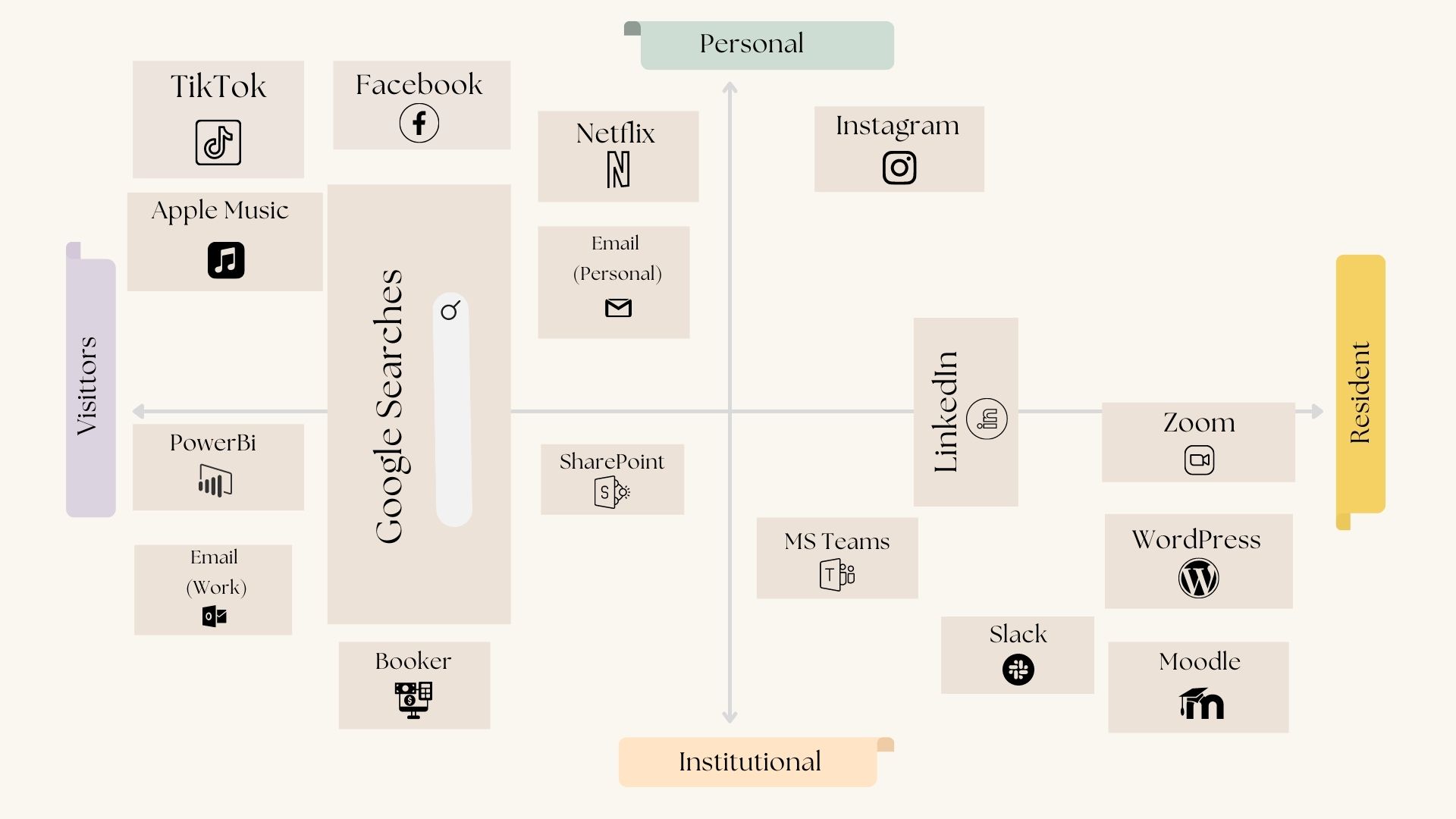
Initially, when I started to build my map of technology, I had originally thought my activities would have fallen more towards the personal-resident spectrum. As it turns out, most of my personal activities online fall in the visitor spectrum. Prior to the pandemic, when I wasn’t working from home, a lot of my technology use was more resident/personal; however, now that I’ve been working from home for two years and have to live, work, sleep, and now be a student all within the same walls, I’ve had to set strict boundaries with how much time I allow myself to use digital technology to avoid burnout. It will be fascinating to see how my technology map evolves over the coming years.

In the toggles below, you’ll find a breakdown of my technology usage, organized by where I fall on the spectrum.

Visitor/Personal

Facebook: I only have connections to my friends and family on Facebook. I generally use Facebook to look at things on Facebook Market Place (but never actually buy anything).

Tik Tok: I don’t follow any of my friends or family. I use this app to anonymously scroll and watch videos (admittedly, a lot of dog and cat videos – the algorithm knows me so well)

Netflix: I don’t think I need to explain this one!

Email (Personal): I use my personal email to interact with friends and family, as well as to spend countless hours unsubscribing from mailing lists.

Apple Music: This is the app that I use the most during the day. Music has a significant impact on my ability to concentrate.

Visitor/Personal and Institutional

Google Searches: Searching engine for both personal and institutional uses.

Visitor/Institutional

PowerBi: I utilize this tool to extract data from our Point-of-Sale System (Booker), which creates key performance indicator data that I use to assess various aspects of the company.

Email (Work): This email is just for work-related purposes.

Booker (POS): Booker is our Point-of-Sale system, which is essentially the software that is used to book and process all appointments for the companies.

SharePoint: I use it to look up company information and documents.

Resident/Personal

Instagram: My Instagram page is open to the public, and it has followers who are my friends, family, and complete strangers. I use Instagram for the social engagement element.

Resident/Institutional

WordPress Blog (RRU): Only used for the MALAT program to engage and contribute to the community via WordPress.

Slack: Strictly used to communicate with the members of this cohort.

Moodle: Moodle is only used to engage and collaborate amongst this cohort.

MS Teams: This is one of the most common business communication methods. This is usually where our team communicates with one another (a lot of times just sending each other GIFs)

Zoom: I mainly use Zoom for team meetings and/or class sessions for the MALAT program.

Resident/ Institutional and Personal

LinkedIn: I use LinkedIn to participate in many groups and discussions, as well as to create and share my own personal posts.

A MALAT Virtual Symposium Reflection

Last week’s virtual symposium was informative. This was a fantastic opportunity to sit back and absorb all the useful information from industry experts. As someone who is relatively new to the field, this has been a life-changing week and I have learned so much already (and it’s only the first week!). I could write pages about this past week’s symposia but, there were a few sessions that I found particularly interesting.

SOARing into Educational Change with Appreciative Inquiry.

The session “SOARing into Education Change with Appreciative Inquiry”, drastically changed my viewpoint on how I evaluate key learning gaps among my franchisees in my current role. I found the appreciative inquiry framework to be rather eye-opening. Dr. Waddington goes on to explain that appreciative inquiry was developed in the 1980s by Dr. David Cooper, who wondered how things could change if we looked at what was working rather than what was broken (Royal Roads University, 2022).  This statement alone provided an “a-ha” moment for me. I’ve always approached my franchisees with a S.W.O.T analysis. Providing a S.W.O.T analysis to a franchisee, in my opinion, has always resulted in a negative outcome. If I shift my lens to an appreciative inquiry using the S.O.A.R technique, I believe there will be a significant shift within the franchise network. Though I have not had the opportunity to put this to the test, I believe that the S.O.A.R approach would provide a wealth of insight and collaboration within the network by focusing on what is going well in their business and how to capitalize on those strengths to better our approach on how we revamp our online learning.

What is Online Learning Post-Pandemic?                                                    

This is an issue I’ve been thinking about a lot lately at work, as our company is re-evaluating our franchisee training. The difficulty I’m up against is a lack of knowledge and awareness about how training should be given within my organization. Most people in my company, for example, believe that the best way to transition to online learning is to transform our lengthy manuals into PowerPoint presentations and hope that our learners will utilize this as a self-guided learning path. As a result of this viewpoint, I’ve found myself at odds with superiors on occasion, even though I know this strategy is ineffective. Dr. Labonte goes on to say that it’s critical to concentrate on the course’s quality and instructional design (Royal Roads University, 2022). I am convinced that the quality and design of online learning contribute significantly to learner engagement. This is one of the reasons I chose to enrol in this programme with the hopes of being able to implement these changes at work.

Final Thoughts

I’ll admit that at the start of this program, I experienced a little bit of imposter syndrome. After finishing my first week and participating in the virtual symposium, my perspective has completely transformed. This week has proven that I am in the right place. I’m excited to see what the future has in store for me.

References:

Gedak, L., & Waddington, L. (2022, April 14). SOARing into Educational Change with Appreciative Inquiry [Video]. Zoom. https://bit.ly/LWLGMALATVS2022

Royal Roads University. (2022, April 3). What is Online Learning Post-Pandemic? [Video]. YouTube. https://www.youtube.com/watch?v=SxazQ6a-WwQ