Improving Medical Aesthetic Education: A Community of Inquiry Approach

As a Learning and Development Consultant, I specialize in enhancing organizational performance through comprehensive training and development strategies. My expertise extends to various industries, including a significant focus on medical aesthetic spas. In collaboration with a Medical Aesthetic Business, one of my esteemed clients, I am instrumental in identifying their unique training needs and designing bespoke learning solutions. This collaboration involves developing and implementing innovative training programs that enhance staff competencies in medical aesthetics and foster a culture of continuous professional growth and teamwork. My role is critical in ensuring that the spa’s practitioners are well-equipped to meet the challenges of a rapidly evolving industry, thereby maintaining operational excellence and achieving the highest levels of client satisfaction. Through my work, I contribute significantly to the spa’s commitment to offering top-tier treatments and promoting an environment of continuous learning and collaboration.

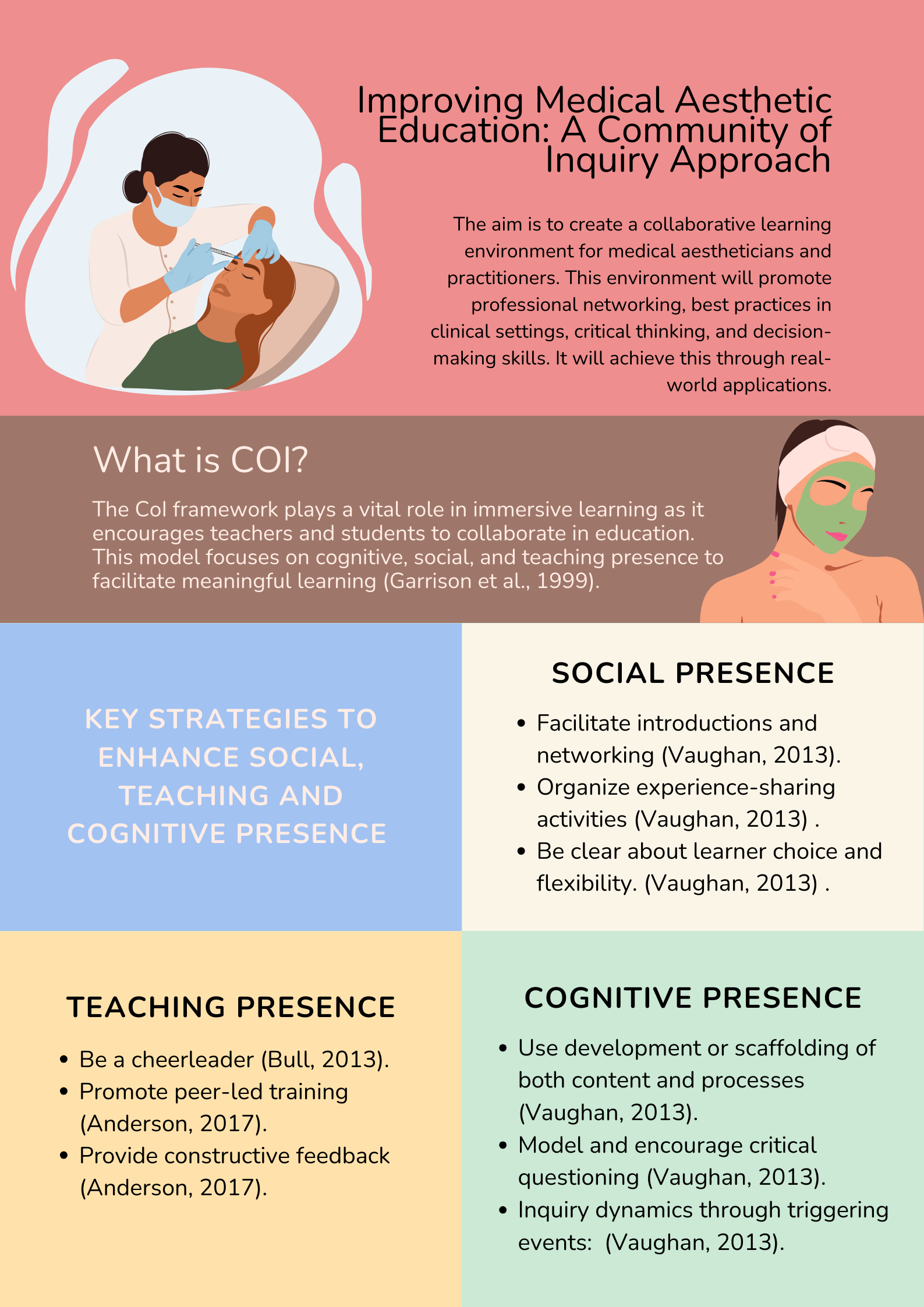
The purpose of this infographic is to cultivate a collaborative learning environment for medical aestheticians and practitioners. It aims to promote knowledge sharing and the development of critical thinking and decision-making skills. The Community of Inquiry (CoI) framework is pivotal in creating an immersive learning experience by fostering collaboration between educators and students. This model emphasizes cognitive, social, and teaching presence, resulting in meaningful and impactful learning opportunities (Garrison et al., 1999).


Social Presence

Social presence enables individuals to authentically connect in communication mediums, particularly in online settings (Fiock, 2020).

  • Encourage initial introductions and ongoing social interaction: Leverage platforms like the spa’s social media or internal communication systems to introduce new team members or treatments, fostering a vibrant community (Vaughan, 2013).
  • Promote activities for instructors and students to share experiences and support each other: Organize activities where medical aestheticians and practitioners can exchange experiences and offer mutual support (Vaughan, 2013).
  • Provide clear choices and flexibility for learners:  Offer flexibility in online training, allowing staff to choose modules or webinars that align with their learning preferences (Vaughan, 2013).

Teaching Presence

Teaching presence orchestrates cognitive and social processes in a learning environment to support educational outcomes (Fiock, 2020).

  • Cheerleader: Actively engage as a cheerleader and advocate for employees, fostering a social presence through celebration of achievements, and virtual chats (Bull, 2013).
  • Promote peer-led training: Facilitate sessions where team members educate their peers about the nuances of their roles (Anderson, 2017).
  • Foster constructive feedback: Implement robust feedback mechanisms and encourage staff to provide feedback to one another, especially in collaborative scenarios (Anderson, 2017).

Cognitive Presence

Cognitive presence involves constructing and validating meaning through reflection, comprising four phases: triggering event, exploration, integration, and resolution (Fiock, 2020).

  • Scaffold both content and processes: Introduce new treatments or protocols in a layered manner, starting with foundational concepts and gradually introducing complexities (Vaughan, 2013).
  • Model and encourage critical questioning: Facilitate digital platforms like monthly “town halls” for staff to discuss current processes or industry trends (Vaughan, 2013).
  • Trigger inquiry dynamics through events: Leverage the continuous evolution of treatments and technology as opportunities for staff learning. Present new treatments or significant operational changes as problems or questions, encouraging teams to explore solutions collaboratively (Vaughan, 2013). 

References

Anderson, T. (2017). How Communities of Inquiry Drive Teaching and Learning in the Digital Age | teachonline.ca. Teachonline.ca. https://teachonline.ca/tools-trends/how-communities-inquiry-drive-teaching-and-learning-digital-age

Bull, B. (2013). Eight roles of an effective online teacher. Faculty Focus. https://www.facultyfocus.com/articles/online-education/eight-roles-of-an-effective-online-teacher/ 

Fiock, H. (2020). Designing a Community of Inquiry in Online Courses. The International Review of Research in Open and Distributed Learning, 21(1), 134–152. https://doi.org/10.19173/irrodl.v20i5.3985

Garrison, D. Randy., Anderson, T., & Archer, W. (1999). Critical inquiry in a text-based environment: Computer conferencing in higher education. The Internet and Higher Education2(2-3), 87–105. https://doi.org/10.1016/S1096-7516(00)00016-6

Vaughan, N. D., Cleveland-Innes, M., & Garrison, D. R. (2013). Facilitation. In Teaching in blended learning environments (pp. 45–61). Athabasca University Press. https://read.aupress.ca/read/teaching-in-blended-learning-environments/section/43261c4a-6d4c-44cf-8c7f-60bc306eb03a




Activity 1-4 |3-2-1 

Three initial thoughts, ideas or feelings you have about facilitation in digital environments.

As the first-week ends, I am intrigued by the significance of learning environments and facilitation in shaping the learning experience. I greatly appreciate the facilitators who effectively handle multiple roles, such as cheerleaders, social butterflies and learning coaches (Bull, 2013). Additionally, the Community of Inquiry (CoI) model resonates with me as I think about themes like “Supporting student success” and “Providing clarity through course structure” (Dunlap & Lowenthal, 2018). It reinforces my belief in educators’ significant impact on creating meaningful and supportive digital learning journeys.

Two questions that I have about digital facilitation:

  1. How can digital facilitators maintain a social presence and consistently engage learners, particularly when facing personal obstacles, potential burnout, or unexpected life events?
  2. What strategies can digital facilitators employ to address feelings of isolation or detachment among participants and foster community? Drawing from Bull’s (2023) concept of the ‘big brother’ role, can this approach be leveraged to enhance student engagement by reaching out to those who have not logged in?

1 metaphor or simile about digital facilitation.

Facilitating in a digital learning environment is like being a DJ that encourages students with kind words (Cheerleader), ensuring they mingle (Social Butterfly) and controls the music’s tempo (Valve Control) to match the party’s mood


References:

Bull, B., EdD. (2023). Eight roles of an effective online teacher. Faculty Focus | Higher Ed Teaching & Learning. https://www.facultyfocus.com/articles/online-education/eight-roles-of-an-effective-online-teacher/
Dunlap, J. C., & Lowenthal, P. R. (2018). Online educators’ recommendations for teaching online: Crowdsourcing in action. Open Praxis, 10(1), 79. https://doi.org/10.5944/openpraxis.10.1.721


Team 4 – Blog 1

Team 4:  Gillian Dixon, Terry Kent, Megan Li, Jessica Sirois

Our team has decided to explore open educational resources (OER), focusing on Massive Open Online Courses (MOOCs). As defined by UNESCO (2018), OER refers to publicly available educational resources, including textbooks, courses, syllabi, assignments, assessments, and more, all of which have an open license. This means these resources are free of cost and can be duplicated, reused, adapted, and shared. To gain a deeper understanding of OER, our team will participate in an “An Introduction to Open Educational Resources (OER)” course by Open Learn.

After exploring websites offering free educational courses like Coursera and MERLOT, we ultimately chose OpenLearn through The Open University. We found the website’s layout more user-friendly than others, with clear descriptions of each course, including course content, reviews, estimated study time and difficulty level. Additionally, we were impressed with the site’s functionality enabling users to filter courses based on estimated completion time. OpenLearn is also committed to accessibility by providing various options for diverse learning needs.

To enhance our understanding of MOOCs, our team investigated several resources. Initially, we focused on the OpenLearn website created by The Open University (OpenLearn, n.d.). OpenLearn provides free, accessible educational content, including bite-sized courses, for users from over 236 countries, catering to the public and the University’s students. We also delved into the OpenLearn FAQ section, which covers essential topics such as user requirements, technical issues, profile management, course information, privacy, accessibility, and copyright concerns (OpenLearn, n.d.). This comprehensive resource allowed us to grasp the platform’s features and offerings better.

According to Zhenghao et al. (2015), over 25 million people enrolled in MOOCs offered by Coursera, EDX, and other platforms globally between 2013 and 2015. The authors indicated that the MOOC skeptics are overly pessimistic, which MOOCs catered to well-educated and affluent individuals, and most people in this group were not completing the courses they registered for. Based on their research results, most people who complete MOOCs report career or educational benefits such as getting a new job, starting a new business, or completing prerequisites for an academic program. The findings also show that people with lower socioeconomic status and less education from developing countries benefit highly from MOOCs. In short, open access to the learning experience is favourable for education and career advancement.    

After reflecting on the course readings, Fawns (2022) and Selwyn (2010), and the notion of the critical approach, we contemplated who we are, what we wanted from this project and our expectations of the learning experience. Both authors discuss how the learner’s context and experience using the technology is contingent on their context (Fawns, 2022; Selwyn, 2010). Fawns (2022) also notes that the student’s physical space and environment in which the learner engages and their values shape the experience. The other area of interest relates to context and the rating level of difficulty of the course.  While we are not experts in OER, we wonder if the advanced rating is appropriate for our backgrounds and what contexts this course may or may not be useful because the course description does not indicate a target learner.  As such, the team has agreed on these two questions to explore:

  1.     How do our differing backgrounds shape our educational experience, the learning experience, and the perceived value of the course’s effectiveness? 
  2.     Who is this course appropriate for, and who may benefit from the learning experience?

We welcome feedback and further ideas to help shape our questions and project. 

As for our critical approach, our team will enroll and complete a MOOC, focusing on Fawns’ (2022) framework for entangled pedagogy, noting that a holistic approach that includes purpose, context, and values towards educational technology allows for a stronger base and more awareness around complexities. Before we commence the course, we will all define what “effective” means to us in an online course and our expectations regarding online courses. We will also be noting our contexts and backgrounds. Finally, after completing our course, we will reflect on our experiences and note areas for further development. 

References

OpenLearn. (n.d.). The Open University. Retrieved April 17, 2023, from https://www.open.edu/openlearn

Fawns, T. (2022). An entangled pedagogy: Looking beyond the pedagogy—technology dichotomy. Postdigital Science and Education, 4(3), 711–728. https://doi.org/10.1007/s42438-022-00302-7

Selwyn, N. (2010). Looking beyond learning: Notes towards the critical study of educational technology. Journal of Computer Assisted Learning, 26(1), 65–73. https://doi.org/10.1111/j.1365-2729.2009.00338.x

UNESCO. (n.d.). Open educational resources. https://www.unesco.org/en/open-educational-resources 

Zhengoa, C., Alcorn, B., Christensen, G., Eriksson, N., Koller, D., & Emanuel, E.J. (2015, September 22). Who’s benefiting from MOOCs, and why. Harvard Business Review. https://hbr.org/2015/09/whos-benefiting-from-moocs-and-why 

Unit 1 – Activity 3

Before starting this assignment, I had limited knowledge of Open Educational Resources (OERs), which UNESCO (2018) defines as freely available educational materials such as textbooks, courses, syllabi, assignments, and assessments. These resources are cost-free and have open licenses, permitting duplication, reuse, adaptation, and sharing.

Our team has selected the Massive Open Online Course (MOOC) OpenLearn (n.d) for a thorough analysis. OpenLearn stands out as a user-friendly platform with an intuitive navigation system and offers more comprehensive filtering options for course length and difficulty levels than other MOOCs, like Coursera.

For example, when browsing Coursera, I found courses that sparked my interest. Still, upon enrollment, I realized the completion time was 4 to 6 months, which is unfeasible as a working professional in graduate school. OpenLearn addresses this issue with better filtering options for individual time constraints and skill levels.

 While exploring MOOCs, I was intrigued by the extensive content and courses available to users. This led me to consider using MOOCs to supplement training programs within franchise organizations. By utilizing the information in MOOCs, franchise companies can save time and resources on content creation while customizing the training program to meet the franchise’s and its employees’ specific needs. However, this solution raised several questions about implementing MOOCs in franchise settings, particularly regarding inclusivity.

I aim to examine how OpenLearn, a specific MOOC, accommodates various learning styles and caters to diverse participant needs. As someone with franchise industry experience, I recognize the presence of diverse learners and wonder how a MOOC can effectively cater to their different learning styles and needs.

To evaluate OpenLearn’s inclusiveness, I will examine several factors. These include the availability of multimedia resources, such as videos, audio files, and interactive content. These can cater to different learning styles and make the learning experience more engaging for visual, auditory, and kinesthetic learners. Additionally, I will consider the accessibility features that OpenLearn offers, such as subtitles, transcripts, and adjustable playback speed, which can support learners with disabilities or language barriers. Finally, I will look at the MOOC’s diverse courses, including a wide range of skill levels and time commitments that allow users to personalize their learning experiences based on their needs and interests. 

I welcome input from others on aspects to consider concerning my specific issue of inclusivity in MOOCs, as well as the learning event and delivery technology. Your feedback will be valuable as I develop my individual learning plan for conducting a critical inquiry into this issue. I will reflect on the feedback provided in my subsequent blog post.

References:

The Open University. (n.d.). OpenLearn. https://www.open.edu/openlearn/ 

UNESCO. (2018). Open educational resources. https://www.unesco.org/en/open-educational-resources 

Final Reflections

In my initial post at the beginning of this course, I shared my thoughts on the essential leadership traits that make a successful leader. As the course progressed, my perspective evolved and expanded, especially regarding the leading change in digital learning environments. In this final reflection, I will focus on three key leadership traits that are crucial for effective leadership in digital spaces: digital literacy, adaptability, and transformative vision.

Digital Literacy: A Must-Have Skill for Digital Leaders

In today’s fast-paced digital world, leaders must possess a certain level of digital literacy to keep up with the rapid changes and seize potential opportunities. My initial post emphasized self-awareness, mindfulness, and personal wisdom as important leadership qualities. However, I now realize that digital literacy is just as vital for leaders in digital environments. Self-aware leaders who recognize their digital literacy strengths and weaknesses can work on honing these skills, ensuring they remain effective and relevant in their digital leadership roles.

Adaptability: The Key to Navigating the Digital Landscape

As I delved deeper into the course material, I realized adaptability is indispensable for leaders in digital environments. Kane et al. (2019) highlighted the importance of open-mindedness, flexibility, and the ability to learn quickly and adopt new methods and processes. Rapid changes are the norm in the digital world, and leaders must stay on their toes to navigate these ever-evolving landscapes. Embracing adaptability enables leaders to remain agile, respond effectively to challenges, and capitalize on new opportunities as they emerge. It also helps them support their teams through change, fostering a resilient and innovative work culture.

Transformative Vision: Anticipating and Shaping the Future

In addition to digital literacy and adaptability, having a transformative vision is crucial for leaders in digital environments. This involves anticipating future trends and developments, understanding the digital landscape, and possessing a deep knowledge of emerging technologies and trends. Leaders with a transformative vision can guide their organization in making strategic decisions, preparing for and shaping the future, and staying ahead of the competition.

As a result of this course, my understanding of leadership traits has evolved, particularly in digital learning environments. As a leader in my current role, I can apply these insights by promoting digital literacy within my team, fostering adaptability and resilience, and keeping a forward-looking mindset. By doing so, I can help lead change within my organization and contribute to a more innovative, responsive, and successful future.

In conclusion, effective leadership in digital learning environments requires a unique blend of skills, including digital literacy, adaptability, and transformative vision. As digital technology continues to reshape our world, leaders must stay ahead of the curve by embracing these traits, fostering a culture of continuous learning, and leading their organizations toward a bright digital future.

References

Kane, G. C., Anh, N., Copulsky, J., & Andrus, G. (2019). How Digital Leadership Is(n’t) Different – ProQuest. Www.proquest.com. https://www.proquest.com/docview/2207927776/abstract/70BA63B9D8FC452BPQ/1?accountid=8056

Toolkit: Assessing Readiness for Change

In this assignment, we, Team B, focused on creating a toolkit to facilitate change in the medical field by evaluating an organization’s preparedness for implementing a learning management system (LMS) to train its employees. A toolkit is a set of resources that guide users through a process, comprising activities, templates, methods, and directed steps, to help them navigate the planning process, regardless of its linearity.

Our toolkit comprises six steps that provide practical considerations and activities to assist managers in making decisions during the change process. These steps have been adapted from Kotter’s Leading Change Method of 1996, which emphasizes creating urgency, developing a vision for change, empowering others, creating short-term victories, consolidating gains, and anchoring new approaches in the organizational culture. We acknowledge that these steps are not necessarily linear and may require concurrent implementation or re-evaluation based on the organization’s analysis or unique circumstances.

Although our toolkit was designed specifically for management in medical settings implementing LMS systems, its principles can be applied to any organization that plans to adopt an LMS system. It is critical to remember that our toolkit only covers phase one of the implementation process, which focuses on readiness assessment.

Leading Projects

Based on my experience implementing an LMS within an organization a few years back, our primary goal was to transition all in-person training onto an online platform. However, we faced opposition from select stakeholders who needed convincing that the online platform was the best option for our organization despite clearly communicating the intended outcome. Our project involved several individuals, including employees who would use the LMS for training, franchisees who would train their employees using it, and executives responsible for approving the project’s budget and allocation of resources.

Although we had a project plan, it needed more comprehensive planning to ensure successful execution. As Watt (2014) highlighted, project planning is an essential aspect of project management that involves identifying goals, objectives, and deliverables. Poor planning led to missed deadlines and misallocated resources. To avoid this in the future, we could have created a more detailed project plan that accounted for all necessary resources and assigned specific roles and responsibilities to team members.

Looking back, there were several measures we could have taken to ensure the success of the LMS implementation project. For example, we could have created a comprehensive project plan that identified all necessary resources and assigned specific roles and responsibilities to team members. Watt (2014) emphasizes that effective resource planning is critical in project management as it ensures projects are completed within budget, on time, and with the desired level of quality. In addition, the project team can anticipate potential resource conflicts and develop strategies to optimize resource utilization by developing a well-defined resource plan. This can help minimize the risks of missing deadlines and mismanaging the project budget. Therefore, investing time and effort in resource planning is crucial as it can significantly contribute to a project’s success.

To increase the success rate of our project, we could have interacted with stakeholders more effectively by giving them updates regularly and addressing their concerns beforehand. Furthermore, if we had carried out a pilot test before launching the platform, we would have been able to make necessary changes and boost the chances of succeeding. This experience taught me the significance of proper planning, efficient communication, and stakeholder involvement in successfully executing a project. For upcoming projects, I intend to adopt a more structured approach that involves detailed planning, frequent stakeholder communication, and risk management techniques. I also plan on implementing agile project management strategies to deal with changes or obstacles during execution flexibly.

 References:

Watt, A. (2014, August 14). Project Management – The Open Textbook Project provides flexible and affordable access to higher education resources. Opentextbc.ca; Pressbooks. https://opentextbc.ca/projectmanagement/

External Scan

To be successful in digital learning environments, executives need to possess the expertise and aptitude to manage transformation effectively. This model centers on having a clear vision, organizational preparedness, and strategic planning. Although various components must be aligned for successful change, proper organization is essential. Nevertheless, according to Al-Haddad and Kotnour (2015), the success rate of change initiatives in organizations is low, with only 30% being successful. To better understand the challenges faced when implementing change within organizations, I spoke with a former colleague who is a Senior Operations Manager in a franchise organization who wishes to remain anonymous.

During the interview, we discussed how to effectively manage change within the organization, particularly about a recent project that shifted from in-person to virtual training. Unfortunately, this project experienced slower progress and more negative outcomes than initially anticipated. This was partially attributed to inadequate communication from the leadership team regarding the project’s intended objectives. Conner (1998) argued that effective change management requires competent leaders who can articulate a clear vision and plan for the project to team members. Jones (2022) further elucidated how crucial clear communication and capable leadership are for successful change management. It facilitates collaboration, creates a shared understanding of a vision, and enables more efficient goal attainment. Thus, organizations must have leaders who can espouse their vision and plan to team members, promote collaboration, and establish an action plan to navigate change more proficiently.

Additionally, many of her team members have had positions within the organization for a long time and have offered in-person training for several years. The transition process took longer than expected as personnel were not keen on embracing the amendment due to their familiarity with the existing systems. Lewin’s three-stage model of change explains that this attitude necessitates “unfreezing” pre-existing perspectives and inspiring a desire for change. This requires effective communication, leadership, and a clear vision for the future. Additionally, Biech (2007) backs up Lewin’s concept of “unfreezing” views by suggesting using the CHANGE model to cease old habits and even erase them. By recognizing and dealing with the need for “unfreezing,” organizations can navigate change more easily and reach their desired outcomes. Organizations can use the CHANGE model or similar approaches to help their employees conquer their aversion to change and attain a smoother transition to new systems and processes.

The interviewee’s experience highlighted how crucial thorough preparation of personnel and effective communication between stakeholders is for successful change management. One of the challenges faced was the need for more communication and planning from upper management. Ackoff and Emery (1972) emphasized the need for systematic reasoning when dealing with human behaviour. Kotnour et al. (2017) state the importance of strategy, clear roles, and alignment of processes, resources, and personnel for meaningful organizational change. To ensure successful implementation, a comprehensive plan should be developed outlining the responsibilities of each team member regarding the initiative’s objectives. Additionally, organizations must make critical decisions such as setting definite goals and implementing performance metrics (Gunasekaran & Kobu, 2007; Ittner & Larcker, 1998; Wouters & Sportel, 2005) to achieve their strategies. Performance metrics provide valuable data for decision-making by evaluating how organizational goals and operational management are being met.

Organizations should have clear communication, strong leadership, and a well-thought-out plan when changing the digital learning environment. Studies have shown that these elements are necessary for successful change management. Even though there might be challenges and delays along the way, carefully planning and executing can help increase the chances of success. Lewin’s three-stage and CHANGE models can help navigate people through the changes. Good leadership requires overcoming existing attitudes, generating enthusiasm for change, and setting clear goals. By focusing on these aspects, organizations can move through changes more easily and achieve their goals more quickly. To sum it up, leaders need to be strategic thinkers who plan meticulously and communicate effectively to manage organizational change successfully.

References

Al-Haddad, S., & Kotnour, T. (2015). Integrating the organizational change literature: a model for successful change. Journal of Organizational Change Management 28(2), 234-262. https://doi.org/10.1108/JOCM-11-2013-0215

Biech, E. (2007). Models for Change. In Thriving Through Change: A Leader’s Practical Guide to Change Mastery. https://ezproxy.royalroads.            ca/sso/skillport?context=22651

Jones, C. (n.d.). Interview with Christina Jones: Unique Challenges, Issues to Consider [Audio Podcast]. In Voices. Welcome to LRNT 525 – Leading Change in Digital Learning.  https://malat-coursesite.royalroads.ca/lrnt525/schedule/voices/   

Weiner, B. J. (2019). A theory of organizational readiness for change. Implementation Science4(1). https://doi.org/10.1186/1748-5908-4-67

Leadership Reflections

In activity one, we were asked to rank 20 leadership characteristics. In the first task, we were asked to evaluate and rank 20 essential leadership traits according to their importance in determining a successful leader. The objective was to identify the key attributes that are considered most vital for leaders to possess. It was fascinating to see how my team members ranked the traits differently from my own perspective and how there were many similarities across the team.  

Our individual experiences with leaders, whether positive or negative, shape what qualities we admire in leaders. A reflective leader aligns with my values. Castelli (2016) states that a reflective leader has self-awareness, mindfulness, and personal wisdom. These traits positively affect teams, promoting motivation and collaboration and creating a safe and inclusive work environment. Now, would these traits be as impactful in digital environments? We know that the digital world is constantly evolving at a fast pace. Leaders in digital environments should still possess self-awareness, mindfulness, and personal wisdom. However, a leader in digital environments should possess digital literacy, adaptability, and be forward-looking.

Digital Literacy

It may be assumed that leaders in digital spaces must possess digital literacy skills; however, this is not always the case. Kane et al. (2019) indicate that “Leaders who lack digital literacy skills may have difficulty keeping up with the rapid changes occurring in the digital world and miss out on potential opportunities and risks” (p. 36). Therefore, it is vital for those leading within digital learning contexts to possess an adequate level of digital literacy. In addition, self-awareness is also a key component of successful leadership in these environments. Self-aware leaders tend to be aware of their own capabilities and limitations, including their level of digital literacy. Through self-awareness, leaders can focus on honing their skills to thrive in rapidly changing digital environments.

Adaptability

Kane et al. (2019) emphasize the importance of adaptability for leaders in digital environments, citing that such leaders must possess an open-minded, flexible attitude and the ability to quickly learn and adopt new methods and processes (p. 36). This is critical to staying abreast of emerging trends and developments in the digital world, as rapid changes can occur anytime. By being adaptable, leaders can ensure they remain well-equipped to guide their teams in the ever-evolving digital landscape. 

Transformative Vision

Leaders in digital environments should possess a transformative vision to remain competitive in the rapidly changing digital world. According to Kane et al. (2019), 22% of respondents identified this as the most important skill in digital organizations. This involves anticipating future trends and developments in the digital world, understanding the digital landscape, and having a deep knowledge of emerging technologies and trends. Having a transformative vision allows leaders to stay ahead of the curve and ensure that their organizations remain competitive.

References

Castelli, P. A. (2016). Reflective leadership review: a framework for improving organisational performance. Journal of Management Development35(2), 217–236. https://doi.org/10.1108/jmd-08-2015-0112

Kane, G. C., Anh, N., Copulsky, J., & Andrus, G. (2019). How Digital Leadership Is(n’t) Different – ProQuest. Www.proquest.com. https://www.proquest.com/docview/2207927776/abstract/70BA63B9D8FC452BPQ/1?accountid=8056

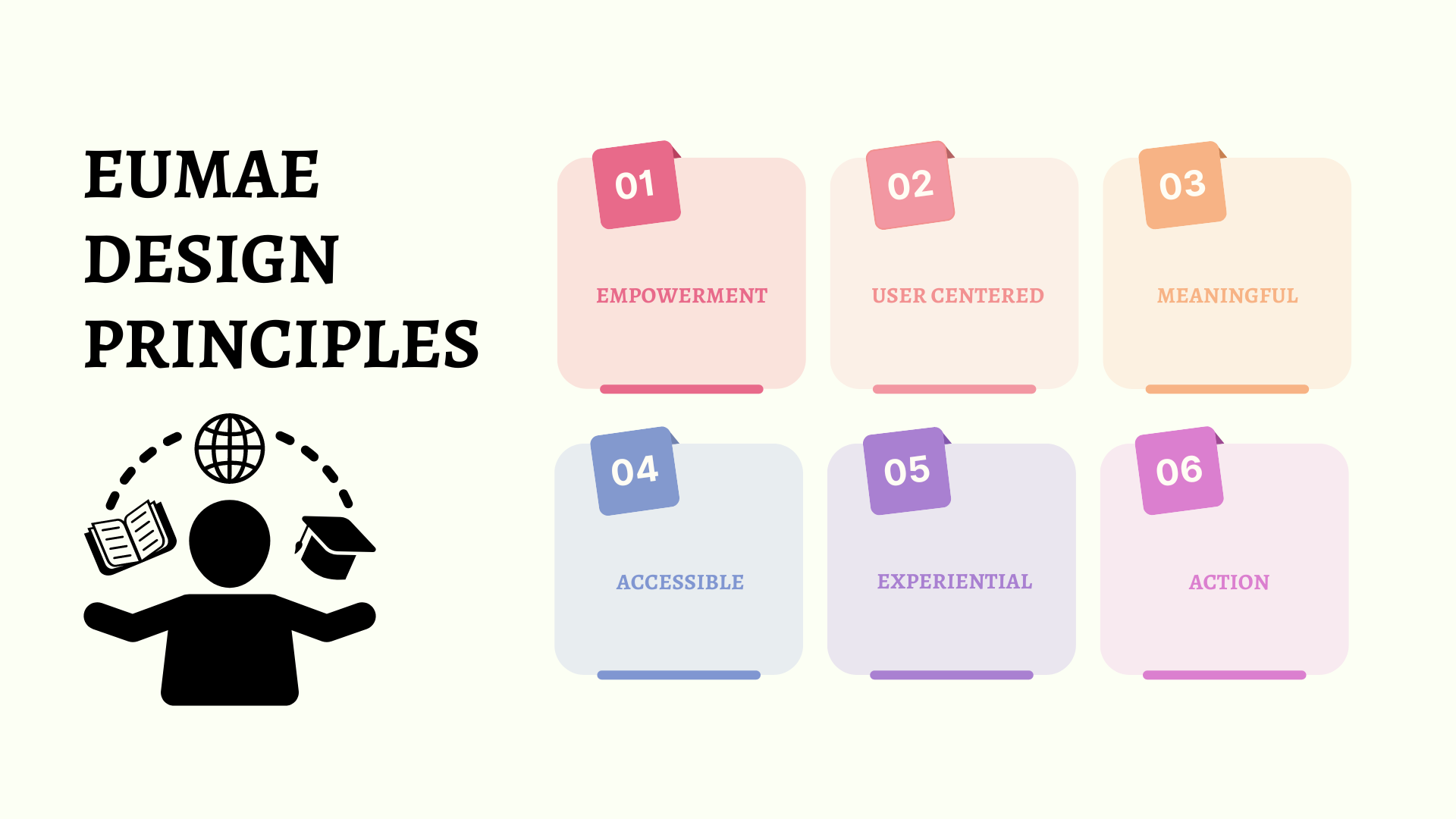
EUMAE Design Principles

Our task in assignment 2A was to work in groups to investigate design challenges in a real-world work environment. Michal and I investigated the design process challenges we encountered at our respective workplaces. Through this investigation, we developed our problem statement: “How can design thinking be used to ensure that corporate training program content is relevant and engaging?”. As a result, we created a prototype that incorporated AI, personalized learning, and social learning in corporate settings to increase learner engagement.

This blog post discusses six design principles that can be used in a corporate environment to promote learner engagement when designing learning. These principles include empowerment, user-centred design, accessibility, meaning, experiential, and multiple means of action or expression. Each principle is briefly defined and explained in the context of corporate learning and its potential to increase learner engagement.

Empowerment

According to the British Council (2014), empowerment is a process in which learners can make choices about their learning experience. This power transfer from teacher to learner allows them to become more self-sufficient and autonomous (British Council, 2014). Giving learners control over their own learning experience by giving them choices in the topics they want to learn about, the pace at which they want to learn, and the methods they want to use by providing a variety of learning options, such as self-paced e-learning modules, virtual instructor-led training, and on-the-job training, gives learners the ability to find the material relevant and engaging.


User-centered

The Interaction Design Foundation (2019) defines user-centered design (UCD) as an iterative process that focuses on understanding and incorporating the needs of the users, in this case, learners, throughout the design process (Interaction Design Foundation, 2019). By involving learners in the design process, we can better understand their needs and preferences, resulting in more meaningful and engaging learning experiences. This approach encourages collaboration between designers and learners, ensuring that learning materials and activities are tailored to the learners’ specific needs.


Accessible

The University of British Columbia (n.d.) defines accessibility in education as the ability for course materials, content delivery, and learning activities to be accessible to students with a wide range of abilities operating in a wide range of environments, conditions, and circumstances (Designing for Accessibility: An Introduction to Universal Design for Learning, n.d.). Employees in corporate settings come from various backgrounds, learning styles, and abilities and may have varying requirements for accessing and engaging with learning materials. Thus, accessibility in corporate learning environments is critical to ensuring that all employees have an equal opportunity to access and benefit from the learning opportunities provided.

Meaningful

According to Hung (2006), meaningful learning is a deliberate process in which learners actively engage in authentic tasks, working cooperatively and intentionally to construct their understanding through interaction with their environment. This method is task-based and collaborative and works best in real-world situations. Therefore, using this approach in a corporate setting by incorporating real-world scenarios and activities relevant to the learners’ job roles and responsibilities, as well as providing opportunities for them to apply what they have learned in the workplace, can improve learners’ engagement in the learning process.


Experiential

According to Kolb and Kolb (2017), experiential learning is a process in which the learner is in direct contact with the realities being studied rather than simply reading or hearing about them. This approach emphasizes the importance of direct sense experience and in-context action as primary sources of learning. It frequently includes a combination of action and reflection, as well as experience and concept. By providing opportunities for hands-on, in-context learning experiences relevant to the learners’ job roles and responsibilities, experiential learning in corporate settings can help increase learner engagement.


Action

According to Kovac (2017), the principle of multiple means of action or expression refers to providing students with various ways to demonstrate what they have learned. This approach is used by teachers when there are multiple ways to assess student knowledge. In addition, this principle can be applied in corporate settings by providing employees with multiple ways to demonstrate their understanding and proficiency in a specific skill or task. This can help employees with different learning styles, and abilities demonstrate their knowledge and skills more comfortably and effectively.

References

Designing for Accessibility: An Introduction to Universal Design for Learning. (n.d.). Retrieved January 15, 2023, from https://isit.arts.ubc.ca/designing-for-accessibility-an-introduction-to-universal-design-for-learning/

Hung, D. (2006). Engaged Learning with Emerging Technologies. Springer Science & Business Media.

Interaction Design Foundation. (2019). What is User Centered Design? The Interaction Design Foundation; UX courses. https://www.interaction-design.org/literature/topics/user-centered-design

Kolb, A., & Kolb, D. (2017). Experiential Learning Theory as a Guide for Experiential Educators in Higher Education. Experiential Learning & Teaching in Higher Education, 1. https://nsuworks.nova.edu/cgi/viewcontent.cgi?article=1005&context=elthe

 TeachingEnglish | British Council | BBC. (2014). TeachingEnglish | British Council | BBC. https://www.teachingenglish.org.uk

Thomson, G. (2021, August 30). Multiple Means of Action or Expression. Accessibility for Ontarians with Disabilities Act (AODA). https://www.aoda.ca/multiple-means-of-action-or-expression