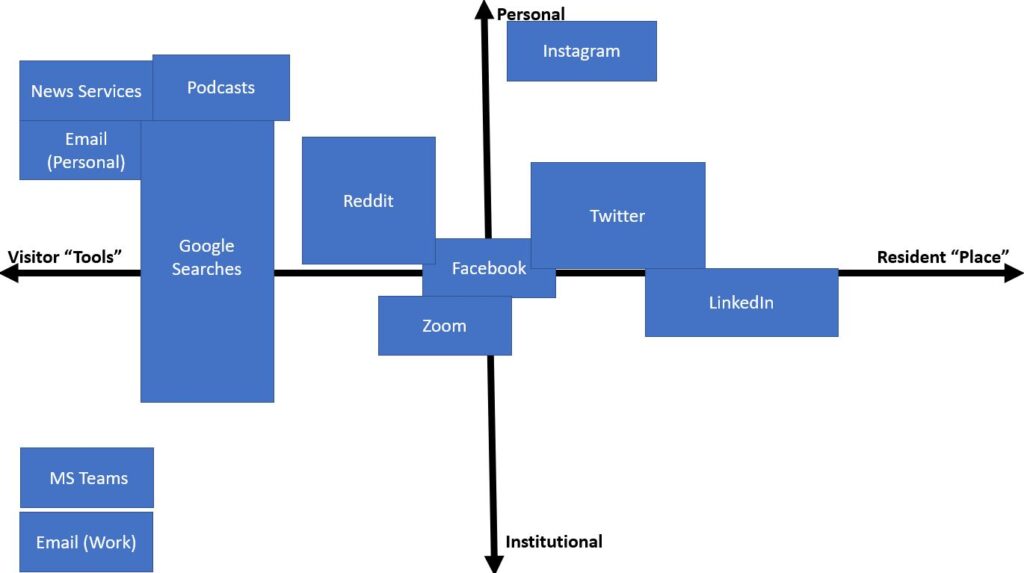
For this exercise, I mapped my technology use based on the resident-visitor typology. White and LeCornu (2011) describe how individuals engage with the internet based on the “visitor and resident continuum.” They state that “visitors” use the internet as a “tool” to achieve a specific task, and “residents” view the internet as a “place and space” where users “feel a sense of being present with others.” Personally, I use the internet more as a “visitor” because I usually use it for a specific purpose, i.e., instant messaging, viewing news sources, looking up information, and checking emails. I rarely post on social media sites, and all of my profiles are private, with LinkedIn being the exception. Before this exercise, I thought I kept my personal and professional internet use separate. After further reflection, I now believe that my web usage is very intertwined. I often interact with colleagues and former students via my personal profiles and use work tools such as Zoom to connect with friends and family. Near the end of the course, I would like to remap my technology use as I believe this course will impact my use and perception of the internet.
References:
White, D. S., & LeCornu, A. (2011). Visitors and residents: A new typology for online engagement. First Monday, 16(9). https://firstmonday.org/article/view/3171/3049
April 18, 2022 at 5:15 pm
Your map looks great Tim! How much would you say your map has changed over the last five years? In which quadrant do you see these changes the most?
April 20, 2022 at 7:40 am
Thanks! Over the past few years I would say in the “institutional” “visitor” has changed the most with technologies being added. Being in the trades the only software I really used was for programming and email. Since I started teaching the zoom and MS teams has become a big part of my professional life. Thank you for the question!
April 20, 2022 at 4:33 pm
Hi Tim,
Thanks for the example.
And thank you for sharing what your notions were before the exercise, and how those changed once you plotted them on your map. It will be interesting as you say, to see where your current situation resides at the end of the course. Perhaps changes will occur because of necessity, enlightenment, or a combination of the two?
April 21, 2022 at 2:23 pm
Thanks for sharing your map Tim! I’m just curious how do you feel about your internet use being very intertwined between professional and personal after your reflection? Were you surprised by that and did you wish it was more separate?
April 26, 2022 at 10:07 pm
This is a great example of what we “think” we use the internet and it’s tools for and what shows up doing this exercise. Some of the work related tools like zoom have been great with keeping up with family and friends, but it is a main tool used in the workplace as well. I like your idea of redoing your map again at a later time to see how it has changed. What do you think you will be adding to your map during the course of the MALAT program?
April 29, 2022 at 11:03 am
This idea of the intertwined or interconnected nature of our personal and professional technology use has shown up in several of the blog posts thus far. My initial thought is that this indicates both how useful simplified typologies and tension pairs are as tools to enable analysis, but also how that simplification will always mean they fall short of a full description of a complex reality.
There is a famous aphorism in research that states something like, “all models are wrong, but some are useful.” It is usually attributed to a statistician named George Box, but others have made similar statements (“All Models Are Wrong,” 2022).
I often keep this idea in mind when considering what a model might be able to tell us and what complexity might be obscured by its assumptions or limited fidelity.
All models are wrong. (2022). In Wikipedia. https://en.wikipedia.org/w/index.php?title=All_models_are_wrong&oldid=1084769927