
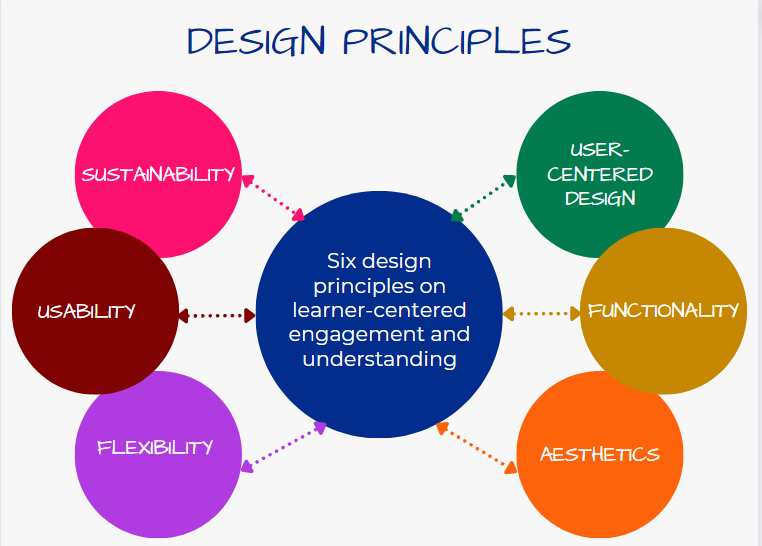
User-centered design: In a hybrid model environment, users need to put in a lot of effort to comprehend the needs, preferences, and barriers to design solutions. Therefore, an effective user-centered design should be created to ensure usability and flexibility. According to Altay (2013), the design improves a broader range of diverse users’ ability to use and accept tools, increasing productivity and reducing errors. This requires having a thorough understanding of the learners’ goals, objectives, skill levels, and potential learning challenges. Additionally, we must collaborate and communicate with the learners to understand their requirements and preferences, putting them at the center of the design process.
Functionality: The learning experience should be functional and efficient, serving the purpose for which it was designed. Chakrabarti and Blessing (1996) said that knowing how something works is essential for a wide range of design tasks, such as comparing, evaluating, and choosing between design options. Therefore, learning content should be organized and presented logically and efficiently, with delivery methods alterable to learner needs.
Aesthetics: The design must be appealing to the eye and consistent with the company’s image. Additionally, this implies that the layout, typography, and visual components of the learning experience should be appealing to learners. According to Parrish (2007), aesthetic principles offer more than just compatibility with preexisting theory; they also support and complement it by showing how to apply it to engaging learning experiences. With the right aesthetic, the overall effectiveness of learners is improved as the learning experience is more memorable and engaging.
Flexibility: The design should be adaptable to changing needs and technology, meaning that the learning experience should evolve as learners’ needs change or new technology becomes available. Moreover, it allows the learning experience to stay current and relevant, which is essential in keeping the learners engaged and motivated. Kokoc (2019) noted that flexible learners tend to be more engaged.
Usability: It is essential to have a system that is easy to use and quick to learn so that users can apply it regardless of their level of experience or technical knowledge. A helpful learning tool should be simple to comprehend, navigate, and use, effectively assisting learners in meeting their learning objectives. Lynch (2019) claimed that usability is the most crucial component of any digital solution regardless of the product, but this is particularly true for digital learning. Additionally, no matter how many resources the system offers, if learners cannot use them easily, it will not matter how many there are.
Sustainability: Sustainability is a crucial principle when creating and delivering learning programs in a corporate setting. As Niederhauser et al. (2018) noted, sustainability is defined as continuous change. This principle emphasizes the value of developing learning opportunities that support organizations and their stakeholders long-term. By prioritizing sustainability, organizations can provide their employees with the knowledge and skills to meet our ever-changing world’s social, environmental, and economic challenges.
References:
Altay, B. (2013). User-centered design through learner-centered instruction. Teaching in Higher Education, 19(2), 138–155. https://doi.org/10.1080/13562517.2013.827646
Chakrabarti, A., & Blessing, L. (1996). Special Issue: Representing functionality in design. Artificial Intelligence for Engineering Design, Analysis and Manufacturing, 10(4), 251–253. https://doi.org/10.1017/s0890060400001608
Kokoç, M. (2019). Flexibility in e-Learning: Modelling its Relation to Behavioural Engagement and Academic Performance. Themes in ELearning, 12. https://files.eric.ed.gov/fulltext/EJ1251161.pdf
Lynch, M. (2019, March 1). Digital Learning and the Importance of Usability. The Tech Edvocate. https://www.thetechedvocate.org/digital-learning-and-the-importance-of-usability/
Niederhauser, D. S., Howard, S. K., Voogt, J., Agyei, D. D., Laferriere, T., Tondeur, J., & Cox, M. J. (2018). Sustainability and Scalability in Educational Technology Initiatives: Research-Informed Practice. Technology, Knowledge and Learning, 23(3), 507–523. https://doi.org/10.1007/s10758-018-9382-z
Parrish, P. E. (2007). Aesthetic principles for instructional design. Educational Technology Research and Development, 57(4), 511–528. https://doi.org/10.1007/s11423-007-9060-7