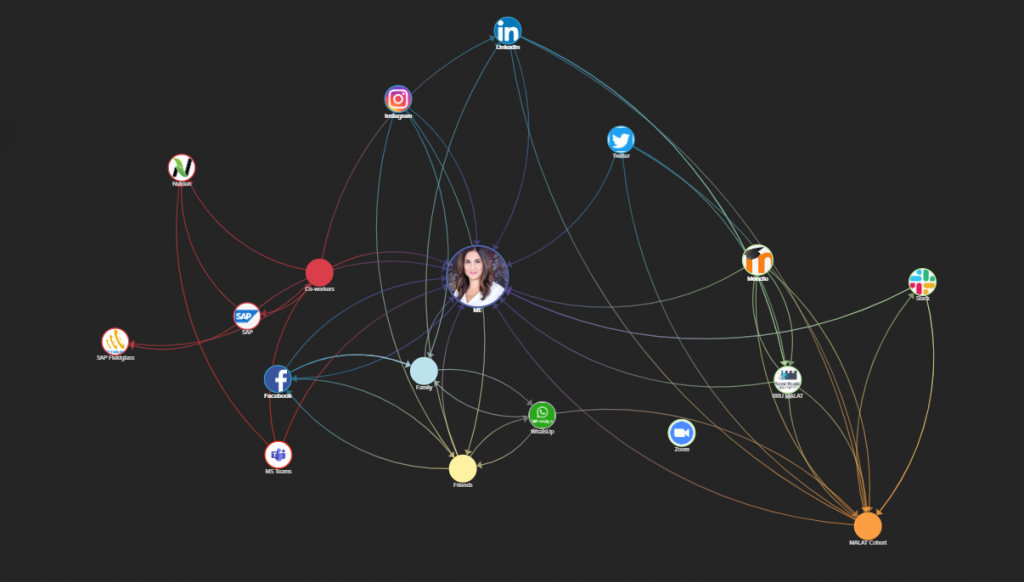
As part of the Unit two activity, we were tasked to read and analyze different videos, articles and blog posts to create a plan to support our digital identity and digital presence. I thought my digital presence and identity were sufficient; boy, was I wrong. Knowing how to turn a computer on, search the web, access social media, and type an email is not having a digital presence or identity. I now understand there is a lot more to that.
After watching David White’s (2013) video when he spoke about “visitor” and “resident,” and after creating “my technology map,” I realized that I am more of a “visitor” than a “resident.” I believe this is due to different reasons. I like to keep my personal life private on social media, but the biggest reason is my insecurities being vulnerable and open and worried that I will get judged. For instance, Kelly Schryver (2013) challenged us to ask ourselves who we “really” are online and, if we are not ourselves, why? This made me think about why I am so afraid to be myself online and create a digital identity and presence both in my personal and professional life. Therefore, one of my goals is to become more of a “resident” during my MALAT program. I want to grow, contribute, and collaborate openly with my cohort and colleagues. White and LeCornu (2011) stated, “Individuals move around the box, sometimes functioning more as Visitors, sometimes more as Residents, according to their motivation.” I want this program to give me the “motivation” to become more of a “resident” because I want to grow my digital identity and presence, especially with my learning community.
In my professional life, my role is to learn new tools, implement them and then teach them to the end-users. Our company consists of over 26 000 employees worldwide, not including all the contractors. As you can imagine, every department and business unit has its own way of what implantation should look like and what process, procedures, design, and learning tools should be incorporated. Therefore, my second goal and hope in this program are to gain skills to help me design and create a better process for implementing new tools and a better pedagogy that engages participants efficiently. Helen Beetham (2015) shared six elements of digital capabilities, although most of them resonated with me; the two that stood out the most as part of my second goal are “Digital creation, innovation and scholarship” and “Digital communication, collaboration and participation.” These two stood out because it talks about everything I need to focus on in order to achieve my goal.
As I am thinking about some of my goals, it proves that I have a lot more to learn and work towards. I am looking forward to gaining more knowledge and confidence in achieving my goals through this program. In addition, it excites me to build my digital identity and presence with my cohort over the next couple of years.
References:
Beetham, H. (2015, Nov 10). Building capability for new digital leadership, pedagogy and efficiency. Jisc Building Digital Capability Blog https://repository.jisc.ac.uk/6236/1/Digital_capabilities_learner_profile.pdf
Schryver, K. (2013, February 5). Who are you online? Considering issues of web identity. The Learning Network. https://learning.blogs.nytimes.com/2013/02/05/guest-post-who-are-you-online-considering-issues-of-web-identity/
White, D. (2013). Just the Mapping [Video]. YouTube. https://youtu.be/MSK1Iw1XtwQ
White, D. S., & LeCornu, A. (2011). Visitors and residents: A new typology for online engagement. First Monday, 16(9). https://firstmonday.org/article/view/3171/3049