Activity 2 | Disseminating Research

As I embark on the journey of disseminating my research findings about the effectiveness of microlearning in enhancing employee engagement within a hybrid work environment, I’m confronted with the challenge of not only conducting valuable research but also ensuring that it has a meaningful impact within my workplace. This is a crucial aspect of my Applied Research Project (ARP) that I’m eager to tackle.

One of the primary ways I intend to share my research is through a workshop presentation. I envision a friendly and interactive session where I can present my findings to my colleagues. This informal setting is conducive to fostering comfortable and engaging discussions. It provides a platform for us to delve into the nuances of microlearning’s role in our workplace context. I believe that such a collaborative approach will not only help me disseminate my research effectively but also encourage my colleagues to engage with and apply the insights from my study actively.

Additionally, I see immense potential in integrating my research outcomes into our organization’s training and development programs. Collaboration with our training department would enable me to seamlessly embed the knowledge gained from my research into our existing training curriculum. This ensures that the insights are disseminated in a structured and actionable manner. By directly incorporating my findings into training programs, I aim to facilitate the practical implementation of microlearning strategies within our workplace. This approach aligns with my goal of not only generating knowledge but also translating it into tangible improvements that benefit both our organization and its employees.

To sum up, I have decided to use two dissemination strategies – workshop presentations and integration into training programs – to share my research within my workplace. These strategies offer the chance to reach a wider audience and, more importantly, enable the practical application of microlearning techniques to improve employee engagement in the dynamic environment of hybrid work.

Reflection On My Digital Identity and Digital Presence Plan

As part of my digital identity and digital presence (DIDP), my focus is to be more of a resident in the digital world and come up with ways where I could get the end-user engaged to participate in the learnings. Dron and Anderson (2014) stated it is “important for any software and surrounding systems designed to support networks to pay close attention to making participation….as easy and painless as possible” (p. 163). That statement has resonated with me as my overall goal is to create systems, groups, and communities where we all participate in achieving the end goal of improving our end-user ability to learn any system concisely and meaningfully.

Throughout the reading, I have learned that we need to focus on different ways to enhance learning, whether personal or work-related. For example, Daniel (1996) claimed that even though it is essential to have a “teacher presence,” it is also vital for us to note that not everyone can participate in the “traditional forms of campus-based education” (p. 18). Therefore, we need to alter online learning to be as effective as in-person education. This is true not only for academic learning platforms but also for corporate learning platforms.


Dron, J., & Anderson, T. (2014). Teaching Crowds. Athabasca University Press. https://read.aupress.ca/read/teaching-crowds/section/d826240c-e4fd-4e4b-bfee-f2cd54259850

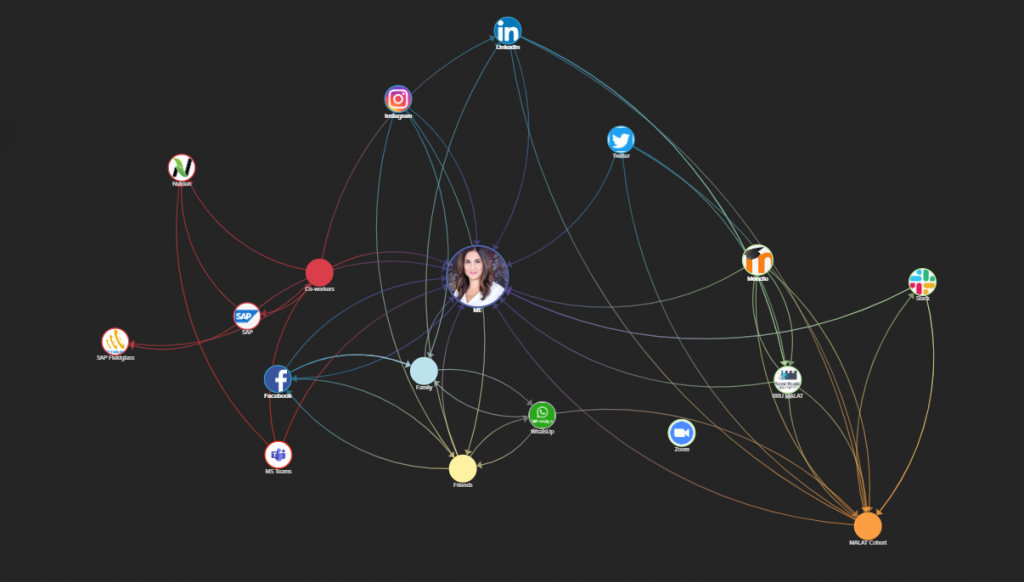
My Visual Network Mapping

Link to my Visual Network Mapping
https://kumu.io/gerovm/my-visual-network-mapping#michal/friends

As part of my LRNT 521 class, we have been asked to construct a visual network map to see where and how we are positioned. I thought this activity was interesting, as I added the different networks and people that I am a part of. In this, I could see how we are all somehow interconnected through the various networks.

As I was doing my network mapping, I noticed that I am not part of a community per se but more groups of people (family members, friends, co-workers, and my MALAT cohort), which led me to reflect on the why, and how can I get more involved? What I realized is that when my kids were younger, I felt more a part of a community, and now, as they are older and I am busy with work, I feel as though I have let that part of my life go.

I am a visual learner, so seeing all the different networks and groups connected painted a beautiful picture that gave me a complete understanding of how we are all somehow interconnected. Whether through our work life, school life, or personal life, we are somehow all connected.

WELCOME!!

Welcome to my personal blog where I will be sharing my Royal Roads University MALAT experience.

My Virtual Symposium Reflection

I experienced all the emotions, stress, excitement, and nervousness this last week. As part of my LRNT521 course requirements, I have attended the MALAT 2022 Virtual Symposium and watched various recorded presentations from previous years. It enriched my knowledge on multiple different topics. In addition, listening to so many diverse speakers with different backgrounds and knowledge bases made it enriching. I will highlight the two stories that stood out to me in this post.

The first is the PowerPoint Improv with Dr. Elizabeth Childs and Dr. George Veletsianos. I was amazed to see how the two of them could take simple pictures like the ones of a tree, pasta, and chameleons and translate the pictures into the work they have been doing in higher education and the digital learning sector. One of the pictures they shared was the tree on the mountain; this symbolized the notion of hope. Dr. George Veletsianos spoke about the notation of hope and what might come post-pandemic relating to education and technology. Next, he stated, we need to create “technology that helps people be better together,” which resonated with me as this is one of the biggest struggles I am dealing with in my current role in my profession.

As a working professional in a corporate setting, having a successful team was one of the most challenging issues we faced; I immensely enjoyed Julia Suzcus presentation on “Successful Teaming,” especially as it related to working with a team online. Working in a team, primarily online and not in-person, cause another layer of complexity than it would have working face to face. Julia has shared many ways to work together as an academic team which is different from working in a work-related team. This includes collaboration, different levels of listening skills, decision making, giving and receiving feedback, facilitating, and team agreements. Although most of us have previously worked or are currently working in a team environment, we need to remember an academic team is different from a work team. Yes, they have many commonalities, but the vital part for me is understanding the difference between a working team and an academic team.

These two presentations are the ones that stood out to me. Therefore, I wanted to share them as I gained much insight and learning that I will use moving forward in my day-to-day life at work and school.


References:

Childs, E., & Veletsianos, G. (2021, April 15). PowerPoint improv [Video]. Blackboard Collaborate. https://ca.bbcollab.com/collab/ui/session/playback/load/c5e490c22efb40a5aeacf457516237a1

Royal Roads University. (2022, April 13). Successful Teaming [Video]Zoom