First Impressions
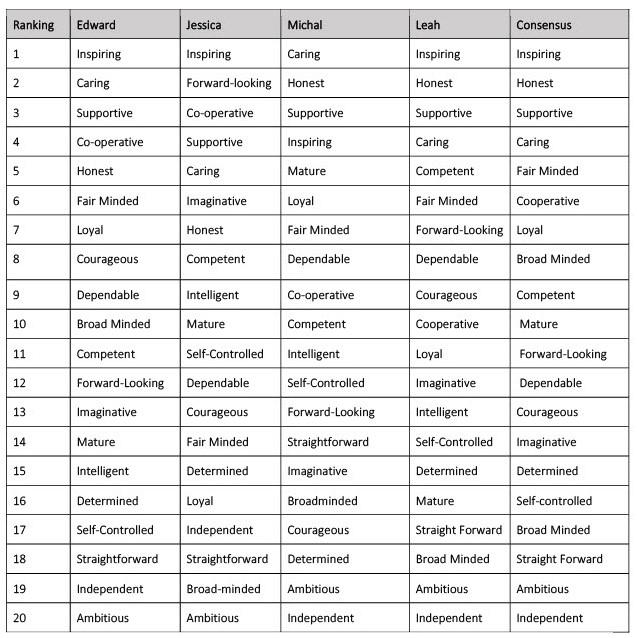
This week in LNRT 525 – Leading Change in Digital Learning, I reflected on my perceptions of leadership, the course readings, and my experience collaborating with class colleagues Michal Gerov, Leah Yardley, and Edward Logan to rank the top twenty attributes of leaders. At first, I described the most significant attributes of a leader as competent, honest and fair minded. My thinking was that a leader must be knowledgeable, efficient, and capable to lead initiatives successfully (Cambridge Dictionary, n.d.). Following, I think honesty and fairness are foundational to trusting relationships, and people need to trust leaders. After reading, I considered how competence, honesty and fair-minded describe good leaders, as well as managers and colleagues. I questioned the essential characteristics of a leader, that is what makes leaders unique from managers, colleagues, and others within an organization?
After Reading
After reading, I shifted my top three leadership attributes to inspiring, forward-looking, and co-operative because several course readings highlighted these critical leadership attributes. Workman and Cleveland-Innes (2012) discussed differences between leading and managing. Importantly, leaders create conditions for innovative change by communicating a vision in ways that influence, excite and motivate; whereas managers establish strategies to shape behaviors and implement changes (Workman & Cleveland-Innes, 2012). Hence, inspiring is an essential leadership characteristic. Next, I suggested forward-looking as a top leadership attribute based on adaptive leadership theory. Khan (2017) suggested that adaptive leadership is flexible and orientated towards change by considering current needs rather than the past. Also, Workman and Cleveland-Innes (2012) described the importance of a vision for change with new and interesting ideas to shift perspectives to look forward. Additionally, adaptive leadership helps organizations handle complex situations by encouraging collective learning and collaboration (Khan, 2017). Therefore, I added co-operative because it is about working with others to achieve a vision. Next, I met with my class colleagues Michal Gerov, Leah Yardley, and Edward Logan to come to a consensus on the top twenty attributes of leaders.
Team Perspectives
I realized other perspectives on leadership through our team discussion to rank attributes of leaders. Our team ranking placed inspiring, honest and supportive as the most important characteristics of leadership. As previously described, inspiring and honest were attributes I consider important, with supportive and caring ranked fourth and fifth. Our team’s top five were similar. However our discussion highlighted other experiences and readings. Huggins (2017) questioned the primary characteristics of leadership and suggested that an aspect of building leadership is having a tolerance for risk, which we collectively interpreted as courageous. Our team discussion helped me to see the importance of understanding that developing leadership capacity is a process with opportunities to learn from mistakes. Also, our team discussed the reading by Julien et al. (2010) about aboriginal leadership. Overall, Julien et al. (2010) suggested that aboriginal perspectives include leadership as a spiritual endeavour that is holistic and equalitarian — the emphasis of leadership is on collective values. As well, aboriginal leaders appreciate and recognise employees as whole people (Julien et al., 2010). After the team discussion, I suggest reflective (to learn from mistakes), holistic and appreciative as additional essential qualities of leadership. Lastly, I reviewed the research that informed the team activity, the characteristics of admired leaders In Credibility : How leaders gain and lose it, why people demand it. Our team ranking had similarities, both suggested honest and inspiring as the top characteristics of admired leaders (Kouzes & Posner, 2014).
What have I learned and how can I use this learning in the future?
In my context to implement teaching and learning technology in higher education I need to pay particular attention to building leadership capacity in myself and others. As Huggins (2017) suggested, taking risks and learning from mistakes is important in the process of change. I see teachers that are hesitant to adopt technology. Mendoza (2022) suggested that the fear of change comes from concern that technology will replace teachers, teachers lack training and doubt the effectiveness of educational technologies. I can use adaptive leadership theory to address the current needs of teachers, to confront fears and with inspiration and honesty. In sum, reflective practice and a supportive culture will help to build a collective vision for digital pedagogy (Sheninger, 2022).
References
Cambridge Dictionary. (n.d.). Competence. https://dictionary.cambridge.org/dictionary/english/competence
Huggins, K. S. (2017). Developing leadership capacity in others: An examination of high school principals’ personal capacities for fostering leadership. International Journal of Education Policy and Leadership, 12(1), 1–15. https://doi.org/10.22230/ijepl.2017v12n1a670
Khan, N. (2017). Adaptive or transactional leadership in current higher education: A brief comparison. International Review of Research in Open and Distance Learning, 18(3), 178–183. https://doi.org/10.19173/irrodl.v18i3.3294
Kouzes, J. M., & Posner, B. Z. (2014). Credibility: How leaders gain and lose it why people demand it. Credibility: How Leaders Gain and Lose It, Why People Demand It, c, 1–250. https://doi.org/10.1002/9781118983867
Mendoza, A. (2022, March 25). 5 reasons why teachers are hesitant to adopt technology in the classroom. https://medium.com/teachers-on-fire/reasons-teachers-are-hesitant-to-adopt-technology-in-the-classroom-5ef9d48ed144#:~:text=Teachers%20worry%20that%20incorporating%20technology,needed%20to%20make%20these%20changes
Sheninger, E. (2023, January 23). 7 pillars of Digital leadership. Houghton Mifflin Harcourt. https://www.hmhco.com/blog/pillars-of-digital-leadership-in-education#:~:text=Digital%20leadership%20can%20thus%20be,school%20success%20in%20the%20future
Workman, T., & Cleveland-Innes, M. (2012). Leadership, personal transformation, and management. International Review of Research in Open and Distance Learning, 13(4), 313–323. https://doi.org/10.19173/irrodl.v13i4.1383