Speculative Futures Essay

What will Technical and Vocational Education and Training Look Like in 2030?
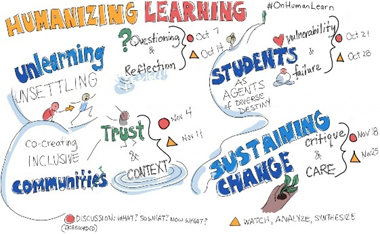
A visualization of the Humanizing Learning co-design schedule from Fall 2021. Drawing by Giulia Forsythe. CC0.

For most trades in Canada, training providers strain to keep up with the demand for tradespeople with adaptive skills, including digital, social, and emotional skills, for future work (Bieler, 2020; Kanwar et al., 2019; Vogt, 2014). Tradespeople typically receive their training in the form of apprenticeships that consist of on-the-job learning and in-person training at a college (Bieler, 2020; Vogt, 2014). The COVID-19 pandemic brought about alternative delivery models and practices for manytechnical and vocational education and training (TVET) institutions because face-to-face instructional time was limited (Vinden et al., 2021). Education collectively continues to cope with and recover from the COVID-19 pandemic. However, the pandemic has also heightened interest in blended delivery for accessible and flexible training (Contact North, 2019; Educause, 2021). Blended learning integrates face-to-face classes with online instruction using various educational technologies, such as e-learning and mobile learning to enrich the learning experience (Vogt, 2014; Dziuban et al., 2018; Herman et al., 2019). Looking ahead, this essay addresses what TVET might look like in 2030, with an emphasis on the role of the educator in educational transformation. Research is inevitably part of making speculations about the future more or less likely (Macgilchrist et al., 2020). Thus, this speculative essay takes an optimistic view and aims to contribute to a more humanized future with blended pedagogies and education modes for TVET education.

By 2030, a possible future is that blended learning modes will be conventional for TVET education. Before the 2020 COVID-19 disruption in education, online and blended pedagogy was well-established in academic higher education programs, with some claiming that blended learning is the new normal (Dziuban et al., 2018; Herman, 2018). However, TVET programs lagged in adopting blended learning (Burke & Larmar, 2020.; Vinden et al., 2021). Pre-2020, there were several pilot programs in TVET across Canada (Vogt, 2014; Kanwar et al., 2019; Contact North, 2019). In the pilot blended programs, different design models were used, and the mix of face-to-face varied depending on the context, with each approach suiting unique student groups and content (Vogt, 2014; Kanwar et al., 2019; Contact North, 2019). Kanwar et al. (2019) found that blended delivery for TVET programs provided many benefits for learners, such as flexibility that serve more diverse groups of learners, opportunities for lifelong learning, technology-enhanced community-based learning, and training access for students living in remote communities. Nevertheless, the pilot programs and the COVID-19 emergency education experiences exposed that TVET educators and students need improved digital skills to adapt to the future of blended education (Vogt, 2014; Kanwar et al., 2019; Vinden et al., 2021).

For blended programs to be effective, instructors need advanced educational technology training. TVET teaching practices need to engage in digital pedagogies, and faculty must be willing to incorporate technology into their teaching and learning practice (Vogt, 2014; Kanwar et al., 2019; Vinden et al., 2021). According to Vinden et al. (2021), COVID-19 brought about the more widespread use of digital tools such as learning management systems, video conferencing, demonstration videos, and simulations (virtual reality) during remote emergency online and blended delivery of TVET programs. I believe that the COVID-19 educational experiences will be a catalyst to expand digital literacy crucial to the future of work and education. Educators must also become fluent in pedagogy and understand the role of technology in education (Educause, 2020; Beile, 2020). Garrison and Vaughan (2008) proposed that blended learning must advance by understanding the challenges associated with shifting teaching and learning paradigms. For example, an educator’s role shifts from lecturer and instructor to facilitator and designer because blended learning emphasises student involvement online and in-class (Kanwar et al., 2019; Contact North, 2019).

For student success in the future, TVET educators must be skilled facilitators to encourage interaction and foster an affective learning environment (Herman, 2018; Palahicky et al., 2019). Burke and Larmar (2020) reported growing evidence that online learning may negatively impact a student’s feeling of connection, leading to isolation, disempowerment, and reduced student outcomes. Palahicky et al. (2019) suggested that instructor care increases student success and engagement. Caring has always been part of good teaching, and the COVID pandemic heightened how vital supportive personal interactions are to students’ well-being and learning (Burke & Lamar, 2020; Hoover et al., 2022). Therefore, I hope that future TVET education is grounded in humanizing pedagogies. My interpretation of the meaning of humanized education is inspired by “Learning to be Human Together” by Green et al. (2022). Green et al. (2022) acknowledged that relationships, inclusivity, connectivity, and pedagogy of care are fundamental to education. In “Reimagining the Student Experience; How colleges can help students connect, belong and engage”, Chronicle writers suggested that students’ apparent desire to connect is a guide to reshape future education to make students’ experience more engaging, worthwhile and successful (Hoover et al., 2022). Thus, pedagogical values, including care, diversity, community and justice, are critical to student success. The future of blended TVET education will follow the trend towards more supportive and connected relationships in education (Palahicky et al., 2019; Hoover, 2022).

In summary, my opinion that blended learning will be commonplace for TVET education by 2030 aligns with education trends. Higher educators will interact with learners in non-traditional ways (Educause, 2021; Hoover et al., 2022). The optimistic future is that education will be more humanized to engage learners actively and make education more flexible, accessible and inclusive (Educause, 2021; Hoover et al., 2022). A common theme in speculations about the future of TVET education is that developing students’ and educators’ digital and social skills is imperative. Pilot blended delivery programs and the COVID-19 emergency education experience provide a foundation to expand blended pedagogies. To enhance TVET teaching practices, faculty must be supported to incorporate technology into their practice, and educators need advanced educational technology training (Vogt, 2014; Kanwar et al., 2019; Vinden et al., 2021). I speculate that by 2030, online learning will have enhanced digital literacy so that tradespeople can continue to learn throughout their careers. Digital and humanized pedagogies will also help build digital and social skills to adapt to future workplaces. Finally, for blended programs to be widespread and effective by 2030, TVET education must continue questioning how to engage students and explore different models and designs for optimal learning experiences (Vogt, 2014; Contact North, 2019).

References

Beile, A. (2020). Bridging generational divides: Advancing Digital Skills in Canada’s apprenticeships and skilled trades ecosystem. The Conference Board of Canada. https://fsc-ccf.ca/research/bridging-generational-divides/

Burke, K., & Larmar, S. (2020). Acknowledging another face in the virtual crowd: Reimagining the online experience in higher education through an online pedagogy of care. Journal of Further and Higher Education, 45(5), 601–615. https://doi.org/10.1080/0309877x.2020.1804536

Contact North. (2019). 220 Pockets of innovation in online learning. Government of Ontario. https://teachonline.ca/sites/default/files/pdfs/contact_north_i_contact_nord_220_pockets_of_innovation_in_online_learning_-_2019_0.pdf

Dziuban, C., Graham, C. R., Moskal, P. D., Norberg, A., & Sicilia, N. (2018). Blended learning: the new normal and emerging technologies. International Journal of Educational Technology in Higher Education, 15(1). https://doi.org/10.1186/s41239-017-0087-5

Educause. (2020, March 2). .2020 Educause Horizon Report: Teaching and learning edition. https://library.educause.edu/resources/2020/3/2020-educause-horizon-report-teaching-and-learning-edition

Educause. (2021, April 26). 2021 Educause Horizon Report: Teaching and learning edition. https://library.educause.edu/resources/2021/4/2021-educause-horizon-report-teaching-and-learning-edition

Garrison, D. R., & Vaughan, N. D. (2008). Blended learning in higher education: Framework, principles, and guidelines – 1st. Ed. Jossey-Bass.

Greene, T., Maher, P., Baker, N., Mommertz, K., Treviranus, J., Jahnke, J. C., Mitchell, J., Hilditch, J., Carroll, H., Bhavsar, H., Forsythe, G., Rawle, F., Cormier, D., Stewart, B., & Co-designed by Students, F., and S. at O. C. A. D. U. (2022, February 28). Learning to be human together. Learning to be Human Together. https://ecampusontario.pressbooks.pub/onhumanlearn/

Hoover, E., Lu, A., Supiano, B., Mangan, K., Swaak, T., Adedoyin, O., Bellows, K., Fischer, K., & Kafka, A. (2022). Reimagining the student experience: How colleges can help students connect, belong, and engage. The Chronicle of Higher Education.

Kanwar, A., Balasubramanian, K., & Carr, A. (2019). Changing the TVET paradigm: New models for lifelong learning. International Journal of Training Research, 17(sup1), 54–68. https://doi.org/10.1080/14480220.2019.1629722

Macgilchrist, F., Allert, H., & Bruch, A. (2020). Students and society in the 2020s. Three future ‘histories’ of education and technology. Learning, Media and Technology, 45(1), 76–89. https://doi.org/10.1080/17439884.2019.1656235

Vinden, S., Flinn, C., & Carson, T. (2021, May 17). Strengthening Digital Teaching & Learning for trades, vocational, education and training practitioners. BCcampus. https://bccampus.ca/2021/05/12/strengthening-digital-teaching-learning-for-trades-vocational-education-and-training-practitioners/

Vogt, R. (2014). Experiences with blended learning program delivery for apprenticeship trades: A case study. International Journal of Higher Education, 3(4). https://doi.org/10.5430/ijhe.v3n4p85

Exploring possible futures: What might technical and vocational education be like in 2030?

Pixabay License. Free for commercial use
No attribution required

Macgilchrist et al. (2020) put forward scenarios for future education to promote inquiry. Research is inevitably part of making speculations about the future more or less likely (Macgilchrist et al., 2020). Thus, I will write a speculative essay to contribute to a more humanized future in technical and vocational education and training (TVET).

Mainly, I will explore new pedagogical blends for more humanized and relational forms of learning (Educause, 2021) for TVET education. The 2020 and 2021 Educause Horizon Reports show the need to focus on flexibility and social dimensions to support students, faculty, and staff health (Educause, 2021). The COVID-19 pandemic exacerbated mental health issues (Educause, 2021). The COVID-19 pandemic also exposed the need for TVET to modernize teaching practices (Vinden et al., 2021).

Transforming TVET teaching practices is needed to engage in digital pedagogies. For example, low digital fluency skills added stress when adapting to digital environments during COVID-19 (Vinden et al., 2021). According to Vinden et al. (2021), COVID-19 brought about innovation, mainly with the use of new digital tools. Macgilchrist et al. (2020) compared current debates about education to those of the 1920s when film was introduced as an educational tool. However, the new device did not transform education (Macgilchrist et al., 2020). My speculative essay will consider how pedagogical blends, including a pedagogy of care, may build on COVID-19 innovations to transform TVET education.

References

2020 Educause Horizon Report: Teaching and learning edition. EDUCAUSE. (2020, March 2). https://library.educause.edu/resources/2020/3/2020-educause-horizon-report-teaching-and-learning-edition

2021 Educause Horizon Report: Teaching and learning edition. EDUCAUSE. (2021, April 26). https://library.educause.edu/resources/2021/4/2021-educause-horizon-report-teaching-and-learning-edition

Macgilchrist, F., Allert, H., & Bruch, A. (2019). Students and society in the 2020s. Three future ‘histories’ of education and technology. Learning, Media and Technology, 45(1), 76–89. https://doi.org/10.1080/17439884.2019.1656235

Vinden, S., Flinn, C., & Carson, T. (2021, May 17). Strengthening Digital Teaching & Learning for trades, vocational, education and training practitioners. BCcampus. https://bccampus.ca/2021/05/12/strengthening-digital-teaching-learning-for-trades-vocational-education-and-training-practitioners/

Media Debate

Image by Shazia Khokhar

The Magic and Potential of Technology by Shazia Khokhar and Jessica Gemella

Do media influence learning? Clark and Kozma debated this question in 1994 publications. To start, in “Media will never influence learning”, Clark claimed that media do not influence learning under any condition (1994). Clark (1994) contended that media has no learning benefit, and that media only provides efficiency and economic benefits. However, in “Will media influence learning: Reframing the debate”, Kozma (1994) argued that social context will help instructional designers take advantage of media capabilities, instructional methods, and cognitive processes to benefit learning. This debate about media and learning provides relevant perspectives to critique current mass media, press releases and software promotion. For example, Wade (n.d.) of Georgetown University stated that social media enhances learning in “How Social Media is Reshaping Today’s Education System”.

Wade (n.d.) in “How Social Media is Reshaping Today’s Education System” proposed that social media is changing education because media enriches learning for several reasons. First, social media is empowering for students and teachers to share and interact (Wade, n.d.). Second, social media is practical and accessible because students are already immersed in its use, it is part of our lives (Wade, n.d.). Third, social media is fast-paced to match the speed of student lives (Wade, n.d.). Lastly, social media promotes teacher-student relationships (Wade, n.d.). In our opinion, Clark’s response to Wade’s assertions would be to argue that the learning benefits of social media could be achieved by other means. For instance, students and teachers could be empowered to share and interact with print media. Writing is also practical and accessible. Students and teachers could write each other letters to improve relationships. As Clark (1994) contended, media benefits efficiency. Thus, social media is faster than letter writing but does not necessarily improve learning. In contrast, we believe that Kozma’s opinion would differ because of the social context media can provide.

Kozma (1994) considered the conditions under which media will influence learning. Kozma (1994) also suggested that instructional design would be influenced by the goals, beliefs, and knowledge of the users. Thus, it is our view that Kozma would support the suggestion that social media has the potential to enhance learning because the media provides the means for users to express themselves and socially construct knowledge. However, Kozma would draw attention to the importance of instructional methods and the complexity of the learning environment in evaluating Wade’s assertion that media enhances learning. Similar to Wade’s representation of Georgetown University’s media-enhanced learning, software companies are also capitalizing on the notion that technology advances teaching and learning.

CanopyLAB is a Danish EdTech software company that has developed an adaptive, social, and intelligent learning experience platform (LXP) based on artificial intelligence (AI) optimized social network structure (CanopyLab, 2022). According to CanopyLab, their remote and blended learning platform functions and feels like a social network site where users can easily communicate, share information, and build a community. 

In their blog post, “5 Ways in which AI is already Shaping the Future of Learning” CanopyLABS (2022) claims, “…we are already two steps ahead, bringing you the future of education today by combining the best aspects of F2F learning with the magic and potential of technology” (para. 12). CanopyLab explains that their platform is centred on social media because they wanted students to interact and learn from one another. In addition, their technology harnessed the power of artificial intelligence (AI) to develop the first AI Course Authoring Tool, which enables course developers to create individualized learning experiences (CanopyLab, 2022).

Clark would argue that combining the best aspects of face-to-face (F2F) learning with the potential of new media technology would have no impact on student learning, based on his initial claim that media are “mere vehicles that deliver instruction” and that the new artificial intelligence-based learning platform is simply a different “vehicle.” Clark (1994) also states, “we must always choose the less expensive way” (p. 22); if cheaper media can achieve the same goals, we must choose it. Clark would concur that there is evidence that diverse media qualities achieve the same educational objective. Therefore, he would argue that the instructional approach, not the medium, that determines learning. Thus, his view would be that this new technology would not directly result in improved learning for students.

In contrast, Kozma (1994) argued that the use of various new media technologies, each of which possesses its own unique capabilities, has the potential to enhance the learning experience by complementing the learners’ abilities. Kozma (1994) views education as an “active, constructive, cognitive and social process”. Therefore, Kozma would agree that CanopyLABS’ adaptive learning platform provides for interaction and connection where students can learn from one another, with the potential to enhance learning for certain types of learners. This technology could allow for more customized and personalized instruction based on the needs of individual learners.

Does technology have the magic to transform education systems and learning interactions to benefit learning? Clark has us consider that efficiency and cost-effective instructional delivery methods are not a formula that results in learning (1994). While Kozma highlights the complexity of instructional design that involves user needs, interactions, media capabilities, cognitive processes, and the intentions of the designer (1994). Clark and Kozma’s 1994 debate provide contrasting perspectives that are still relevant in seeking answers.

References

CanopyLAB. (2022, August 6). 5 Ways in which AI is already Shaping the Future of Learning [web log]. Retrieved September 24, 2022, from https://canopylab.com/5-ways-in-which-ai-is-already-shaping-the-future-of-learning/  

Clark, R. E. (1994). Media will never influence learning. Educational Technology Research and Development, 42(2), 21-29. https://doi.org/10.1007/BF02299088 

Kozma, R. B. (1994). Will media influence learning: Reframing the debate. Educational Technology Research and Development, 42(2), 7-19. https://doi.org/10.1007/BF02299087 

Wade, L. (n.d.). How social media is reshaping today’s education system. Center for Social Impact Communication. Retrieved September 25, 2022, from https://csic.georgetown.edu/magazine/social-media-reshaping-todays-education-system/  

Assignment #1: Introduction to Catherine Cronin

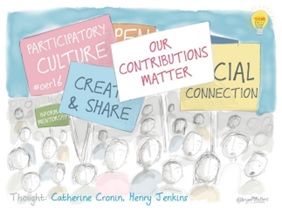
Capturing Catherine’s ideas in her Keynote at OER16 from Bryan Mathers.
Image Credit: CC BY-NC-ND 2.0 Visual Thinker

25 Years of Ed Tech” by Weller (2020) with “Between the Chapters: OER Podcast” (2021) influenced me to consider how educational technology plays a role in justice. Thus, I will share Catherine Cronin’s significant contributions to the field of educational technology. Catherine Cronin is an open educator focusing on social justice approaches (Cronin, 2022). Cronin’s contributions to educational technology include open-access publications such as; Feminisms, technologies and learning: continuities and contestationsFraming open educational practices from a social justice perspective; and Theorizing progress: Women in science, engineering, and technology in higher education. In addition, Catherine Cronin’s website captures an extensive collection of scholarship and creative works.

Cronin’s open-access approach is necessary to the field of education and technology. First, decades of research show inequities in access to technology (Bali et al., 2020). Poor, minority and female students have less access (Bali et al., 2020). In Cronin’s collaborative research, such as Framing open educational practices from a social justice perspective, Cronin applied feminist thinking and challenged assumptions to promote justice through open education practices (Bali et al.,2020). Second, Cronin contributes to conversations about digital literacies (Cronin, 2022). Recently, Cronin was the keynote speaker for the annual AMICAL (an international consortium of universities) conference (Cronin, 2022). The keynote presentation emphasised the need for critical digital and data literacies so that students can develop agency – as learners, creators, and collaborators (Cronin, 2020). Catherine Cronin has made significant contributions to the field of education and technology. 

References

Bali, M., Cronin, C., & Jhangiani, R. S. (2020). Framing open education practice from a social justice perspective. Journal of Interactive Media in Education, 2020(1), 10. http//doi.org/10/5334/jime.565

Cronin, C. (2022). Catherine Cronin: Independent open educator, open researcher. https://catherinecronin.net/   

Cronin, C. (2022). Critical digital literacies: Developing agency and sustaining hope in troubled times [Conference presentation]. AMICAL Consortium. https://www.amicalnet.org/sessions/cronin-keynote  

Pasquini, L. (Host). (2021, January 21). Between the chapters: OER (No. 11) [Audio podcast episode]. In 25 Years of Ed Tech. Transistor. https://25years.opened.ca/2021/01/27/between-the-chapters-oer/

Weller, M. (2020). 25 years of ed tech. Athabasca University Press. https://doi.org/10.15215/aupress/9781771993050.01  

Lessons from Education Technology Histories 2002-2011

Pixabay License. Free for commercial use
No attribution required

This week I continued reading “25 Years of Ed Tech” by Weller (2020). I focused my reading on lessons from educational technology histories from 2002 to 2011. First, the reading influenced me to consider more deeply the potential of connectivism for teaching, learning and research. Connectivism principles accept that knowledge occurs in a diversity of opinions, and learning happens when learners connect to and participate in a learning community (Siemens, 2006). Second, Weller (2020) offered a relevant debate on using videos. In particular, the shift in content delivery as part of a flipped learning concept (learning content outside face-to-face classes). Weller (2020) stated that by 2006 the emergence of the internet shifted the role of internet users from passive to interactive. User-generated approaches in education expanded with blogs, videos, and social media (Weller, 2020). By the late 2000s, connectivism grew as a set of principles for teaching, learning, and research.

I see that connectivism principles have immediate relevance in my work in higher education. For instance, Weller (2020) explained the value of networked identity in achieving scholarly goals and expanding academic communities. As a Curriculum Teaching and Learning Specialist (CTLS), I am working to build research capacity in technical and vocational education and training (TVET). Applied research aims to solve problems by applying new knowledge and technologies to create practical products, services, and processes (Algonquin College of Applied Arts and Technology, n.d.). As expressed by Weller (2020), networked media provides the potential to expand beyond formal university publications with easy-to-read blogs and social media. Accordingly, I see connectivism principles as essential in my work for public engagement and dissemination of research. In addition to blogs and social media, internet capability also connects learning communities with streaming videos to share content (Weller, 2020).

While video provides many benefits for informal learning and sharing, I believe there are conflicts with video use. For example, in my CTLS role to support instructional design, I see many instructors using videos as part of a flipped classroom delivery model. The flipped learning concept means students spend time at home learning concepts before coming together for interactive learning activities (Weller, 2020). There are also conflicts in synchronous video classes because streaming capacity or home/other environments can limit student participation (Pasquini, 2021). Consequently, video use favours students with stable home life (Weller, 2020). In addition, video can also create tensions for educators. According to Weller (2020), educators are not experienced in assessing what makes a good video assignment. Thus, video use as an assessment is used comparatively less than written assignments (Weller, 2020). Lastly, some teachers feel pressured to become broadcasters and performers to make videos with limited support (Pasquini, 2021).

References

Algonquin College of Applied Arts and Technology. (n.d.). Applied research. Office of Applied Research, Innovation & Entrepreneurship. Retrieved September 11, 2022, from https://www.algonquincollege.com/arie/about/applied-research/#:~:text=Applied%20research%20is%20focused%20on,business%2C%20industry%20and%20community%20partners

Pasquini, L. (Host). (2021, January 28). Between the chapters: talking videos (No. 12) [Audio podcast episode]. In 25 Years of Ed Tech. Transistor.  https://25years.opened.ca/2021/01/27/between-the-chapters-video/

Siemens, G. (2006). Connectivism. Learning theory or pastime for the self-amused? http://altamirano.biz/conectivismo.pdf

Weller, M. (2020). 25 Years of Ed Tech. In G. Veletsianos (Ed.), 25 Years of Ed Tech. Athabasca University Press. https://doi.org/10.15215/aupress/9781771993050.01

25 Years of Ed Tech and Beyond

Pixabay License. Free for commercial use. No attribution is required.

In the book “25 Years of Ed Tech”, Weller (2020) provided a compelling argument to dispel the myth that higher education has resisted technological innovation. As described by the author, there is a history of innovation and effective implementation of educational technology (ed tech) in higher education over the past 25 years. The author illuminated one innovation or key technology adopted by higher education per year starting in 1994 and ending in 2018. This week I read the first eight chapters. The writer’s 1994 beginning seemed appropriate as it focuses on the internet as the dominant technology shaping ed tech. I thought two ed tech innovations stood out as significant. First, in 1994 the Bulletin Boards System (BBS) gained popularity by establishing discussion forums as a precursor to social media. Second, in 1998 Wikis exemplified open education. Wikis facilitated collaboration and the construction of knowledge within a respectful space. Thus, becoming a foundation for open education. I now see that the networked participation and openness I aim to enhance in my teaching are based on historical precedent. My response to the 25 Years of Ed Tech retrospective is to wonder and hope for the book’s next edition.

What critical ed tech and pedagogy will be highlighted in the following chapters, from 2019 and beyond? In my opinion, the author’s aim is vital while higher education emerges from the shadow of the COVID-19 pandemic that began in 2020. Open and flexible education methods have drawn interest due to the COVID-19 pandemic (Naidu & Editor, 2022). Flexibility has been an essential and consistent aspect of innovation in education over the past 40 years (Veletsianos & Houlden, 2019). The pandemic crisis also exposed inequities in higher ed (Veletsianos & Houlden, 2020). For these reasons, if I was to edit the next edition of 25 Years of Ed Tech, I would add flexibility and accessibility as key concepts for future chapters. What would you recommend?

References

Hodges, C., Moore, S., Lockee, B., Trust, T., & Bond, A. (n.d.). The difference between emergency remote teaching and online learning. EDUCAUSE. Retrieved September 4, 2022, from https://er.educause.edu/articles/2020/3/the-difference-between-emergency-remote-teaching-and-online-learning

Naidu, S., & Editor, E. (2022). Threats and tensions for open , flexible , and distance learning post-COVID-19. Distance Education, 43(3), 349–352. https://doi.org/10.1080/01587919.2022.2088482

Veletsianos, G., & Houlden, S. (2019). An analysis of flexible learning and flexibility over the last 40 years of Distance Education. Distance Education, 40(4), 454–468. https://doi.org/10.1080/01587919.2019.1681893

Veletsianos, G., & Houlden, S. (2020). Radical Flexibility and Relationality as Responses to Education in Times of Crisis. Postdigital Science and Education, 2(3), 849–862. https://doi.org/10.1007/s42438-020-00196-3

Weller, M. (2020). 25 Years of Ed Tech. In G. Veletsianos (Ed.), 25 Years of Ed Tech. Athabasca University Press. https://doi.org/10.15215/aupress/9781771993050.01