Reflections on Leadership 

This course has provided me with valuable insights into the attributes of a leader in a digital learning environment. At the beginning of this course, our class reflected on the essential attributes of a leader working in a digital learning environment. Then, we engaged in an active learning strategy by working in groups to rank twenty attributes from most valued to least important. This exercise was an engaging way to start the course and has had a lasting impact on me. Throughout the course, I have been thinking about leadership attributes and what stands out to me is that a leader needs vision and the ability to communicate it effectively.

Another experience that captured my attention during the course was the discussions about ChatGPT. We had conversations about it in Zoom, Moodle, informally in the class Slack channel, and through the class-created toolkits. The rapid pace of change and resulting tensions made this course immediately relevant to my work. In a rapidly changing environment, which education has been in recent years, adaptability is of immense importance. A leader must be able to adapt to changing circumstances and be flexible in their approach and thinking. Additionally, empathy is another essential attribute, given the stresses and emotions of change. A good leader aims to listen and empathize with the people they lead. Therefore, I value vision, communication, adaptability, and empathy as critical leadership. 

I also found the readings about data-driven decisions meaningful. I have been using student feedback to inform my teaching practice and reviewing basic learning management system information to track student progress and provide support. However, I am now curious to learn more about ethically accessing and gathering data to gain further insight to improve teaching and learning. As well as data could help me gain a better understanding of the institution where I teach. I look forward to learning more about research methods to develop my strategic planning leadership skills and support innovation. Using data to inform decisions makes my planning initiatives more likely to succeed.

In sum, this course has helped me develop my leadership skills by providing insights into the attributes of a leader in a digital learning environment, demonstrating the importance of vision, adaptability, and empathy, and highlighting the value of data-driven decisions. I believe that by continuing to develop these skills, I can become a more effective leader in my context

Leading Projects

Photo by Hubert Neufeld on Unsplash

Welcome to this blog post about leading projects. Projects are becoming increasingly complex, and it is important to have the appropriate strategies to manage them effectively (Bates, 2014; Conway et al., 2017; Watt, 2014). In the book “Project Management”, Watt (2014) referenced the Standish Group CHAOS report to define project success as being on time, on budget and meeting the required features and functions. Standish Group International has released the CHAOS report for many years and provides a success scale to increase the probability of a project’s success (Musings, 2020). The 2009 Standish Group CHAOS reported a 68% project failure rate across various industries (Watt, 2014). I did a cursory search to find more current success and failure rates in the context of implementing new technology. The Standish Group reported that 83.9% of information technology projects failed in 2021 (Open Door Technology, 2021). I work in a higher education organization in BC, where colleges and universities are operating in budget deficits as we recover from the financial impact of the COVID-19 pandemic (Fletcher, 2021). Considering the historical project failure rates and the current budget deficits in higher education, I see effective project management as particularly critical for implementing learning technologies. In this blog post, I will reflect on a recent project management experience in higher education in BC and articulate the valuable insight I gained from the course readings to improve my practice.

I was recently part of a project to implement a new faculty development initiative that aimed to enhance teachers’ digital literacy capacity and competence. Watt (2014) outlined the considerations to attend to in project planning — I followed many of the processes and practices outlined in the readings. Through my planning experience and the course project management readings, three factors emerged as critical to project success: planning, agility, and user and stakeholder involvement. My planning began with discussing with other institutions that had developed similar initiatives, reviewing data to estimate registration interest, and then surveying faculty to gain insight into interests, delivery mode preferences, and preferred schedules. I created a Gantt chart to sequence the planning process and set a reporting structure with weekly updates to communicate progress and challenges. A Gantt chart is a graphic schedule that illustrates a critical path noting work breakdown with dates associated with key tasks (Watt, 2014). Reflecting on my experience, the planning was well done as I managed time, costs, scope and resources well. However, I think that risks, particularly barriers to participation or resistance to participation could be better managed with user involvement.

The user or stakeholder input is important because it ensures that the project functions as intended and meets expectations (Open Door Technology, 2021; Watt, 2014). I considered users and stakeholders in the project planning by consulting the department involved (users) to document needs and define goals; and outlined the scope of the work and resources available with administration and registration (stakeholders). However, there were stakeholders that I did not identify in the early stages of planning and may have created a barrier to participation because some faculties did not perceive the value. While I have general project management skills with experience in the design and construction industry, I have little experience in project management in educational contexts. As described by Watt (2014), understanding the project environment in terms of culture and social influences is often misunderstood. What I have learned from the readings is that the probability of project success increases with user and stakeholder involvement and with an understanding of the project environment. As I am new in my current role, I will plan for more consultations with leadership to help motivate individuals and to help me to better understand the unspoken influences at work within my institution (Watt, 2014).

References

Bates, T. (2014). Is the ADDIE model appropriate for teaching in a digital age? | Tony Bates. https://www.tonybates.ca/2014/09/09/is-the-addie-model-appropriate-for-teaching-in-a-digital-age/

Conway, R., Masters, J., & Thorold, J. (2017). From design thinking to systems change. RSA Action and Research Centre, July, 32. https://www.thersa.org/globalassets/pdfs/reports/rsa_from-design-thinking-to-system-change-report.pdf

Fletcher, T. O. M. (2021). B.C. colleges , universities allowed to run COVID-19 deficits. Victoria News. https://www.vicnews.com/business/b-c-colleges-universities-allowed-to-run-covid-19-deficits/

Musings, P. M. (2020). My theory on why IT projects fail. https://pmhut.com/my-theory-on-why-it-projects-fail

Open Door Technology. (2021). The Standish Group reports 83.9% of IT projects fail – How to Save Yours. Opendoor, 365. https://www.opendoorerp.com/the-standish-group-report-83-9-of-it-projects-partially-or-completely-fail/

Watt, A. (2014). Project management 2nd edition. In Engineer (Vols. 24-MAY). https://opentextbc.ca/projectmanagement/.

Important Characteristics of a Leader

First Impressions

This week in LNRT 525 – Leading Change in Digital Learning, I reflected on my perceptions of leadership, the course readings, and my experience collaborating with class colleagues Michal Gerov, Leah Yardley, and Edward Logan to rank the top twenty attributes of leaders. At first, I described the most significant attributes of a leader as competent, honest and fair minded. My thinking was that a leader must be knowledgeable, efficient, and capable to lead initiatives successfully (Cambridge Dictionary, n.d.). Following, I think honesty and fairness are foundational to trusting relationships, and people need to trust leaders. After reading, I considered how competence, honesty and fair-minded describe good leaders, as well as managers and colleagues. I questioned the essential characteristics of a leader, that is what makes leaders unique from managers, colleagues, and others within an organization?

After Reading

After reading, I shifted my top three leadership attributes to inspiring, forward-looking, and co-operative because several course readings highlighted these critical leadership attributes. Workman and Cleveland-Innes (2012) discussed differences between leading and managing. Importantly, leaders create conditions for innovative change by communicating a vision in ways that influence, excite and motivate; whereas managers establish strategies to shape behaviors and implement changes (Workman & Cleveland-Innes, 2012). Hence, inspiring is an essential leadership characteristic. Next, I suggested forward-looking as a top leadership attribute based on adaptive leadership theory. Khan (2017) suggested that adaptive leadership is flexible and orientated towards change by considering current needs rather than the past. Also, Workman and Cleveland-Innes (2012) described the importance of a vision for change with new and interesting ideas to shift perspectives to look forward. Additionally, adaptive leadership helps organizations handle complex situations by encouraging collective learning and collaboration (Khan, 2017). Therefore, I added co-operative because it is about working with others to achieve a vision. Next, I met with my class colleagues Michal Gerov, Leah Yardley, and Edward Logan to come to a consensus on the top twenty attributes of leaders.

Team Perspectives

I realized other perspectives on leadership through our team discussion to rank attributes of leaders. Our team ranking placed inspiring, honest and supportive as the most important characteristics of leadership. As previously described, inspiring and honest were attributes I consider important, with supportive and caring ranked fourth and fifth. Our team’s top five were similar. However our discussion highlighted other experiences and readings. Huggins (2017) questioned the primary characteristics of leadership and suggested that an aspect of building leadership is having a tolerance for risk, which we collectively interpreted as courageous.  Our team discussion helped me to see the importance of understanding that developing leadership capacity is a process with opportunities to learn from mistakes. Also, our team discussed the reading by Julien et al. (2010) about aboriginal leadership. Overall, Julien et al. (2010) suggested that aboriginal perspectives include leadership as a spiritual endeavour that is holistic and equalitarian — the emphasis of leadership is on collective values. As well, aboriginal leaders appreciate and recognise employees as whole people (Julien et al., 2010). After the team discussion, I suggest reflective (to learn from mistakes), holistic and appreciative as additional essential qualities of leadership. Lastly, I reviewed the research that informed the team activity, the characteristics of admired leaders In Credibility : How leaders gain and lose it, why people demand it. Our team ranking had similarities, both suggested honest and inspiring as the top characteristics of admired leaders (Kouzes & Posner, 2014).  

What have I learned and how can I use this learning in the future?

In my context to implement teaching and learning technology in higher education I need to pay particular attention to building leadership capacity in myself and others. As Huggins (2017) suggested, taking risks and learning from mistakes is important in the process of change. I see teachers that are hesitant to adopt technology. Mendoza (2022) suggested that the fear of change comes from concern that technology will replace teachers, teachers lack training and doubt the effectiveness of educational technologies. I can use adaptive leadership theory to address the current needs of teachers, to confront fears and with inspiration and honesty. In sum, reflective practice and a supportive culture will help to build a collective vision for digital pedagogy (Sheninger, 2022).

References

Cambridge Dictionary. (n.d.). Competence. https://dictionary.cambridge.org/dictionary/english/competence   

Huggins, K. S. (2017). Developing leadership capacity in others: An examination of high school principals’ personal capacities for fostering leadership. International Journal of Education Policy and Leadership, 12(1), 1–15. https://doi.org/10.22230/ijepl.2017v12n1a670

Khan, N. (2017). Adaptive or transactional leadership in current higher education: A brief comparison. International Review of Research in Open and Distance Learning, 18(3), 178–183. https://doi.org/10.19173/irrodl.v18i3.3294

Kouzes, J. M., & Posner, B. Z. (2014). Credibility: How leaders gain and lose it why people demand it. Credibility: How Leaders Gain and Lose It, Why People Demand It, c, 1–250. https://doi.org/10.1002/9781118983867

Mendoza, A. (2022, March 25). 5 reasons why teachers are hesitant to adopt technology in the classroom. https://medium.com/teachers-on-fire/reasons-teachers-are-hesitant-to-adopt-technology-in-the-classroom-5ef9d48ed144#:~:text=Teachers%20worry%20that%20incorporating%20technology,needed%20to%20make%20these%20changes

Sheninger, E. (2023, January 23). 7 pillars of Digital leadership. Houghton Mifflin Harcourt. https://www.hmhco.com/blog/pillars-of-digital-leadership-in-education#:~:text=Digital%20leadership%20can%20thus%20be,school%20success%20in%20the%20future  

Workman, T., & Cleveland-Innes, M. (2012). Leadership, personal transformation, and management. International Review of Research in Open and Distance Learning, 13(4), 313–323. https://doi.org/10.19173/irrodl.v13i4.1383


Leadership Characteristics

Photo by Matteo Vistocco from Unsplash.com.
Unsplash photos are made to be used freely.

What do you consider to be the most important attributes of a leader?

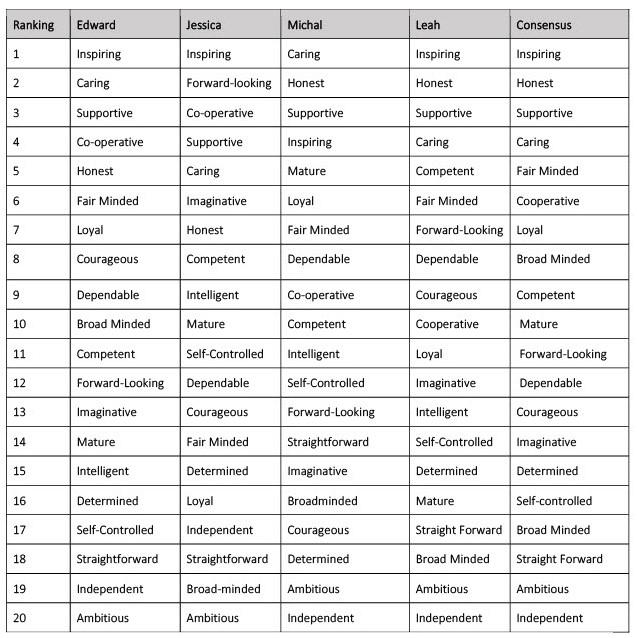
Michal Gerov, Leah Yardley, Edward Logan, and Jessica Gemella (Team A) individually ranked 20 leadership characteristics, then came to a consensus as shown on the table below.

Leadership Characteristics – Ranking & Consensus

Team Reflection

As a team, we all found the process of ranking leadership characteristics challenging, however, the process was insightful. The shift between our initial rankings to our post-reading rankings was not significant for the most part, and we found that we were more or less aligned as a group for the top five and the bottom five characteristics. Our top characteristics embody human connection, whereas our bottom characteristics are more individually driven. 

The process of arriving at a consensus resulted in some good conversation around the meaning of words or characteristics and what we would include and exclude from a future list. One characteristic that we discussed in greater depth was ‘mature’. This particular characteristic has multiple meanings, and we felt it was hard to rank due to this fact. We felt that we could remove this from the list and that perhaps it could be assumed that a leader would be mature if they possessed some of the other characteristics. We had a similar conversation about competence. For example, is a leader that possesses all of the characteristics listed inherently competent, or does competence reflect the ability to do their job outside of leadership skills? Regardless, we decided competence would remain on the list. 

We also believe collaboration and reflection should be added to a leader’s list of important attributes. First, collaboration is the capacity to work well with others toward a shared objective (Cambridge Dictionary, n.d.). For example, O’Toole (2008) emphasized the importance of collaboration in value-based leadership because people will only follow leaders who are able to help followers realize where they want to go, but cannot achieve the desired outcomes by themselves. Additionally, Workman and Cleveland-Innes (2012) asserted that transformational leadership is founded on collaboration and shared purpose. Second, reflection refers to the ability to evaluate one’s and the team’s performance to grow and learn from mistakes (Huggins, 2017). Reflection is characterized by self-awareness, careful observation, and flexible response – to creating a relationship-based organization (Fraser, 2023). 

Therefore, focusing on collaboration and reflection, ensures that a leader can help create a learning culture where ideas are shared, and teamwork is encouraged. As a result,  everyone is supported in reaching their goals. When a leader is reflective, they are self-aware, mindful, and possess personal wisdom enabling them to think critically, plan long-term, and innovate to solve problems (Castelli, 2016). We felt that including reflection as a characteristic could lead to a reflective leadership approach which is more holistic, human-centric, and aligns with our top characteristics and values. Several effective leadership approaches, including reflective and adaptive, promote collaboration (Castelli, 2016; Khan, 2017) which prompted us to also include adaptable as an important leadership characteristic.

References

Cambridge Dictionary. (n.d.). Collaboration. https://dictionary.cambridge.org/dictionary/english/collaboration  

Castelli, P. (2016) Reflective leadership review: a framework for improving organisational performance. Journal of Management Development, 35(2), 217-236. https://doi.org/10.1108/JMD-08-2015-0112  

Huggins, K. S. (2017). Developing leadership capacity in others: An examination of high school principals’ personal capacities for fostering leadership. International Journal of Education Policy and Leadership, 12(1), 1–15. https://doi.org/10.22230/ijepl.2017v12n1a670 

Khan, N. (2017). Adaptive or transactional leadership in current higher education: A brief comparison. International Review of Research in Open and Distance Learning, 18(3), 178–183. https://doi.org/10.19173/irrodl.v18i3.3294 

OʹToole, J. (2008). Notes Toward a Definition of Values‑Based Leadership. The Journal of Values-Based Leadership, 1(1). http://scholar.valpo.edu/jvbl%5Cnhttp://scholar.valpo.edu/jvbl/vol1/iss1/10

Workman, T., & Cleveland-Innes, M. (2012). Leadership, personal transformation, and management. International Review of Research in Open and Distance Learning, 13(4), 313–323. https://doi.org/10.19173/irrodl.v13i4.1383 

Fraser, J. (2023, January 20). What is reflective leadership? [Blog]. Zero to Three. https://www.zerotothree.org/resource/what-is-reflective-leadership/#:~:text=Reflective%20leadership%20is%20the%20key,her%20strengths%2C%20and%20her%20limitations