Podcasts as Knowledge Mobilization

Photo by Mitchell Luo on Unsplash

In the first few weeks of the LNRT 526 – Inquiry into Contemporary Issues in Learning Technologies course, my learning team (consisting of Leah Yardley, Giulia Di Giovanni, and Tim Wong) and I have been critically examining podcasts. We started by selecting and listening to a podcast by Ologies, an amusing collection of podcasts that simplifies science for the general public, curated by Alie Ward (Ward, 2023). After reflecting on our learning experiences together, we found the podcasts to be thought-provoking, accessible, and provide flexible learning opportunities.

Initially, I was drawn to the efficiency, effectiveness, and engagement of podcasts from a pedagogical perspective. Evans (2008) found that podcasts make learning easy and accessible because they are portable and can be accessed whenever and wherever people want. Moreover, Evans (2008) suggested that students learn more and feel more engaged when listening to a podcast than when reading. Podcasts are essential for disseminating the most current, evidence-based practices and just-in-time training to fill knowledge gaps, particularly in rapidly changing fields of study, such as medicine (Kelly et al., 2022; Wang et al., 2023). From my perspective as a teacher in higher education I see the efficiency, effectiveness, and engagement of podcasts to disseminate knowledge as significant. However, after doing a brief literature review and course background readings, I am now more curious about how podcasts fit within the wider institutional and societal context to promote social justice.

Selwyn’s (2010) suggested that technology-enhanced learning needs to be seen in the social world of education to foster issues of social justice including empowerment, equality, and participatory democracy. Podcasts are becoming increasingly popular as an effective tool for scholars and researchers to engage a broader audience outside of academia to build community and reach diverse publics (Demarco, 2022; Ferrer et al., 2019; Kern, 2022; Swiatek, 2018). Swiatek (2018) argued that podcasts can create a feeling of closeness between geographically distant listeners, thereby overcoming barriers related to information and context. Collaborative podcasts, proposed by Day et al. (2017), serve as a research method for critical inquiry and knowledge mobilization, which can promote decolonization in research. Now I am looking at podcasts from a social justice perspective, and my individual inquiry assignment asks the following questions.

As a future researcher, I am interested in exploring how podcasts can be used to mobilize research within and beyond educational institutions to promote social justice. I have several sub-questions:

  • What broader audiences can podcasts reach within my research context?
  • How are podcasts breaking down traditional hierarchies of knowledge production and dissemination?
  • How is research translated through podcasts for real-world impact?
  • How might podcasts expand research methods to facilitate a more inclusive and diverse approach and help to challenge traditional academic notions of peer review?

As current and future researchers, what questions do you have about podcasting as a way of mobilizing knowledge?

References

Day, L., Cunsolo, A., Castleden, H., Martin, D., Hart, C., Anaviapik-Soucie, T., Russell, G., Paul, C., Dewey, C., & Harper, S. L. (2017). The expanding digital media landscape of qualitative and decolonizing research: Examining collaborative podcasting as a research method. MediaTropes, 7(1), 203–228. https://mediatropes.com/index.php/Mediatropes/article/view/28320

Demarco, C. (2022). Hear here! The case for podcasting in research. Journal of Research Administration, 53(1), 30–61. https://files.eric.ed.gov/fulltext/EJ1348008.pdf

Evans, C. (2008). The effectiveness of m-learning in the form of podcast revision lectures in higher education. Computers and Education, 50(2), 491–498. https://doi.org/10.1016/j.compedu.2007.09.016

Ferrer, I., Lorenzetti, L., & Shaw, J. (2019). Podcasting for social justice: exploring the potential of experiential and transformative teaching and learning through social work podcasts. Https://Doi.Org/10.1080/02615479.2019.1680619, 39(7), 849–865. https://doi.org/10.1080/02615479.2019.1680619

Kelly, J., Perseghin, A., Dow, A., Trivedi, S., Rodman, A., & Berk, J. (2022). Learning through listening: A scoping review of podcast use in medical education. Academic Medicine, 97(7), 1079–1085. https://doi.org/10.1097/ACM.000000000000456

Kern, V. (2022). Going public: Library support for knowledge translation and mobilization for the public good. Https://Doi.Org/10.1080/01930826.2022.2043689, 62(3), 312–333. https://doi.org/10.1080/01930826.2022.2043689

Selwyn, N. (2010). Looking beyond learning: notes towards the critical study of educational technology. Journal of Computer Assisted Learning, 26(1), 65–73. https://doi.org/10.1111/J.1365-2729.2009.00338.X

Swiatek, L. (2018). The Podcast as an intimate bridging medium. In: Llinares, D., Fox, N., Berry, R. (eds) Podcasting. Palgrave Macmillan, Cham. https://doi.org/10.1007/978-3-319-90056-8_9

Wang, L. K., Paidisetty, P., & Sathyanarayanan, S. (2023). Using podcasts to study efficiently and increase exposure to medical specialties. Academic Medicine, 98(2), 157. https://doi.org/10.1097/ACM.0000000000005075

Ward, A. (2023). Ologies episodes. https://www.alieward.com/ologies  

Reflections on Leadership 

This course has provided me with valuable insights into the attributes of a leader in a digital learning environment. At the beginning of this course, our class reflected on the essential attributes of a leader working in a digital learning environment. Then, we engaged in an active learning strategy by working in groups to rank twenty attributes from most valued to least important. This exercise was an engaging way to start the course and has had a lasting impact on me. Throughout the course, I have been thinking about leadership attributes and what stands out to me is that a leader needs vision and the ability to communicate it effectively.

Another experience that captured my attention during the course was the discussions about ChatGPT. We had conversations about it in Zoom, Moodle, informally in the class Slack channel, and through the class-created toolkits. The rapid pace of change and resulting tensions made this course immediately relevant to my work. In a rapidly changing environment, which education has been in recent years, adaptability is of immense importance. A leader must be able to adapt to changing circumstances and be flexible in their approach and thinking. Additionally, empathy is another essential attribute, given the stresses and emotions of change. A good leader aims to listen and empathize with the people they lead. Therefore, I value vision, communication, adaptability, and empathy as critical leadership. 

I also found the readings about data-driven decisions meaningful. I have been using student feedback to inform my teaching practice and reviewing basic learning management system information to track student progress and provide support. However, I am now curious to learn more about ethically accessing and gathering data to gain further insight to improve teaching and learning. As well as data could help me gain a better understanding of the institution where I teach. I look forward to learning more about research methods to develop my strategic planning leadership skills and support innovation. Using data to inform decisions makes my planning initiatives more likely to succeed.

In sum, this course has helped me develop my leadership skills by providing insights into the attributes of a leader in a digital learning environment, demonstrating the importance of vision, adaptability, and empathy, and highlighting the value of data-driven decisions. I believe that by continuing to develop these skills, I can become a more effective leader in my context

Leading Projects

Photo by Hubert Neufeld on Unsplash

Welcome to this blog post about leading projects. Projects are becoming increasingly complex, and it is important to have the appropriate strategies to manage them effectively (Bates, 2014; Conway et al., 2017; Watt, 2014). In the book “Project Management”, Watt (2014) referenced the Standish Group CHAOS report to define project success as being on time, on budget and meeting the required features and functions. Standish Group International has released the CHAOS report for many years and provides a success scale to increase the probability of a project’s success (Musings, 2020). The 2009 Standish Group CHAOS reported a 68% project failure rate across various industries (Watt, 2014). I did a cursory search to find more current success and failure rates in the context of implementing new technology. The Standish Group reported that 83.9% of information technology projects failed in 2021 (Open Door Technology, 2021). I work in a higher education organization in BC, where colleges and universities are operating in budget deficits as we recover from the financial impact of the COVID-19 pandemic (Fletcher, 2021). Considering the historical project failure rates and the current budget deficits in higher education, I see effective project management as particularly critical for implementing learning technologies. In this blog post, I will reflect on a recent project management experience in higher education in BC and articulate the valuable insight I gained from the course readings to improve my practice.

I was recently part of a project to implement a new faculty development initiative that aimed to enhance teachers’ digital literacy capacity and competence. Watt (2014) outlined the considerations to attend to in project planning — I followed many of the processes and practices outlined in the readings. Through my planning experience and the course project management readings, three factors emerged as critical to project success: planning, agility, and user and stakeholder involvement. My planning began with discussing with other institutions that had developed similar initiatives, reviewing data to estimate registration interest, and then surveying faculty to gain insight into interests, delivery mode preferences, and preferred schedules. I created a Gantt chart to sequence the planning process and set a reporting structure with weekly updates to communicate progress and challenges. A Gantt chart is a graphic schedule that illustrates a critical path noting work breakdown with dates associated with key tasks (Watt, 2014). Reflecting on my experience, the planning was well done as I managed time, costs, scope and resources well. However, I think that risks, particularly barriers to participation or resistance to participation could be better managed with user involvement.

The user or stakeholder input is important because it ensures that the project functions as intended and meets expectations (Open Door Technology, 2021; Watt, 2014). I considered users and stakeholders in the project planning by consulting the department involved (users) to document needs and define goals; and outlined the scope of the work and resources available with administration and registration (stakeholders). However, there were stakeholders that I did not identify in the early stages of planning and may have created a barrier to participation because some faculties did not perceive the value. While I have general project management skills with experience in the design and construction industry, I have little experience in project management in educational contexts. As described by Watt (2014), understanding the project environment in terms of culture and social influences is often misunderstood. What I have learned from the readings is that the probability of project success increases with user and stakeholder involvement and with an understanding of the project environment. As I am new in my current role, I will plan for more consultations with leadership to help motivate individuals and to help me to better understand the unspoken influences at work within my institution (Watt, 2014).

References

Bates, T. (2014). Is the ADDIE model appropriate for teaching in a digital age? | Tony Bates. https://www.tonybates.ca/2014/09/09/is-the-addie-model-appropriate-for-teaching-in-a-digital-age/

Conway, R., Masters, J., & Thorold, J. (2017). From design thinking to systems change. RSA Action and Research Centre, July, 32. https://www.thersa.org/globalassets/pdfs/reports/rsa_from-design-thinking-to-system-change-report.pdf

Fletcher, T. O. M. (2021). B.C. colleges , universities allowed to run COVID-19 deficits. Victoria News. https://www.vicnews.com/business/b-c-colleges-universities-allowed-to-run-covid-19-deficits/

Musings, P. M. (2020). My theory on why IT projects fail. https://pmhut.com/my-theory-on-why-it-projects-fail

Open Door Technology. (2021). The Standish Group reports 83.9% of IT projects fail – How to Save Yours. Opendoor, 365. https://www.opendoorerp.com/the-standish-group-report-83-9-of-it-projects-partially-or-completely-fail/

Watt, A. (2014). Project management 2nd edition. In Engineer (Vols. 24-MAY). https://opentextbc.ca/projectmanagement/.

Important Characteristics of a Leader

First Impressions

This week in LNRT 525 – Leading Change in Digital Learning, I reflected on my perceptions of leadership, the course readings, and my experience collaborating with class colleagues Michal Gerov, Leah Yardley, and Edward Logan to rank the top twenty attributes of leaders. At first, I described the most significant attributes of a leader as competent, honest and fair minded. My thinking was that a leader must be knowledgeable, efficient, and capable to lead initiatives successfully (Cambridge Dictionary, n.d.). Following, I think honesty and fairness are foundational to trusting relationships, and people need to trust leaders. After reading, I considered how competence, honesty and fair-minded describe good leaders, as well as managers and colleagues. I questioned the essential characteristics of a leader, that is what makes leaders unique from managers, colleagues, and others within an organization?

After Reading

After reading, I shifted my top three leadership attributes to inspiring, forward-looking, and co-operative because several course readings highlighted these critical leadership attributes. Workman and Cleveland-Innes (2012) discussed differences between leading and managing. Importantly, leaders create conditions for innovative change by communicating a vision in ways that influence, excite and motivate; whereas managers establish strategies to shape behaviors and implement changes (Workman & Cleveland-Innes, 2012). Hence, inspiring is an essential leadership characteristic. Next, I suggested forward-looking as a top leadership attribute based on adaptive leadership theory. Khan (2017) suggested that adaptive leadership is flexible and orientated towards change by considering current needs rather than the past. Also, Workman and Cleveland-Innes (2012) described the importance of a vision for change with new and interesting ideas to shift perspectives to look forward. Additionally, adaptive leadership helps organizations handle complex situations by encouraging collective learning and collaboration (Khan, 2017). Therefore, I added co-operative because it is about working with others to achieve a vision. Next, I met with my class colleagues Michal Gerov, Leah Yardley, and Edward Logan to come to a consensus on the top twenty attributes of leaders.

Team Perspectives

I realized other perspectives on leadership through our team discussion to rank attributes of leaders. Our team ranking placed inspiring, honest and supportive as the most important characteristics of leadership. As previously described, inspiring and honest were attributes I consider important, with supportive and caring ranked fourth and fifth. Our team’s top five were similar. However our discussion highlighted other experiences and readings. Huggins (2017) questioned the primary characteristics of leadership and suggested that an aspect of building leadership is having a tolerance for risk, which we collectively interpreted as courageous.  Our team discussion helped me to see the importance of understanding that developing leadership capacity is a process with opportunities to learn from mistakes. Also, our team discussed the reading by Julien et al. (2010) about aboriginal leadership. Overall, Julien et al. (2010) suggested that aboriginal perspectives include leadership as a spiritual endeavour that is holistic and equalitarian — the emphasis of leadership is on collective values. As well, aboriginal leaders appreciate and recognise employees as whole people (Julien et al., 2010). After the team discussion, I suggest reflective (to learn from mistakes), holistic and appreciative as additional essential qualities of leadership. Lastly, I reviewed the research that informed the team activity, the characteristics of admired leaders In Credibility : How leaders gain and lose it, why people demand it. Our team ranking had similarities, both suggested honest and inspiring as the top characteristics of admired leaders (Kouzes & Posner, 2014).  

What have I learned and how can I use this learning in the future?

In my context to implement teaching and learning technology in higher education I need to pay particular attention to building leadership capacity in myself and others. As Huggins (2017) suggested, taking risks and learning from mistakes is important in the process of change. I see teachers that are hesitant to adopt technology. Mendoza (2022) suggested that the fear of change comes from concern that technology will replace teachers, teachers lack training and doubt the effectiveness of educational technologies. I can use adaptive leadership theory to address the current needs of teachers, to confront fears and with inspiration and honesty. In sum, reflective practice and a supportive culture will help to build a collective vision for digital pedagogy (Sheninger, 2022).

References

Cambridge Dictionary. (n.d.). Competence. https://dictionary.cambridge.org/dictionary/english/competence   

Huggins, K. S. (2017). Developing leadership capacity in others: An examination of high school principals’ personal capacities for fostering leadership. International Journal of Education Policy and Leadership, 12(1), 1–15. https://doi.org/10.22230/ijepl.2017v12n1a670

Khan, N. (2017). Adaptive or transactional leadership in current higher education: A brief comparison. International Review of Research in Open and Distance Learning, 18(3), 178–183. https://doi.org/10.19173/irrodl.v18i3.3294

Kouzes, J. M., & Posner, B. Z. (2014). Credibility: How leaders gain and lose it why people demand it. Credibility: How Leaders Gain and Lose It, Why People Demand It, c, 1–250. https://doi.org/10.1002/9781118983867

Mendoza, A. (2022, March 25). 5 reasons why teachers are hesitant to adopt technology in the classroom. https://medium.com/teachers-on-fire/reasons-teachers-are-hesitant-to-adopt-technology-in-the-classroom-5ef9d48ed144#:~:text=Teachers%20worry%20that%20incorporating%20technology,needed%20to%20make%20these%20changes

Sheninger, E. (2023, January 23). 7 pillars of Digital leadership. Houghton Mifflin Harcourt. https://www.hmhco.com/blog/pillars-of-digital-leadership-in-education#:~:text=Digital%20leadership%20can%20thus%20be,school%20success%20in%20the%20future  

Workman, T., & Cleveland-Innes, M. (2012). Leadership, personal transformation, and management. International Review of Research in Open and Distance Learning, 13(4), 313–323. https://doi.org/10.19173/irrodl.v13i4.1383

Leadership Characteristics

Photo by Matteo Vistocco from Unsplash.com.
Unsplash photos are made to be used freely.

What do you consider to be the most important attributes of a leader?

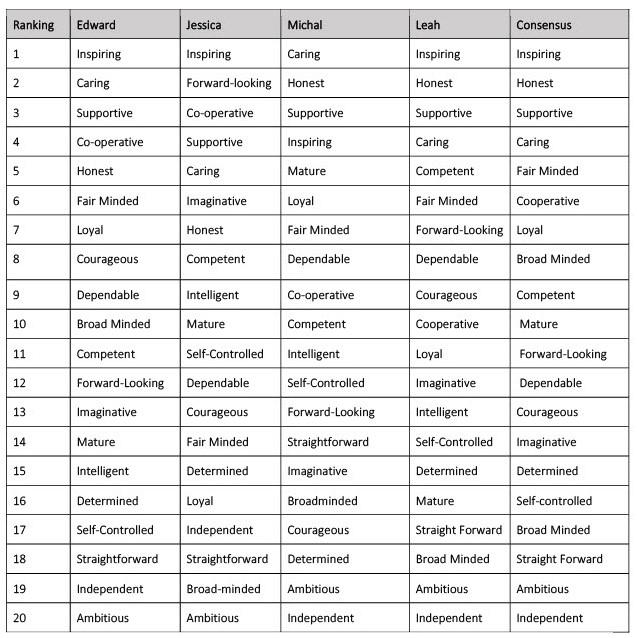
Michal Gerov, Leah Yardley, Edward Logan, and Jessica Gemella (Team A) individually ranked 20 leadership characteristics, then came to a consensus as shown on the table below.

Leadership Characteristics – Ranking & Consensus

Team Reflection

As a team, we all found the process of ranking leadership characteristics challenging, however, the process was insightful. The shift between our initial rankings to our post-reading rankings was not significant for the most part, and we found that we were more or less aligned as a group for the top five and the bottom five characteristics. Our top characteristics embody human connection, whereas our bottom characteristics are more individually driven. 

The process of arriving at a consensus resulted in some good conversation around the meaning of words or characteristics and what we would include and exclude from a future list. One characteristic that we discussed in greater depth was ‘mature’. This particular characteristic has multiple meanings, and we felt it was hard to rank due to this fact. We felt that we could remove this from the list and that perhaps it could be assumed that a leader would be mature if they possessed some of the other characteristics. We had a similar conversation about competence. For example, is a leader that possesses all of the characteristics listed inherently competent, or does competence reflect the ability to do their job outside of leadership skills? Regardless, we decided competence would remain on the list. 

We also believe collaboration and reflection should be added to a leader’s list of important attributes. First, collaboration is the capacity to work well with others toward a shared objective (Cambridge Dictionary, n.d.). For example, O’Toole (2008) emphasized the importance of collaboration in value-based leadership because people will only follow leaders who are able to help followers realize where they want to go, but cannot achieve the desired outcomes by themselves. Additionally, Workman and Cleveland-Innes (2012) asserted that transformational leadership is founded on collaboration and shared purpose. Second, reflection refers to the ability to evaluate one’s and the team’s performance to grow and learn from mistakes (Huggins, 2017). Reflection is characterized by self-awareness, careful observation, and flexible response – to creating a relationship-based organization (Fraser, 2023). 

Therefore, focusing on collaboration and reflection, ensures that a leader can help create a learning culture where ideas are shared, and teamwork is encouraged. As a result,  everyone is supported in reaching their goals. When a leader is reflective, they are self-aware, mindful, and possess personal wisdom enabling them to think critically, plan long-term, and innovate to solve problems (Castelli, 2016). We felt that including reflection as a characteristic could lead to a reflective leadership approach which is more holistic, human-centric, and aligns with our top characteristics and values. Several effective leadership approaches, including reflective and adaptive, promote collaboration (Castelli, 2016; Khan, 2017) which prompted us to also include adaptable as an important leadership characteristic.

References

Cambridge Dictionary. (n.d.). Collaboration. https://dictionary.cambridge.org/dictionary/english/collaboration  

Castelli, P. (2016) Reflective leadership review: a framework for improving organisational performance. Journal of Management Development, 35(2), 217-236. https://doi.org/10.1108/JMD-08-2015-0112  

Huggins, K. S. (2017). Developing leadership capacity in others: An examination of high school principals’ personal capacities for fostering leadership. International Journal of Education Policy and Leadership, 12(1), 1–15. https://doi.org/10.22230/ijepl.2017v12n1a670 

Khan, N. (2017). Adaptive or transactional leadership in current higher education: A brief comparison. International Review of Research in Open and Distance Learning, 18(3), 178–183. https://doi.org/10.19173/irrodl.v18i3.3294 

OʹToole, J. (2008). Notes Toward a Definition of Values‑Based Leadership. The Journal of Values-Based Leadership, 1(1). http://scholar.valpo.edu/jvbl%5Cnhttp://scholar.valpo.edu/jvbl/vol1/iss1/10

Workman, T., & Cleveland-Innes, M. (2012). Leadership, personal transformation, and management. International Review of Research in Open and Distance Learning, 13(4), 313–323. https://doi.org/10.19173/irrodl.v13i4.1383 

Fraser, J. (2023, January 20). What is reflective leadership? [Blog]. Zero to Three. https://www.zerotothree.org/resource/what-is-reflective-leadership/#:~:text=Reflective%20leadership%20is%20the%20key,her%20strengths%2C%20and%20her%20limitations  

Design Principles

Image Credit: Yoann Boyer (2017). Free to use under the Unsplash License

Assignment 2b Introduction

The first part of this assignment, assignment 2a, was a team activity to participate in a design thinking process. Consequently, this assignment 2b builds on the design challenge defined through a process of emphasizing with a user, defining a problem using a Point of View (POV) Framework, and ideating or brainstorming ways to address the challenge defined.

Context

For context, I work as a curriculum teaching and learning specialist in higher education. The design challenge statement developed by Leah Yardley and myself in the first part (2a) of the assignment is; I (Jessica) need a way to help instructors create supportive learning environments because changes to the structure of learning combined with the collective trauma resulting from the Covid-19 pandemic have increased levels of stress and anxiety for students and instructors (Gemella & Yardley, 2023). In assignment 2a, Leah Yardley and I acknowledged that in higher education, student well-being is often supported through distinct services, such as counselling and medical services (Centre for Innovation in Campus Mental Health, n.d.; Fovet, F., 2020; Hsu & Goldsmith, 2021; Semu & Henshaw, 2022; Van Der Bijl-Brouwer & Price, 2020). Leah Yardley and I argued that instructors could also play an important role in minimising the impact of stress and anxiety within the learning experience (Centre for Innovation in Campus Mental Health, n.d.). The proposed solution within the context of our presented problem is to use a Universal Design for Learning framework (UDL). Briefly, UDL provides guidelines to ensure that all learners can access and participate in learning opportunities (CAST, 2020).

Design Thinking

Svihla (2017) stated that design thinking refers to methods, practices, and processes that guide instructional designers in creating learning experiences based on understanding the needs of learners. Tracey & Hutchinson (2019) suggested that to create meaningful learning experiences, instructional designers must be empathetic to learners’ cognitive and emotional needs. Design principles are a set of considerations and values that help guide decision-making, align decisions with desired outcomes, and advance design goals (Brignell, n.d.; Cable, 2015; Crichton & Childs, 2022). The following principles draw from the UDL framework, emphasising mental health. These recommended design principles aim to guide instructional design to minimise the impact of stress and anxiety within the learning experience.

References

Brignell, B. (n.d.). Design principles. https://principles.design/

Brignell, B. (n.d.). The ten principles of inclusive web design. https://principles.design/examples/the-ten-principles-of-inclusive-design

Cable, S. (2015, June 18). Design principles – a guide. Cxpartners. https://k12.designprinciples.org/design-principles

CAST. (2020). UDL tips for designing learning experiences. https://www.cast.org/products-services/resources/2020/udl-tips-designing-learning-experiences  

Centre for Innovation in Campus Mental Health. (n.d.). Recognizing, responding and referring students to crisis supports. https://campusmentalhealth.ca/wp-content/uploads/2022/03/CICMH-Recognize-Respond-to-Students-Flowchart.pdf

Crichton, S., & Childs, E. (2022). Design principles for schools. https://k12.designprinciples.org/design-principles

Enser, Z. (2021, December 03). Responsive teaching and the importance of formative assessment. [Blog]. The Education People. https://www.theeducationpeople.org/blog/responsive-teaching-and-the-importance-of-formative-assessment/

Fovet, F. (2020, March 03). Exploring the potential of universal design for learning with regards to mental health issues in higher education [Paper Presentation]. The 2020 Pacific Rim International Conference on Disability and Diversity. Honolulu, Hawai’i. https://viurrspace.ca/handle/10613/23314

Gemella, J., & Yardley, L. (2023). LNRT 524 Assignment 2a: Design thinking project [Class Assignment]. Design Thinking Process LRNT 524 2a – Jessica Gemella and Leah Yardley – Google Docs

Hsu, J. L., & Goldsmith, G. R. (2021). Instructor strategies to alleviate stress and anxiety among college and university STEM students. CBE Life Sciences Education, 20(1), 1–13. https://doi.org/10.1187/cbe.20-08-0189

Instructional Design Australia. (n.d.) First Principles of Instruction. https://instructionaldesign.com.au/what-is-instructional-design/first-principles-of-instruction/

Rose, E., & Tingley, K. (2008). Science and math teachers as instructional designers: Linking ID to the ethic of caring. Canadian Journal of Learning and Technology, 34(1). https://files.eric.ed.gov/fulltext/EJ1073835.pdf

Semu, L. L., & Henshaw, L. A. (2022). Building trauma-informed approaches in higher education. Behavioural Sciences, 12(10), 368. https://doi.org/10.3390/bs12100368

Tracey, M. W., & Hutchinson, A. (2019). Empathic design: Imagining the cognitive and emotional learner experience. Educational Technology Research and Development, 67(5), 1259–1272. https://doi.org/10.1007/s11423-019-09683-2 

University of Minnesota. (2015). Mental health and well-being ecological model. https://mch.umn.edu/resources/mhecomodel/

Van Der Bijl-Brouwer, M., & Price, R. (2020). An adaptive and strategic human-centred design approach to shaping pandemic design education that promotes wellbeing. Strategic Design Research Journal, 14(1). https://doi.org/10.4013/sdrj.2021.141.09

Wiliam, D. (2016, July 15). Dylan Wiliam: Formative assessment. [YouTube]. https://youtu.be/sYdVe5O7KBE

Virtual Reality for Enhanced Blended Learning in technical and vocational education and training (TVET)

Free to use under the Pixabay license
No attribution required

Before the 2020 COVID-19 disruption in education, online and blended pedagogy was well-established in academic higher education programs; however, blended learning is less prevalent in technical and vocational education and training (TVET) programs (Burke & Larmar2020; Dziuban et al., 2018; Herman et al., 2019; Vinden et al., 2021). Blended learning mixes face-to-face classes with online instruction using various educational technologies, including simulations or virtual reality, to enrich the learning experience (Vogt, 2014; Dziuban et al., 2018; Herman et al., 2019). Virtual reality can play many beneficial roles in TVET teaching and learning, for example, practising motor skills, working with avatars in simulations with virtual humans, and practising unfamiliar situations for behaviour training to prepare for emergencies (UNESCO-UNEVOC, 2022). This blog post critiques virtual reality as a technology to facilitate deep learning in blended TVET learning environments by describing (a) innovation; (b) impact on learning; (c) reliance on technology; (d) usability; (e) assess risk, and (f) value proposition. First, innovation in teaching and learning refers to a new pedagogical technique, tool or strategy that improves learning (Steph, 2022).

Virtual reality is innovative in the specific context of blended TVET because it addresses the need for experiential learning and motor skills training in a way different from traditional face-to-face approaches (UNESCO-UNEVOC, 2022). Virtual reality is a computer-based technology that creates an immersive experience with visual, auditory, and stimuli, providing the feeling of being present in a virtual setting and that provides individualized immediate feedback from body movement (Hu-Au & Lee, 2017; Karageorgaskis, 2020; Sánchez et al., 1997; UNESCO-UNEVOC, 2022). Although virtual reality is often associated with gaming and military training, it is innovative in TVET with the potential to adapt to specific learner needs, to be linked to authentic job site learning, and to engage and motivate learners (Fragkaki et al., 2020; Khukalenko et al., 2022; UNESCO-UNEVOC, 2022). Virtual reality engages students in practical skills in classroom settings, online environments, and training outside of school (for instance, learning on the job) (Fragkaki et al., 2020; Steph, 2022). Furthermore, virtual practice allows learners to gain confidence and safely practice dangerous or complicated techniques, lessening risks and reducing costs of material and equipment (Steph, 2022; UNESCO-UNEVOC, 2022). In addition, virtual reality provides benefits beyond engagement to promote deeper learning.

Fragkaki et al. (2020) proposed that virtual reality impacts learning by promoting deeper learning in blended learning settings. Fragkaki et al. (2020) advocated that deeper learning goes beyond content memorization and repetition to develop critical thinking, collaboration, and communication skills. Deeper learning is associated with increased retention, intrinsic motivation and a lasting understanding of the experiences and principles being studied (Fragkaki et al., 2020). Virtual reality also provides an approach that can evoke feelings of empathy in learners to encourage learners to take interactive and collaborative roles in learning (Fragkaki et al., 2020). Virtual reality enhances teaching and learning, but education faces some reservations due to teachers’ perception of instructional technologies, teaching approaches, and reliance on technology (Fragkaki et al., 2020; Karageorgaskis, 2020; Khukalenko et al., 2022).

Virtual reality relies on technology, and various input-output devices are used to immerse learners, usually headsets and handheld devices (Karageorgaskis, 2020; Fragkaki Khukalenko et al., 2022). Khukalenko et al., 2022 identified several barriers to virtual reality adoption, including limited budgets to develop applications, teachers’ low confidence in using new technologies and the lack of support, and resistance to changes and innovation. Also, Khukalenko et al. (2022) stated that virtual reality research provides mixed or negative evidence of virtual reality being more effective in achieving learning outcomes than other learning supports. Additionally, some risks of using virtual reality are gear overheating and cybersickness (mainly headaches, dizziness, nausea, fatigue, and increased heart rate) (Khukalenko et al., 2022). Lastly, Khukalenko et al. (2022) suggested that the lack of teacher training poses the risk of ineffective integration of virtual reality that does not address the learning challenges students may face.

In summary, I see virtual reality as an innovation in teaching and learning because it incorporates new pedagogical media and methods relevant to blended TVET. As well, virtual reality is valuable as it has the potential to provide opportunities to learn remotely or in person. For example, virtual welding and heavy equipment simulators provide beginners and advanced students with training modules to improve their skills remotely while conserving resources. Importantly, virtual simulations can promote deep learning through collaboration and problem-solving scenarios. However, educators need time, support, and technical skills to design experiences to meet learning outcomes.

References

Burke, K., & Larmar, S. (2020). Acknowledging another face in the virtual crowd: Reimagining the online experience in higher education through an online pedagogy of care. Journal of Further and Higher Education, 45(5), 601–615. https://doi.org/10.1080/0309877x.2020.1804536

Dziuban, C., Graham, C. R., Moskal, P. D., Norberg, A., & Sicilia, N. (2018). Blended learning: the new normal and emerging technologies. International Journal of Educational Technology in Higher Education, 15(1). https://doi.org/10.1186/s41239-017-0087-5

Fragkaki, M., Mystakidis, S., Hatzilygeroudis, I., Kovas, K., Palkova, Z., Salah, Z., Hamed, G., Khalilia, W., & Ewais, A. (2020). TPACK instructional design model in virtual reality for deeper learning in science and higher education: From “apathy” to “empathy”. DOI:10.21125/edulearn.2020.0943

Herman, C., Gracia, R., Macniven, L., Clark, B., & Doyle, G. (2019). Using a blended learning approach to support women returning to STEM. Open Learning, 34(1), 40–60. https://doi.org/10.1080/02680513.2018.1554475

Karageorgaskis, T. (2020). What is the impact of virtual reality in education? [Blog]. What is the impact of Virtual Reality in Education? — Educraft

Khukalenko, I., Kaplan-Rakowski, R., An, Y., Vera, Lushina, V. (2022). Teachers’ perceptions of using virtual reality technology in classrooms: A large-scale survey. Education and Information Technologies, 27, 11591–11613 (2022). https://doi.org/10.1007/s10639-022-11061-0

UNESCO-UNEVOC. (2022). Using augmented and virtual reality in TVET: MilleaLab – the all-in-one VR platform for education. [Video]. https://youtu.be/9jlK7jygSO0

Vinden, S., Flinn, C., & Carson, T. (2021, May 17). Strengthening digital teaching &learning for trades, vocational, education and training practitioners. BCcampus. https://bccampus.ca/2021/05/12/strengthening-digital-teaching-learning-for-trades-vocational-education-and-training-practitioners/

Vogt, R. (2014). Experiences with blended learning program delivery for apprenticeship trades: A case study. International Journal of Higher Education, 3(4). https://doi.org/10.5430/ijhe.v3n4p85

Exploring Design Models

I have taught in Technical and Vocational Education and Training (TVET) for about seven years, following a 25-year career as an environmental designer (landscape architect #286, under the BC Architects Act). My transition to teaching was abrupt and challenging. Like most TVET teachers, I transitioned into higher education as a subject matter expert without formal teacher training (Vinden, 2020). After my first year of teaching, I was eager to improve my teaching practice, so I embarked on the BC Provincial Instructor Diploma (PIDP). The PIDP provided me with an introduction to learning theory and instructional strategies. After reading about instructional design over the past two weeks in this LNRT 524 course, I am reminded that teachers have a vast body of research they should rely on to design effective, efficient, and engaging teaching and learning environments (Vinden, 2020; Heaster, 2020). In the article “Popular Instructional Design Models: Their Theoretical Roots and Cultural Consideration”, Heaster (2020) evaluated common learning models for designing inclusive learning environments. According to Heaster (2020), learning design decisions must consider the diversity of learners and culture.  

First, culture has a significant role in learning and beliefs about knowledge (Hester, 2020). Instructional design decisions should consider the cultural context (Hester, 2020). In my teaching context, TVET in western higher education, three paradigms underpin learning theory: behaviourism, cognitivism, and constructivism (Hester, 2020). Hester (2020) outlined three learning models shaped by behaviourism: the ADDIE model, Bloom’s Taxonomy, and the Dick and Carey Model. Behaviourist models are appropriate in a curriculum culture where managing student behaviour and transferring content is foremost (Western Governors University, 2021). Behaviourist models are unsuitable for analytical learning or for meeting the needs of diverse learners (Hester, 2020; Western Governors University, 2021). Cognitivism influences models by Merrill, Kemp, and Gagne (Hester, 2020). Learners are at the forefront of cognitive design approaches. Learners’ experiences are considered in the design, and learners are encouraged to take an active role in planning and self-monitoring (Hester, 2020). Lastly, Universal Design for Learning (UDL) is a constructivist approach with multiple means of engagement, representation and expression that removes barriers to include all learners. Learners are central to the design process. Learners are encouraged to connect their experiences to new knowledge (Kimmons & Caskurlu, 2020). Having read evaluations of instructional design models, I have developed a better understanding of selecting appropriate instructional design models. However, I am not yet confident about how I might find out more about the cultural context and learners in a future learning environment. Each group of learners will be different; many unknowns exist when designing a new course. Consequently, I think UDL is of particular importance.

UDL is a teaching and learning model that considers the diversity of learners by aiming to remove learning barriers. The approach is user-centred and offers many means of engagement, representation and expression (Takacs et al., 2022). The design process creates learning environments accessible to various abilities and preferences (Takacs et al, 2022). The UDL model is based on design thinking which encompasses empathising with learners, defining problems, brainstorming solutions, prototyping, and testing ideas (Kimmons & Caskurlu, 2020). UDL intends to create expert learners that are motivated, resourceful, and strategic (Takacs et al, 2022). For me, UDL provides insight into how I might draw on my experience as a designer. Instruction design takes a similar approach to environmental design by applying a design process that best meets the users’ needs for inclusive and diverse spaces.

In summary, the LNRT 524 course readings have highlighted how a design process based on theory can support effective learning design decisions. I feel that UDL is especially useful for making inclusive design decisions. Design models that emphasise analysis of the culture when defining desired outcomes are more likely to meet learners’ needs.

References

Heaster, K. L. (2020). Popular Instructional Design Models: Their Theoretical Roots and Cultural Considerations Kristen Lina Heaster-Ekholm. International Journal of Education and Development Using Information and Communication Technology, 16(3), 50–65. https://files.eric.ed.gov/fulltext/EJ1275582.pdf

Kimmons, R. & Caskurlu, S. (2020). The Students’ Guide to Learning Design and Research. EdTech Books. https://edtechbooks.org/studentguide

Takacs, D. S., Zhang, J., Lee, H., Truong, L., & Smulders, D. (2022). A Comprehensive Guide to Applying Universal Design for Learning. Justice Institute of British Columbia. https://pressbooks.bccampus.ca/jibcudl/

Vinden, S. (2020). Backward Design. [Presentation]. Trades Summit Series. BC Campus. https://bccampus.ca/event/strengthening-teaching-and-learning-for-the-future/

Western Governors University. (2021, March 23). What is the behavioral learning theory? Western Governors University. Retrieved November 19, 2022, from https://www.wgu.edu/blog/what-behavioral-learning-theory2005.html#close   

Speculative Futures Essay

What will Technical and Vocational Education and Training Look Like in 2030?

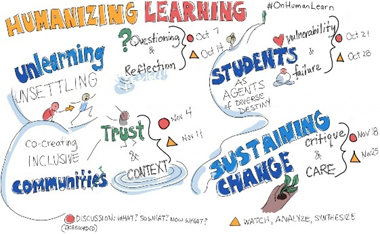
A visualization of the Humanizing Learning co-design schedule from Fall 2021. Drawing by Giulia Forsythe. CC0.

For most trades in Canada, training providers strain to keep up with the demand for tradespeople with adaptive skills, including digital, social, and emotional skills, for future work (Bieler, 2020; Kanwar et al., 2019; Vogt, 2014). Tradespeople typically receive their training in the form of apprenticeships that consist of on-the-job learning and in-person training at a college (Bieler, 2020; Vogt, 2014). The COVID-19 pandemic brought about alternative delivery models and practices for manytechnical and vocational education and training (TVET) institutions because face-to-face instructional time was limited (Vinden et al., 2021). Education collectively continues to cope with and recover from the COVID-19 pandemic. However, the pandemic has also heightened interest in blended delivery for accessible and flexible training (Contact North, 2019; Educause, 2021). Blended learning integrates face-to-face classes with online instruction using various educational technologies, such as e-learning and mobile learning to enrich the learning experience (Vogt, 2014; Dziuban et al., 2018; Herman et al., 2019). Looking ahead, this essay addresses what TVET might look like in 2030, with an emphasis on the role of the educator in educational transformation. Research is inevitably part of making speculations about the future more or less likely (Macgilchrist et al., 2020). Thus, this speculative essay takes an optimistic view and aims to contribute to a more humanized future with blended pedagogies and education modes for TVET education.

By 2030, a possible future is that blended learning modes will be conventional for TVET education. Before the 2020 COVID-19 disruption in education, online and blended pedagogy was well-established in academic higher education programs, with some claiming that blended learning is the new normal (Dziuban et al., 2018; Herman, 2018). However, TVET programs lagged in adopting blended learning (Burke & Larmar, 2020.; Vinden et al., 2021). Pre-2020, there were several pilot programs in TVET across Canada (Vogt, 2014; Kanwar et al., 2019; Contact North, 2019). In the pilot blended programs, different design models were used, and the mix of face-to-face varied depending on the context, with each approach suiting unique student groups and content (Vogt, 2014; Kanwar et al., 2019; Contact North, 2019). Kanwar et al. (2019) found that blended delivery for TVET programs provided many benefits for learners, such as flexibility that serve more diverse groups of learners, opportunities for lifelong learning, technology-enhanced community-based learning, and training access for students living in remote communities. Nevertheless, the pilot programs and the COVID-19 emergency education experiences exposed that TVET educators and students need improved digital skills to adapt to the future of blended education (Vogt, 2014; Kanwar et al., 2019; Vinden et al., 2021).

For blended programs to be effective, instructors need advanced educational technology training. TVET teaching practices need to engage in digital pedagogies, and faculty must be willing to incorporate technology into their teaching and learning practice (Vogt, 2014; Kanwar et al., 2019; Vinden et al., 2021). According to Vinden et al. (2021), COVID-19 brought about the more widespread use of digital tools such as learning management systems, video conferencing, demonstration videos, and simulations (virtual reality) during remote emergency online and blended delivery of TVET programs. I believe that the COVID-19 educational experiences will be a catalyst to expand digital literacy crucial to the future of work and education. Educators must also become fluent in pedagogy and understand the role of technology in education (Educause, 2020; Beile, 2020). Garrison and Vaughan (2008) proposed that blended learning must advance by understanding the challenges associated with shifting teaching and learning paradigms. For example, an educator’s role shifts from lecturer and instructor to facilitator and designer because blended learning emphasises student involvement online and in-class (Kanwar et al., 2019; Contact North, 2019).

For student success in the future, TVET educators must be skilled facilitators to encourage interaction and foster an affective learning environment (Herman, 2018; Palahicky et al., 2019). Burke and Larmar (2020) reported growing evidence that online learning may negatively impact a student’s feeling of connection, leading to isolation, disempowerment, and reduced student outcomes. Palahicky et al. (2019) suggested that instructor care increases student success and engagement. Caring has always been part of good teaching, and the COVID pandemic heightened how vital supportive personal interactions are to students’ well-being and learning (Burke & Lamar, 2020; Hoover et al., 2022). Therefore, I hope that future TVET education is grounded in humanizing pedagogies. My interpretation of the meaning of humanized education is inspired by “Learning to be Human Together” by Green et al. (2022). Green et al. (2022) acknowledged that relationships, inclusivity, connectivity, and pedagogy of care are fundamental to education. In “Reimagining the Student Experience; How colleges can help students connect, belong and engage”, Chronicle writers suggested that students’ apparent desire to connect is a guide to reshape future education to make students’ experience more engaging, worthwhile and successful (Hoover et al., 2022). Thus, pedagogical values, including care, diversity, community and justice, are critical to student success. The future of blended TVET education will follow the trend towards more supportive and connected relationships in education (Palahicky et al., 2019; Hoover, 2022).

In summary, my opinion that blended learning will be commonplace for TVET education by 2030 aligns with education trends. Higher educators will interact with learners in non-traditional ways (Educause, 2021; Hoover et al., 2022). The optimistic future is that education will be more humanized to engage learners actively and make education more flexible, accessible and inclusive (Educause, 2021; Hoover et al., 2022). A common theme in speculations about the future of TVET education is that developing students’ and educators’ digital and social skills is imperative. Pilot blended delivery programs and the COVID-19 emergency education experience provide a foundation to expand blended pedagogies. To enhance TVET teaching practices, faculty must be supported to incorporate technology into their practice, and educators need advanced educational technology training (Vogt, 2014; Kanwar et al., 2019; Vinden et al., 2021). I speculate that by 2030, online learning will have enhanced digital literacy so that tradespeople can continue to learn throughout their careers. Digital and humanized pedagogies will also help build digital and social skills to adapt to future workplaces. Finally, for blended programs to be widespread and effective by 2030, TVET education must continue questioning how to engage students and explore different models and designs for optimal learning experiences (Vogt, 2014; Contact North, 2019).

References

Beile, A. (2020). Bridging generational divides: Advancing Digital Skills in Canada’s apprenticeships and skilled trades ecosystem. The Conference Board of Canada. https://fsc-ccf.ca/research/bridging-generational-divides/

Burke, K., & Larmar, S. (2020). Acknowledging another face in the virtual crowd: Reimagining the online experience in higher education through an online pedagogy of care. Journal of Further and Higher Education, 45(5), 601–615. https://doi.org/10.1080/0309877x.2020.1804536

Contact North. (2019). 220 Pockets of innovation in online learning. Government of Ontario. https://teachonline.ca/sites/default/files/pdfs/contact_north_i_contact_nord_220_pockets_of_innovation_in_online_learning_-_2019_0.pdf

Dziuban, C., Graham, C. R., Moskal, P. D., Norberg, A., & Sicilia, N. (2018). Blended learning: the new normal and emerging technologies. International Journal of Educational Technology in Higher Education, 15(1). https://doi.org/10.1186/s41239-017-0087-5

Educause. (2020, March 2). .2020 Educause Horizon Report: Teaching and learning edition. https://library.educause.edu/resources/2020/3/2020-educause-horizon-report-teaching-and-learning-edition

Educause. (2021, April 26). 2021 Educause Horizon Report: Teaching and learning edition. https://library.educause.edu/resources/2021/4/2021-educause-horizon-report-teaching-and-learning-edition

Garrison, D. R., & Vaughan, N. D. (2008). Blended learning in higher education: Framework, principles, and guidelines – 1st. Ed. Jossey-Bass.

Greene, T., Maher, P., Baker, N., Mommertz, K., Treviranus, J., Jahnke, J. C., Mitchell, J., Hilditch, J., Carroll, H., Bhavsar, H., Forsythe, G., Rawle, F., Cormier, D., Stewart, B., & Co-designed by Students, F., and S. at O. C. A. D. U. (2022, February 28). Learning to be human together. Learning to be Human Together. https://ecampusontario.pressbooks.pub/onhumanlearn/

Hoover, E., Lu, A., Supiano, B., Mangan, K., Swaak, T., Adedoyin, O., Bellows, K., Fischer, K., & Kafka, A. (2022). Reimagining the student experience: How colleges can help students connect, belong, and engage. The Chronicle of Higher Education.

Kanwar, A., Balasubramanian, K., & Carr, A. (2019). Changing the TVET paradigm: New models for lifelong learning. International Journal of Training Research, 17(sup1), 54–68. https://doi.org/10.1080/14480220.2019.1629722

Macgilchrist, F., Allert, H., & Bruch, A. (2020). Students and society in the 2020s. Three future ‘histories’ of education and technology. Learning, Media and Technology, 45(1), 76–89. https://doi.org/10.1080/17439884.2019.1656235

Vinden, S., Flinn, C., & Carson, T. (2021, May 17). Strengthening Digital Teaching & Learning for trades, vocational, education and training practitioners. BCcampus. https://bccampus.ca/2021/05/12/strengthening-digital-teaching-learning-for-trades-vocational-education-and-training-practitioners/

Vogt, R. (2014). Experiences with blended learning program delivery for apprenticeship trades: A case study. International Journal of Higher Education, 3(4). https://doi.org/10.5430/ijhe.v3n4p85

Exploring possible futures: What might technical and vocational education be like in 2030?

Pixabay License. Free for commercial use
No attribution required

Macgilchrist et al. (2020) put forward scenarios for future education to promote inquiry. Research is inevitably part of making speculations about the future more or less likely (Macgilchrist et al., 2020). Thus, I will write a speculative essay to contribute to a more humanized future in technical and vocational education and training (TVET).

Mainly, I will explore new pedagogical blends for more humanized and relational forms of learning (Educause, 2021) for TVET education. The 2020 and 2021 Educause Horizon Reports show the need to focus on flexibility and social dimensions to support students, faculty, and staff health (Educause, 2021). The COVID-19 pandemic exacerbated mental health issues (Educause, 2021). The COVID-19 pandemic also exposed the need for TVET to modernize teaching practices (Vinden et al., 2021).

Transforming TVET teaching practices is needed to engage in digital pedagogies. For example, low digital fluency skills added stress when adapting to digital environments during COVID-19 (Vinden et al., 2021). According to Vinden et al. (2021), COVID-19 brought about innovation, mainly with the use of new digital tools. Macgilchrist et al. (2020) compared current debates about education to those of the 1920s when film was introduced as an educational tool. However, the new device did not transform education (Macgilchrist et al., 2020). My speculative essay will consider how pedagogical blends, including a pedagogy of care, may build on COVID-19 innovations to transform TVET education.

References

2020 Educause Horizon Report: Teaching and learning edition. EDUCAUSE. (2020, March 2). https://library.educause.edu/resources/2020/3/2020-educause-horizon-report-teaching-and-learning-edition

2021 Educause Horizon Report: Teaching and learning edition. EDUCAUSE. (2021, April 26). https://library.educause.edu/resources/2021/4/2021-educause-horizon-report-teaching-and-learning-edition

Macgilchrist, F., Allert, H., & Bruch, A. (2019). Students and society in the 2020s. Three future ‘histories’ of education and technology. Learning, Media and Technology, 45(1), 76–89. https://doi.org/10.1080/17439884.2019.1656235

Vinden, S., Flinn, C., & Carson, T. (2021, May 17). Strengthening Digital Teaching & Learning for trades, vocational, education and training practitioners. BCcampus. https://bccampus.ca/2021/05/12/strengthening-digital-teaching-learning-for-trades-vocational-education-and-training-practitioners/