
What will Technical and Vocational Education and Training Look Like in 2030?
For most trades in Canada, training providers strain to keep up with the demand for tradespeople with adaptive skills, including digital, social, and emotional skills, for future work (Bieler, 2020; Kanwar et al., 2019; Vogt, 2014). Tradespeople typically receive their training in the form of apprenticeships that consist of on-the-job learning and in-person training at a college (Bieler, 2020; Vogt, 2014). The COVID-19 pandemic brought about alternative delivery models and practices for manytechnical and vocational education and training (TVET) institutions because face-to-face instructional time was limited (Vinden et al., 2021). Education collectively continues to cope with and recover from the COVID-19 pandemic. However, the pandemic has also heightened interest in blended delivery for accessible and flexible training (Contact North, 2019; Educause, 2021). Blended learning integrates face-to-face classes with online instruction using various educational technologies, such as e-learning and mobile learning to enrich the learning experience (Vogt, 2014; Dziuban et al., 2018; Herman et al., 2019). Looking ahead, this essay addresses what TVET might look like in 2030, with an emphasis on the role of the educator in educational transformation. Research is inevitably part of making speculations about the future more or less likely (Macgilchrist et al., 2020). Thus, this speculative essay takes an optimistic view and aims to contribute to a more humanized future with blended pedagogies and education modes for TVET education.
By 2030, a possible future is that blended learning modes will be conventional for TVET education. Before the 2020 COVID-19 disruption in education, online and blended pedagogy was well-established in academic higher education programs, with some claiming that blended learning is the new normal (Dziuban et al., 2018; Herman, 2018). However, TVET programs lagged in adopting blended learning (Burke & Larmar, 2020.; Vinden et al., 2021). Pre-2020, there were several pilot programs in TVET across Canada (Vogt, 2014; Kanwar et al., 2019; Contact North, 2019). In the pilot blended programs, different design models were used, and the mix of face-to-face varied depending on the context, with each approach suiting unique student groups and content (Vogt, 2014; Kanwar et al., 2019; Contact North, 2019). Kanwar et al. (2019) found that blended delivery for TVET programs provided many benefits for learners, such as flexibility that serve more diverse groups of learners, opportunities for lifelong learning, technology-enhanced community-based learning, and training access for students living in remote communities. Nevertheless, the pilot programs and the COVID-19 emergency education experiences exposed that TVET educators and students need improved digital skills to adapt to the future of blended education (Vogt, 2014; Kanwar et al., 2019; Vinden et al., 2021).
For blended programs to be effective, instructors need advanced educational technology training. TVET teaching practices need to engage in digital pedagogies, and faculty must be willing to incorporate technology into their teaching and learning practice (Vogt, 2014; Kanwar et al., 2019; Vinden et al., 2021). According to Vinden et al. (2021), COVID-19 brought about the more widespread use of digital tools such as learning management systems, video conferencing, demonstration videos, and simulations (virtual reality) during remote emergency online and blended delivery of TVET programs. I believe that the COVID-19 educational experiences will be a catalyst to expand digital literacy crucial to the future of work and education. Educators must also become fluent in pedagogy and understand the role of technology in education (Educause, 2020; Beile, 2020). Garrison and Vaughan (2008) proposed that blended learning must advance by understanding the challenges associated with shifting teaching and learning paradigms. For example, an educator’s role shifts from lecturer and instructor to facilitator and designer because blended learning emphasises student involvement online and in-class (Kanwar et al., 2019; Contact North, 2019).
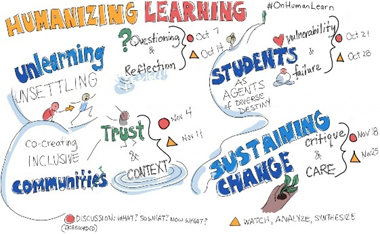
For student success in the future, TVET educators must be skilled facilitators to encourage interaction and foster an affective learning environment (Herman, 2018; Palahicky et al., 2019). Burke and Larmar (2020) reported growing evidence that online learning may negatively impact a student’s feeling of connection, leading to isolation, disempowerment, and reduced student outcomes. Palahicky et al. (2019) suggested that instructor care increases student success and engagement. Caring has always been part of good teaching, and the COVID pandemic heightened how vital supportive personal interactions are to students’ well-being and learning (Burke & Lamar, 2020; Hoover et al., 2022). Therefore, I hope that future TVET education is grounded in humanizing pedagogies. My interpretation of the meaning of humanized education is inspired by “Learning to be Human Together” by Green et al. (2022). Green et al. (2022) acknowledged that relationships, inclusivity, connectivity, and pedagogy of care are fundamental to education. In “Reimagining the Student Experience; How colleges can help students connect, belong and engage”, Chronicle writers suggested that students’ apparent desire to connect is a guide to reshape future education to make students’ experience more engaging, worthwhile and successful (Hoover et al., 2022). Thus, pedagogical values, including care, diversity, community and justice, are critical to student success. The future of blended TVET education will follow the trend towards more supportive and connected relationships in education (Palahicky et al., 2019; Hoover, 2022).
In summary, my opinion that blended learning will be commonplace for TVET education by 2030 aligns with education trends. Higher educators will interact with learners in non-traditional ways (Educause, 2021; Hoover et al., 2022). The optimistic future is that education will be more humanized to engage learners actively and make education more flexible, accessible and inclusive (Educause, 2021; Hoover et al., 2022). A common theme in speculations about the future of TVET education is that developing students’ and educators’ digital and social skills is imperative. Pilot blended delivery programs and the COVID-19 emergency education experience provide a foundation to expand blended pedagogies. To enhance TVET teaching practices, faculty must be supported to incorporate technology into their practice, and educators need advanced educational technology training (Vogt, 2014; Kanwar et al., 2019; Vinden et al., 2021). I speculate that by 2030, online learning will have enhanced digital literacy so that tradespeople can continue to learn throughout their careers. Digital and humanized pedagogies will also help build digital and social skills to adapt to future workplaces. Finally, for blended programs to be widespread and effective by 2030, TVET education must continue questioning how to engage students and explore different models and designs for optimal learning experiences (Vogt, 2014; Contact North, 2019).
References
Beile, A. (2020). Bridging generational divides: Advancing Digital Skills in Canada’s apprenticeships and skilled trades ecosystem. The Conference Board of Canada. https://fsc-ccf.ca/research/bridging-generational-divides/
Burke, K., & Larmar, S. (2020). Acknowledging another face in the virtual crowd: Reimagining the online experience in higher education through an online pedagogy of care. Journal of Further and Higher Education, 45(5), 601–615. https://doi.org/10.1080/0309877x.2020.1804536
Contact North. (2019). 220 Pockets of innovation in online learning. Government of Ontario. https://teachonline.ca/sites/default/files/pdfs/contact_north_i_contact_nord_220_pockets_of_innovation_in_online_learning_-_2019_0.pdf
Dziuban, C., Graham, C. R., Moskal, P. D., Norberg, A., & Sicilia, N. (2018). Blended learning: the new normal and emerging technologies. International Journal of Educational Technology in Higher Education, 15(1). https://doi.org/10.1186/s41239-017-0087-5
Educause. (2020, March 2). .2020 Educause Horizon Report: Teaching and learning edition. https://library.educause.edu/resources/2020/3/2020-educause-horizon-report-teaching-and-learning-edition
Educause. (2021, April 26). 2021 Educause Horizon Report: Teaching and learning edition. https://library.educause.edu/resources/2021/4/2021-educause-horizon-report-teaching-and-learning-edition
Garrison, D. R., & Vaughan, N. D. (2008). Blended learning in higher education: Framework, principles, and guidelines – 1st. Ed. Jossey-Bass.
Greene, T., Maher, P., Baker, N., Mommertz, K., Treviranus, J., Jahnke, J. C., Mitchell, J., Hilditch, J., Carroll, H., Bhavsar, H., Forsythe, G., Rawle, F., Cormier, D., Stewart, B., & Co-designed by Students, F., and S. at O. C. A. D. U. (2022, February 28). Learning to be human together. Learning to be Human Together. https://ecampusontario.pressbooks.pub/onhumanlearn/
Hoover, E., Lu, A., Supiano, B., Mangan, K., Swaak, T., Adedoyin, O., Bellows, K., Fischer, K., & Kafka, A. (2022). Reimagining the student experience: How colleges can help students connect, belong, and engage. The Chronicle of Higher Education.
Kanwar, A., Balasubramanian, K., & Carr, A. (2019). Changing the TVET paradigm: New models for lifelong learning. International Journal of Training Research, 17(sup1), 54–68. https://doi.org/10.1080/14480220.2019.1629722
Macgilchrist, F., Allert, H., & Bruch, A. (2020). Students and society in the 2020s. Three future ‘histories’ of education and technology. Learning, Media and Technology, 45(1), 76–89. https://doi.org/10.1080/17439884.2019.1656235
Vinden, S., Flinn, C., & Carson, T. (2021, May 17). Strengthening Digital Teaching & Learning for trades, vocational, education and training practitioners. BCcampus. https://bccampus.ca/2021/05/12/strengthening-digital-teaching-learning-for-trades-vocational-education-and-training-practitioners/
Vogt, R. (2014). Experiences with blended learning program delivery for apprenticeship trades: A case study. International Journal of Higher Education, 3(4). https://doi.org/10.5430/ijhe.v3n4p85
