In my professional practice, I assist adult learners in preparing for regulatory exams that increasingly require integrating multiple concepts. Learners can usually achieve competency in the foundational knowledge, yet often stumble when required to synthesize knowledge across different areas. The third-party vendor materials provide an excellent framework for acquiring foundational knowledge, but our team is responsible for developing the skill of synthesis. The 4C/ID model of van Merriënboer, described by Frerejean et al. (2019), and the Understanding by Design (UbD) model from McTighe and Wiggins (2012) serve complementary roles in instructional design to help us bridge this gap.
Both models emphasize transferring learning toward authentic, real-world performance, to be demonstrated on assessments that simulate real-world tasks. However, UbD’s central premise is working backward from that endpoint, whereas 4C/ID provides more granular guidance for building a whole-task learning experience and competencies. The benefit of using both models concurrently is that they provide reciprocal checks and balances on the instructional design. UbD’s focus on alignment can expose gaps between instructional activities and required outcomes, while 4C/ID’s emphasis on authentic tasks can reveal skills or knowledge that were missed or lacked adequate scaffolding in the original design.
For efficiency, our team typically doesn’t evaluate our design output through multiple lenses. Instead, we usually select a single best practice model for developing learning programs. The potential trade-off for that efficiency is overlooking weaknesses in our designs. This comparison directly challenges our current practice of selecting and using a single, supposedly most suitable model. Whether the designs could be sufficiently strengthened to justify the effort of evaluating through two models is a question for exploration.
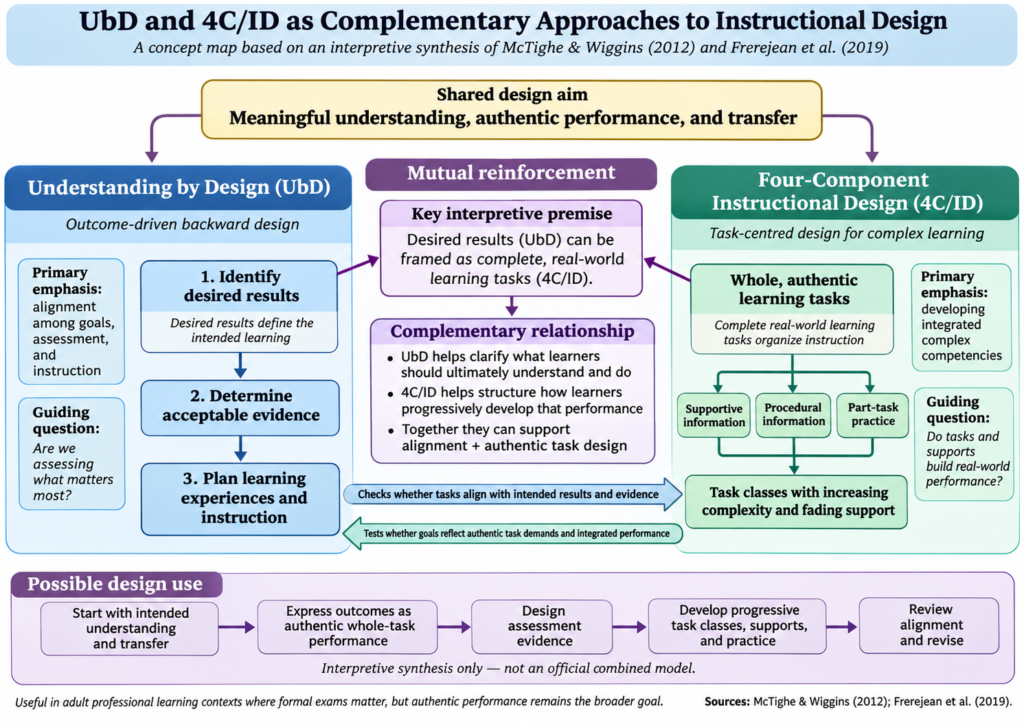
The flows and directionality of the concept map below illustrate the potential interconnectivity and mutual reinforcement of UbD and 4C/ID more effectively than other comparative tools such as a simple table.
References
Frerejean, J., van Merriënboer, J. J. G., Kirschner, P. A., Roex, A., Aertgeerts, B., & Marcellis, M. (2019). Designing instruction for complex learning: 4C/ID in higher education. European Journal of Education, 54(4), 513–524. https://doi.org/10.1111/ejed.12363
McTighe, J., & Wiggins, G. (2012). The Understanding by Design framework. ASCD. https://files.ascd.org/staticfiles/ascd/pdf/siteASCD/publications/UbD_WhitePaper0312.pdf
Statement on the use of AI
All words were written by me*, then refined using suggestions from Grammarly. I also used both Google Scholar and the Royal Roads library search tools to help me find references to explore, before settling on the two reference sources above.
I generated my concept map using ChatGPT with the following prompt, “Using my blog posts’s premise that 4C and UdB (from my 2 reference sources I have selected) are mutually reinforcing, where the desired results (for UbD) = complete, real-world learning tasks (for 4C), create a visual concept map of how they complement one another within instructional design.” Since my skills for creating visual items are sorely lacking, I very much appreciate being able to offload this task to generative AI, allowing me to focus on critical thinking.
* ChatGPT generated the blog post title for me. I am not good with catchy wording, and therefore I similarly appreciate generative AI’s ability to step in for me for this task.
Leave a Reply