Introduction
When working in ever-changing online learning environments, successfully supporting learners to success requires that facilitators leverage a set of proven instructional strategies that help to create and sustain learner engagement.
Plan Your Facilitation Approach
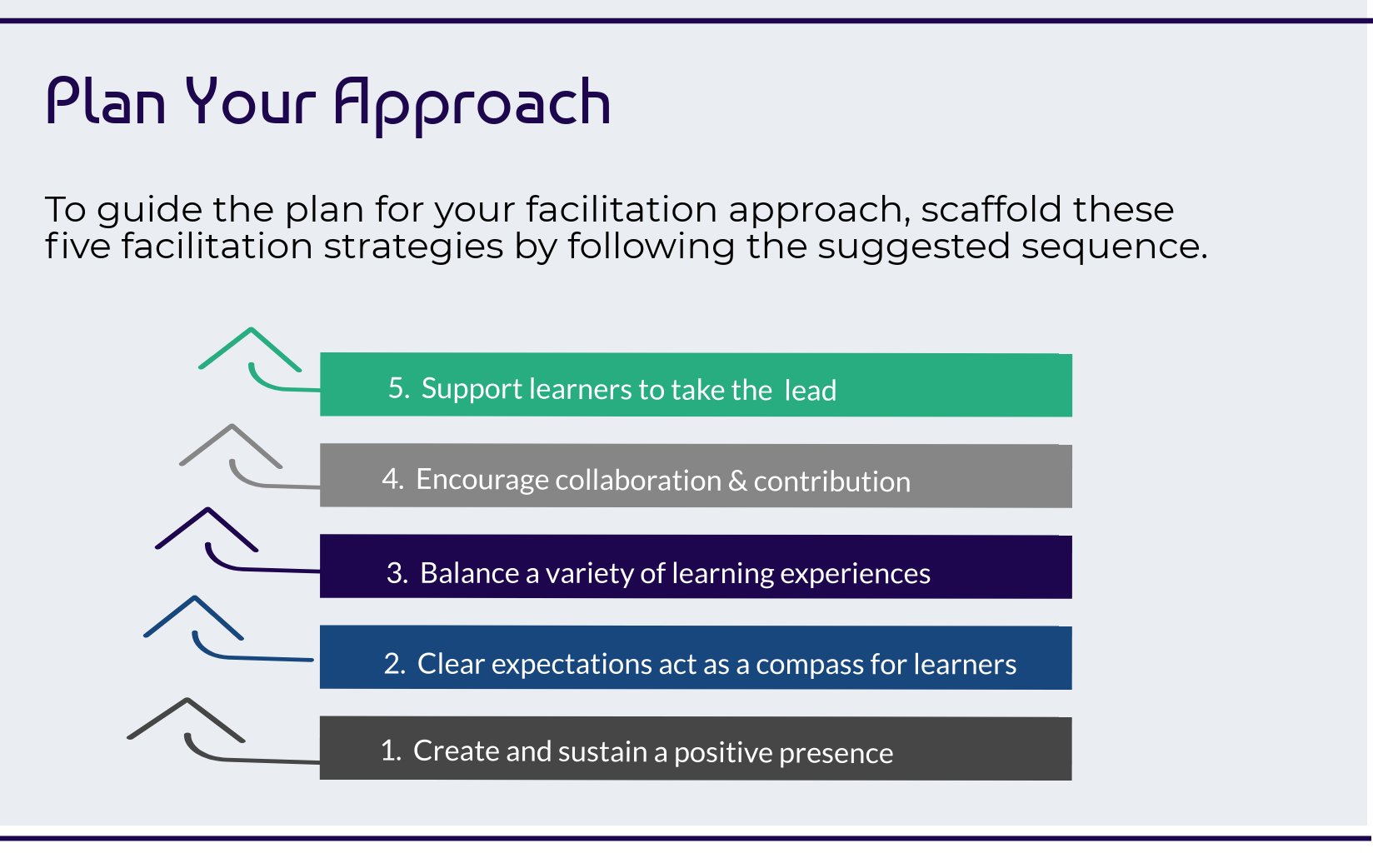
When planning your approach to effective facilitation in an online learning environment, scaffold these five facilitation strategies by following the suggested sequence:
- Start by determining how you will create and sustain a positive presence (Boettcher, 2013; Bonk, 2010; Bull, 2013; Dunlap & Lowenthal, 2018; Salmon, 2018).
- Next consider how you will provide clear expectations, which will act as a compass for learners (Boettcher, 2013; Bonk, 2010; Bull, 2013; Dunlap & Lowenthal, 2018; Salmon, 2018).
- As you develop activities, balance a variety of learning experiences so that you honour all types of learners (Boettcher, 2013; Bull, 2013; Dunlap & Lowenthal, 2018).
- Ensure that you incorporate ways that encourage learners to collaborate and contribute within and outside of the learning community (Boettcher, 2013; Bonk, 2010; Bull, 2013; Dunlap & Lowenthal, 2018; Salmon, 2018).
- Finally, make sure that your planned approach will support learners to take the lead in their learning experience (Bonk, 2010; Bull, 2013; Dunlap & Lowenthal, 2018; Salmon, 2018).
Sustain Your Facilitation Approach
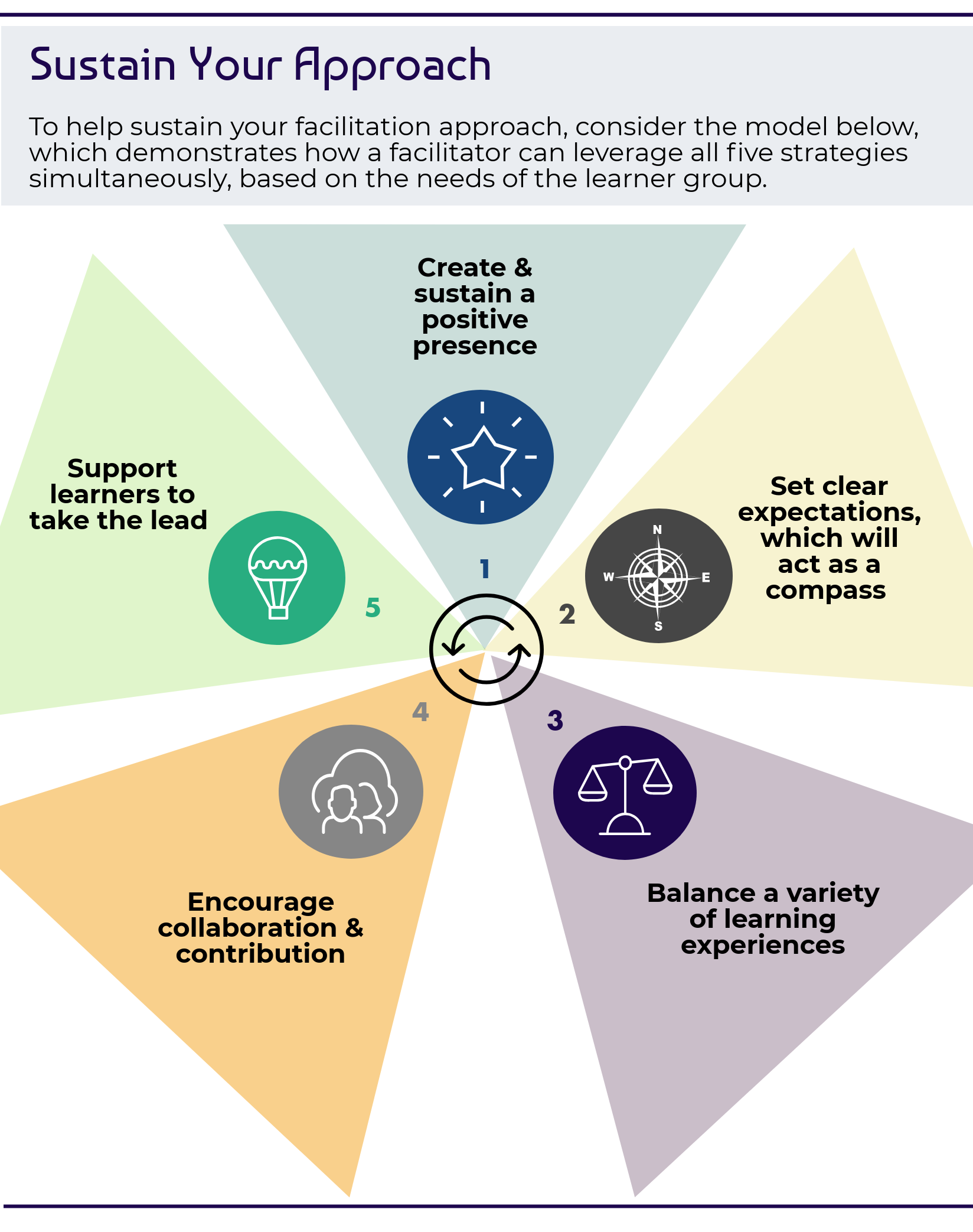
Remember that online learning environments are ever-changing, so during facilitation you will need to keep all five strategies as a priority so that you best engage and support diverse learner needs throughout the duration of your course.
In the infographic below, consider the model proposed, which demonstrates how a facilitator can sustain their planned facilitation approach by leveraging all five strategies simultaneously to support learners to success.
Consider and Select Appropriate Actions
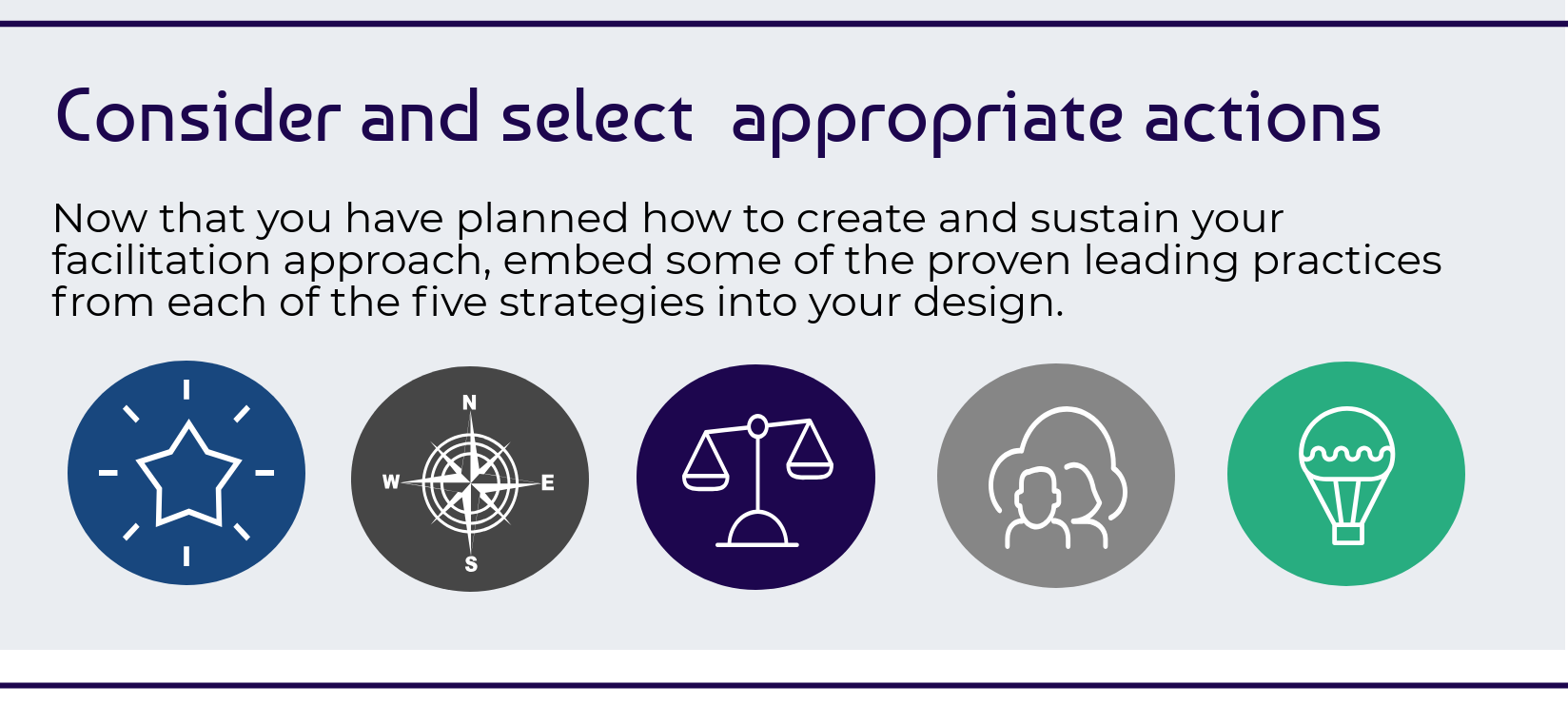
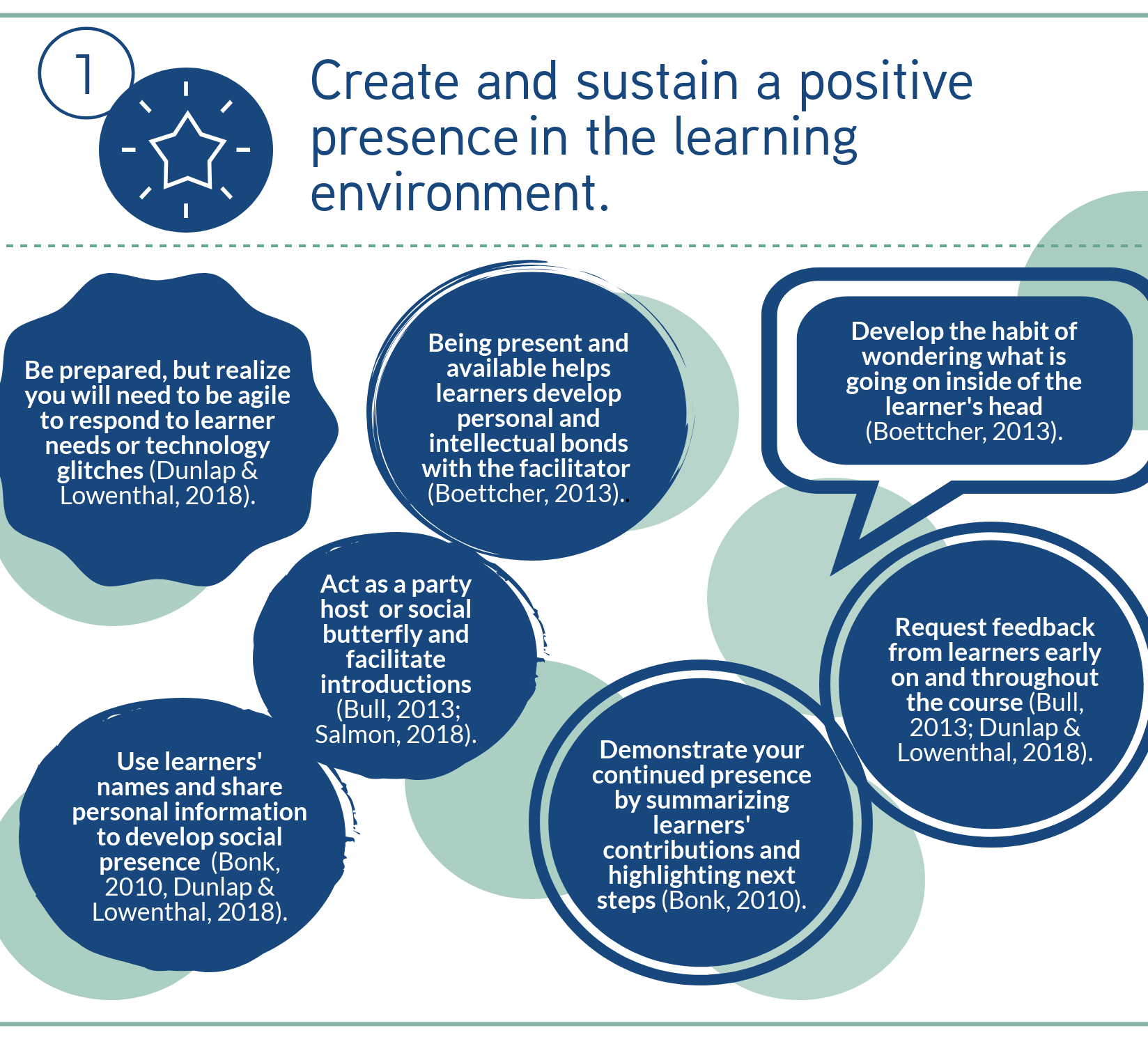
Now that you have planned how to create and sustain your facilitation approach, embed actions from each of the five strategies.
Embrace a Continuous Improvement Mindset
Effective online facilitation takes practice. Each course that you design and facilitate will provide valuable feedback from learners that will help you to continuously improve your approach moving forward. Consider tracking feedback so that you can evaluate responses from diverse learners, arming you with a toolkit of strategies and supporting actions that you can leverage as you learn and grow as an online facilitator.

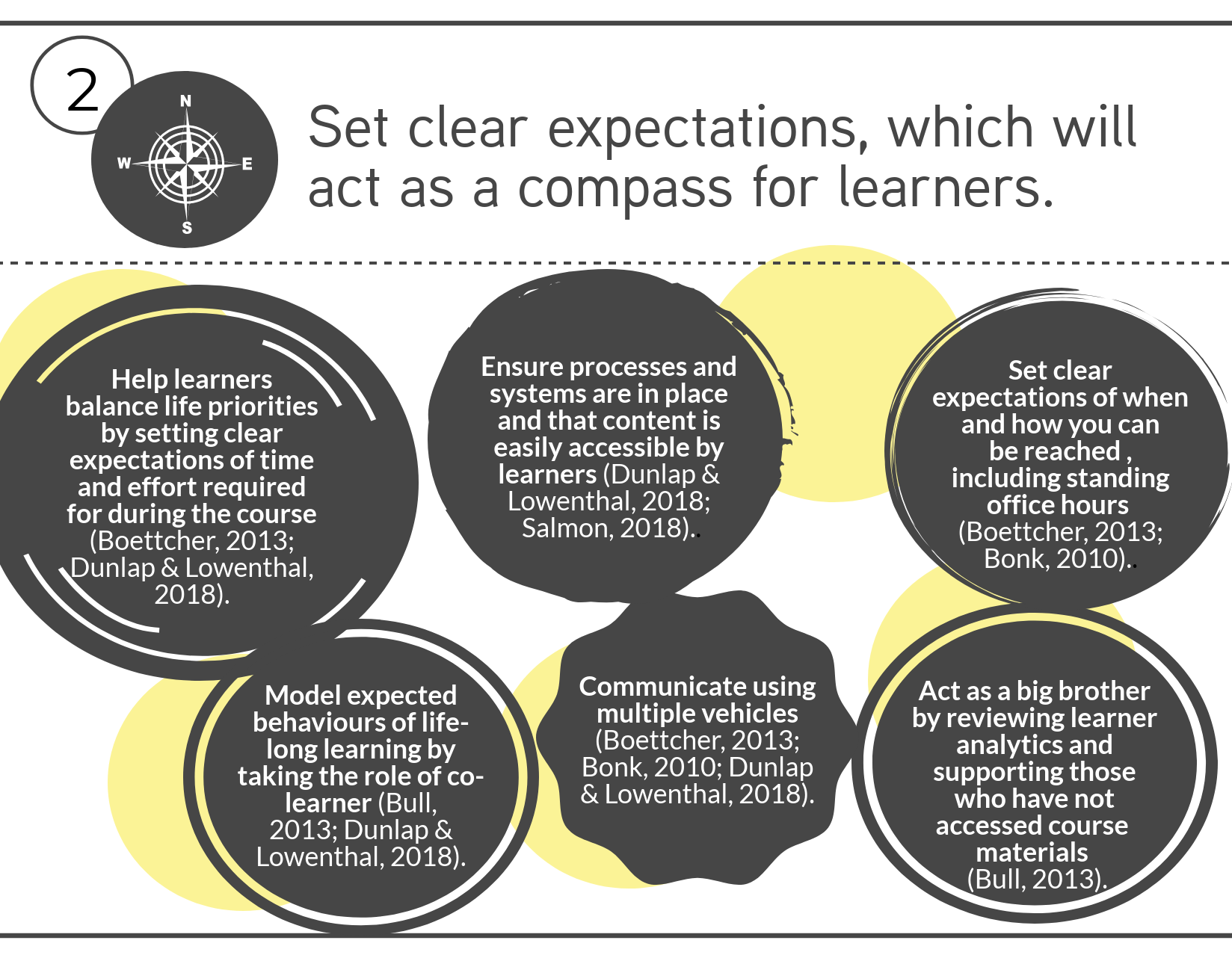
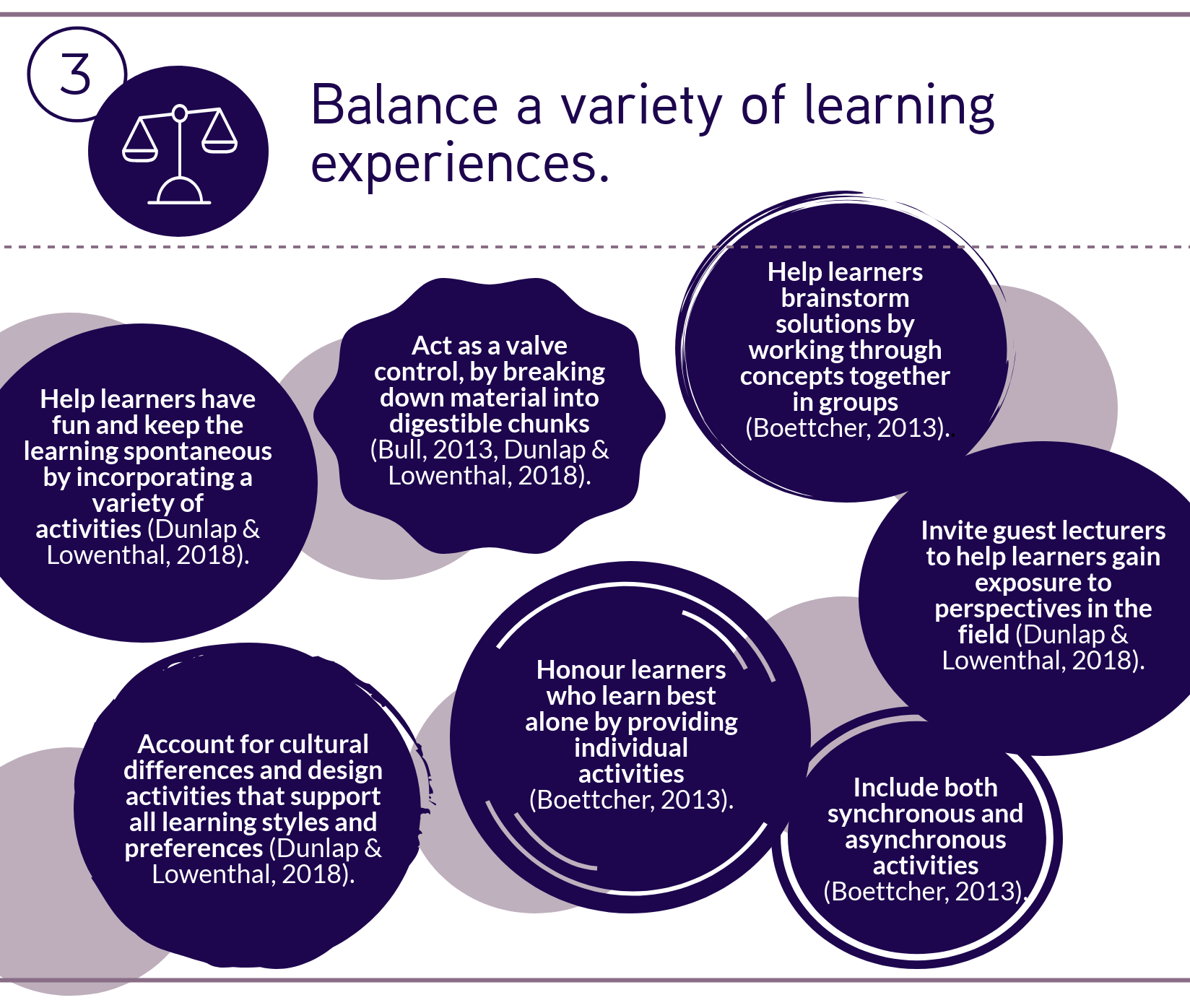
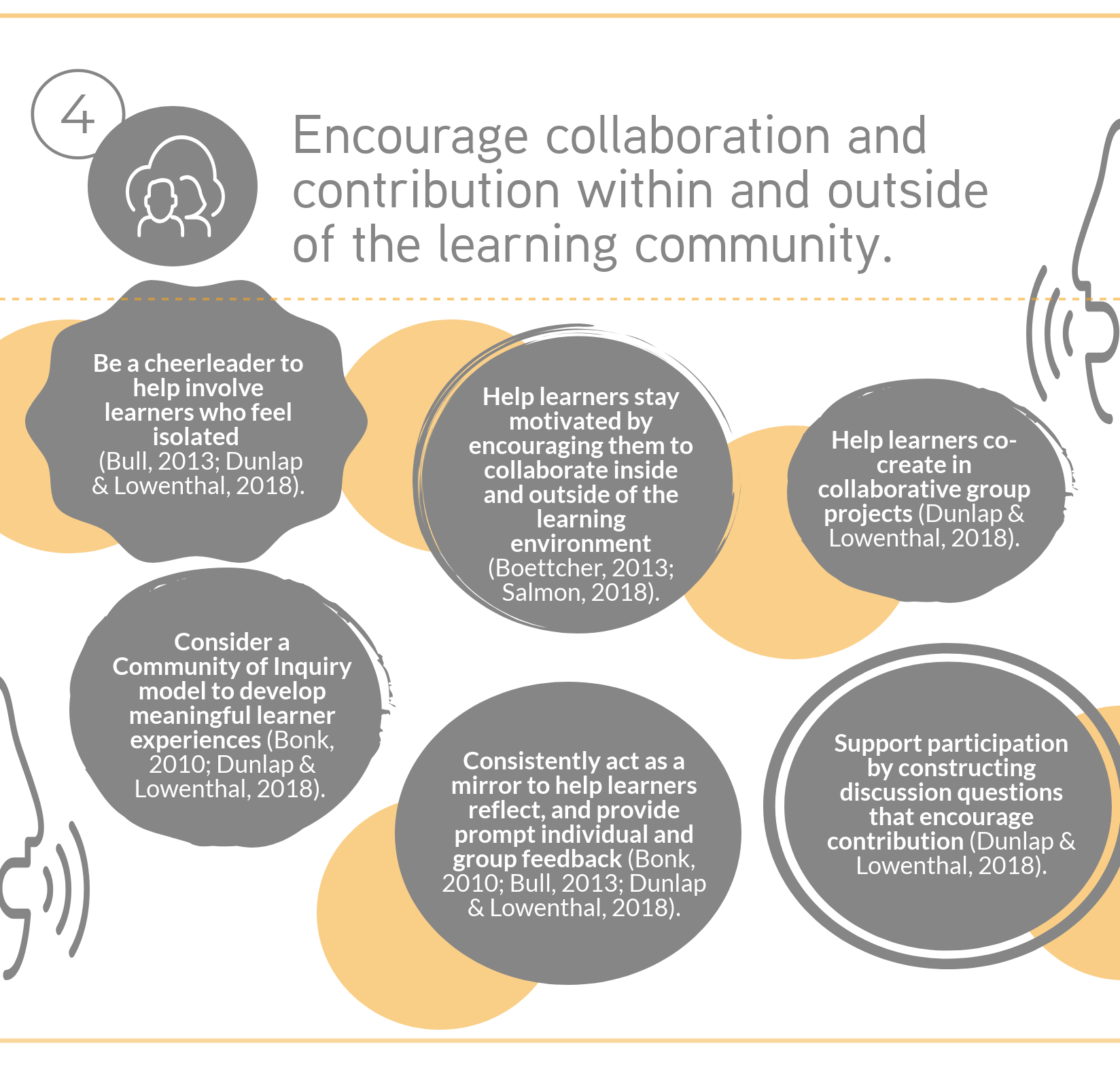
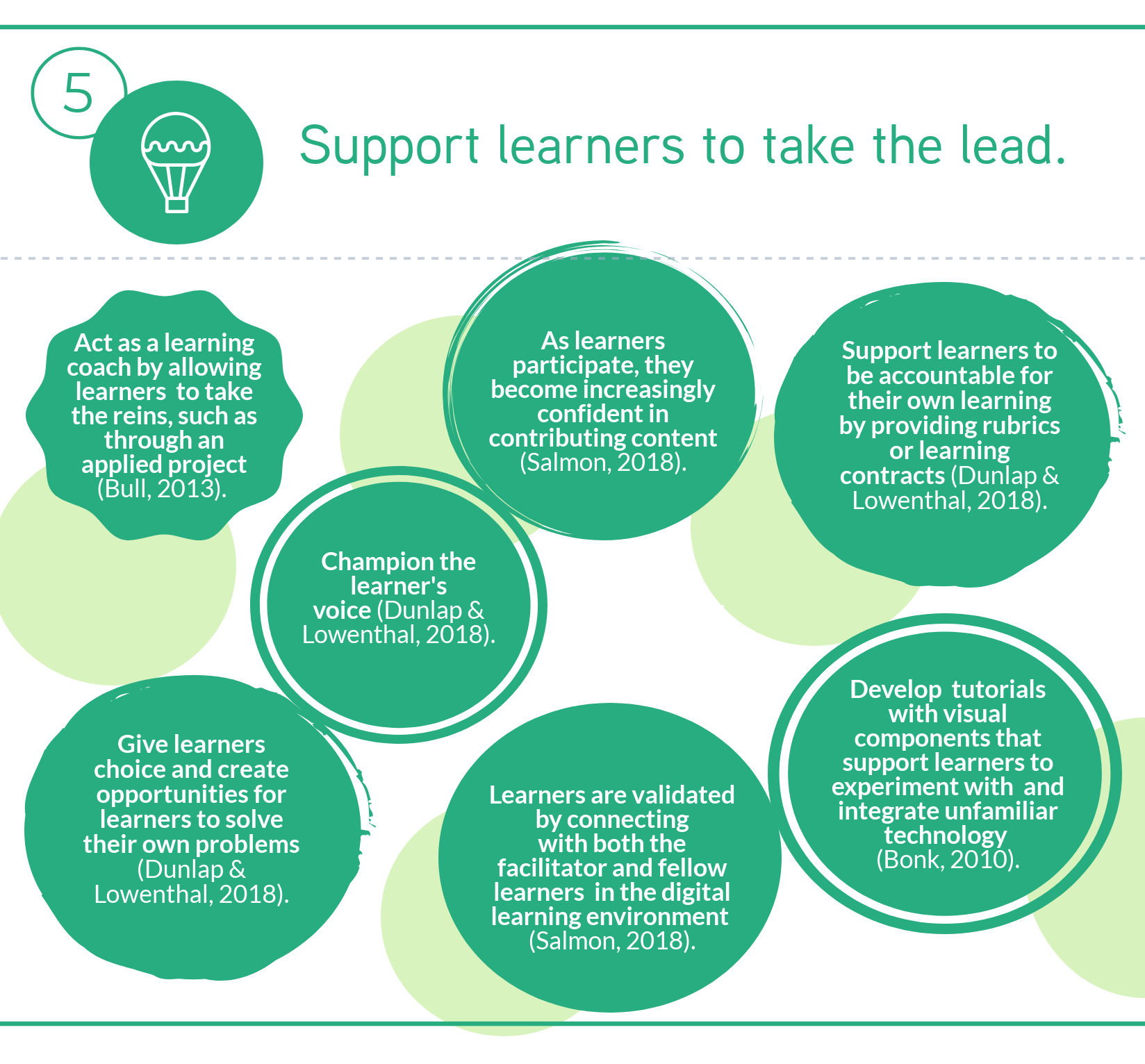

Hello Karen!
I find your post and infographic very familiar, and that is for no other reason than me also being confronted with a lot of good advises for an effective facilitation. No doubt the readings were filled with excellent information so I guess you, like me, spent quite some time selecting which ones to include in the report. I see you mention several tips for every one of the top five strategies. Although the approaches differ a little, both group items to sum up the final cut. I particularly agree with your final statement about continuously improving, a facilitator has to be constantly learning from students, from content, and from the sessions’ experience.
Cheers!
Alfonso
Thanks, Alfonso, for your comments. I did take a look at your infographic and agree that we had quite a few similarities. As I work in the corporate sector, measurements and continuous improvement are a daily reality for me, especially during budget time – haha! Karen.
Hi Karen, fantastic graphic. I like how you have the bite-sized statements for each tip from your resources. I agree with all the tips (not surprising as you commented as much on my infographic), but I was wondering if you’ve considered any conflict between Points 3 & 4. By personalizing and supporting all learning styles you may run into learners who would prefer to be less interactive and recluse. There are learners who select online learning because they are more introverted and prefer not to collaborate as much. Bringing those students into the fold may prove to be a challenge. As you sum up in your post, continuous improvement and experience should be helpful. As I have limited facilitation experience myself, I was wondering if you’ve experienced this issue (or anyone else who wants to chime in)?
Thanks,
Karen this is wonderful work. Well done. You managed to nicely synthesize all the core unit readings and cleanly organize them into different themes, picking up on the thematic similarities of the unit readings. One question. I notice that the arrows in the “Sustain your Approach” section seem to run against the natural 1,2 3, progression flow of the numbers. Was that intentional?
I am impressed how you have outlined a well-balanced groping of tips within your infographic and write-up. Boettcher (2011) emphasizes that the focus of online facilitation should be on the learner and promote effective methods of supporting the learner. Boettcher (2011) further explains that both the learner and the facilitator should also both be part of the educational experience. The presentation of the information in your infographic elaborates on learner-centred facilitation, while the flow helps build the tools to facilitate an online environment dedicated for the learner. You final tip grouping, at the end of your list, that promotes the learner to take the lead resonates with my own curriculum development, specifically the tip that focuses on student accountability. This point is reflected through feedback from the community, governments, and “employers who want more accountability and the development of graduates” (Bates, 2015, p.1). I tend to describe accountability as the right-of-passage stage of the learner.
References
Bates, A. (2015). Teaching in a Digital Age – The Open Textbook Project provides flexible and affordable access to higher education resources. Retrieved from https://opentextbc.ca/teachinginadigitalage/
Boettcher, J. (n.d.). Ten Best Practices for Teaching Online. Retrieved September 4, 2018, from http://www.designingforlearning.info/services/writing/ecoach/tenbest.html