Having now attempted to complete my first environmental scan, I appreciate that conducting research takes practice and have uncovered some missteps in my design decisions that I can leverage to improve future research attempts. In designing my approach I first chose the tool that I would use to display results from my data collection, selecting Piktochart, and then worked to create questions that would result in data that could be easily translated into an infographic. This design decision did result in my ability to share data visually, but narrowed the opportunity to dig deeper to further explore the network participants’ specific examples of effective change management experiences.

In selecting my network, I chose to gather perspectives from those who I knew had relevant experiences to share. With scheduling, including time zone and availability differences as a recurrent challenge, most of my contact with participants was via text or email. Although I did work to describe the purpose of this research, in future I will ensure that synchronous options to connect are prioritized so participants can ask questions and I can provide clarity as needed.

Finally, in an effort to honour confidentiality, I committed to amalgamating results into trends. In future, I will spend more time with my network by building in multiple contact points so I can dig deeper and explore each participant’s level of comfort with sharing examples from their experiences. Overall, input from my network participants does echo key findings from established change management models and theories. I am left wondering what else I could have uncovered if I had made different design decisions throughout this exercise, but am excited to leverage this learning in the future.

Leading Through Change

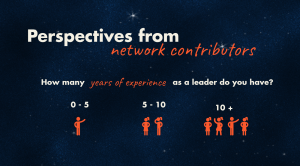
Personal communications with my seven network participants uncovered three trends that align with established change management models and theories:

1.     Leaders must be passionate, engaging and committed to change.

2.     Leaders must prioritize change as a team activity.

3.     Leaders must spend time planning and preparing for change.

Leaders Must Be Passionate, Engaging and Committed to Change

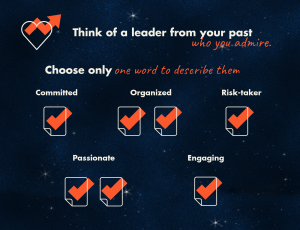
Kuipers et al. (2014) describe leadership as “an important driver of change” (p. 23). When asked to choose one word to describe a change leader from their past whom they admired, 57 per cent of network respondents contributed ideas around passion, commitment and an ability to engage the team. Weiner (2009) agrees that building organizational readiness for change requires that leaders engage participants in sharing a commitment to implementing change and in believing that they will succeed. By inspiring a shared vision, participants gain clarity on how their commitment will contribute to achieving successful change outcomes (Graetz, 2000).

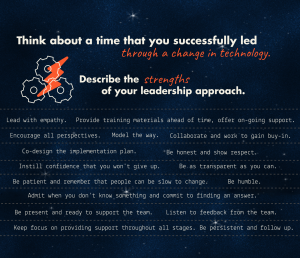
When developing organizational readiness for change, Jaskyte (2004) found that leaders must motivate their teams to commit to change by supporting the development of shared values and practices that support innovation. Themes of leading with passion, commitment, and engaging the team again emerged when participants described strengths in their leadership approach, such as: model the way, instill confidence that you won’t give up, and be present and ready to support the team. These leadership approaches demonstrate passion for the proposed change and a commitment to engaging in following it through to success.

Along with being passionate, engaged and committed to change, network participants agree that collaboration is a key success determinant when leading through change.

Leaders Must Prioritize Change as a Team Activity

Al-Haddad and Kotnour (2015) state that strong collaboration by all stakeholders can support successful outcomes when leading through change by encouraging teams to participate and become active contributors. When reflecting on the strengths they adopted during a successful change they led, participants shared examples of behaviours that support collaboration. Responses including encouraging all perspectives, co-designing the implementation plan, working to gain buy in through collaboration, listening to feedback, being persistent and following up, all encourage the team to share their perspectives. As Weiner (2009) found, when participants value the proposed change, they exhibit high efficacy are more likely to demonstrate behaviours required to support the change initiative.

Part of supporting their teams to participate actively requires that leaders also demonstrate commitment by effectively planning and preparing for change.

Leaders Must Spend Time Planning and Preparing for Change

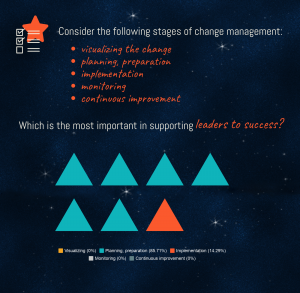
Planning and preparation are common components in the examples shared in Al-Haddad and Kotnour’s (2015) exploration of successful change models. Six of seven network respondents agree that planning and preparation are important considerations when leading through change. Examples of leadership strengths that network participants have successfully leveraged to support them through change that relate to planning and preparation include: provide training materials ahead of time, keep focus on providing support throughout all stages, and be as transparent as you can. 

When reflecting back on leaders they admire, 29 per cent of participants described organization as a key success factor. One network participant contributed an idea that change leaders must be patient and remember that people can be slow to change. Another shared a best practice was to admit when you don’t know something and commit to finding an answer. Both responses highlight that today’s ever-shifting environment demands that change leaders must also engage change methods which also continuously evolve (Al-Haddad & Kotnour, 2015) and plan and prepare to flex their approach when the environment shifts.

Conclusion

In 2000, Graetz stated that implementing change successfully is the primary task that all leaders of face. Al-Haddad and Kotnour (2015) share that “change leaders are people with creative visions, who are able to foresee a new reality and how to get to it” (p. 239). Leading with passion and commitment helps to engage  participation in the change process and works to develop a shared vision of success.

Using a collaborative approach also engages teams, especially when, as one participant shared, leaders lead with empathy. When change leaders design strategies with an empathetic approach, participants are encouraged to view the change through different perspectives, permitting openness and creative exploration (Mattelmäki, Vaajakallio, & Koskinen, 2014).

In today’s ever-changing environment, change leaders must plan and prepare not only for a successful implementation, but to make on-going changes in their approach when the environment shifts. By leading the team with a focus on being prepared for these shifts, a leader establishes change as an opportunity to continually strive for an established shared vision of success.

References

Al-Haddad, S., & Kotnour, T. (2015). Integrating the organizational change literature: a model for successful change. Journal of Organizational Change Management28(2), 234-262.

Graetz, F. (2000). Strategic change leadership. Management decision38(8), 550-564.

Jaskyte, K. (2004). Transformational leadership, organizational culture, and innovativeness in nonprofit organizations. Nonprofit Management and Leadership15(2), 153-168.

Kuipers, B. S., Higgs, M., Kickert, W., Tummers, L., Grandia, J., & Van der Voet, J. (2014). The management of change in public organizations: A literature review. Public administration92(1), 1-20.

Mattelmäki, T., Vaajakallio, K., & Koskinen, I. (2014). What Happened to Empathic Design?. Design issues30(1), 67-77.

Weiner, B. J. (2009). A theory of organizational readiness for change. Implementation science4(1), 67.

Leading change

Embracing change is standard in today’s environment if an organization wants to succeed and thrive, yet Al-Haddad and Kotnour (2015) found that success rates for change initiatives fall at less than 30 percent. If organizations need to change and adapt to their environment, what is the missing link to success?

I agree with Feldstein (2017), when they suggest that there is not one LMS (Learning Management System) that can meet the diverse needs of all environments. Taking a one-size fits all approaches cannot work, as each organization faces different challenges and because the environment itself is continuously evolving (Al-Haddad & Kotnour, 2015). Perhaps, then, the missing link is developing organizational readiness for change. Jaskyte (2004) shares that for organizations to develop a readiness for change, organizational leaders must motivate their teams to commit to change by supporting the development of shared values and practices that support innovation. Doing so can help a leader to shape the organization’s change culture, and shift it towards one that fosters innovation, where stakeholders are committed to change and believe in their ability to execute that change through their actions (Weiner, 2009).

Change leaders have the ability to see where their organization must grow, and can motivate their employees to take an active part in the change process (Al-Haddad & Kotnour, 2015). Along with setting the vision, leaders who join their teams as part of the “value chain” (Udas, 2008, para. 3) work in partnership to co-design a deep understanding of “task demands, resource availability and situational factors” (Weiner, 2009, p. 70). By collaborating during these environmental scans, leaders help teams “to take responsibility and be an active part of the change” (Al-Haddad & Kotnour, 2015, p. 239) and work to tease out past and current challenges. I believe that implementing change is a team process, and that team members who value a proposed change and believe in its importance for the organization are more likely to validate their commitment by demonstrating the behaviours required in changing environments (Weiner, 2009).

Based on the change theories outlined in Al-Haddad and Kotnour (2015), I believe the Leucke method best fits my approach, because change is proposed by leaders as an opportunity, as opposed to a threat. Core to my leadership approach is to engage disparate viewpoints and to support suggested risks, as long as they align with the set vision. To shift the culture in our organization our leadership team engaged the team to explore current and past problems and solutions, working to create of a shared vision of success. We focused on how the new technology will support our end users to success in their practice and committed to a continuous improvement mindset that allows us to flex as the environment shifts.

When considering Weller’s (2013) four factors of resilience: latitude, resistance, precariousness and panarchy, I was left with some questions for our organizational context. How resistant is our team to changing the procedures they’ve come to master? Are the changes we plan to make are too fulsome to be sustainable? Are we already operating at our organization’s limit and will external forces shift the environment to a completely new or renewed state? Leaders who lead change in digital environments work to leverage technology where it would support change, while retaining the core function and identity of the existing practice (Weller, 2013). This idea reminds me to lead the team in prioritizing the fulfillment of our shared vision, as this lens will help us make decisions that align with our end users’ needs. I believe that our careful commitment to collaboration and to a continuous improvement mindset will provide a resilient framework that readies us for organizational change. By working together and promoting the value of leadership at all levels, we can absorb change and continue to evolve to meet the needs of our end users.

References

Al-Haddad, S., & Kotnour, T. (2015). Integrating the organizational change literature: a model for successful change. Journal of Organizational Change Management28(2), 234-262.

Feldstein, M. (2017, May 28). A flexible, interoperable digital learning platform: Are we there yet? [blog post]. Retrieved from https://mfeldstein.com/flexible-interoperable-digital-learning-platform-yet/

Jaskyte, K. (2004). Transformational leadership, organizational culture, and innovativeness in nonprofit organizations. Nonprofit Management and Leadership15(2), 153-168.

Udas, K. (2008, June 30). Distributed learning environments and OER: the change management challenge. [blog post]. Retrieved from https://web.archive.org/web/20160309200155/http://mfeldstein.com/distributed-learning-environments-and-oer-the-change-management-challenge/

Weiner, B. J. (2009). A theory of organizational readiness for change. Implementation science4(1), 67.

Weller, M., & Anderson, T. (2013). Digital resilience in higher education. European Journal of Open, Distance and E-learning16(1).

Leading with Energy and Enthusiasm

Continual technological advances permeate everything we do, in work and in play. By continuing to accept a “head in the sand mentality” (Sheninger, 2014, p. 1) toward implementing new or renewed approaches in digital learning environments (DLEs), leaders deny their teams the ability to the develop the capacity needed to succeed when technological advances shift their environment. For teams to be successful in today’s ever-changing environments, they need leaders who collaborate to create a shared vision of success, who model open communication and who embrace a continuous improvement mindset.

My Leadership Approach:
Early in my leadership journey I was introduced to Simon Sinek’s (2011) “Golden Circle” concept, which guides leaders to inspire action by helping teams to articulate not just what they do every day, or how they complete tasks in their role, but why their work is important within their organization’s context. Although I didn’t realize it at the time, I can now see that Sinek’s work introduced me to one of my core leadership approaches, wherein I start work with a new team by encouraging collaboration. By teasing out and exploring individual perspectives, I support the team to shape a compelling shared vision of the future, resulting in team members who are united by a common purpose (O’Toole, 2008).

Much of my leadership experience has been gained through project-based work, wherein I parachute into an existing team to lead the implementation of a new or renewed approach to service delivery. By consistently modeling open communication, individual team members are motivated to contribute, as they trust that their perspectives will be valued (Castelli, 2017). This helps to set the foundation of a safe environment.

Throughout my leadership experiences, I have consistently found that some of the best ideas arise through ongoing environmental scans that include the divergent perspectives of all team members, (Huggins, Klar, Hammonds & Buskey, 2017) and that valuable lessons can be uncovered from feedback during or after project implementation. Co-owning triumphs and challenges supports a shared approach that promotes trust, values open communication, connects work to the organization’s mission, and builds self-esteem and confidence in the workforce (Castelli, 2016). I believe that debriefing what was learned throughout the life-cycle of a project further supports the continual development of a shared vision and demonstrates a commitment to continuous improvement.

Since organizational priorities shift, core to my leadership approach is supporting my team members to develop confidence in their individual leadership capacity. This takes an enthusiastic commitment to mindfully create “leadership opportunities” (Huggins et al., 2017, p. 8) for all team members. Doing so follows a distributed leadership approach and requires sustained energy and a tolerance for risk. Although it is true that a team member may make mistakes, which could negatively reflect on my leadership, my experience in distributing leadership across all desks has led to innovative ideas for program or service delivery.

Leading in Digital Environments:
I agree with Sheninger (2014) when he states that “leaders need to be the catalysts for change” (p. 4), especially when leading in digital learning environments. Leaders must also realize that each team member is different, with resistance to embracing technology running along a continuum from those who refuse to participate to early adopters. Like Sheninger (2014) describes, leading through technology changes requires that leaders understand that learners may have a fear around using technology to complete tasks. By encouraging collaboration, team members share their collective knowledge and are better able to adapt in changing environments (Khan, 2017).

Technology changes rapidly, so leading in a digital learning environment requires leaders to prioritize the development of agile teams. Leaders who work with their teams to set a shared vision help to support ever-changing DLEs by developing ongoing team capacity, as evidenced in Castelli (2016), where “the legacy of the leader’s influence is perpetuated through the followers’ incorporation of legacy principles into their lives as they become leaders” (p. 220).

Building leadership capacity at all levels helps to increase organizational capacity and tolerance to change. Sustainable change in DLEs requires that leaders empower teams and embrace technology through a strategic mindset that improves desired outcomes by leveraging available resources (Sheninger, 2014). By working to engage all stakeholders of an organization through open communication, collaboration and a commitment to continuous improvement, leaders in digital environments lay the groundwork for teams to share leading practices and to work with a common purpose. Doing so helps individuals to confidently make decisions in their work, as all decisions are framed within a shared compelling vision, regardless of shifts in technology or organizational priorities.

Conclusion:
Successful leaders adopt the approaches that their teams need to succeed. Using a values-based leadership framework supports the development of a team’s leadership capacity. When leaders support decisions that are important to members of the group, team members are motivated, as the leader helps “them to realize the things they hold most dear, that which they value” (O’Toole, 2008, p. 2). Values based leadership creates a common language of behaviour that cements the team’s purpose, setting the vision of how work is completed and how services are delivered.

By consistently acting on behalf of the team, a leader provides the conditions and resources that the team needs to succeed, but that they couldn’t provide on their own (O’Toole). Distributing leadership throughout a team also helps to develop the team’s leadership capacity, building each person’s confidence to share leading practices and to support one another. As Huggins et al (2017) describe, leadership development is a process that requires leadership capacity builders to direct, monitor and provide feedback. Leaders that consistently practice reflection ask what was learned throughout and after project completion.

As I continue my leadership development journey, I will be mindful to continue focusing on encouraging collaboration, practicing open communication and embracing a continuous improvement mindset. These core principles, coupled with mindful implementation of values-based, distributed and reflective leadership practices will work in concert to provide the foundation that our teams need to successfully sustain technological and organizational shifts.

References

Castelli, P. (2016). Reflective leadership review: a framework for improving organisational performance. Journal of Management Development, 35(2), 217-236.

Huggins, K., Klar, H. W., Hammonds, H. L., & Buskey, F. C. (2017). Developing Leadership Capacity in Others: An Examination of High School Principals’ Personal Capacities for Fostering Leadership. International Journal of Education Policy and Leadership, 12(1).

Khan, N. (2017). Adaptive or Transactional Leadership in Current Higher Education: A Brief Comparison. The International Review of Research in Open and Distributed Learning, 18(3).

O’Toole, James (2008). Notes Toward a Definition of Values-Based Leadership. The Journal of Values-Based Leadership, 1(1).

Sheninger, E. (2014). Pillars of digital leadership. International Centre for Leadership in Education.

Sinek, S. (2011). Start with why: How great leaders inspire everyone to take action. Penguin.