Which framework(s) will provide the backbone?


In the first Padlet exercise of LRNT 622 I listed a few overarching goals, one of which described that findings should be applicable to an adult learner group, making Adult Learning Theory seemingly a good fit. Ruey (2010) explores how using Knowles’ contract learning concept can help learners plan experiences based on their needs, prior experiences, goals, interests and self-concept. Doing so can increase learner self-awareness around their preferred learning style, which can help the learner assume more responsibility for their own learning. Since the model I hope to evaluate would include on-demand learning, this theoretical framework should help to provide a backbone of known information off of which my research will build.

The second framework that seems like it may be valuable to bound the research is Engagement Theory, which also focuses on experiential and self-directed learning (Kearsley & Shneiderman, 1993). Bonk and Khoo (2014) suggest that learner engagement is manifested through behaviour, and that “when it comes to achievement, involvement in the learning process matters” (p. 209).

A couple of questions popped up for me to consider:

  1. I wonder if the fact that the professional development I am exploring is mandatory and tied directly to the learners’ ability to sustain their professional designation will have an impact?
  2. I wonder how or if a learner’s ability and comfort level with using technology will factor in when evaluating strategies for online professional development?

References

Bonk, C. J., & Khoo, E. (2014). Adding some TEC-VARIETY: 100+ activities for motivating and retaining learners online (pp. 1-368). OpenWorldBooks.com and Amazon CreateSpace.

Kearsley, G., & Shneiderman, B. (1998). Engagement theory: A framework for technology-based teaching and learning. Educational technology38(5), 20-23.

Ruey, S. (2010). A case study of constructivist instructional strategies for adult online lea rning. British Journal of Educational Technology, 41(5), 706-720. doi:10.1111/j.1467-8535.2009.00965.xv

Building a bench

As I begin the final phase of this MALAT journey, I must now contemplate how my efforts may be valuable in the future to those who are working towards building out a team development framework.

The first question to answer is why this research important to me. As a leader who has worked in corporate and not-for-profit organizations, I have learned the importance of developing a bench of trained, confident and motivated individuals. However, I have also been challenged with capacity in finding and maintaining the time, money and people-power to accommodate a fulsome program.

As I visualize how my research can support me to be a better learner, facilitator and leader, I begin to wonder who else may find the outcomes of this research valuable. I hope that my research helps to provide a robust framework, so that other leaders can get down to what’s important – developing a strong culture of learning and development in their organization.

So that I can reach those who may find value in my research findings, I have begun to consider how I can disseminate the findings.

I am involved in a few professional networks, all of which revolve around professional excellence and continuous improvement. It could be effective to simply share the findings through a blog contribution, including an invitation for readers to reach out and collaborate.

Or, perhaps, it could be effective to also submit a proposal to present at a local, provincial or national conference. Most of the professional networks to which I belong accept such proposals, as long as they are in line with the scope or overarching conference topic. Having been successful in submitting similar proposals in the past a few times, I am confident that I will be able to find a good fit.

I would need to be mindful of gaining approval from our CEO and Board of Directors for either of these suggestions for dissemination. However, I work with a progressive organization who believe in the importance of working collaboratively, so I anticipate that my suggestion(s) will be valued and approved.

Lastly, as an effort to continually move towards being a content contributor, as opposed to simply a content consumer, I could disseminate my findings through an article on LinkedIn, or through my blog. Although it seems too daunting to even consider, I also am keen to consider working towards being published in an academic journal. Exploring this idea a bit further has made me realize that this goal can be achieved if I simply research and ask questions from publications that could be a good fit with my findings. After all, if I truly want to become a content contributor, I will need to jump outside of my comfort zone to further explore where my potential audience may be so that I can reach them.

Five Strategies for Effective Online Facilitation

Introduction

When working in ever-changing online learning environments, successfully supporting learners to success requires that facilitators leverage a set of proven instructional strategies that help to create and sustain learner engagement.

Plan Your Facilitation Approach

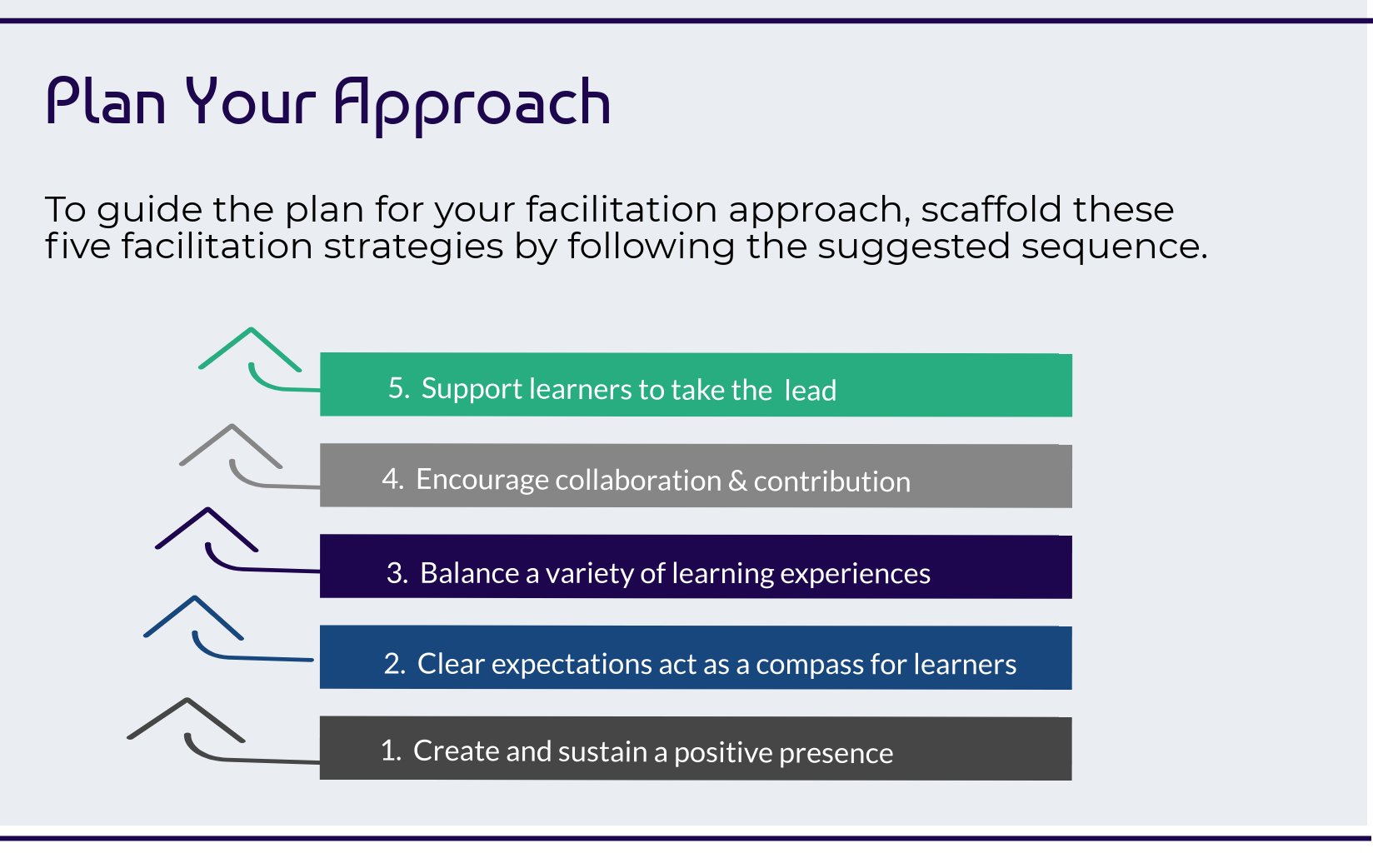
When planning your approach to effective facilitation in an online learning environment, scaffold these five facilitation strategies by following the suggested sequence:

  1. Start by determining how you will create and sustain a positive presence (Boettcher, 2013; Bonk, 2010; Bull, 2013; Dunlap & Lowenthal, 2018; Salmon, 2018).
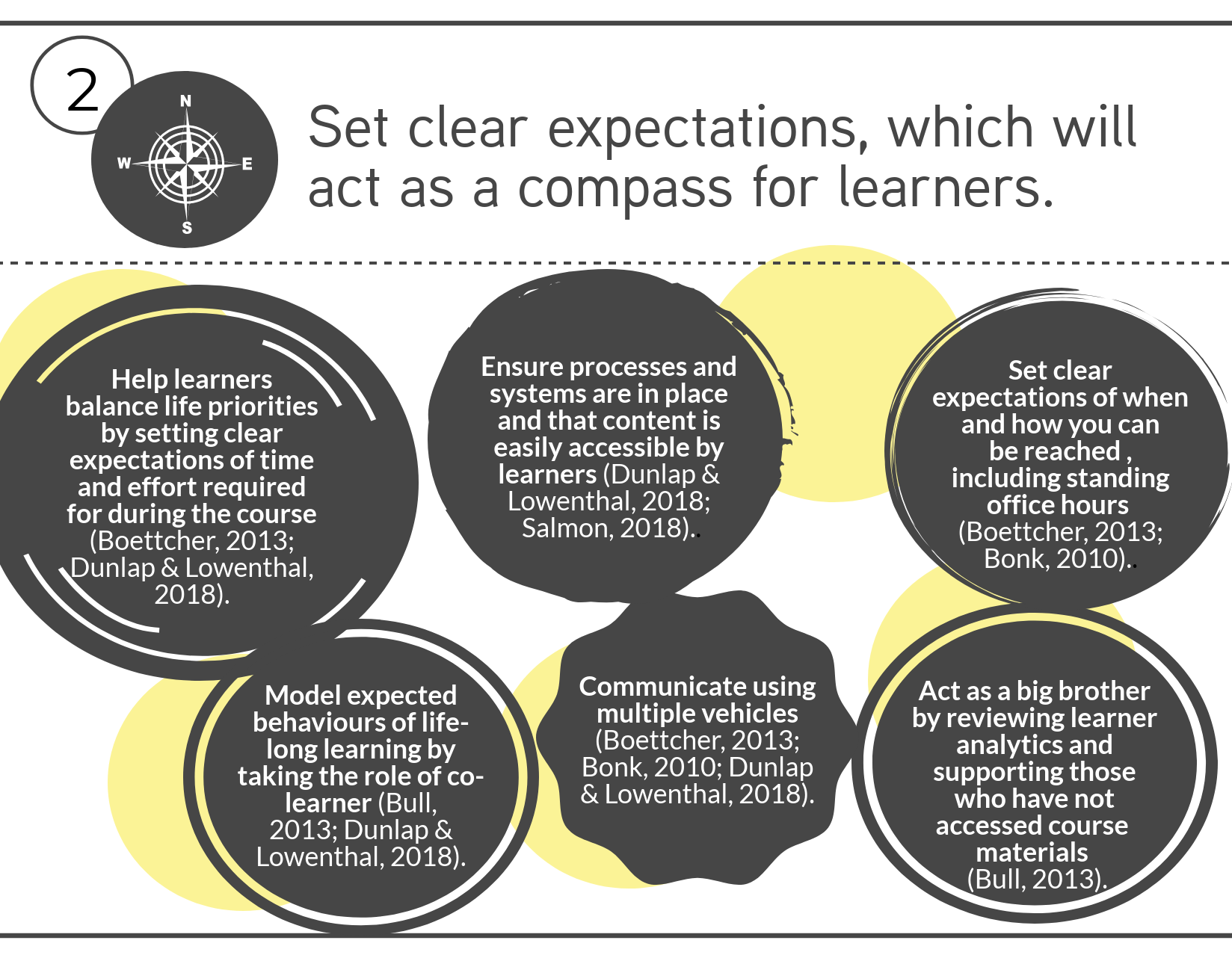
  2. Next consider how you will provide clear expectations, which will act as a compass for learners (Boettcher, 2013; Bonk, 2010; Bull, 2013; Dunlap & Lowenthal, 2018; Salmon, 2018).
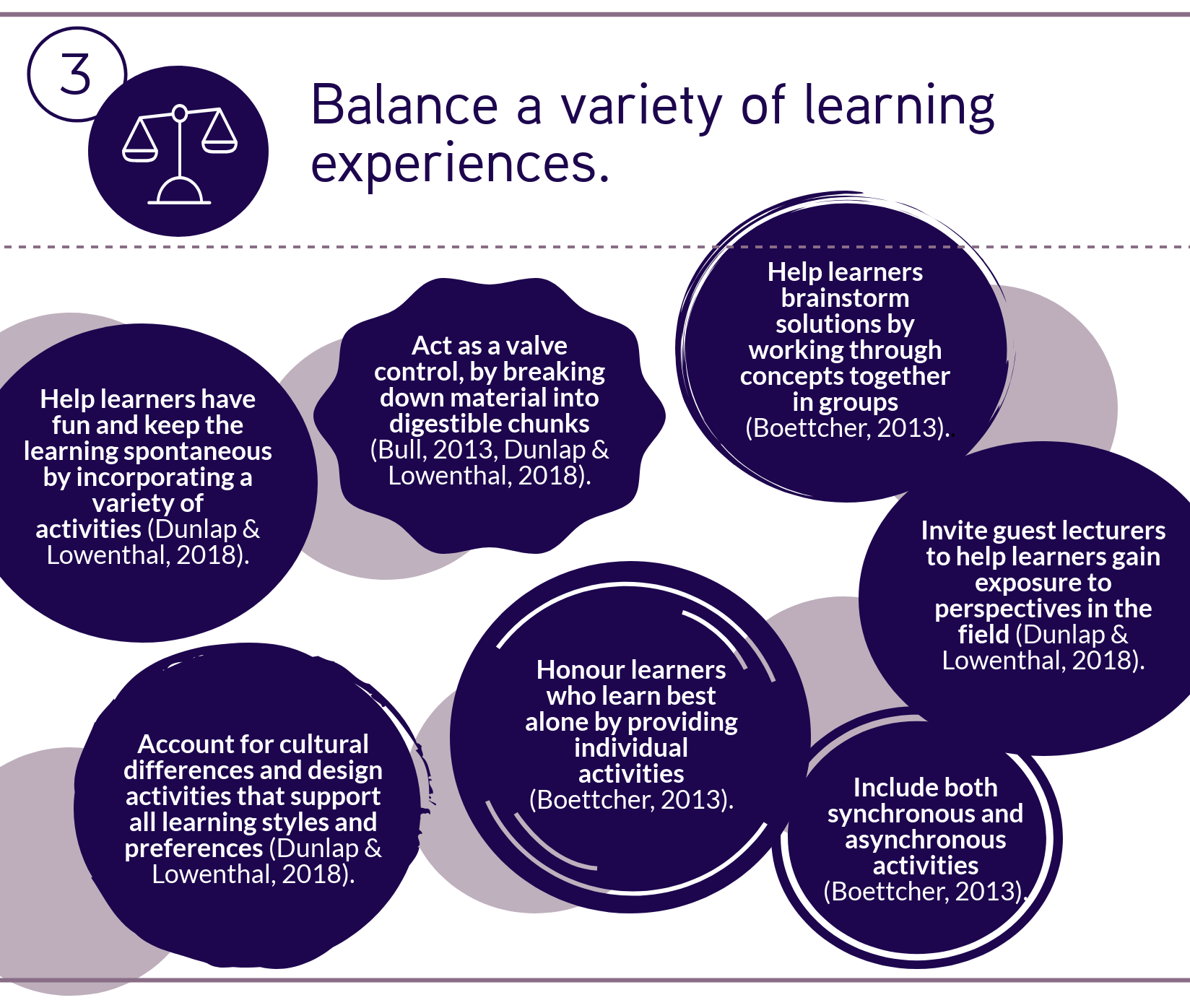
  3. As you develop activities, balance a variety of learning experiences so that you honour all types of learners (Boettcher, 2013; Bull, 2013; Dunlap & Lowenthal, 2018).
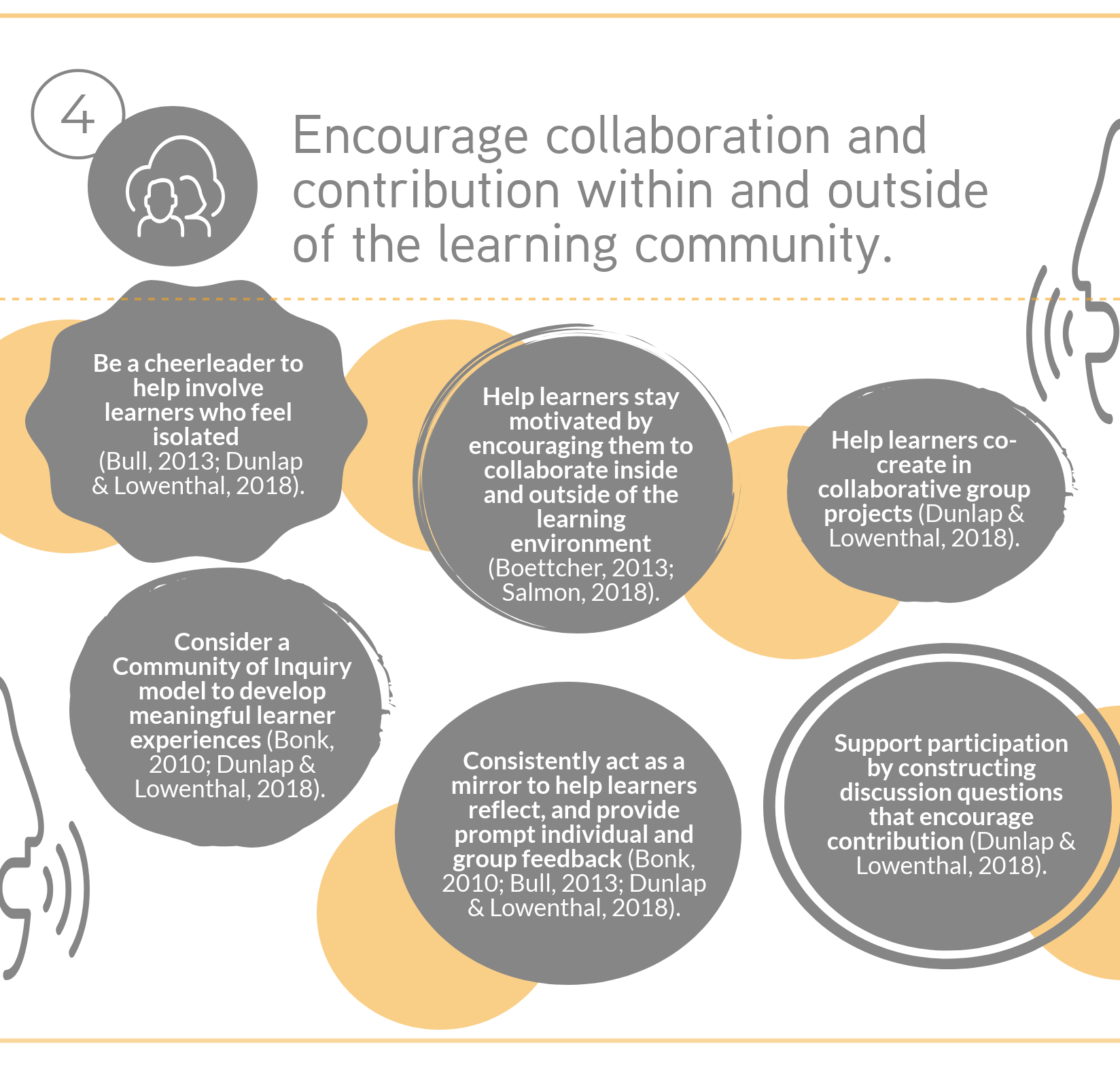
  4. Ensure that you incorporate ways that encourage learners to collaborate and contribute within and outside of the learning community (Boettcher, 2013; Bonk, 2010; Bull, 2013; Dunlap & Lowenthal, 2018; Salmon, 2018).
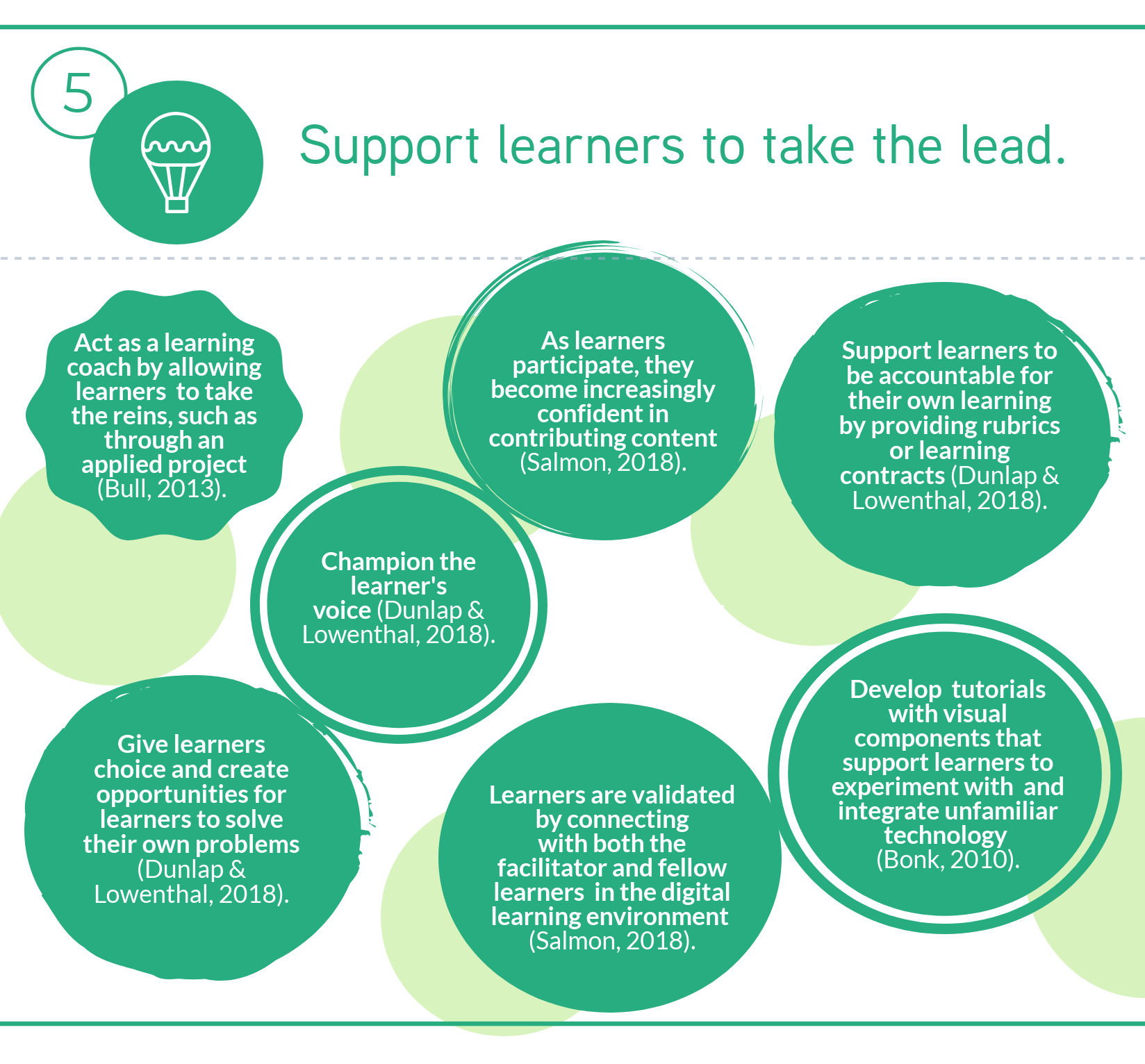
  5. Finally, make sure that your planned approach will support learners to take the lead in their learning experience (Bonk, 2010; Bull, 2013; Dunlap & Lowenthal, 2018; Salmon, 2018).

Sustain Your Facilitation Approach

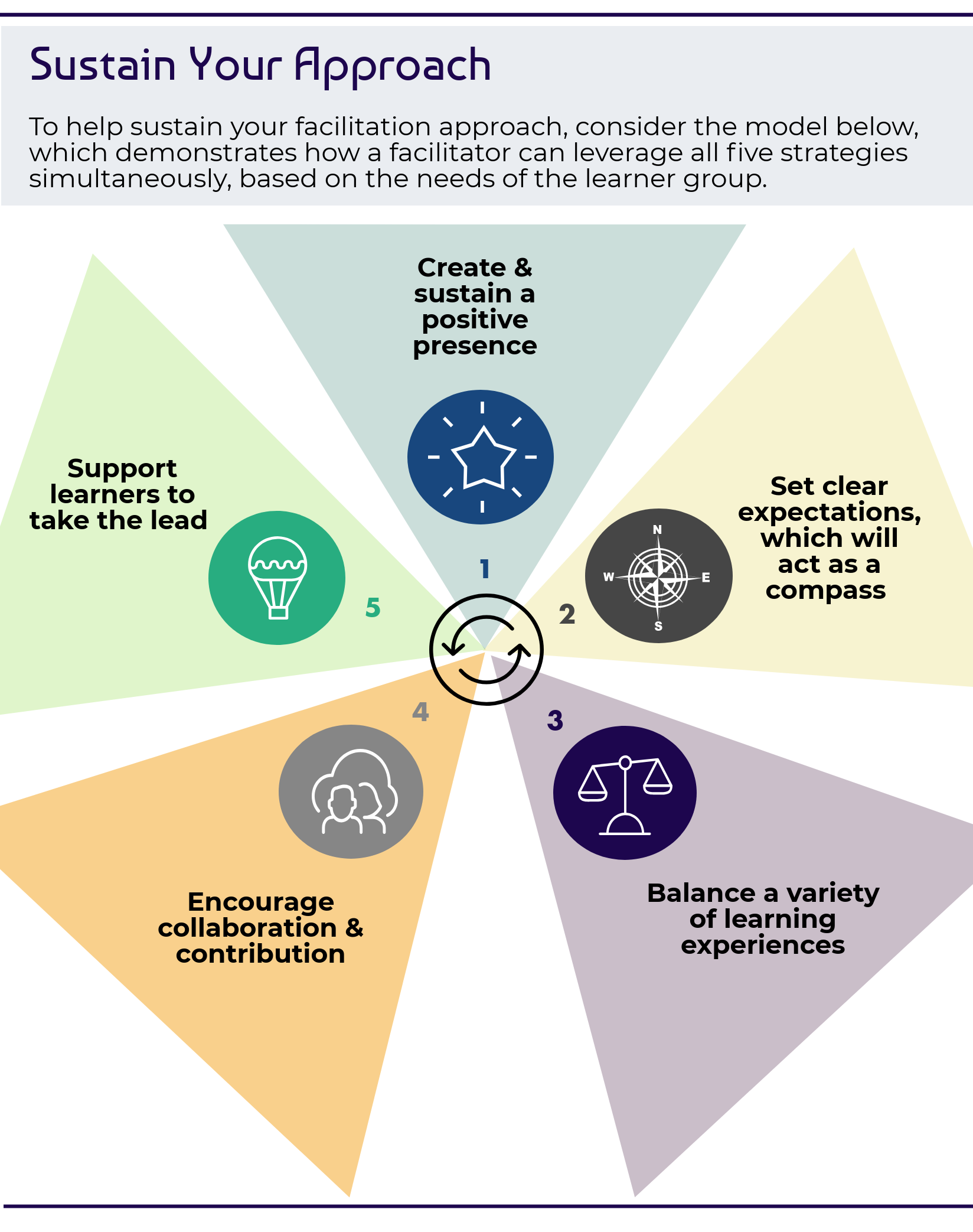
Remember that online learning environments are ever-changing, so during facilitation you will need to keep all five strategies as a priority so that you best engage and support diverse learner needs throughout the duration of your course.

In the infographic below, consider the model proposed, which demonstrates how a facilitator can sustain their planned facilitation approach by leveraging all five strategies simultaneously to support learners to success.

Consider and Select Appropriate Actions

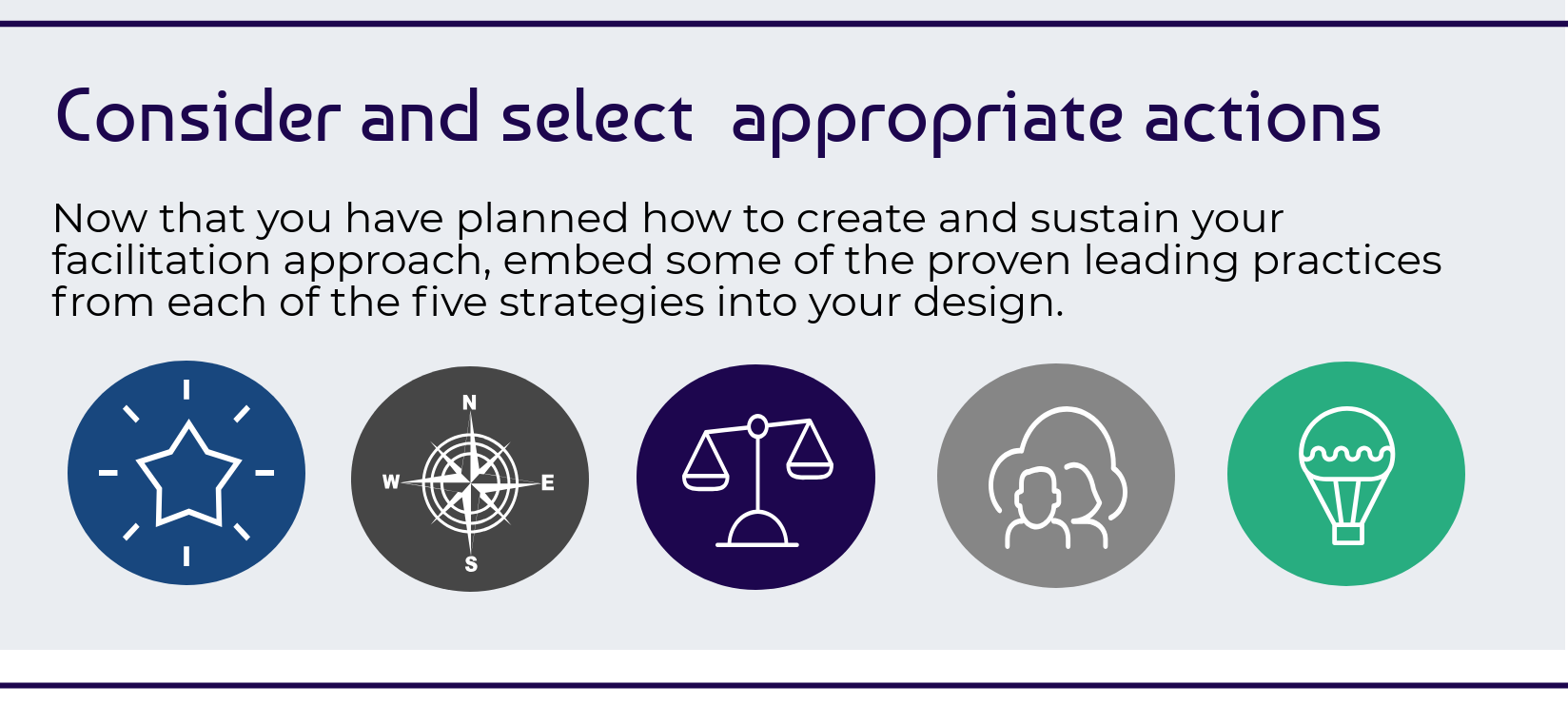
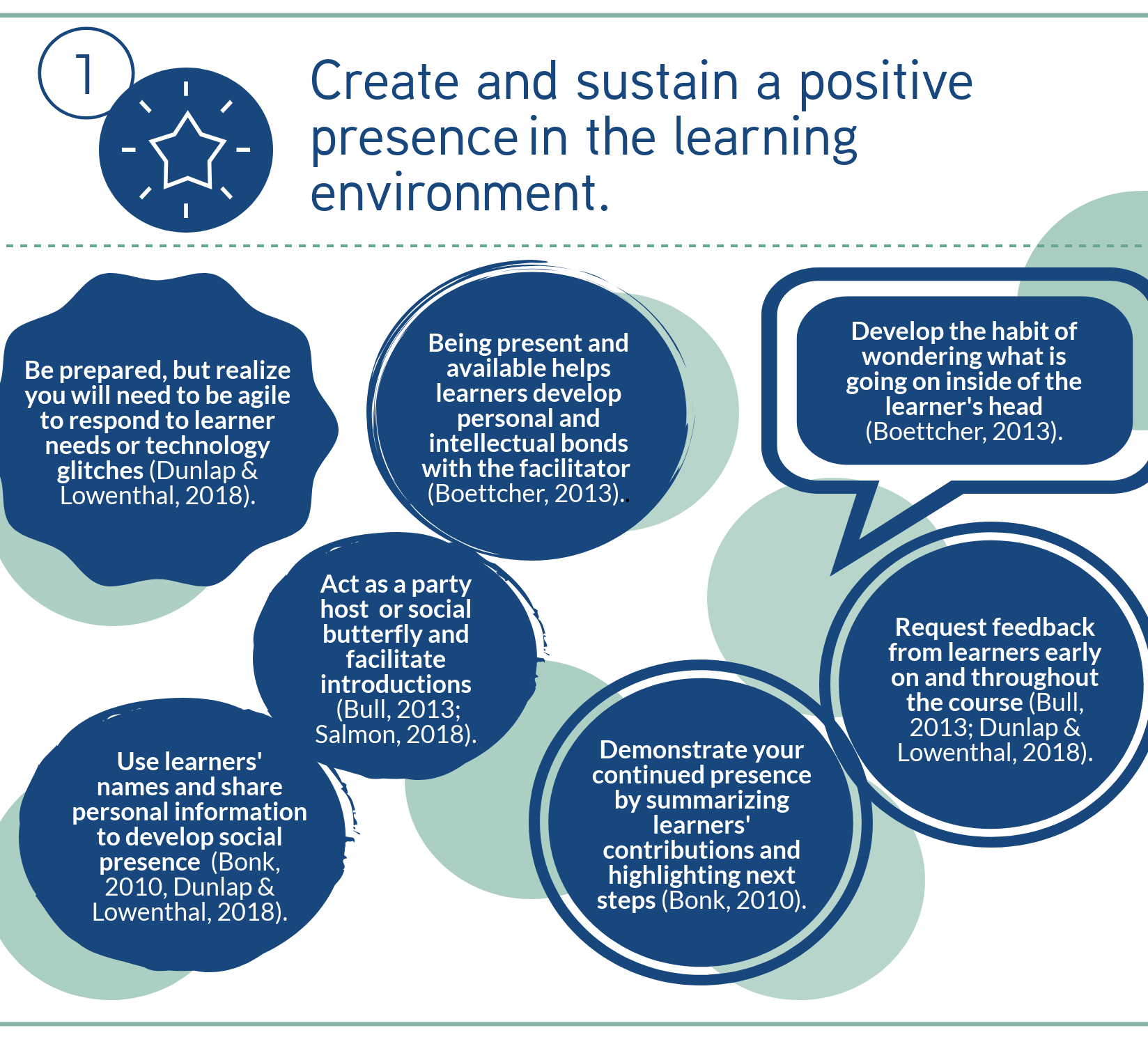
Now that you have planned how to create and sustain your facilitation approach, embed actions from each of the five strategies.

Embrace a Continuous Improvement Mindset

Effective online facilitation takes practice. Each course that you design and facilitate will provide valuable feedback from learners that will help you to continuously improve your approach moving forward. Consider tracking feedback so that you can evaluate responses from diverse learners, arming you with a toolkit of strategies and supporting actions that you can leverage as you learn and grow as an online facilitator.

Reflecting on Design Thinking

Having completed the final phase of the design thinking process, it’s time to reflect and consider what I learned through the experience. To frame this blog post, I will consider the following questions that were suggested by our Instructor:

What was the most surprising thing that I learned by participating in the design thinking process and designing and developing your digital learning resource (DLR)?

Having experienced the design thinking process both as a learner in a previous MALAT course (LRNT 524), and as a participant at a conference earlier this year, what struck me as valuable about the process is that it helps designers to prioritize input from their intended audience. Sounds so obvious, but the process effectively guides the work. I enjoyed participating in the empathy phase during the design of my DLR. By experiencing prototype development with actual learners, I found that I did not know my intended audience as well as I thought I did. It was meaningful to share the experience with the learners, peers and my Instructor, as I was able to incorporate perspectives other than my own. I look forward to sharing the prototype with my team at work to learn their ideas on how the next iteration can be improved.

What suggestions and improvements did I receive? Did I get any feedback that I did not expect? What feedback needs further investigation?

My program peers and Instructor provided me with actionable feedback that I can use to ideate an improved versions of digital learning resources that I develop in the future. Specifically, it was recommended that I am more mindful of the pace of the videos I create. By slowing videos down and by aligning voice-overs with content, I may help to decrease learner cognitive load. I was pleased to learn that my attempt at scaffolding learning was effective, and will incorporate the suggestion to include a list of frequently asked questions from the in-person sessions to my next iteration. One piece of feedback that I will need to explore a solution around is reducing the number of links that I provide, as they direct the learner outside of the learning environment and may act to reduce motivation and increase cognitive load.

What are the next steps I will like to take to build upon my digital learning resource?

I am looking forward to including the suggested improvements to my next iteration. Feedback from both my peers and Instructor included that I flesh out the in-person sessions. These sessions are meant to provide the learners with an opportunity to network and share ideas, but I am intrigued by the idea of including a technology-supported option. Doing so may help to engage those learners who are located remotely, so that they benefit from the learning opportunities. Perhaps incorporating a live conversation-shaping technology solution, such as Pigeonhole Live, in concert with a webinar component could work.

How might I utilize the design thinking process for the design and creation of digital learning resources in the future, or for other tasks that you may encounter within your instructional context?

Moving forward, I will continue to embrace the design thinking process when creating digital learning resources. I can also see benefits from using this approach with a team when planning to execute change in the workplace, especially the empathy and ideate phases. By actively encouraging the viewpoints of all stakeholders, through leveraging a design thinking process, I may allow the team to ideate creative solutions for the challenges we face, thereby engaging them in a shared vision of success.

Thank you to my Instructor, peers and collaborators on this project!

Activity 3 – Developing a Design Plan

Purpose

To support new members in navigating the suite products and services provided by the professional organization, the new member orientation will be refreshed to provide a more flexible approach. The proposed delivery model, designed to be framed within a continuous improvement mindset, will allow the organization to be more nimble and proactive in training delivery. As a part of the continuous improvement framework, capacity including an annually reviewed budget allocation and timeline of review procedures will be established.

Over the next year the organization plans to operationalize multiple new products and services, all of which will require strong communication and on-going training. The new format will allow training lessons to be continually improved as new products or services are introduced, or as shifts in the industry occur.

Learning Goals

The new member orientation will:

  • Provide an orientation to industry and organizational rules, regulations, professional standards and by-laws.
  • Deliver an overview of each of the products and services provided by the professional organization in a blended model of on-demand lessons and quarterly in-person sessions.
  • Chunk materials into topic-based lessons, which can be accessed when needed or through suggested learning paths.
  • Provide quarterly in-person sessions that allow members to access timely information delivered by subject matter experts, and to network with members from the industry and from supporting industries.
  • Increase members’ confidence that they understand the key learning deliverables of each lesson through the administration of a knowledge check at the end of each lesson.

Intended Audience

The intended audience for this digital learning resource is new members of the professional organization but will also provide existing members with opportunities to access help when they need it, as access will be housed on the organization’s secure member page.

Rationale

Based on feedback gleaned from a human-centered needs assessment, the new member orientation must accommodate the needs of learners from multiple backgrounds and levels of experience. Some learners are experienced in the industry, yet they lack the ability to navigate the suite of available products and services efficiently, and require an understanding of the organization’s policies, procedures, rules and regulations. Other learners are new to both the industry and the organization, so require additional support around the industry’s policies, procedures, rules and regulations.

Members of the professional organization are all cooperating competitors who earn a commission-based pay structure. To that end, their business activity cannot always be planned, as activity must be planned according to the schedule of members’ customers. In the current iteration of the new member orientation, members must block an entire day out of their calendars, to get a crash course on all the benefits of membership, including a content-driven overview of everything they need to know to get up and running in their professional practice. In the refreshed model new members are provided an in-person, 30-minute orientation which includes support in accessing the new member orientation program, after which lessons can be accessed in an on-demand model.

Tools

The refreshed design follows a blended approach, including a series of on-demand lessons and, at least quarterly, face-to-face networking sessions each of which includes a discrete learning opportunity. Examples of quarterly sessions include: access to a panel of experts on a practice-specific topic, co-sponsored events with members from supporting industries, or technology labs where members can access one-on-one support.

Criteria Required

  • To support a continuous improvement framework, tools must allow content to be further developed as the organization shifts and grows.
  • To support accurate and current content, course development must include the ability to collaborate with subject matter experts.
  • As the course will be mandatory for new members, tools must allow a way to track course completions.
  • To provide broader access to existing members who may wish to access the course topics in an on-demand model, tools must allow learners to access specific topics as needed.
  • To allow members to have confidence that they understand the key learning deliverables for any topic, tools must allow for an assessment component.

Tools Chosen

Articulate Rise.

The ability to easily collaborate is important as there are subject matter experts for all products and services. Inviting experts to collaborate during course development will allow for the content to be both current and accurate, with Articulate Rise allowing invitations for collaboration to be sent to any subject matter expert. Collaborators can be added and removed from a course as needed, and course ownership can be transferred as needed during development or continuous improvement stages.

Flexibility is a key consideration in the development of the new member orientation and includes that content must be accessible by learners through a wide range of devices.  Articulate’s software allows content to flex seamlessly between device types, allowing learners to effectively access the content on laptops or desktops, iPads or tablets, or any mobile phone.

One challenge that the organization faces is that they do not have an LMS, as current learning activities are only delivered in-person. However, one of the organization’s current strategic priorities is to support professionalism for the members, so decision makers are open to considering an investment into professional development infrastructure.

Articulate Rise does allow that courses are downloaded for off-line viewing, however to access embedded links, the learner would have to be connected to the internet. For this assignment, the course will be shared for feedback using a password-protected weblink.

Piktochart.

Piktochart was chosen as the tool used to develop overview information pages for all topics. Piktochart provides a free version that allows users to access templates that can be customized to meet the user’s needs. Additionally, completed work can be exported as blocks that will be used in the Articulate Rise course so there is continuity in the design approach.

Additional features, such as PDF exports, custom colour schemes, watermark removal and additional security through password protection can be accessed by upgrading the free version currently in use. Upon completion of the pilot lessons, organizational decision makers will consider how future iterations can be improved through the investment of an upgraded paid version of the tool.

Screencast-O-Matic.

Screencast-O-Matic is video recording and editing tool that allows designers to record their screen, while adding voiceovers. Based on feedback from previous attempts at sharing courses through Articulate Rise, an introductory video that showcases how to navigate the course will be provided.

Depending on future needs of the organization, a paid account, such as Solo Deluxe may be purchased, as it will allow the removal of the watermark and access to a full video editing suite.

PowToon.

PowToon is a tool that allows designers to develop videos using templates and to include customized voiceovers to enhance the content.  The organization has a subscription to a PRO account and has used this tool effectively for short explainer videos over the last year.  PowToon will be leveraged again in some of the lessons, to engage learners and to provide content variety.

Feedback and Assessment Plan

Formal assessment will be given through end-of-lesson quizzes, with correct answers provided for incorrect submissions in real time. By providing frequent quizzes, learners will remain constantly engaged with the material (Halpern, Graesser, & Hakel, 2007). For those who choose to retest their knowledge, at the culmination of all lessons a more fulsome quiz is provided, again with incorrect submissions corrected in real time, supporting better long-term retention of the materials (Halpern, Graesser, & Hakel, 2007).

Learning Theories

Motivation theory.

Keller and Suzuki’s ARCS (Attention, Relevance, Confidence and Satisfaction) model principles will support learner engagement (Keller & Suzuki, 2004). At the beginning of each lesson, learners will be engaged with a video overview that will capture their attention and inform them of the relevance of each lesson. Feedback will be provided in end-of-lesson quizzes to engage learner confidence, further supplemented by in-person sessions where learners gain satisfaction by applying “what they learn in real-life situations” (Ally, 2008, p. 29).

Cognitivism.

To help manage cognitive load, lessons will follow both the coherence principle and special contiguity principles (Halpern, Graesser, & Hakel, 2007). Lesson content will be chunked into appropriate size to facilitate effective processing with no more than five to nine items on a screen (Ally, 2008).

The in-person interventions will allow for cognitive flexibility (Halpern, Graesser, & Hakel, 2007) as learners will be encouraged to collaborate with peers and experts to share ideas and viewpoints.

Constructivism.

In constructivism, where the learner is at the centre of the learning, personal meaning is gleaned through active processes (Ally, 2008), where learners are given control of the learning process through a guided process. Collaborative and cooperative learning will be achieved by encouraging learners to participate in face-to-face learning interventions, allowing higher level interaction with peers and subject matter experts (Anderson, 2016).

Instructional Design Principles

The following six design principles work in concert to guide decision points and ensure that the new or renewed approaches taken in developing courses provide a positive learner experience.

  1. Honour learner diversity.
  • Use gender neutral language and mindfully include a variety of examples to resonate with learners from all backgrounds and levels of experience.
  • Use Mattelmäki et al’s (2014) four layers of sensitivity for consistency in empathetic design: sensitivity towards humans, sensitivity toward design, sensitivity toward techniques and sensitivity toward collaboration.
  1. Make time for collaboration.
    • Encourage the sharing of perspectives in everything we do and with stakeholders from all levels.
    • Be solutions-focused. Our shared actions help us reach our shared vision.
  2. Use plain language.
    • Employ readability tools to ensure content is written at an appropriate level for learners.
    • Explain jargon, culture-specific language and limit use of acronyms.
  3. Remember pedagogical frameworks.
    • Use a consistent template throughout materials and chunk knowledge into building blocks to decrease cognitive load for learners.
    • Consider Keller and Suzuki’s (2004) ARCS motivation model throughout design, including all four sub-sets: attention, relevance, confidence and satisfaction.
    • Allow collaboration and cooperation by including opportunities for learners to work together.
  4. Support knowledge retention.
    • Provide opportunities for continuous reinforcement and self-assessment throughout learning interventions.
    • Stay with the learner; don’t jump ahead of their readiness. Provide learners with opportunities to self-assess, self-reflect, consider feedback and collaborate with fellow learners.
  5. Embrace a continuous improvement mindset.
    • Measure learner satisfaction and evaluate responses for on-going improvement opportunities.
    • Be committed with capacity and resources to evaluate and support feedback into meaningful improvements.

Instructions for Use

New members.

New members are currently provided with package of both paper and digital resources and are invited into the organization’s office to retrieve it. Members are then invited to participate in a one-day in-person workshop where they receive a high-level overview of the products and services provided by the organization.

In the refreshed approach, the Member Orientation team will connect with the new member to arrange a 30-minute in-person introduction to the organization. During this introduction the staff member will sit beside the new member in front of a work station to walk through the new member package and to provide a guided tour of the available resources, including lessons and a calendar of networking and learning opportunities. Members will be invited to bring along their preferred device, if they wish, so that they can customize their learning experience.

Existing members.

Proven communication protocols to existing members have been established, with 87.5 per cent of members reporting that they are satisfied with the organization’s communication in an April 2018 member satisfaction survey. To ensure deep message penetration, the launch of the program will be added to the content calendar as an on-going event, so that all members know when they can access training.

Plan for Use

The proposed refreshed approach to delivery supports only members of the professional organization, as membership fees fund the program and the information provided is proprietary. Due to these considerations, I will use an “All Rights Reserved” copyright (Australian Research Council Centre of Excellence for Creative Industries and Innovation, 2009) to protect the content.

Future Iterations

The tools and approach chosen for the new member orientation uncovered multiples ideas for improvement of the learner experience and for the addition of additional audiences, as follows:

Access to more feedback.

To include informal feedback, each lesson of a future iteration will include pre- and post-self-assessments that allow members time to uncover their learning gaps and reflect on their learning.

Learning paths.

In a future iteration of the project learning paths will allow learners to choose to participate in a curated curriculum but can still engage with ad hoc topics that are timely for their practice.

Interactive PDFs.

In each lesson, members will have access to interactive PDFs that summarize key processes and information and provide space for members to take notes in their own words.

Increased access to content.

One of the organization’s strategic priorities includes work to help positively shift the public’s perception of members. In a future iteration, the materials provided to members can be refreshed to align with the needs of a new audience, the public. Doing so may help to inform members of the public of the benefits of working with a member of the organization and may help to provide information that will support more seamless transactions. If this iteration does occur, I will use an “Attribution-Noncommercial-No Derivative Works” (Australian Research Council Centre of Excellence for Creative Industries and Innovation, 2009) license.

Added opportunities to continue professional development.

Learners who choose to continue their learning will have access to continuous development activities such as: community-based or organizational board member opportunities, options on becoming an instructor, procedures on how to develop a course, ideas on how to become more involved in committees or taskforces, etc.

Networking opportunities may be augmented by the addition of facilitated round tables that are either community or topic-specific. Round tables will provide learners with problem-based learning, wherein communities of practice may emerge (Halpern, Graesser, & Hakel, 2007).


References

Ally, M. (2008). Foundations of educational theory for online learning. In T. Anderson (Ed.), The theory and practice of online learning (pp.15-44). Edmonton, AB: AU Press.

Anderson, T. (2016). Theories for learning with emerging technologies. In G. Veletsianos (Ed.), Emergence and innovation in digital learning: Foundations and applications (pp. 35 – 50). Edmonton, AB: AU Press.

Australian Research Council Centre of Excellence for Creative Industries and Innovation. (2009). Which Creative Commons License is right for me? Retrieved from http://creativecommons.org.au/content/licensing-flowchart.pdf

Halpern, D. F., Graesser, A., & Hakel, M. (2007). (25) Learning principles to guide pedagogy and the design of learning environments. Washington, DC: Association of Psychological Science Taskforce on Lifelong Learning at Work and at Home.

Keller, J., & Suzuki, K. (2004). Learner motivation and e-learning design: A multinationally validated process. Journal of educational Media29(3), 229-239. doi:10.1080/1358t65042000283084

Mattelmäki, T., Vaajakallio, K., & Koskinen, I. (2014). What Happened to Empathic Design?. Design Issues30(1), 67-77. doi:10.1162/DESI_a_00249

Accessing the Hidden Knowledge of the User

As I began this activity, I was reminded of a story told to me by a good friend who was a book binder with over 30 years of experience working for the same employer. In his story, my friend shared how his employer was making a substantial capital investment into their infrastructure which would allow them to diversify and provide book binding services for additional types of books, thereby providing the organization with the ability to bid on more jobs. It was great news, as everyone working for this employer would have enough work to sustain their jobs on a full-time basis.

On his first day back to work with the new equipment, my friend found that the physical location of the equipment did not allow the operator to work effectively, as there was not enough room to control the equipment safely. The only tangible solution was to remove the equipment and rotate it by thirty degrees, thereby allowing enough room to operate the equipment effectively and safely.

As I reflect on this story through the lens of “designing products that fit the user’s life” (Kouprie & Visser, 2009, p. 438), I realize what went wrong. In reading more about using an empathic framework in design, I am beginning to realize the importance of understanding the end user’s needs. I appreciated Seelig’s (2013) examples of the benefits of reframing a problem. Instead of focusing on what we think members need to know to be successful in their professional practice, I will reframe my problem to explore how members access the products and services that we provide to support them in their professional practice. My desired outcome is to reframe our approach so that the training we provide around products and services proactively meets the needs of our end users, instead of taking our current reactive approach to solving problems as they arise.

My Empathetic Framework

In my design challenge I have decided to explore our new member orientation, which is a mandatory course that is designed to help new members better understand the products and services we provide. I chose this particular course because it has remained almost unchanged for over a decade, coupled with the fact that the metrics collected from our help desk uncovered gaps in the training and led us to wonder if we could be doing a better job of on-boarding our members. I liken the current orientation to drinking from a firehose, with so much information provided in a short time that it seems impossible to remember it all. I wonder if we are providing the right level of training, too many topics or if our scope is too narrow.

I plan to start building out my empathetic framework by using an experience prototype (Kouprie & Visser, 2009), wherein I will step into the member’s experience by simulating the user’s experience in accessing our products and services. Having never been in professional practice in this industry, I realize that my experience will be different than that of the end user. However, our suite of products and services perform discrete functions, the outcomes for which I am very familiar.

I started by mapping out a typical day-in-the-life of a member as they perform the core tasks required in their profession. Doing so allowed me to experience both bottlenecks and seamless experiences, thereby allowing insight into which topics need to be fleshed out and which can remain static – at least from my experience as a user.

To further validate my findings, I have reached out to a new member who I already have a relationship with as I coached them around using a core tool during their first week. By observing this user in their environment, I will “stay beside” (Kouprie & Visser, 2009, p. 443) the user and be drawn into their experience. I imagine I will gain insight into whether the challenges they face are the same that I faced during my experience prototype. This work should allow me to have a more “comprehensive objectification” (Kouprie & Visser, 2009, p. 443) of the member’s experience, leaving me with a more fulsome understanding of their experience.

Potential Challenges:

Challenges I expect include that my experience prototype will not accurately reflect the needs of all users as each individual has their own unique experience (Kouprie & Visser, 2009). However, even with a small sample size to build from, I will gain the ability to step outside of my own perspective and see the existing design through the eyes of our member (Matthews, Williams, Yanchar, & McDonald, 2017).

Another challenge I anticipate is balancing the tension of multiple stakeholders (Matthews, Williams, Yanchar, & McDonald, 2017). How will we provide the same quality of learning provided by our new member training to existing members? We typically onboard about 80 members per year, with each member having unique challenges, whether they be understanding the rules, regulations and bylaws (which are written in complicated language) or whether they lack the digital technology skills to effectively manage the various technology products. I hope that uncovering bottlenecks and seamless experiences will help bring an empathetic perspective to our work, helping us to achieve a broader range of goals (Matthews, Williams, Yanchar, & McDonald, 2017), including an improved experience for all members.

I know that I am not the first person to experience these challenges and look forward to your insights and ideas on how I can face these potential challenges.

References

Kouprie, M., & Visser, F. S. (2009). A framework for empathy in design: stepping into and out of the user’s life. Journal of Engineering Design20(5), 437-448.

Seelig, T. (2013). How reframing a problem unlocks innovation. Extracted Sept.

Matthews, M. T., Williams, G. S., Yanchar, S. C., & McDonald, J. K. (2017). Empathy in Distance Learning Design Practice. TechTrends61(5), 486-493.

LRNT 526 – Unit 1, Activity 3: Retention with Retention

In LRNT 526 we were tasked to begin a critical inquiry into an online modality, for which our team – Team MOOCtastic – has chosen a Massive Open Online Course (MOOC) called Learning How to Learn from the Coursera platform. We plan to conduct a SWOT analysis (Strengths, Weaknesses, Opportunities, Threats), with my area of focus being opportunities.

In my role we work to support professional association members with learning opportunities, some of which are mandatory and others that are voluntary. The industry Regulator and Provincial Association currently design and monitor mandatory interventions, with our team supporting by delivering a consistent and positive learner experience. Our team also designs and delivers additional learning interventions which focus on supporting members in achieving professional excellence. Although learners must complete a minimum number of additional learning experiences, they do have flexibility to choose the content topics and delivery methods that they prefer.

Our goal is to shift the culture of learning to one where learners access learning interventions because they value the content and can measure how the learning positively impacts their skills and knowledge in professional practice. Instead of members accessing a minimum amount of professional development, we envision a learning program that engages and motivates learners to participate due to the value they receive. I wonder if the opportunities provided by MOOCs, such as Coursera, could provide a framework to support a refreshed approach to content delivery in our association.

From past courses I am reminded of pedagogical approaches such as cognitive load theory, motivation theory, and gamification theory. Each seems to have a space in the MOOC environment and each has implications for the design and delivery of learning.  During our preliminary research into MOOCs, Team MOOCtastic found that learner course completion rates are supported by supporting specified instructor-led timetables (Adamopolous, 2013), by allowing flexibility for learners that accommodates their various schedules (Khalil & Ebner, 2014), by motivating learners through access to feedback (Huang & Hew, 2016) and by including gamified elements (de Freitas, Morgan, & Gibson, 2015). In reflecting back on these studies, I am reminded learner completion rates are an important metric to track, especially when related to our learners’ needs to complete a specific number of courses.

As I was brainstorming opportunities that MOOCs provide, I was reminded of an LRNT 523 debate where I provided evidence that digital badges could render degrees obsolete. We found evidence that digital badges are a non-traditional way of representing learners’ skills, qualifications and achievements, which may not otherwise be captured in a degree (DiSalvio, 2016; Dyjur & Lindstrom, 2017; Shields & Chugh, 2017). This information resonated with me again in this inquiry, as I saw a correlation to the learning interventions we provide, which are not tied to a degree, but rather are tied to professional competencies. A key take-away from that debate that I will continue to explore was that there is disagreement in the world of badging, from those viewing digital badges as a reward to those who embrace a badge’s ability to evidence competency.

A question that pops top of mind as I delve deeper into my area of study is how learner content retention can be tracked and measured? If our goal is to positively shift professional excellence in practice, then we also need to measure learner content retention. I wonder if MOOCs can provide the framework that a learner needs to effectively recall the desired information (or easily access it) when needed in the field? A near-term priority for my inquiry will revolve around exploring content retention in MOOCs.

Our colleagues from Team Awesome Sauce posed a question on our blog post that resonated for me in my organizational context that asked what Learning How to Learn offers that differs from other MOOCs in the same modality. Now that I have completed the course, I can share that my experience was positive. I even find myself leveraging some of the learning in my practice, leading me to assume that I retained at least some of the core learning. Perhaps the reason is that I was committed throughout and that the content was applicable in the work I do? Perhaps it was due to the course design? I will need to explore this further as another near-term priority.

Through my continued critical inquiry I hope to uncover best practices, pedagogical approaches, and design principles that support learners to both complete a MOOC and to retain the content learned in practice. Justice, Rice, Roy, Hudspith, and Jenkins (2009) share that critical inquiry “occurs in an environment supportive of open-minded discussions, the questioning of assumptions, and the critical assessment of information, evidence and argument” (p. 843). To that end, I invite my colleagues to share their experiences and questions with me in the comments below.

Thanks for reading!

References

Adamopoulos, P. (2013). What makes a great MOOC? An interdisciplinary analysis of student retention in online courses.Retrieved April 12, 2018 from http://pages.stern.nyu.edu/~padamopo/What%20makes%20a%20great%20MOOC.pdf

de Freitas, S. I., Morgan, J., & Gibson, D. (2015). Will MOOCs transform learning and teaching in higher education? Engagement and course retention in online learning provision. British Journal of Educational Technology, 46(3), 455-471. doi:10.1111/bjet.1

DiSalvio, Philip. (2016, May 3). New pathways to credentialing: The digital badge. New England Journal of Higher Education [Blog post] Retrieved from http://www.nebhe.org/thejournal/new-pathways-to-credentialing-the-digital-badge/

Dyjur, P., & Lindstrom, G. (2017). Perceptions and Uses of Digital Badges for Professional Learning Development in Higher Education. TechTrends, 61(4), 386–392. doi: 10.1007/s11528-017-0168-2Huang, B., & Hew, K. F. (2016). Measuring learners’ motivation level in massive open online courses. International Journal of Information and Education Technology, 6(10), 759-764. doi:10.7763/ijiet.2016.v6.78 8

Justice, C., Rice, J., Roy, D., Hudspith, B., & Jenkins, H. (2009). Inquiry-based learning in higher education: administrators’ perspectives on integrating inquiry pedagogy into the curriculum. Higher education58(6), 841.

Khalil, H., & Ebner, M. (2014). MOOCs completion rates and possible methods to improve retention-A literature review. In EdMedia: World Conference on Educational Media and Technology (pp. 1305-1313). Association for the Advancement of Computing in Education (AACE). Retrieved April 12, 2018 from https://www.learntechlib.org/p/147656

Shields, R., & Chugh, R. (2017). Digital badges—Rewards for learning? Education and Information Technologies, 22(4), 1817–1824. Retrieved from https://link-springer-com.ezproxy.royalroads.ca/article/10.1007%2Fs10639-016-9521-x

Having now attempted to complete my first environmental scan, I appreciate that conducting research takes practice and have uncovered some missteps in my design decisions that I can leverage to improve future research attempts. In designing my approach I first chose the tool that I would use to display results from my data collection, selecting Piktochart, and then worked to create questions that would result in data that could be easily translated into an infographic. This design decision did result in my ability to share data visually, but narrowed the opportunity to dig deeper to further explore the network participants’ specific examples of effective change management experiences.

In selecting my network, I chose to gather perspectives from those who I knew had relevant experiences to share. With scheduling, including time zone and availability differences as a recurrent challenge, most of my contact with participants was via text or email. Although I did work to describe the purpose of this research, in future I will ensure that synchronous options to connect are prioritized so participants can ask questions and I can provide clarity as needed.

Finally, in an effort to honour confidentiality, I committed to amalgamating results into trends. In future, I will spend more time with my network by building in multiple contact points so I can dig deeper and explore each participant’s level of comfort with sharing examples from their experiences. Overall, input from my network participants does echo key findings from established change management models and theories. I am left wondering what else I could have uncovered if I had made different design decisions throughout this exercise, but am excited to leverage this learning in the future.

Leading Through Change

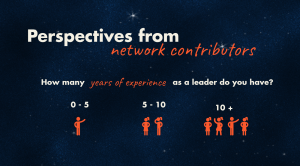
Personal communications with my seven network participants uncovered three trends that align with established change management models and theories:

1.     Leaders must be passionate, engaging and committed to change.

2.     Leaders must prioritize change as a team activity.

3.     Leaders must spend time planning and preparing for change.

Leaders Must Be Passionate, Engaging and Committed to Change

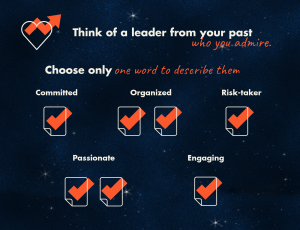
Kuipers et al. (2014) describe leadership as “an important driver of change” (p. 23). When asked to choose one word to describe a change leader from their past whom they admired, 57 per cent of network respondents contributed ideas around passion, commitment and an ability to engage the team. Weiner (2009) agrees that building organizational readiness for change requires that leaders engage participants in sharing a commitment to implementing change and in believing that they will succeed. By inspiring a shared vision, participants gain clarity on how their commitment will contribute to achieving successful change outcomes (Graetz, 2000).

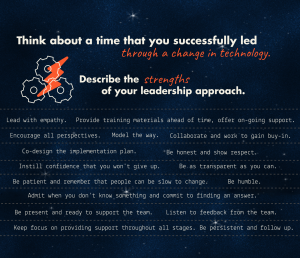
When developing organizational readiness for change, Jaskyte (2004) found that leaders must motivate their teams to commit to change by supporting the development of shared values and practices that support innovation. Themes of leading with passion, commitment, and engaging the team again emerged when participants described strengths in their leadership approach, such as: model the way, instill confidence that you won’t give up, and be present and ready to support the team. These leadership approaches demonstrate passion for the proposed change and a commitment to engaging in following it through to success.

Along with being passionate, engaged and committed to change, network participants agree that collaboration is a key success determinant when leading through change.

Leaders Must Prioritize Change as a Team Activity

Al-Haddad and Kotnour (2015) state that strong collaboration by all stakeholders can support successful outcomes when leading through change by encouraging teams to participate and become active contributors. When reflecting on the strengths they adopted during a successful change they led, participants shared examples of behaviours that support collaboration. Responses including encouraging all perspectives, co-designing the implementation plan, working to gain buy in through collaboration, listening to feedback, being persistent and following up, all encourage the team to share their perspectives. As Weiner (2009) found, when participants value the proposed change, they exhibit high efficacy are more likely to demonstrate behaviours required to support the change initiative.

Part of supporting their teams to participate actively requires that leaders also demonstrate commitment by effectively planning and preparing for change.

Leaders Must Spend Time Planning and Preparing for Change

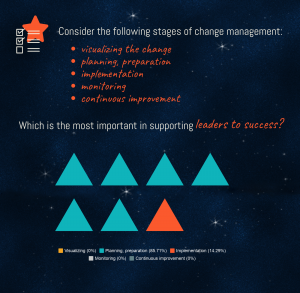
Planning and preparation are common components in the examples shared in Al-Haddad and Kotnour’s (2015) exploration of successful change models. Six of seven network respondents agree that planning and preparation are important considerations when leading through change. Examples of leadership strengths that network participants have successfully leveraged to support them through change that relate to planning and preparation include: provide training materials ahead of time, keep focus on providing support throughout all stages, and be as transparent as you can. 

When reflecting back on leaders they admire, 29 per cent of participants described organization as a key success factor. One network participant contributed an idea that change leaders must be patient and remember that people can be slow to change. Another shared a best practice was to admit when you don’t know something and commit to finding an answer. Both responses highlight that today’s ever-shifting environment demands that change leaders must also engage change methods which also continuously evolve (Al-Haddad & Kotnour, 2015) and plan and prepare to flex their approach when the environment shifts.

Conclusion

In 2000, Graetz stated that implementing change successfully is the primary task that all leaders of face. Al-Haddad and Kotnour (2015) share that “change leaders are people with creative visions, who are able to foresee a new reality and how to get to it” (p. 239). Leading with passion and commitment helps to engage  participation in the change process and works to develop a shared vision of success.

Using a collaborative approach also engages teams, especially when, as one participant shared, leaders lead with empathy. When change leaders design strategies with an empathetic approach, participants are encouraged to view the change through different perspectives, permitting openness and creative exploration (Mattelmäki, Vaajakallio, & Koskinen, 2014).

In today’s ever-changing environment, change leaders must plan and prepare not only for a successful implementation, but to make on-going changes in their approach when the environment shifts. By leading the team with a focus on being prepared for these shifts, a leader establishes change as an opportunity to continually strive for an established shared vision of success.

References

Al-Haddad, S., & Kotnour, T. (2015). Integrating the organizational change literature: a model for successful change. Journal of Organizational Change Management28(2), 234-262.

Graetz, F. (2000). Strategic change leadership. Management decision38(8), 550-564.

Jaskyte, K. (2004). Transformational leadership, organizational culture, and innovativeness in nonprofit organizations. Nonprofit Management and Leadership15(2), 153-168.

Kuipers, B. S., Higgs, M., Kickert, W., Tummers, L., Grandia, J., & Van der Voet, J. (2014). The management of change in public organizations: A literature review. Public administration92(1), 1-20.

Mattelmäki, T., Vaajakallio, K., & Koskinen, I. (2014). What Happened to Empathic Design?. Design issues30(1), 67-77.

Weiner, B. J. (2009). A theory of organizational readiness for change. Implementation science4(1), 67.

Leading change

Embracing change is standard in today’s environment if an organization wants to succeed and thrive, yet Al-Haddad and Kotnour (2015) found that success rates for change initiatives fall at less than 30 percent. If organizations need to change and adapt to their environment, what is the missing link to success?

I agree with Feldstein (2017), when they suggest that there is not one LMS (Learning Management System) that can meet the diverse needs of all environments. Taking a one-size fits all approaches cannot work, as each organization faces different challenges and because the environment itself is continuously evolving (Al-Haddad & Kotnour, 2015). Perhaps, then, the missing link is developing organizational readiness for change. Jaskyte (2004) shares that for organizations to develop a readiness for change, organizational leaders must motivate their teams to commit to change by supporting the development of shared values and practices that support innovation. Doing so can help a leader to shape the organization’s change culture, and shift it towards one that fosters innovation, where stakeholders are committed to change and believe in their ability to execute that change through their actions (Weiner, 2009).

Change leaders have the ability to see where their organization must grow, and can motivate their employees to take an active part in the change process (Al-Haddad & Kotnour, 2015). Along with setting the vision, leaders who join their teams as part of the “value chain” (Udas, 2008, para. 3) work in partnership to co-design a deep understanding of “task demands, resource availability and situational factors” (Weiner, 2009, p. 70). By collaborating during these environmental scans, leaders help teams “to take responsibility and be an active part of the change” (Al-Haddad & Kotnour, 2015, p. 239) and work to tease out past and current challenges. I believe that implementing change is a team process, and that team members who value a proposed change and believe in its importance for the organization are more likely to validate their commitment by demonstrating the behaviours required in changing environments (Weiner, 2009).

Based on the change theories outlined in Al-Haddad and Kotnour (2015), I believe the Leucke method best fits my approach, because change is proposed by leaders as an opportunity, as opposed to a threat. Core to my leadership approach is to engage disparate viewpoints and to support suggested risks, as long as they align with the set vision. To shift the culture in our organization our leadership team engaged the team to explore current and past problems and solutions, working to create of a shared vision of success. We focused on how the new technology will support our end users to success in their practice and committed to a continuous improvement mindset that allows us to flex as the environment shifts.

When considering Weller’s (2013) four factors of resilience: latitude, resistance, precariousness and panarchy, I was left with some questions for our organizational context. How resistant is our team to changing the procedures they’ve come to master? Are the changes we plan to make are too fulsome to be sustainable? Are we already operating at our organization’s limit and will external forces shift the environment to a completely new or renewed state? Leaders who lead change in digital environments work to leverage technology where it would support change, while retaining the core function and identity of the existing practice (Weller, 2013). This idea reminds me to lead the team in prioritizing the fulfillment of our shared vision, as this lens will help us make decisions that align with our end users’ needs. I believe that our careful commitment to collaboration and to a continuous improvement mindset will provide a resilient framework that readies us for organizational change. By working together and promoting the value of leadership at all levels, we can absorb change and continue to evolve to meet the needs of our end users.

References

Al-Haddad, S., & Kotnour, T. (2015). Integrating the organizational change literature: a model for successful change. Journal of Organizational Change Management28(2), 234-262.

Feldstein, M. (2017, May 28). A flexible, interoperable digital learning platform: Are we there yet? [blog post]. Retrieved from https://mfeldstein.com/flexible-interoperable-digital-learning-platform-yet/

Jaskyte, K. (2004). Transformational leadership, organizational culture, and innovativeness in nonprofit organizations. Nonprofit Management and Leadership15(2), 153-168.

Udas, K. (2008, June 30). Distributed learning environments and OER: the change management challenge. [blog post]. Retrieved from https://web.archive.org/web/20160309200155/http://mfeldstein.com/distributed-learning-environments-and-oer-the-change-management-challenge/

Weiner, B. J. (2009). A theory of organizational readiness for change. Implementation science4(1), 67.

Weller, M., & Anderson, T. (2013). Digital resilience in higher education. European Journal of Open, Distance and E-learning16(1).