
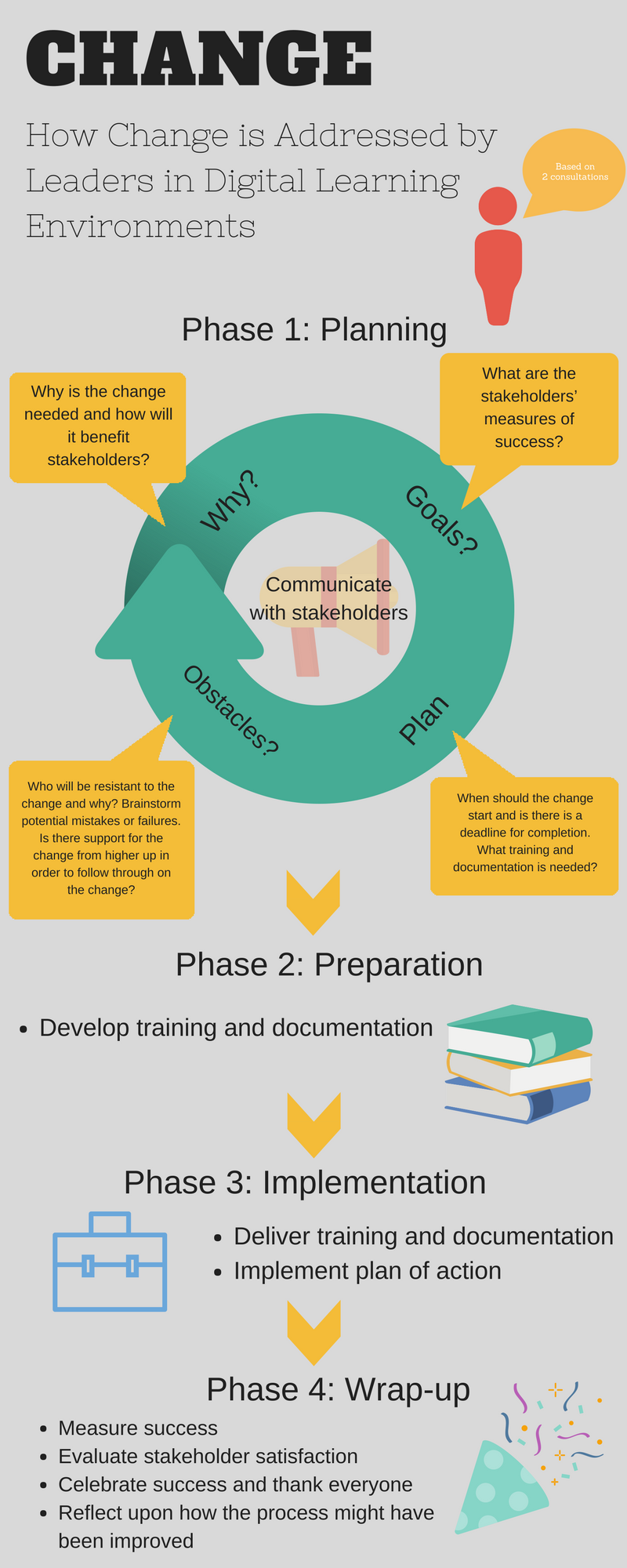
The purpose of this assignment was to consult with two colleagues in my learning network about successful examples of change management, create a one-page visual that displays how change is addressed by leaders in digital learning environments, and to describe how the approach aligns with established change models and theories.
I consulted with two learning professionals who work at other universities in roles that require them to implement significant, campus-wide learning technology changes. I asked them questions about how they handle the change process, what role leadership plays in the process, and what challenges they have needed to overcome. This information, along with my own experience leading change, is summarized in the infographic. There is a large emphasis on the first phase, the planning phase, as we all agreed that successful change requires careful planning.
The planning phase consists of an iterative process of continued communication with stakeholders until the four core planning components are developed. According to Biech (2007), involving all stakeholders is critical to successful change. The four core components of a successful planning phase are understanding the goals of the change, understanding why the change is needed, understanding potential obstacles, and developing a change plan. The goals will include the stakeholders’ measures of success.
Understanding why the change is needed and how it will benefit the stakeholders is essential in communication and development of the plan. Antwi and Kale (2014) mention that the NHS Change Management Guidelines emphasize the importance of understanding why the change is desirable, while, Weiner (2009), discusses the value of helping stakeholders understand why the change is needed, important, and worthwhile.
Change goals were found by Al-Haddad and Kotnour (2015) to define the organizational strategy, making their definition critically important. A clear understanding of why the change is needed and the goals of the change are important components of the change vision, which Kotter (2007) describes as being critical to the change effort.
Preparing for obstacles may mean understanding who is expected to be resistant to the change and why, while also brainstorming potential failures or mistakes in order to avoid problems. Successful change may require support further up in the organization to mandate the change.
The change plan should include a start date and deadline, and what training and documentation may be needed. The plan should attempt to align itself with the culture of the organization, as being too different can, according to Biech (2007), lead to adoption failure. Communication of change must be clear and consistent, according to Weiner (2009), otherwise, stakeholders will perceive organizational unreadiness. Biech (2007) states that you must have a plan and the plan needs concrete steps that people can follow to achieve successful change.
The preparation phase prepares any training, documentation, or other resources needed before the change process can begin. This phase may also include making other minor changes in preparation for supporting the overall project.
The implementation phase implements the change plan. Training and documentation are provided, and obstacles are avoided if possible.
During the wrap-up phase, the stakeholders’ measures of success are determined, and everyone involved is congratulated and thanked. The success of the change requires stakeholder satisfaction (Al-Haddad & Kotnour, 2015). Moran and Brightman (2000) describe managing change as really managing people who are facing change, which emphasizes the importance of stakeholder satisfaction. During this phase, there should also be a reflective process that feeds back into the next change project. There can be great insights to be gained from reflecting on change.
Notable differences in the change management strategies indicated by those consulted with were around stakeholder involvement and leadership.
One organization focused on communication with stakeholders, empowering them to make major decisions, while the other organization assumed that the change team knew what was best, after initial stakeholder consultations, and implemented the change without significant further communication with stakeholders. One organization had managers lead all significant change projects while the other assigned and trusted non-managers to lead significant change projects.
I think a major contributing factor in both of these differences may have been due to one organization being much larger than the other. It can be difficult to regularly assess stakeholder feedback in larger organizations when the number of stakeholders can be very high; however, use of committees can try to address this issue. Also, the manager-led change projects were in the larger organization where change projects could be dealing with millions of dollars and a large number of stakeholders, and therefore a manager-led, more-standardized change process was likely more valued.
References
Al-Haddad, S., & Kotnour, T. (2015). Integrating the organizational change literature: a model for successful change. Journal of Organizational Change Management, 28(2), 234-262.
Antwi, M., & Kale, M. (2014). Change Management in Healthcare: Literature Review, (January), 1–35.
Biech, E. (2007). Models for Change. In Thriving Through Change: A Leader’s Practical Guide to Change Mastery. Alexandria, VA: ASTD Press.
Kotter, J. (2007). Leading change: Why transformation efforts fail. Harvard business review, 86, 97-103.
Moran, J. W., & Brightman, B. K. (2000). Leading organizational change. Journal of Workplace Learning, 12(2), 66-74.
Weiner, B. J. (2009). A theory of organizational readiness for change. Implementation Science, 4(67).