
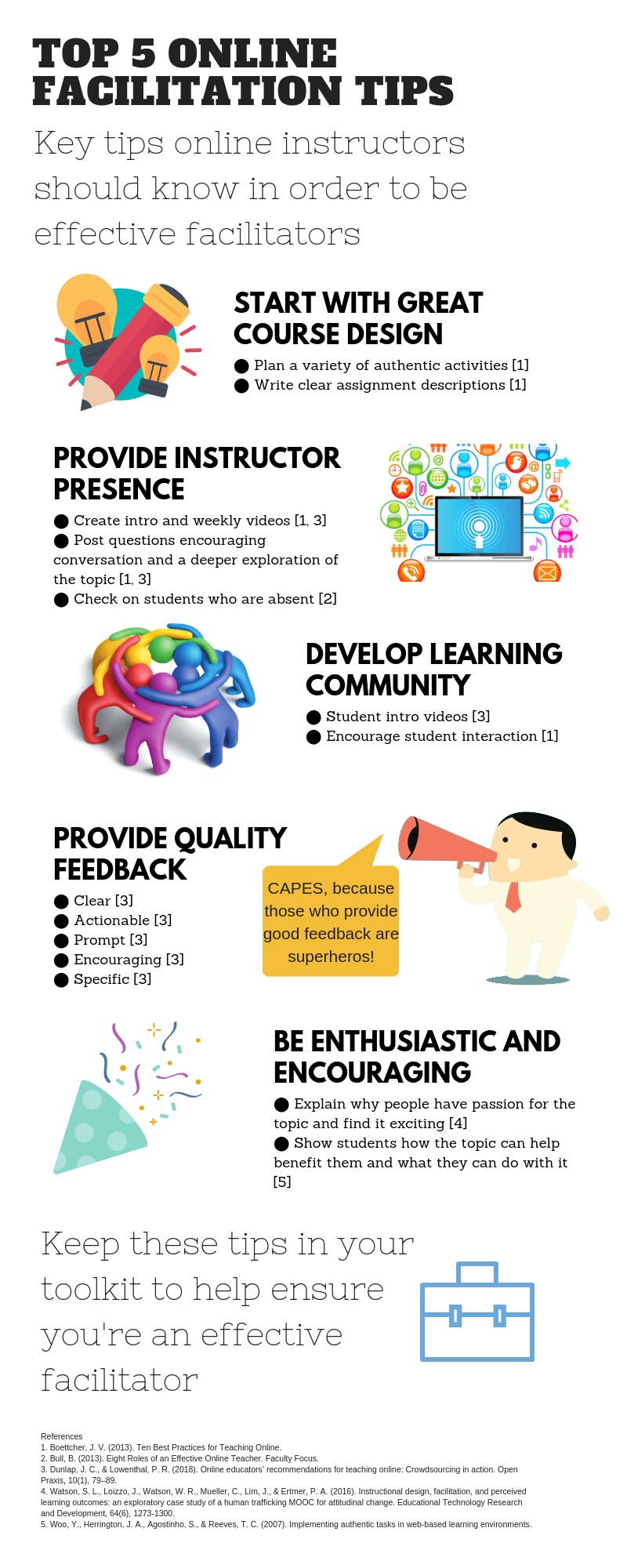
The infographic below provides five key tips that online instructors should know in order to be effective facilitators.
The first tip is for online instructors to start with great course design. Online instructors should plan a variety of authentic activities and write clear assignment descriptions (Boettcher, 2013). A greater variety of activities provides more effective, engaging learning environments and clear assignment descriptions may reduce student frustration, allowing students to focus on their learning instead of trying to figure out assignment expectations.
The second tip is for online instructors to provide instructor presence. Online instructors should consider creating intro and weekly videos, post questions encouraging conversation and a deeper exploration of the topic, and connect with students who are absent (Boettcher, 2013; Bull, 2013; Dunlap, 2018). With instructor presence, students may feel more supported and engaged in their course.
The third tip is for online instructors to develop a course learning community. Students and the instructor can post intro videos to get to know each other, and the instructor should take every opportunity to encourage student-student interaction and communication (Bull, 2013; Dunlap, 2018). The learning community provides students with student-student interaction opportunities and may allow students to feel more engaged and connected.
The fourth tip is for online instructors to provide quality feedback (Dunlap, 2018). Quality feedback should be clear, actionable, prompt, encouraging, and specific. These words create the mnemonic CAPES, which is easily remembered by thinking that instructors who give great feedback are superheros and therefore wear capes! Quality feedback helps students improve and understand what they need to work on.
The fifth tip is for online instructors to be enthusiastic and encouraging (Watson, 2016; Woo, 2007). The instructor should explain why people have a passion for the topic and find it exciting. It is preferable that the instructor is also passionate and excited about the topic, or at least tries to be. Finally, the instructor should show students how the topic can help benefit them and what they can do with it so that it is meaningful to them in their contexts and lives. Students may more easily learn the content if it seems to serve a purpose in their life, while enthusiasm and passion for a topic are often very encouraging.
References
Boettcher, J. V. (2013). Ten Best Practices for Teaching Online.
Bull, B. (2013). Eight Roles of an Effective Online Teacher. Faculty Focus.
Dunlap, J. C., & Lowenthal, P. R. (2018). Online educators’ recommendations for teaching online: Crowdsourcing in action. Open Praxis, 10(1), 79–89.
Watson, S. L., Loizzo, J., Watson, W. R., Mueller, C., Lim, J., & Ertmer, P. A. (2016). Instructional design, facilitation, and perceived learning outcomes: an exploratory case study of a human trafficking MOOC for attitudinal change. Educational Technology Research and Development, 64(6), 1273-1300.
Woo, Y., Herrington, J. A., Agostinho, S., & Reeves, T. C. (2007). Implementing authentic tasks in web-based learning environments.
Hi Jason,
As always, it’s pleasure reading your work. What stood out most to me was how actionable and specific your tips were. Rather than refer to general strategies, you included actual activities and tasks that instructors could apply to strengthen their facilitation. I also appreciated the way you were able to integrate citations into the graphic without detracting from the content – that’s often a challenge. Here are a couple of tips if you want to improve the graphic: include a superhero character next to your description of CAPES (very creative mnemonic, by the way); start your first bullet point under Develop Learning Community to start with an action word, the way you have with other bullet points; and finally, you may want to consider adding active links or including URLs to your references.
Cheers,
Amber
Hi Amber,
It’s always a pleasure reading your feedback! I agree that I should have added a caped character. I even joked about doing it but was ultimately too lazy and just went with the character I had already added 🙂
Thanks for all the ideas!
Hello Jason!
I find your infographic and blog post entertaining and useful. I think that when enthusiasm is present from the beginning everything flows easily because thinking of preparing a topic that does not get me excited about would make things harder. Simply put, if you like what you do it comes about without effort and it shows. I read once that when you do what you love energy will follow… so true!
Cheers!
Alfonso
Solid work, Jason. CAPES! Brilliant mnemonic. I agree with Amber. Your points are actionable, and you’ve done a nice job in synthesizing the readings for the unit into this infographic. Well done.
Jason,
Thank you for this tool-kit. The flow and overview of this infographic and outline intuitively describe what a facilitator should look incorporate within a learning community. I have always been a proponent for the pre-development and planning of well-developed course design. Your first stage emphasizes the importance of implementing many elements when it comes to creating an effective course design. It is important to note that course development should not focus solely on the content, but more on the proposed “interaction between instructors and students” (Bates, 2015, para.13). So, yes pre-planned activities should play an important role to promote community interaction among the cohort. From there, then the facilitator can present the course that demonstrates the four of your remaining strategies.
I also concur with your fifth tips in the promotion of the facilitator to provide an environment of enthusiasm and encouragement. No matter the type of academic environment, Knowles (1973) summarizes that enthusiasm in a teacher is a highly desirable trait by students. Castelli (2015) also echoes this sentiment in which any leader should provide an authentic level “momentum, motivation, and enthusiasm” (p.222) in order to engage those around them.
References
Bates, T. (2014). Is the ADDIE model appropriate for teaching in a digital age? | Tony Bates. Retrieved May 6, 2018, from https://www.tonybates.ca/2014/09/09/is-the-addie-model-appropriate-for-teaching-in-a-digital-age/
Castelli, P. A. (2016). Reflective leadership review: a framework for improving organisational performance. Journal of Management Development, 35(2), 217–236. https://doi.org/10.1108/JMD-08-2015-0112
Knowles, M. (1973). The Adult Learner: A Neglected Species. Educational Researcher (Vol. 8). Gulf Publishing. https://doi.org/10.2307/1174362