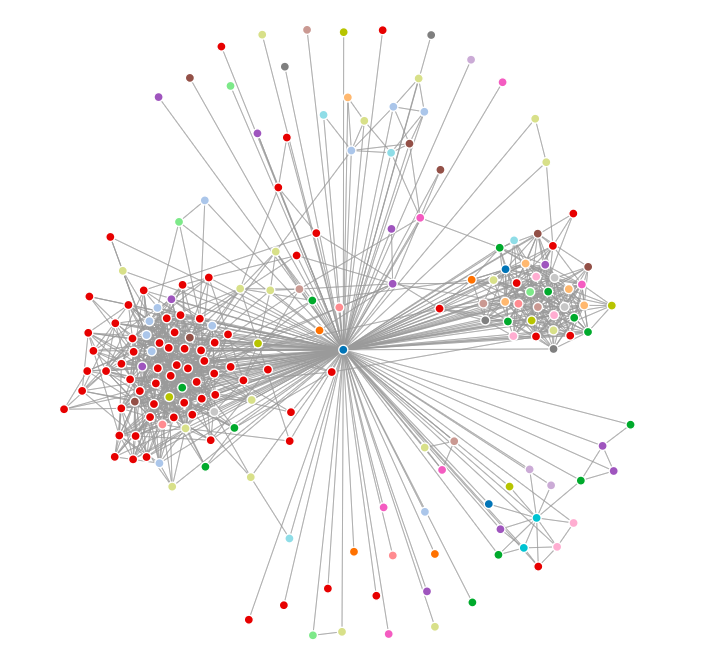
My Linkedin connections displayed by Socilab: arranged as connected to me by industry. (figure credit: Socilab)
We were asked in our Digital Learning Environments, Networks, Communities course LRNT521 to do a map using Socilab that visually displays our Linkedin connections in a variety of arrangements. I ran the program with limits that would consider my Linkedin connections as associated with me by industry. The result is above, a double-node display with a smattering of other, loose connections surrounding it. The two nodes represent connections from two of my strongest communities of interest. The largest node is my career community as I am passionate about practice development and collaborative practices. The smaller node is an extracurricular (West Coast Swing dancing) community. Veletsianos (2016) helps us to define a difference between a network and a community by stating that networks are likely to have low barriers to entry and exit as individuals “come and go as they wish” (p. 245), whereas a community “…appears to exhibit commitment, coherence, and continuity” (p. 245). In my experience, both healthcare workers and swing dancers are committed to their tribes!
I have, as of late, been a heavy resident user of Linkedin and have trying to develop a larger professional network in learning and development. Socilab represents these efforts with the loose connections seen in the diagram above. Rheingold (2010) states that “Just as the print technologies and literacies shaped the Enlightenment, the social media technologies and literacies will shape the cognitive, social, and cultural environments of the 21st century” (p. 24). I have been using social media to shape my cognitive environment through coursework on Lynda.com and edX. I am increasing my social media literacy in the process of doing graduate studies work in learning and technology – A graduate studies course that has been shaped by the need for understanding how we can navigate the intersection of learning and technology.
Rheingold (2010) also supports that we will need to continue to observe and mitigate “…the interconnected social media literacies of attention, participation, cooperation, network awareness, and critical consumption” (p. 24). His work asks us to critically examine our digital networks, becoming aware of who we trust and who we give our precious time and attention to online (Rheingold, 2010). Boyd (2011) confirms that:
Networked publics are not just publics networked together, but they are publics that have been transformed by networked media, its properties, and its potential. The properties of bits regulate the structure of networked publics, which, in turn, introduces new possible practices and shapes the interactions that take place (p. 4 ).
Linkedin, as a networked public, represents new possible connections for me as I consider changes in career direction. This potential then shapes my interactions and dictates my engagement with the platform. I am looking forward to re-running my Socilab ‘experiment’ in another year to reflect further on new patterns that evolve.
Christy
References:
Boyd, D. (2011). Social network sites as networked publics: Affordances, dynamics, and implications. In Z. Papacharissi (Ed.), A Networked Self (pp. 39–58). New York, NY: Rutledge.
Rheingold, H. (2010). Attention, and other 21st-century social media literacies. Educause Review, 45(5), 14.
Veletsianos, G. (2016). Digital learning environments. In N. Rushby & D. Surry (Eds), Handbook of Learning Technologies (pp. 242-260). UK: John Wiley & Sons.