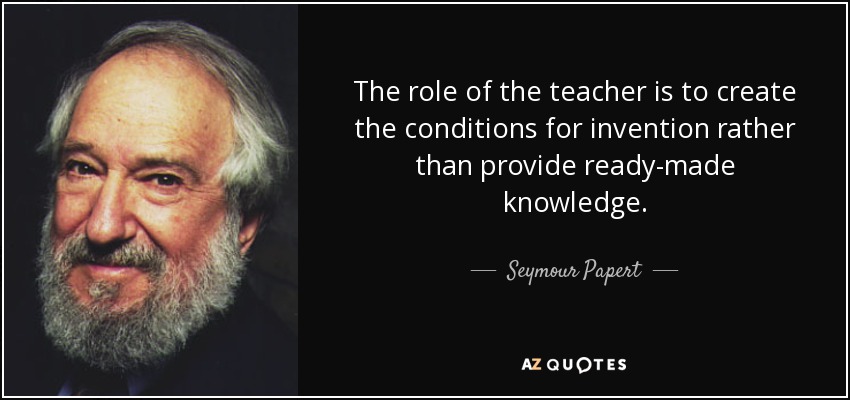
Photo from AZ Quotes.
Seymour Papert’s vision of the future of educational technology in the 1970’s was incredibly accurate. His hope was for computers to be used as tools to ignite creativity and creation in young learners, thus becoming a conduit for endless learning (Levin & Tsybulsky, 2017). Although most educational institutions did not adopt the computer in the way he hoped, his still vision has strong supporters. Several authors in my bibliography hope to see his theory of Constructionism rise to the challenge of truly integrating technology into our children’s education and supporting their digital literacy.
I chose to do Assignment #2 on the educational theory of Constructionism, a theory developed by the man Martinez & Stager refer to as the ‘Father of the maker movement’, Seymour Papert. (2013). My synthesis will focus on the theory of constructionism and how Papert’s vision has not only survived for decades despite being largely ignored by educational institutions but is being supported and hailed as the foundation behind the ‘maker’ movement.
Here is my spreadsheet of resources used to create the synthesis:
LRNT523 assignment2-spreadsheet
The synthesis is yet to be written. Thanks for your patience!
CB
References:
Levin, I., & Tsybulsky, D. (2017). The Constructionist Learning Approach in the Digital Age. Creative Education, 8(15), 2463–2475. https://doi.org/https://doi.org/10.4236/ce.2017.815169
Martinez, S. L., & Stager, G. (2013). Invent to learn: Making, tinkering, and engineering in the classroom (pp. 31-41). Torrance, CA: Constructing modern knowledge press.
Veletsianos, G. (2017). Annotation template. Retrieved from http://www.veletsianos.com
October 1, 2018
Hi Christy, I just read your post on my blog and I promptly had to look what your topic is. I have been reading about Papert quite a bit in my research! And I was curious to learn more about him and his research…now I will. Looking forward to read what you will find out and you will see my synthesis on my blog.