For Assignment #2 of LRNT 525: Leading Change in Digital Learning we are examining the results of an external scan of our colleagues surrounding their experiences with change management. All three of my anonymous participants had long backgrounds in the healthcare industry; a combined 80 years of experience. They had seen many changes, but I asked them to specifically reflect on a change that had taken place involving digital learning.

An influx of digital health solutions is resulting in large-scale, seemingly continuous healthcare changes. (Photo by Pixabay user mcmurryjulie)

Participants were asked to reflect on the following questions:
- Can you provide an example of an organizational change related to digital learning that was successfully implemented?
- What role did leadership play and what were some important steps that a leader or leaders took within the process?
- What challenges did they (or you) need to overcome?
One participant remembered a transition from a paper to an online charting system, another participant described a similar change to using electronic forms requiring data entry skills. The final participant reflected on experiences she had while transitioning to teaching via a learning management system in the context of higher education. The infographic below brings all their views together to show overall themes which are, not surprisingly, very human-centric.
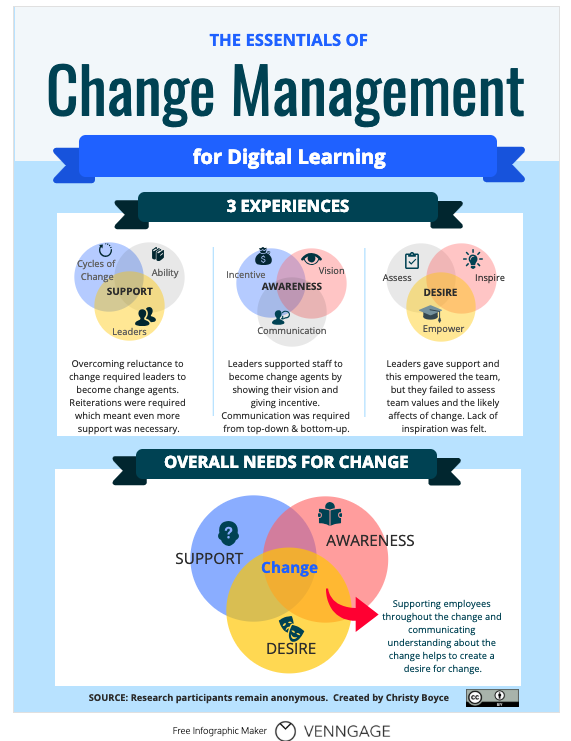
Participant #1 recalled feeling support and empowerment from leadership throughout the change. She spoke to ideas supported by Weiner (2009) in how information sharing and consistent messaging was used throughout the change. Her leaders used many components of Prosci’s (n.d.) ADKAR framework as they created Awareness, Desire, Knowledge, and Ability for the change. Leadership in this scenario decided to use a digital training tool to support knowledge dissemination after they evaluated the digital literacy of the group. This act speaks to characteristics of strong change leaders in alignment with Al Haddad and Kotnour’s (2015) mention of the need for tuning into the environment and challenging prevailing wisdom. New foundations of knowledge were required, and this leadership group recognized the need for large-scale support and interaction in the learning process. Participant #1’s leaders brought in Reinforcement through reiterations and revisions of the plan for change as employees gave feedback and vocalized the need for even more support.
Participant #2 reported leadership creating an environment similar to Weiner’s (2009) description of a strong psychological state to encourage readiness for change. His leadership focused on people from the top-down and the bottom-up, as they incited change and leveraged their influence through many coalitions. This behavior is in line with Sheninger’s (2014) argument that social influence is needed for leadership achievement. Leadership in this scenario also highlighted a funding incentive through their communication of the ‘Why’ behind the change, harnessing the Desire step of the Prosci (n.d.) ADKAR model. This participant felt strongly that ADKAR helped to create change agents throughout all levels of the team, leading to higher rates of successful change.
Participant #3 exposed both successes and failures in leading change in her scenario. Her recall of a transition to using an online learning management system in higher education brought on a discussion of values-based leadership. Her reflections were in alignment with O’Toole’s (2008) description of successful leadership inquiring about and analyzing the desires and values of their team members in order to find commonality. Her leadership failed to connect to the team’s values by neglecting to discuss how the technology could affect their teaching, their relationships to their learners, and their anxieties about their own digital literacy. This led to a lack of empowerment and buy-in for the change. When leaders frame a change through common desires, they make the change more relevant, desirable, and achievable as a result. Again, this connects to the Awareness and Desire stage in Prosci’s ADKAR model (n.d.).
Overall, participant stories demonstrated themes of focusing on the needs of people, the social environment and managing expectations. This recognition of people and culture is mentioned in Khan’s (2017) work on adaptive leadership, where she mentioned that adaptive leaders focus on relationships and the environment. Remaining human-centered and relational in a change management approach appears to help improve the motivation for change and the ability to sustain change. Effective communication and engagement with all individuals impacted by the change appears to be a strong change management approach.
CB
Khan, N. (2017). Adaptive or Transactional Leadership in Current Higher Education: A Brief Comparison. The International Review of Research in Open and Distributed Learning, 18(3).
O’Toole, J. (2008). Notes Toward a Definition of Values-Based Leadership. The Journal of Values-Based Leadership, 1(1).
Prosci (n.d.) The Prosci ADKAR Model [website] Retrieved from https://www.prosci.com/adkar
Sheninger, E. (2014). Pillars of digital leadership. International Centre for Leadership in Education.
Varkey, P. & Antonio, K. (2010). Change management for effective quality improvement: A primer. The American Journal of Medical Quality. 25(4), p 268 -273. DOI: 10.1177/1062860610361625
Weiner, B. J. (2009). A theory of organizational readiness for change. Implementation Science, 4(67).