As we wrap up LRNT 525, I find myself swept up in a new position at work and starting a new training course at work – Lean Six Sigma Black Belt. As a result of my workload, this post will be uncharacteristically short but no less meaningful to the author.
The content in this course has been timely for me in an uncanny way. A review of leading change, project management, and systems theory could not possibly have come at a better time than now. As we progressed through the course, I worked through the phases of leading a large health care pilot trial while later transitioning to a Quality Improvement team. Every theory and idea that resonated with me got placed into action immediately or discussed on a thread with a new connection on Twitter. The result was some incredible cross-contextual conversations, leaning into the concept of breaking down silos for innovation.
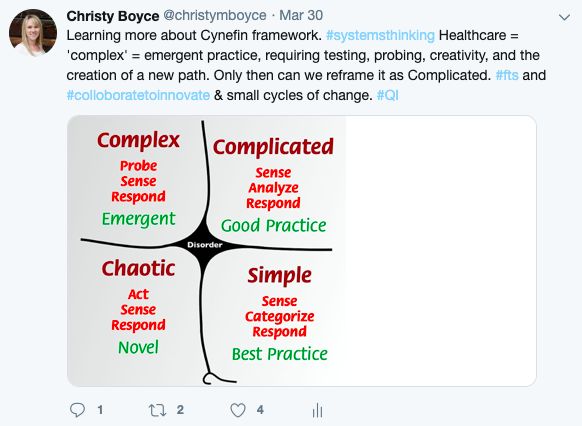
I knew a physician colleague that would be excited about the potential of the theory as well. So I tagged him. The IT presentation slides directly echoed @Gatweway Medic’s passion for reducing siloed communication and promoting collaboration, a leadership practice that I am a very strong advocate of myself.
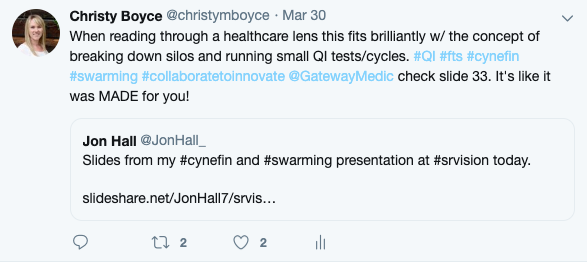
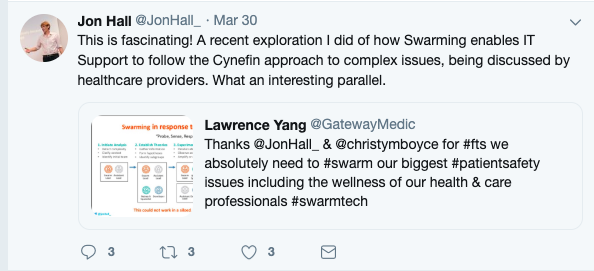
Then the IT Specialist/DevOps advocate @JonHall_ saw that we were completely out of context but had nonetheless found great relevance in his work within our contexts of primary and acute healthcare.
So, in short, this course has:
- Exploded my understanding of leading through change, allowing me to better support all the stakeholders in my current pilot project.
- Introduced me to Conway, Masters and Thorold’s (2017) theory of Intrapreneurship – using Systems and Design thinking to work through inevitable system immune response to support innovative change.
- Offered ideas for supporting a more thorough evaluation of my pilot trial.
- Supported practices of reflective (Castelli, 2016), adaptive (Khan, 2017), and values-based (O’Toole, 2008) Leadership styles to support my current knowledge and behavior.
- Allowed me to better understand how to assess my organization’s readiness for change with the help of Biech’s (2007) Thriving Through Change resource – an incredible read to support my pilot trial and future healthcare QI projects.
- Introduced me to Cynefin theory and supported my passion for testing, trialing and learning in small cycles of change within the complex system of healthcare.
- Allowed further development of my online network and an understanding that there truly are cross-contextual solutions to the complex social problems we are currently faced with.
I was thrilled to participate in this course and will take these learnings ahead with me in my new role, placing the new skills in practice and putting theories to the test!
CB
References:
Biech, E. (2007). Models for Change. In Thriving Through Change: A Leader’s Practical Guide to Change Mastery. Alexandria, VA: ASTD Press. [Books24x7 database]
Castelli, P. (2016). Reflective leadership review: a framework for improving organisational performance. Journal of Management Development, 35(2), 217-236.
Conway, R., Masters, J., & Thorold, J., (2017). From design thinking to systems change: How to invest in innovation for social impact. Royal Society of Arts, Action and Research Centre.
Khan, N. (2017). Adaptive or Transactional Leadership in Current Higher Education: A Brief Comparison. The International Review of Research in Open and Distributed Learning, 18(3).
O’Toole, James (2008). Notes Toward a Definition of Values-Based Leadership. The Journal of Values-Based Leadership, 1(1).