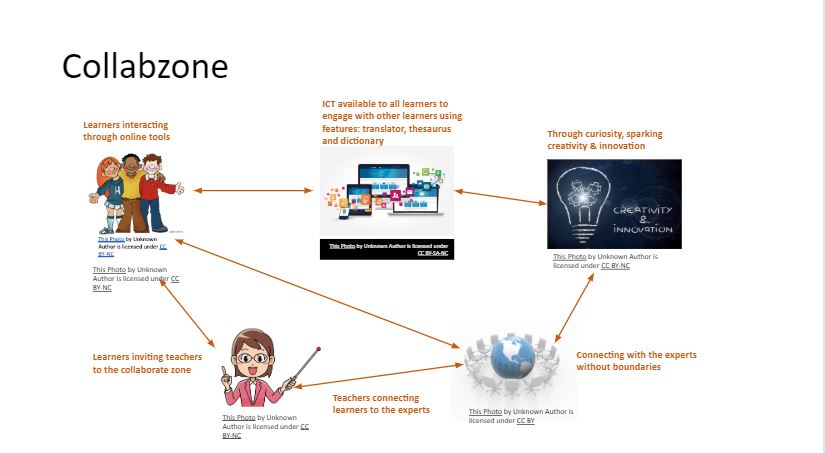
CollabZone App
By: Kerry, Sharon & Sue
We felt a critical component was missing from online learning and we wanted to include an inclusive, safe environment where students can engage in intellectual risk taking. Breaking free of the fear of intellectual risk is integral to a students success, as they will be free to engage with their peers in a judgement free zone.
Using new software for the first time can be an overwhelming and intimidating experience. Keeping this in mind, we wanted to ensure our App would be accessible, and user friendly, as well as offer an easy to use tool. Based on empathic design, a few things we had to consider within the design thinking process was to appeal to the diversity of all students. The application will be accessible to hearing, learning and visually impaired students, as well as students who may encounter a language barrier. We want the student to be able to access the software from any laptop (PC/Mac), smartphone, desktop or tablet. To view a more detailed, visual representation of the proposed software, please view the following link: CollabZone App
The decision to develop a mobile app in a world that currently has over 1 million prototypes submitted to Apple and Android app stores each year, revealed that the biggest challenge was how to stand out from the crowd. To that end, the initial analysis and research activities were crucial in the early stages of our development process to identify the key selling features of the app. From an instructional designer perspective, the first question we asked ourselves was: Is there a gap in the learner’s ability to communicate with their peers? The answer was a resounding yes, which we chose as our founding principal in our design. As online learners are not restricted to geographic areas, their global environment means they can potentially live anywhere and speak any language. In fact, online learners are truly mobile in that their physical mobility is not restricted by the limitations inherent in face-to-face interactions. Therefore, their access to communicate with each other, regardless of language, should reflect this openness. Hence our app is a translator that transcends language barriers for learners to engage in a safe and supportive space.
We wanted to ensure the features could be easily transferred and uploaded to an App used by a college/university. Websites such as Zappar, Zoho and Cloud business allow the App creator to take full control of the virtual world and assist with adding desired features and augmented reality into their software. We would work closely with an instructional designer from the institution to ensure policies and procedures are upheld. Instructional designers will help us manage analyze and consult with the project to ensure we create a cohesive online application. Most educational institutions take socio-economic status into consideration, as did our group in designing the App. If the student cannot afford a device, the institution can lend this out. Students can log in together if they feel comfortable enough to do so from one device and if needed, students can even access a computer for free from a public or school library.
We feel this App will offer an innovative learning community with a universal language, constructing meaning together without boundaries. Would you consider using our CollabZone App to engage in intellectual risk?
References:
Atukunda, B., Priya, Juby, J., Micheal, Francies, R., Aguilar, A.,Google Digital Marketing Certification. (n.d.). 6 Biggest Challenges in Mobile App Development. Retrieved from https://www.apogaeis.com/blog/6-biggest-challenges-in-mobile-app-development/.
Cloud Software Suite and SaaS Applications for Businesses. (n.d.). Retrieved from https://www.zoho.com/.
Instructional Designer Competencies. (n.d.). Retrieved from http://ibstpi.org/instructional-design-competencies/.
Mattelmäki, T., Vaajakallio, K., & Koskinen, I. (2014). What happened to empathic design?. Design Issues, 30(1), 67-77.
Zappar. (n.d.). Augmented, Virtual & Mixed Reality Solutions. Retrieved from https://www.zappar.com/.
December 1, 2019 at 10:16 am
Hi Kerry, Sharon & Sue
Thank you for putting together such a clear picture of your design prototype. I like how it encourages student agency by giving them control over whom they interact with and in what capacity.
I see that the app also promotes the sharing of responsibility with the rotation of moderator responsibilities. Do you see this function as an opportunity for the learners to exercise some autonomy and self direction or as a self policing function? Further, do you anticipate any social issues with this changing role among the cohort?
Your app would certainly address the need for context, collaboration and construction (Jonassen and Duffy. 1994 as cited by Thomas, 2010) and I notice your graphic indicates the “learners inviting teachers to the collaborate zone”.
Is this invitation optional? I ask because Thomas also suggests that the creation of a learning environment would do well to include the teacher as a guide or coach in a bilateral negotiation of meaning between student to student and student to teacher. Possibly some facilitator oversight may bring more to your Collaborate Zone.
Thank you again,
kind regards,
Sandra Kuipers and Owen Lloyd
December 2, 2019 at 4:44 pm
Hi Sandra & Owen,
Thank you for your comments and feedback, much appreciated. Fantastic to see that you were able to pin point the exact reason we wanted the students to share the responsibility of moderating the App. The function would serve both purposes, exercising autonomy and self policing. We would hope that the change in moderators would help promote a fair and equitable collaboration amongst the cohort, reducing the amount of social issues that there may be by having only 1 moderator.
Yes, the invitation for the instructor would be optional. We see both a benefit (as pointed out by Jonassen and Duffy) by inviting the instructor into the conversation/collaboration and the negative side. We were worried that some students would not be as engaged with their peers, or as open/honest as they could be, as well as engage in intellectual risk with an instructor being present.
We really appreciate your comments, thank you for posting.
Kindest regards,
Kerry, Sharon & Sue
December 3, 2019 at 5:39 pm
Hi Kerry, Sharon, and Sue!
The Collabzone App that you have put together seems like a great solution to much of what is missing from online learning in terms of inclusive, safe environments where students can engage in intellectual risk-taking. I particularly appreciate your intention to create a space where students feel free to engage with their peers in a judgement-free zone.
The detail and clarity with which you presented Collabzone was awesome! The visual component of the sharing of your model highlighted how well thought-out it is, as well as the multiple components of students’ journeys and connections that are important to incorporate in such a collaborative model. Garrison’s (1996) elaboration upon the community of inquiry (CoI) framework in a computer mediated context, and Wenger’s (1998) Communities of Practice (CoP) framework both support your apps strengths in many ways. The role of the instructor is peripheral in our Collabzone, feeding more current constructs where we have the teacher as more of “a guide on the side,” as much more of a facilitator than leader of learning. On that note, the fact that your instructor “may be invited” (or not), and that students share the moderator role, is also of great interest to me. I feel this supports your design intentions of creating a safe, student-driven collaborative zone, fuelled by other learners and professionals in their field or discipline.
Your goal to ensure that your App would be accessible, based on empathic design, taking into account hearing, visual and language barriers are commendable. I wonder if your efforts to be so many things, to so many students might be overambitious. For example, an “app that is a translator to transcend language barriers” is challenging for linguistic and cultural factors. My experiences with students using Google Translate often leave much to be desired in direct translations, because the structures and nuances of languages are often difficult to capture. Many more seasoned linguists will point out that “interpretation of a word or a phrase into another language may introduce unintended meanings” (Ker, 2008).
Your foresight into providing ‘borrowing access’ to a device with your app for students who could not afford to own it is excellent.
I would definitely consider using your Collabzone App to engage in intellectual risk!
Well done! Thank you for sharing with such clarity and detail.
Best regards,
Leigh
Reference
Ker, D. (2008). What I lost in the translation. Ecumenical Review, 60(4), 426. Retrieved from https://doi.org/10.1111/j.1758-6623.2008.tb00683.x
December 3, 2019 at 8:11 pm
Thank you for your generous comments Leigh! We appreciate the considerable thought you’ve taken to provide your feedback. We’d agree that the scope of the features we’d like to include in our App are ambitious (we got pretty excited 🙂 however, as Collabzone is a prototype, it’s likely further exploration would lead to a refinement of original ideas. We would imagine that in the ‘real’ world, the final product would look differently than we originally envisioned.
Your observations of the challenges surrounding language translators are also very accurate. Most applications that offer a language translation feature leave a lot to be desired! The promising aspect is that as the technology continues to evolve, the emerging iterations are exponentially improving. Given the complexities of human language (apparently there are over 6,500!) it would be impossible to create a perfect solution of course. However, as the ability to learn different languages becomes increasingly accessible, because of technology, it’s conceivable that the functionality of a language translator would decrease in complexity as a result. It certainly will be interesting to see how this area develops in the future!
Thanks again for your thoughts,
Kerry, Sharon and Sue
December 4, 2019 at 9:36 am
Hello Kerry, Sharon and Sue,
Your prototype solution sounds as though it would absolutely provide a perceptually safe platform for learners to participate and engage in intellectual risk taking. From my perspective, there are many apps (Whatsapp, Messenger, Facebook, Moodle) that could be used in a similar way you to what described here; to facilitate communication among a cohort. Where I see your solution diverging into innovative territory , is in the elements you’ve chosen to include; such as augmented reality, and a translator.
In my field, English is often not the first language for many of my students. I have seen this create silos in the classroom, and absolutely deter a learner from demonstrating risk taking behaviors (as they’re either preoccupied by or embarrassed of their linguistic skills). In Collabzone, I see an opportunity for learners to emerge from their silos and can see how this app would actually allow for richer and more meaningful connection among peers digitally than possible for some learners in a face-to-face classroom.
Elements I’m unclear on are; the degree of customization available to institutions, and to what degree the use of this app would be required. If not required as an element of classroom engagement by an institution or individual instructor, or if not consistently used by all learners, then I wonder if the potential of this app to dismantle silos and nurture collaboration could be realized?
I think the idea of an app of this nature has great potential and it’s awesome how it can address the needs of diverse groups of learners. To keep it as effective as possible, I suggest including implications for use or guidelines for integration into the classroom as an element of your prototype solution.
Laren
December 4, 2019 at 4:51 pm
Hi Laren,
Thank you for your thoughtful feedback. I agree that our proposed communication tool features exist in apps you mentioned above and what stands out is our ability to apply empathic and universal design to address accessibility and language issues. Definitely more engagement needs to occur to address gaps or concerns that we may have inadvertently missed in our prototype. This is an iterative process and the goal is continuous improvement. As suggested in the design thinking process for educators (2013), learning design is about engaging the learners and the community. It is not about perfection but continuously improving the product or service.
Thank you.
Kerry, Sharon and Sue
December 6, 2019 at 1:05 pm
Kerry, Sharon & Sue, I really enjoyed reading your blog and your fresh approach on a topic of collaboration/tools. You are right in indicating that Team collaboration software is on the rise. From communication to project management, technology offers an abundance of options. More online collaboration tools spring up every year, while existing ones are constantly improving their features and functionality. Some companies grow and thrive through holacracy, a collaborative management structure.
For many of us, the default way we collaborate with each other in the workplace is email. Yes, that tried and true, reverse chronological stream of messages that rules our lives. There are many ways that email is terrible for group collaboration, primarily the fact that multiple messages between a team of people are hard to follow and track over a period. To solve these issues, enterprises now deploy a wide variety of collaboration software, which ranges in complexity from simple chat interfaces to full-fledged project management platforms that integrate with multiple parts of the business.
I like the fact that you address some of the challenges right off the bat in your article such as how do you stand out in a world that currently has over 1 million prototypes submitted each year. The translation barrier was definitely one of the gaps when you talk about global community.
Another highlight of the article was easily transferred and uploading capacity with augmented reality into the software, that is something which has a great demand provided the efficacy of the IT infrastructure and platform.
One thing that I am curious about is the adoption rate. I work in the IT sector and all the bells and whistles of the tools and gadgets are meaning less if the adoption of technologies are less than favorable. This is something many of the CIOs expressed deep interest in the data, sharing that this is one of their top priorities through the end of 2018 and into 2019. There is an interesting report I came across and the key findings were:
Work adoption emulates personal adoption of technologies
Age isn’t a significant factor in adoption
While most leaders use collaboration tools, the crucial middle manager lags behind
Collaboration adoption rates vary significantly by industry
I wonder what your take on this point and do you see any potential challenges that your app might encounter in this realm. Thoughts!!
References
Li, Charlene. (August, 2018). Altimeter, a Prophet Company. Retrieved from. http://bit.ly/altimeter-collab-tools
Tehreem.
December 7, 2019 at 4:27 pm
Hi Tehreem,
Thank you for your comments and the awesome amount of information you brought to the surface. I think it is fantastic to have someone look at our prototype from an I.T lens, as you pose great questions. I agree with what you are saying in that the middle manager lags behind, as well as, “Work adoption emulates personal adoption of technologies”. I sadly do foresee a few complications/challenges along the way when it comes to integrating this App throughout a college, student body, and staff population. Where there is software/technology, there are always challenges and we are not disillusioned to this. We would need an extensive training period with faculty and people who work within the I.T department, as they will be the people in the front lines dealing with questions/concerns from students. We think that working closely with an instructional designer would be beneficial before implementing the App, as this could ensure as little “bugs” as possible when the App goes into effect. Having a FAQ section within the App for instructors to access, would be a must and working hand in hand with people from I.T would be essential for the success of the App.
Kindest regards,
Kerry