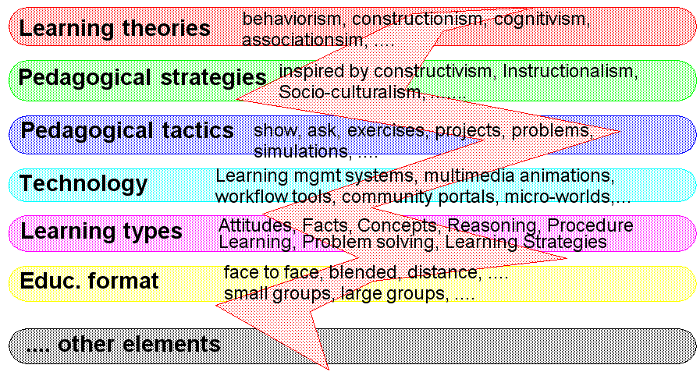
Image: http://edutechwiki.unige.ch/en/File:Educational_Technology_Problem_Space.png
From paintings on cave walls to live streaming, educational technology covers a vast and immense field where learners use tools to help explain and advance their own learning. Educational technology is derived to help problem solve and using constructivist and cognitivist learning theories (Educational technology, n.d), creates a learning environment to help expand intellectual behavior. Technology use in education is multifaceted in order to stay current and up to date, as well as offer the best, most diverse options to students and instructors alike.
I remember having overhead projectors in class when I was younger and writing notes from the blackboard/dry erase board that the teacher wrote their lessons on. Nowadays, this is replaced with smartboards and the cloud, D2L and moodle, and multiple other software programs that make the blackboard seem archaic. When did PowerPoint become outdated? Seeing this evolution in such a short time shows that educational tools are forever evolving. The question I couldn’t find an answer to when researching this topic was: what is driving the technological change? Classroom demands vs existing technologies?
There are studies which show what tools seem to harbor or hinder a classrooms learning, but this is subjective as it can boil down to culture, location, prior technology knowledge and student preferences (to name a few). Because of the advancements we continue to see, there are multiple new theories arising with pedagogical frameworks being written to explain what works best and why. We are in a new age with new software coming out all the time, it will be interesting to see what the future has in store and how effective these tools will be.
References:
Educational technology. (n.d.). Retrieved from http://edutechwiki.unige.ch/en/Educational_technology
Haran, M. I. (2015, May 29). A History of Education Technology. Retrieved from http://institute-of-progressive-education-and-learning.org/a-history-of-education-technology/
September 6, 2019 at 6:40 am
Hi Kerry, you bring up some good points. What really resonates with me is how you mentioned how culture and location can affect what technologies are “new”. PowerPoint presentations are still the “in” thing where I teach, and our smartboards don’t work half the time which means I’m using a normal whiteboard. Many technological tools that seem to be very familiar to our cohort were new to me when I started the program (ie. Padlet). So my location definitely affects the technology I use on a daily basis.
September 6, 2019 at 11:16 am
Hi Kerry,
Thank you for sharing your findings. I really think existing technology shaped the history of educational technology. and will continue to shape its future. If you think of it this way, there is no new technology that doesn’t depend on old technology. pictures and videos, for example, are old technologies and but yet they are still used in new technologies but in different forms. This field is so interconnected in such an amazing way!
September 7, 2019 at 1:30 pm
Hello Kerry!
You raise an interesting question “what is driving the technological change? Classroom demands vs existing technologies?” As a person, I’ve always been curious in what technology can do, but as a Learning Consultant, I’m keenly interested in what technology can do, for us. And how the tension between the ‘wow’ factor can be navigated to identify technological solutions that are the right tool, rather than the newest flavour of the time. Like you, I’m interested in learning more about what the future will bring.
September 9, 2019 at 8:49 pm
I MISS overhead projectors! When I was younger, and would imagine being a teacher, I totally imagined using one. Feeling a little bit short-changed there aren’t any available at the College for us… lol
Thanks for sharing your thoughts Kerry!
Laren