Activity 4 – Reflections on my theoretical and pedagogical stance

Through reading Ertmer & Newby’s article Behaviourism, Cognitivism, Constructivism: Comparing critical features from an instructional design perspective, it became clear that I am working primarily from Cognitivism as my theoretical centre when teaching online and more from a Constructivism centre when teaching in the classroom.

Declaring an alignment with a particular theoretical stance for all of my work is not really possible because my work occurs in a variety of different contexts, for a variety of reasons.

I instruct and facilitate in Human Services programs, teaching primarily support strategies courses in the classroom and interpersonal communication online. The classroom work is dynamic, students have full access to each other and are encouraged to bring their own wisdom and experience to bear on the activities we do. Human Services is messy, unpredictable work, and students are given many opportunities to research, understand, discover and practice the skills that will be required in a variety of real-world scenarios (Ertmer & Newby, 2013, p. 57). The work is relational, so teaching a cut-and-dried set of procedures will not help students once they are in the work force. In order for them to be best equipped, I give them messy, ill-structured problems and as that they work individually and in groups to understand their relationship to the problem, their possible solutions, and how others might solve the problem differently, but with equal validity. Students are regularly asked to reflect on how they came to the conclusions they did, to examine personal experiences and biases that brought them to those conclusions, and the cultural context in which it all occurred (Ertmer & Newby, p. 56). Students complete their credential with practicum placements, which firmly places the learning in the realm of Constructivism.

The interpersonal communication course that I teach online has very different parameters. This is somewhat due to the constraints of the LMS (Learning Management System) we are working within, somewhat because of the constraints of working within a standardized course. There are several different instructors teaching this particular course and we endeavour to have some consistency (standardization) across all the classes and delivery methods. The constraints of the LMS make it difficult to have students practice their interpersonal skills with each other (curricular things such as eye contact, and open body language), and the institutional constraints make it difficult to introduce other applications for this practice (video conferencing software) as we are cognizant of privacy laws and student use of 3rd party applications. Within this course, I structure the environment of the course to have explanations, demonstrations and examples to guide students. We talk about how learners encode information, and work with a variety of study skills that are designed to support their learning through activating their prior information, connecting the new information to it, practicing or demonstrating this new information, and ongoing rehearsal of the information as a way of ensuring that it is encoded in memory (Ertmer & Newby, 2013, p. 52). Students are expected to demonstrate that they can apply the new information in a variety of contexts (transfer) through different assignments and class discussions in the forums. Coaching the students to use appropriate learning strategies is in line with a Cognitivism theoretical base (Ertmer & Newby, p. 52).

Due partly to the different contexts of the courses I teach and the different expectations of the courses, my role in the classroom is much more of facilitator (which I see as in line with Constructivism) and of instructor online (more in line with both Behaviourism and Cognitivism). Students in my online courses will all come away with the same set of skills and information, but the students in my face-to-face classes will come away from the course with learning that is meaningful to them.

Resources

Ertmer, P., & Newby, T. (2013). Behaviorism, Cognitivism, Constructivism: Comparing critical features from an instructional design perspectivePerformance Improvement Quarterly26(2), 43-71.

Activity 3: Application of readings to my context

Lesson from the past that I can apply to my work:

The quality of media use matters. Reiser (2001, p. 58) identifies that much of the reason that instructional television began to lose its momentum as an educational media was that the instructional quality was poor. Poorly designed materials are poorly designed materials, no matter how expensive, interesting, modern or cutting edge the delivery method is. Shoehorning poor pedagogy or andragogy into a new delivery method will not make a good lesson.

Really this is very relevant in my work. As instructors, we need to remember that the first thing in the 1994 Association for Educational Communications and Technology definition of field categories for Education Technology is design. Taking time to first design a lesson, prioritizing the learning outcomes over the media through which we are working with students is paramount to finding ways to use technology effectively. My current strategy is to think through, “what are the things I need the students to come away with?” Then to look at the educational media tools at my disposal to see which one best delivers the information and allows for student input and feedback.

Lesson from the past that conflicts, contradicts, or causes problems with my work:

Reiser (2001, p.59) talks about how the early work done in computer-assisted instruction from the 1950s did not change the way the information was being delivered to students, and that education practices remain the same – just that tech has become the media through which that teaching happens. I’d like to see that, at my institution, we can move beyond replicating the classroom experience to the virtual realm, to do more than videotape and post lectures. I am currently part of a committee that is developing a course, and much of the suggestion has been around filming in-class to create video lectures, enabling us to translate the course from a face-to-face setting to an online setting. My concern is that there is no room in this model for student feedback and relationship to the material. There is a prevailing attitude that putting it online is easy, that additional development does not need to be done. I would argue that 1950s attitude about what educational media can do for us and our students is still prevalent in my post-secondary institution today.

Reference

Reiser, R. A. (2001). A history of instructional design and technology: Part I: A history of instructional mediaEducational Technology Research and Development49(1), 53-64.

Introducing Martha Burtis and Jim Groom

Graphic Recording of Jim Groom talking about sd106 for BC Campus(A note at the outset – I started writing this post about Jim Groom, only to realize how important Martha Burtis’ voice is to the story of ds106. I elected to write about the two of them to ensure that her voice is not lost.)

I would like to share a brief overview Jim Groom and Martha Burtis’ work around Digital Storytelling 106 (ds106) with the University Mary Washington (UMW) in Fredricksburg, Virginia.

Ds106, originally written by Jennifer Pollack, was restructured and delivered in an experimental ‘Open’ way in 2011 by Jim Groom and Martha Burtis. Faculty at UMW had, the year before, received their own domains and had started writing blogs, experimenting with open community and network building. Groom had been teaching ds106 face-to-face and suggested opening it up to the World Wide Web, allowing open participation. Burtis agreed, and the phenomenon of ds106 was born.

They taught different sections of the course – the first of its kind. It combined a real, practical understanding of ‘Open’ as an education concept and successful implementation. Ds106 is remarkable for several reasons: students received their own domain with which to demonstrate learning (something that later evolved into Domain of Ones Own, or DoOO), all the domains were syndicated into the main site so that they could be viewed by categories and tags, creating a connected, online community of students. Students were given the opportunity to submit assignments for themselves and other students to do, allowing them to choose an assignment a week from this democratized assignment bank to complete and post for others to view, give feedback and comment on.

This short introduction does not capture the seismic effect that this course delivery model had on Ed Tech in general. The after shocks of ds106 are seen in our own program, with each member of our cohort having a blog to publish to and network with, our syndication through Feedly, and the use of the RRU WordPress site to house the bulk of our teaching materials. Our blogs are open to the Web, meaning that anyone can view and comment on our work.


Martha Burtis is currently Learning Teaching Developer at Plymouth State University. She has blogged for many years at The Fish Wrapper, and currently muses about Ed Tech, teaching and more at Beyond the Wrapper.

Jim Groom is currently an owner operator of the web hosting company Reclaim Hosting, founded in 2013 that specializes in hosting for Higher ed. He continues to blog about Ed Tech, Edupunk topics, media, and his personal life over at Bava Tuesdays.

Resources:

Groom, J. (n.d.). About – Reclaim Hosting. Retrieved September 20, 2019, from Reclaim Hosting website: https://reclaimhosting.com/about/

Friend, C. (2016, August 19). Making and Breaking Domain of One’s Own: Rethinking the Web in Higher Ed. Retrieved September 20, 2019, from Hybrid Pedagogy website: https://hybridpedagogy.org/making-breaking-rethinking-web-higher-ed/

University Mary Washington. (2019). About ds106 [Course Description]. Retrieved September 20, 2019, from http://ds106.us/about/

Musings on the History of Education Technology

Cave Painting - Paleolithic, Cantabria, Spain painted 20,000 years agoGetting an understanding of the history of education technology really relies on the definition given to the word technology. Is technology defined only in what might be considered a modern way? As a mechanical or electronic gadget that mediates learning? Or can we look back to see that carving marks into stone (cuneiform script as early as 3200 BC in Mesopotamia) or tying knots into string (going back to the first millennium AD in Andean South America) could be considered technology used to pass on knowledge (to teach)?
I like the idea that we’ve been using all of our technologies to teach each other since the dawn of time, that the only real differences through history are the technological tools we use and the types of information that we convey. I do graphic recording and illustration and think of the power of mark-making as one of the most powerful tools that humans possess to convey information. With this, I think that education technology has been used since the first person went from teaching through oral history to teaching through image and mark making, perhaps by using a stick to draw on the ground during a conversation, and later through the use of pigments to make images on stone and in caves.

Wandering through the research and different perspectives was interesting. The Rosetta stone is the earliest known written translation between languages. Early religious teachings of the contents of holy books were done through paintings (in religions that favour use of images of god), and through illuminated manuscripts in the early centuries AD. The boom of literacy that came with the invention of the printing press in the 15th Century AD was unprecedented and opened up a new era of education, creating a mechanism by which information could be distributed on a mass scale. The next largest boom in terms of mass access to information was probably late last century, with the wide adoption of use of the World Wide Web.

Between the printing press and the adoption of the web was a time rich with ongoing growth in education technologies. I’d not heard of desktop sandboxes for practicing the alphabet (1806), or hornbooks (1450) but remember my grandfather talking about use of slate in his Prairie one-room schoolhouse. As a child, I learned a lot from watching Sesame Street and The Electric Company on our little black and white television. I look at our K-12 and post-secondary settings today with their use of electronics for everything from creating and distributing digital print documents to the use of richly multimodal teaching materials, ones that are interlinked with as much (or little) as a student might like to know.

I’m excited to be stepping into history at this point in the stream, having the opportunity to look back and learn more about what has led us to this point, as well as to squint into the future to see what new ways of teaching and learning it might hold.

Thoughts from a virtual Q&A with George Veletsianos

It had the distinct pleasure of meeting George briefly several years ago at an Open Textbooks conference held at TRU at which he was keynote speaker and I was graphic recorder. I was impressed at the time at his understanding and use of social media as a means to communicate with his students, and at his understanding of how contemporary students communicate, and what it takes to meet people where they are at.

Our group asked him about snowball sampling – something that was completely new to me.  My parents are both scientists. Growing up, my family looked at things from a very quantitative angle. My anecdotal understanding of research was that it was always large study groups, wide-ranging, random subjects, and that everything could be boiled down to numbers in tables. My Dad referred to human services as ‘soft sciences’ and pointed to the problems that qualitative data had, in his opinion, inherently, such as difficulty with self-identifying mental or physical states. He would ask, “how do I know that my 3/5 pain is the same as yours, or someone else’s?” His view on this has always stayed with me. I’ve really always thought of quantitative data as ‘hard’ data and qualitative data as ‘soft’ data, and that ‘soft’ was not in a flattering way, not like real science.

This course has challenged a lot of biases that I wasn’t aware that I had when it comes to research and data. It has been useful to move through the course and unpack each of these little internal resistances that I’ve felt as we’ve moved along. While I still have a long way to go, it was helpful to have a mirror held up to my ways of thinking, to allow my horizons to expand around this.

Our group’s question was:

Do you find that using snowball sampling allows for a varied enough sample group for the types of research you are doing? When is it more or less appropriate to implement this as a way of finding participants?

George described snowball sampling as identifying participants who then identify further participants. He shared with us that it is appropriate when looking for groups of subjects who share certain characteristics. This makes sense with the type of research he is doing, where he is looking to speak to a specific demographic of people about their experience.

I had to do some work around his answer – are data valid if they are from a narrow demographic? The answer, of course, is yes! It was my bias that was keeping me from seeing how this way of finding participants has value.

This all connects so beautifully with the way he answered the question asked by Team Four regarding biases – that to work in a team is an important part of the research. He said that other people in the team are there to help challenge each other’s biases. I like the idea of working in a team of people that have strong boundaries set and are comfortable enough that they can challenge each other’s biases without jeopardizing the work relationship. I see, too, how this ties back into the teamwork we are doing in an ongoing way in our cohort, having the opportunity to practice these skills, over and over again.

I’m looking forward to having dinner with my parents later this week, to talk about some of the things that have come up during the course, to learn more about their experience in research, both in their work and when they were in University. I’ll share with them the discovery and exploration of my own biases and hope to explore some of their thoughts and experience around biases, too.

Reflections on Melanie Wrobel’s video lecture Is Copyright a Little Fuzzy? A Guide to Copyright

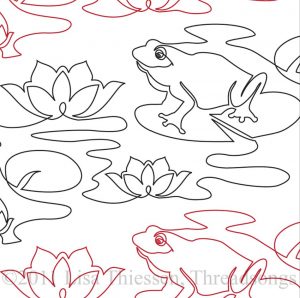
The video lecture Is Copyright a Little Fuzzy? A Guide to Copyright (2018) by Melanie Wrobel was jam-packed with information and left me thinking about two points in particular. I have some experience with copyright through a pattern line I design here in Canada, which is published in the US and distributed Continuous line drawing of frogs on lily pads interspersed with water lily blooms.worldwide, but even so, there were new things in this talk for me. The big take-aways that I had were around Law of the Land, and the non-protection of ideas.

Listening to Melanie talk about the Law of the Land guidelines from the Berne Convention left me with some questions about how copyright can operate across countries with different guidelines. A simple way to explain the idea of the Law of the Land is that, regardless of the country of origin of a work, the work is subject to the law of the land that it is in – for instance, works in the US and EU move into the public domain after the life of the creator plus 75 years, whereas in Canada, after the life of the creator plus 50 years regardless of the country of origin of the work.

I can see how in a time before the internet, that this would have been a reasonably easy thing to enforce – even thinking of my own print patterns as an example: here in Canada, 50 years after my death, people will be able to trade my patterns freely, to share them without issue while in the US they can be monetized for a further 25 years. Before the internet, one would have to procure a physical pattern in Canada and either mail or deliver it to the US to use or distribute it before that further 25 year window was up. Now, with digital files being so easy to share, all it would take is a post to a public forum and those files could be distributed from Canada for free to the US and world, despite the copyright still being in effect in many of the countries that they would now be available in. Further reading about the Berne Convention has uncovered another rule, which partially answered my question – the Rule of the Shorter Term. This states that the term of copyright in the country of origin will be the guideline for other countries (Berne Convention, Article 7 [8]). Interestingly enough, not all countries abide by this rule – the US in particular has not, to date (“United States non-acceptance of the rule of the shorter term—Meta,” n.d.).

Another piece that stayed with me from the Wrobel video lecture was that ideas themselves are not protected under the Berne Convention, just the unique expression of the idea (Wrobel, 2018, 4:00). I found this interesting in contrast to the idea that traditional knowledge is protected (Wrobel, 2018, 49:00). Wrobel gave an example of the idea of a story about a girl who has a red cape and goes through the forest as a way of explaining the former – that it is not the idea of this little girl that is protected by copyright, but the unique way in which the story of Little Red Riding Hood is told that is protected. This would lead one to believe that traditional knowledge is protected due to the way in which those stories are told, or that information is uniquely expressed through culture. I am interested in this distinction and will do further reading about it.

References:

Berne Convention. (2019). In Wikipedia. Retrieved from https://en.wikipedia.org/w/index.php?title=Berne_Convention&oldid=910814818

United States non-acceptance of the rule of the shorter term—Meta. (n.d.). Retrieved August 16, 2019, from https://meta.wikimedia.org/wiki/United_States_non-acceptance_of_the_rule_of_the_shorter_term

Wrobel, M. (2018). Is Copyright a Little Fuzzy? A Guide to Copyright. [Video file]. Retrieved from https://moodle.royalroads.ca/moodle/mod/page/view.php?id=347413

Activity assignment paper about academic writing to share

As part of our Unit 1, Activity 2 feedback, some of us were asked to share our papers to be resources for others. I’ve included my paper below, and would be happy to answer any questions about it.tabletop with several people's hands holding a pen on different pieces of paper. Other items on the table include eyeglasses, 3 books, a laptop and coffee mugs. Photo credit Startup Photos from Pexels.

Please note that there are a few formatting differences demanded by the blog environment. I included my name on the title line as we were not using title pages for this paper. Other formatting differences are as follows: this is missing a running head, page numbers (upper right-hand corner), hanging indent for the resources, and double spacing throughout (with no extra spacing between paragraphs). The image above was not included in the paper and would have had to be directly related to the content of the artcile and included using APA style as a figure (American Psychological Associaltion, 2010, p. 151)

Reflection on my Academic Writing to Date by Lisa A. Gates

After careful review of the Royal Roads Academic Writing resources (RRU Library, n.d., Paragraph Section), the Publication Manual of the American Psychological Association (American Psychological Association, 2010), along with my own papers and instructor feedback to date, I believe that there are specific places I can make improvements in my academic writing practices. I will address three issues in this paper: recognition of the difference between information that is self-evident and that which needs to be backed up with citation, which pieces of my analysis can be deepened, and places in which I could be using American Psychological Association (APA) Style writing more effectively – specifically around punctuation in citation and references. The first two issues are quite complex, the third much less so.

In APA Style (American Psychological Association, 2010) it is expected that any idea that comes from reading another’s work should be correctly cited and included in the reference list (p. 169). At this time, I am sometimes unsure as to which pieces of information are necessary to be cited, and what might be considered self-evident. I am gaining understanding of context in this new (to me) Masters’ level student role. My background is in teaching and writing curriculum for online courses and digital work (including managing social media, working online in groups, blogging, website building, and more). This varied background has left me with a set of skills and opinions that I am unsure where they originated from – whether the opinions developed are through years of reading, through experience, or some combination of the two is occasionally difficult to discern. LRNT521 dealt with digital learning environments, the power and social constructs that occur within them, and how that interplays with the work of teaching and learning. While I learned a vast amount in that course (I’ll probably read Teaching Crowds [Anderson & Dron, 2014] twice more), there were ideas in it that were not new to me. Teasing out which ones I should be crediting to these authors that I’m becoming acquainted with and which ideas are accepted as part of the general understanding of this field is an ongoing challenge, one that I welcome more feedback about. At this time, my intention is that, if I find an idea in the literature that supports my work, I will cite

As I’m developing my understanding of academic writing, I struggle to see the places in which I might be able to deepen or broaden the exploration of some points. In an assignment writing about specific actions that I’ll be taking this fall to facilitate my own students’ meaning making through group activities (Anderson & Dron, 2014, p. 39), the feedback from the instructor of LRNT521 was: “Unpacking this a bit more would deepen this section and allow you to see and reflect on the actions you are undertaking” (E. Childs, personal communication, June 27, 2019). I believe it will take more experience with writing to understand which pieces need further development. Going forward, I will endeavor to choose a limited number of points to make in my writing and try to expand on each within the constraints of the assignment. My hope is that, with fewer points, each will be more relevant to the topic, allowing for greater discussion.

Gaining better facility with the mechanics of APA Style (2011) writing is going to take practice and reading. Referring to feedback from previous papers, I’ve learned some specific places in which my punctuation can be improved. For example, in one of the early assignments, I was consistently putting a period in the wrong place in my citations when they fell at the end of sentences. This was easy to fix once it was brought to my attention. It changed the way that I read the APA Style guide – now I read it slowly, with much more care. In order to improve my overall understanding of this style, I am currently reading a chapter a week of the physical book, along with looking up specific cases on an as-needed basis both in the book and online.

The first two tasks of improving my writing are quite complex in that they depend on the context, the topic, and my ongoing learning of the writing process to improve on. The learning of APA Style will be simpler, but a continuing task. I’ll endeavour to keep the strategies outlined above in mind as I move into new writing throughout the next two years.

References

American Psychological Association. (2010). Publication manual of the American Psychological Association (6th ed.). Washington, DC: Author.

Anderson, T., & Dron, J. (2014). Teaching Crowds: Learning and Social Media. https://doi.org/10.15215/aupress/9781927356807.01

APA Style. (n.d.). Retrieved July 7, 2019, from https://apastyle.apa.org website: https://apastyle.apa.org/index

Paragraphs | RRU Library [University]. (n.d.). Retrieved July 7, 2019, from Royal Roads University Writing Centre website: https://library.royalroads.ca/writing-centre/writing/structure/paragraphs

What makes a good research question?

A good research question:

  • Endeavors to answer something new – not something that has already been investigated (Steely Library NKU, 2018).
  • Does not contain inherent bias. The example given in a handout from Duke University (Porush, 1995) is “why are social networking sites harmful?” The bias inherent in this question is that social networking sites are, by nature, harmful. A better question would not make unfounded, value-based assumptions.
  • Is open-ended, needing more than a yes or no answer, or a statistic to satisfy it (Steely Library NKU, 2018).
  • Is not so broad that it can’t be answered in the scope of the paper to be written (Porush, 1995).
  • Is important to the larger readership, extending conversation about the topic (Steely Library NKU, 2018).
  • Is clear, can be read and understood by its intended audience (Steely Library NKU, 2018).

References:

stock photo of man looking at papers and diagrams on a wall. By Startup Stock Photos.

Porush, D. (1995). A Short Guide to Writing About Science. (pp. 92-93). New York: Harper Collins.

Steely Library NKU. (2018). Developing a Research Question. [Video] Australia: Academic Skills, University of Melbourne.

Film or Webcam? What makes sense?

(This post is outside of our expected academic posting, but I’m hoping that others will weigh in with their thoughts.)

I work in a lovely, diverse faculty – one that is very forward thinking about philosophy and methodology of teaching. They are always bringing in new points of view and tools to use in a variety of different ways for all kinds of applications. For the most part, we agree on things.

Keep the student at the centre? Check.

Keep the individuals that our students will eventually be in the service of in mind at all times? Check.

Find ways to keep our students engaged and motivated, while helping them to understand what might be a whole new paradigm (to them) about the world, and different philosophies around disability and understanding behaviour? Check.

*Whew*

This fall will see us introducing a new course developed and taught by a colleague. We’re hoping to make the initial face-to-face offering something that can be delivered online in subsequent semesters, one that can get across the visceral experience of having guest speakers – 1st voice – in the room. To this end, we’re planning on filming the guests each week.

The colleague who has written it is interested in high production film (two camera points-of-view, lapel mics for good sound quality, augmentative lighting, visually interesting editing), something that I’ve done before and will be happy to assist with.

I was having a conversation with another colleague about what her department does in such circumstances, and she said that they do their guest speaker filming with a webcam – that the sound is good enough, that the video is fine for their purposes, and that they change and iterate their courses often enough that investing the time and money into ‘capital F’ Film doesn’t make a lot of sense.

Hm.

This left me wondering…

both instructors are people I have a huge amount of respect for, who push boundaries all the time and innovate educational experiences for students, AND are approaching this idea from completely different points of view. It left me thinking that perhaps my high production value colleague is coming from another paradigm…one heavily influenced by print. After all, we used to put a lot of effort into educational artifacts – textbooks, films, and physical objects to convey information. Creating a film is an undertaking in this paradigm, one that takes a highly skilled staff.

I wonder then, if, in contrast, my webcam colleague is coming from a more contemporary paradigm – video is easy, ubiquitous, and iterative. Anyone with a smartphone can make a film, quality is not as important as accessibility. We’re often asking students to make short films of their own in response to our participation prompts through applications such as Flipgrid, and are less concerned about quality over content.

Or…is it about the need to have polished video that represents what the Institution is doing? Versus iterating until the right ‘note’ is hit?

I’m curious as to what others might think. Would webcam capture be good enough to convey the point to students? Would it make more sense to use higher quality film production? Where are the lines between not good enough, good enough and more effort than necessary?

Related reading:

Jenkins, H. (2009). Confronting the challenges of participatory culture: Media education for the 21st century. MIT Press.


Access to Education for Students with Disabilities – Group Project

Unit 4 – Activity 1 | Discussing Impacts of Digital Learning

The Impact of Digital Learning: Access to Education for Students with Disabilities

Lisa Gates, Jeff Goodes, and Eunice Leung

The rise of technology has provided more equitable opportunities for students with disabilities to support their learning. There are wide ranges of assistive technology, both hardware and software, that have been designed to either help with a difficult task or learn a new skill. The following sections outline some of the impacts technology has had on creating access to education for students with disabilities.

Profile: Students with Disabilities

The following bullet points highlight the various needs that a student who has a disability might have. Sometimes it can be only a specific need, other times it can also be a combination of needs. Unfortunately, not all learning needs at the post-secondary level are always supported.

  • The term “students with disabilities” is a broad one and can encompass a wide spectrum of students with “an array of problems, from those related to particular impairments to those related to learning and behavioural difficulties experienced by some learners compared with other similar learners (Florian and Hegarty, 2003, p.8-9).” Within this definition, the needs of this group are:
    • communication and interaction
    • cognition and learning
    • behaviour, emotional and social development
    • sensory and/or physical (Florian and Hegarty, 2003).
  • “People with disabilities-some 54 million in the U.S. (McNeil, 1997)-remain underrepresented in postsecondary education” (Schmetzke, 2001, p.1).

Impact of Digital Learning in the Classroom

Utilizing assistive technology has increased opportunities for students with disabilities to participate online and in the classroom. The decreasing costs and rising availability for supports have created a more equitable to make learning more accessible to everyone regardless of their needs.

  • The use of assistive technologies has increased access to online learning for people with disabilities. Studies have shown that assistive technology has removed barriers for students which had impeded their academic success. In fact, many students are using more than one adaptive technology due to the fact that they have more than one disability. In addition, some students may co-opt technology for another disability to their own needs. “For example, screen readers are not only used by those who are blind, but by those who have a learning disability such as dyslexia.” (Seale, 2006, p. 57)
  • With decreasing cost, rising availability of software and the ability to deliver online instruction,  the accessibility of the written word has expanded. Digital text displayed on a screen can be converted to speech (i.e., screen readers), mechanically reproduced as braille characters on a specialized keyboard (i.e., refreshable braille display), and enlarged to an accessible size (i.e., screen magnifier) (Taylor, 2016).

Impact of  Digital Learning Design

When hardware and software are incorporated to support the learning of students with disabilities, accommodations need to be made. As a result, instructional designers have started to take into an account designing content that is accessible to their learners. Applying universal design principles when designing content has increased accessibility, however, more can be done.

  • Just as there are enabling and disabling conditions in the physical environment, so are there conditions associated with digital technology that result in the inclusion or exclusion of certain people. Technology that is not universally designed, without consideration for the full spectrum of human (dis) abilities, is likely to contain access barriers for people with print disabilities (Schmetzke, 2001).
  • Schmetzke notes that online learning can be challenging to those with print disabilities, leading to scenarios in which those with print disabilities are discriminated against. “The amount of accommodations and adaptations to the regular online course that, by law, need to be made under such circumstances would be tremendous. And even then, the legality of the end result would be questionable: In essence, students with print disabilities would end up taking courses in a separate track-a scenario that is at odds with the legal mandate to provide programs in the most integrated settings”. (Schmetzke, 2001).
  • Accessibility is an issue across online learning. Not all academic online resources available to students are universally barrier free.  Schmetzke observes that, “A study within the University of PM ITD Journal Wisconsin-Madison revealed that only 38% of the 101 departmental homepages evaluated with Bobby, an automated accessibility checker, were free of accessibility problems. After an additional, more stringent manual assessment, only a mere 14% passed as barrier-free” (Accessibility & Technology, 2000 as cited in Schmetzke, 2001).
  • “Students with visible disabilities, such as people who are blind or who are using wheelchairs, are noticed in the physical campus environment. Anyone observing a person in a wheelchair attempting to negotiate a sidewalk curb will quickly realize the need for a curb cut. In the online environment, the needs of people with disabilities tend to go unobserved, and thus unacknowledged. The planners of online classrooms are unlikely to meet face-to-face with blind individuals as they link to course web sites only to find most information to be provided in an inaccessible image format” (Schmetzke, 2001, p. 13).
  • Designed correctly, distance education options create learning opportunities for everyone. Designed poorly, they erect barriers to equal participation in academics and careers for potential students and instructors with disabilities. Employing universal design principles as we create technology-based distance learning courses can bring us closer to making learning accessible to everyone, everywhere, at any time (Burgstahler, 2002).

Changing Teacher/Instructor Roles

The role of the teacher/instructor has changed drastically. To incorporate the use of assistive technology within learning, new knowledge and skills are being required of them.

  • Using digital learning material to enhance the education experience for students with disabilities has not always been successful. The challenge, according to Seale is not the lack of digital accessibility tools, it’s that “very few practitioners however, know exactly how to make e-learning accessible” (Seale, 2006, p. 1).
  • Technology in the classroom has been used since the 1970s to enhance the  learning experience of students with disabilities. Success has been varied. Florian and Hegarty (2003) suggest that there are three essential elements which contribute to the success of technology to assist students with disabilities: “the right equipment , access to high-quality materials and ongoing practice-based training” (Florian and Hegarty, 2003, p.33).
  • Siyam (2019) echoes the need for training by teachers: “the strong impact of self-efficacy on teacher’s actual use of technology…indicates the importance of providing teachers with training on the technology tools presented to them” (Saddler, 2006 as cited in Siyam, 2019, p.33).
  • Special education teachers should be exposed to hands-on activities that focus not only on how to use the tool, but on how this tool has the ability to impact students’ learning and behavioural outcomes (Almeida et al. 2016). Secondly, technology should be included in preparatory programs for special education teachers and should cover a different range of tools such as learning management systems, academic platforms, behavior tracking apps and social assistive technology. Moreover, special education policies should be improved to develop understanding and awareness of the importance of using technology in special education classroom practices (Siyam, 2019).
  • Faculty need to take responsibility for both the technology that they choose to use and that which they choose not to use. Both decisions can have a significant impact on student accessibility (Taylor, 2016).

References

Burgstahler, S. (2002). Distance Learning: Universal Design, Universal Access.  AACE Journal, 10(1), 32–61. Retrieved from https://www.learntechlib.org/primary/p/17776/

Florian, L and Hegarty, J. ICT and Special Educational Needs, McGraw-Hill Education, 2003. ProQuest Ebook Central. Retrieved from http://ebookcentral.proquest.com/lib/royalroads-ebooks/detail.action?docID=287830. Created from royalroads-ebooks on 2019-05-30 13:09:54.

Seale, J. K. (2013). E-learning and Disability in Higher Education: Accessibility Research and Practice. Retrieved from https://doi.org/10.4324/9780203095942

Schmetzke, A. (2001). Online Distance Education – “Anytime, Anywhere” But Not For Everyone. Retrieved from: https://www.csus.edu/indiv/s/stonerm/schemetzke%20article%20on%20web%20accessibility.pdf

Siyam, N. (2019). Factors impacting special education teachers’ acceptance andWild lady slipper orchids - white modified bottom petal with red and green modified lateral sepals. actual use of technology. Education and Information Technologies, 24(3), 2035–2057.  Retrieved from https://doi.org/10.1007/s10639-018-09859-y

Taylor, M. A. (2016). Improving Accessibility for Students with Visual Disabilities in the Technology-Rich Classroom. PS: Political Science & Politics, 49(01), 122–127. Retrieved from https://doi.org/10.1017/S1049096515001134