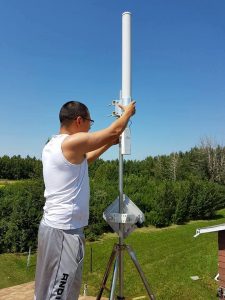
Bruce up on the roof
I’m a First Nations person and a technology instructor, and I work in First Nations technology skills development. I made a conscious choice to work within this field, and I admire other First Nations people who also work toward closing the digital divide that exists in this country (Financial Post, 2018). I previously taught at the British Columbia Institute of Technology (BCIT), Capilano University, and worked as a Student Advisor for the Native Education College in East Vancouver. Today, I travel throughout British Columbia and instruct for the First Nations Technology Council (FNTC). I teach foundational digital technology and coding skills including web development, networking, and software testing. I fly in or drive into host remote communities that partner with the FNTC and work closely and directly with First Nations throughout the province. Many of my classes are held on Reservations, and the technology infrastructure required to support education technology is sorely lacking (Friends of Canadian Broadcasting, 2018). The digital divide is a real thing; I work hard to do my part in closing it, and I’ve dedicated my work to it.

Bruce Buffalo
I have met many allies in this struggle, and I am proud to call my classmates at Royal Roads some of my closest allies. One of the strongest voices I have met during my work with Indigenous technology and development is Bruce Buffalo. I use a video documentary that focuses on Bruce’s work in my indigenous networking course. One of my indigenous students reached out to Bruce through social media and he and I connected and I invited him to video conference into my classroom. He has an impact on my Indigenous students. They see themselves and they recognize their community in his. His community is not unique; there are many First Nations communities that are under-served and lack technological infrastructures and knowledge (Edmonton Journal, 2018).
There are First Nations communities that do not have access to the quality of internet services that other Canadian citizens enjoy and may take for granted (Edmonton Journal, 2018). Some education technology requires a technological platform in order for it to be used, and internet access may be a part of that platform. Internet access may be able to open up access to the use of ed tech in remote First Nations communities, and people such as Bruce work hard to provide these much needed technologies to First Nations Peoples throughout Canada.
References
Edmonton Journal. (2018). Opinion: better internet service crucial for indigenous communities. Retrieved from https://edmontonjournal.com/opinion/columnists/opinion-better-internet-service-crucial-for-indigenous-communities
Financial Post. (2018). Indigenous connectivity summit to address need for affordable and sustainable internet access. Retrieved from https://business.financialpost.com/pmn/press-releases-pmn/business-wire-news-releases-pmn/indigenous-connectivity-summit-to-address-need-for-affordable-and-sustainable-internet-access
Friends of Canadian Broadcasting. (2018). Canada’s digital divide: preserving indigenous communities means bringing them online. Retrieved from https://friends.ca/explore/article/canadas-digital-divide-preserving-indigenous-communities-means-bringing-them-online/

September 13, 2019 at 12:00 pm
Hi Earl! Great post. I have a new hero in Bruce Buffalo! As you know, the digital divide in Canada, and globally, have a big place in my mind and heart. I continue to be very interested in what you do with your students and programs. It’s great that you were able to engage your students in a video conference with Bruce Buffalo. Amazing and inspiring.
The digital divide makes me shake my head. AND THEN it motivates me, even more, to engage in research that can hopefully contribute to more awareness and timely solutions.
Great video! It is interesting that it was produced by Al Jazeera… a broadcaster based in the Middle East — promoting awareness about someone working to address some fundamental issues that are a part of the digital divide in Canada. I really liked the CBC article as well! I Tweeted it out today.
Thanks, Earl.
Leigh
September 15, 2019 at 10:46 am
Hi Leigh, my friend. You are such a great ally, and you’re one of the ally’s that I’m specifically calling out in my post.
September 13, 2019 at 8:49 pm
Hi Earl,
How wonderful that you chose to showcase someone you know personally 🙂
This is an important reminder that internet access is NOT a given in all communities., and considering that the internet and connectivity have been major proponents for Ed-Tech, bringing awareness about those who are prohibited from experiencing the potential benefits of ed-tech due to lack of connectivity is a critical step in working towards a solution(s). It’s actually sort of remarkable that this post is the first I’ve read throughout the program thus far that references the ‘digital divide’. Thanks for bringing another perspective to the forefront.
Laren
September 15, 2019 at 10:45 am
Hi Laren, thank you for the comment. People like Bruce are indicative of people that I’ve met that are battling such hard uphill battles in trying to improve First Nations reservation conditions – they’re just not well known. I find it telling that it took a non-Canadian agency to create this great documentary to shine a light on this issue.
September 14, 2019 at 1:15 am
Hi Earl,
I enjoyed reading your post. I truly appreciate your effort in highlighting the great work done by Bruce Buffalo. People need to know about this kind of effort done by the First Nations to tackle the digital divide. I find it astonishing to try to fix the problem and not stand there watch and do nothing about it.
Great choice!
Thank you Earl!
September 15, 2019 at 10:39 am
Hi Tala, thank you for your remarks. I know you’re a great ally!
September 14, 2019 at 6:56 pm
Earl, thank you for posting this.
I’ve been trying to learn more about the indigenous populations and the reconciliation recommendations. I have done some reading on the digital divide and its effect on northern indigenous communities yet I recognize that I ‘know’ nothing about the whole situation.
Orange shirt day is soon and I’ll show my support by supporting the awareness movement and continuing to seek out truthful information.
The documentary you posted is very moving and I feel guilty being able to sit here and casually ‘connect’ with you with out even giving it a second thought – while watching your documentary you posted on YouTube.
It seems ironic to me that at the end of my run this morning, I was trying to explain to my friends the impact of the digital divide and the effect its having on northern communities.
Needless to say, my friends had no idea, even to the minuscule amount of knowledge I have on the subject.
Owen
September 15, 2019 at 10:39 am
Hi Owen, thanks for your comment – and your commitment to improving the digital divide. It’s people like you who take the effort to talk about the existence of the divide who actually create change. I believe that generally people want the digital world to be inclusive, but they’re unaware of the divide that exists for First Nations Peoples. Some of the rez’s that I teach on are woefully under-served, and just generally poor – the infrastructure, that is – the people are resilient.
September 15, 2019 at 11:03 am
It was this quote posted on Sharon’s blog that really got me thinking deeper about this.
“Bringing broadband to communities does not just bring technical skills… It brings health skills; it brings education skills, so people are able to remain in the community” (Garrick, 2015, para. 8).” attributed to Penny Cerpenter, that really re-framed how I look at the effect of digital access.
Especially the part about access enabling people to remain in the community.
Clearly wi-fi access is far more than the simple convenience it is to the majority of users.
September 15, 2019 at 2:08 pm
Connectivity/Wifi should be a human right (alongside clean drinking water which is unbelievably STILL not the case) Thank you for introducing me to Bruce’s work Earl, I noticed in one article I read they called him “Broadband Bruce” sounds like a superhero name to me:)
September 15, 2019 at 5:14 pm
Thanks for the comments, Lisa. Maybe a saturday morning cartoon?
September 15, 2019 at 5:16 pm
Thank you so much Earl, for shining a light on the incredible work of Bruce Buffalo. The documentary you shared is very informative and I will definitely share it with others. Your post has certainly encouraged me to deepen my commitment to understanding more about this issue. I admire and deeply respect all that Bruce Buffalo is doing to decrease the digital divide; it is also an important reminder of how how deeply and systemically rooted these issues are – there is a lack of accountability on a wider scale from settlers, and government – we must do better. Education is a human right and this right is not being upheld as it pertains to Indigenous communities across Turtle Island.