
Infographic
Synthesis
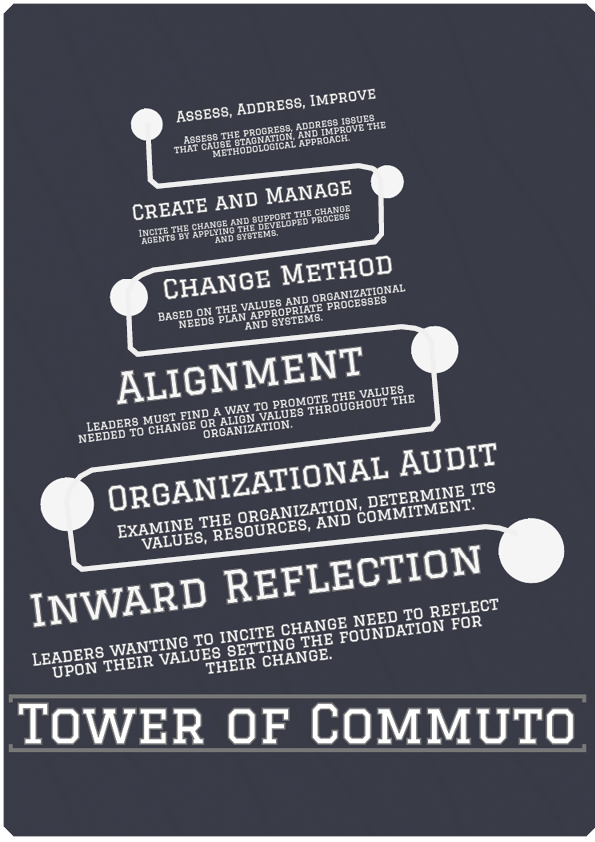
The Tower of Commuto is an approach to leadership and transformation that focuses on two disciplines of change in resistant K – 12 school divisions: (1) psychology and sociology, and (2) management and leadership (Al-Haddad & Kotnour, 2015). Using the term commuto, spoken in the transitive voice, which means to alter, rearrange, replace, and transform (Latdict, 2021), the tower ingrains the constant need to grow that is ever-present in today’s world. It takes a systematic approach. Each step builds upon the last, granting stability and antifragility by moving beyond resiliency, adapting to change and improving with each iteration it is applied (Weller & Anderson, 2013).
Inward Reflection
Agents that want to incite change need to reflect upon their values by asking themselves would they be willing to fight for these values, die for these values, and engage in dialogue with others about their values (Kouzes & Posner, 2011). While it may seem melodramatic, an established set of values act as a bedrock for adversity, allowing the change agent to persevere over hardship and establish latitude by increasing the amount an organization can change and still hold its core values (Weller & Anderson, 2013; McTaggart, 1991).
Organizational Audit & Alignment
Rather than announcing what values are essential and expecting others to follow, determine the organization’s fundamental shared values (Kouzes & Posner, 2011; McTaggart, 1991). Create a dialogue with stakeholders that encourages discourse by not suppressing diversity or enthroning heterogeneity, preferably impress the need to conserve the integrity of both (Kouzes & Posner, 2011). Prairie Land School Division’s (PLSD) non-negotiables is an example of this process (2021). It was instantiated by engaging stakeholders in a dialogue about their core and shared beliefs to determine a common ground of ethical standards that now stand as the foundation of their values. Furthermore, once the organization’s values are obtained, appropriate change models can be applied.
Change Method
Determining the best managerial approach to change depends on the organization’s capacity and values, type of change, and leadership style (Al-Haddad & Kotnour, 2015; Dunphy & Stace, 1988). During the COVID-19 pandemic, PLSD had to pivot to online learning; to facilitate this change, the Google suite, which was already instantiated in the division, was utilized. Dunphy and Stace would refer to this type of change as dictatorial change because PLSD needed radical transformation vital to complete its primary mission (1988). As part of this paper, the superintendent, Cam McKeage, and a principal, Corry Raugust, were interviewed, and both cited increased anxiety in stakeholders. Given their supportive leadership style, a substantial amount of time was spent calming emotions, echoing the need for leaders to engage in and be knowledgeable of emotional and symbolic interventions (Dunphy & Stace, 1988). However, many teachers felt lost and abandoned despite supportive leadership because they lacked the digital knowledge to effectively translate their practice from the classroom to digital environments, accentuating the need for organizations to have intentional training and develop capacity in their staff. In PLSD’s case, external forces created the need for dramatic and substantial change; however, in most cases, change can be planned and deliberate based on the organization’s needs and stakeholders.
Furthermore, given the complexity of change in organizations, determining the best approach depends significantly on the change’s type and duration. Al-Haddad and Kotnour created a matrix to show the relationship between change types and methods, creating a quantifiable output to determine the hypothetical success rate (2015). By applying this matrix, PLSD best aligns with participatory action research (PAR) (McTaggart, 1991) and integrative methods (Bullock & Batten, 1985). In PLSD’s current state, resistant stakeholders do not value the digital ecosystems, impressing the need to change the individual’s perspective through dialogue and authentic participation, enabling them to become socially invested in the organization’s values (McTaggart, 1991, pp. 174 – 175). Once the values have become percolated throughout the organization, approaches like integrative methods can be implemented because they view change as a longitudinal and continuous process by standardizing other change models to a single systematic approach (Bullock & Batten, 1985).
Create and Manage; Assess, Address, Improve
The final two steps focus on implementing the change and assessing its effectiveness in the organization. These two steps create a reciprocal relationship where the action of the change is continuously assessed to determine if the objectives of the change have been met. It becomes the change agents’ responsibility to assess and address issues by supporting their stakeholders and creating a concrete path towards improvement. As earlier stated, the goal of the Tower of Commuto is to achieve change through organizational alignment under a shared set of values; to ensure success, two measures need to be evaluated: (1) the objectives of the change have been met (Al-Haddad & Kotnour, 2015), and (2) the culture of the organization engage in a think globally, act locally mindset regarding the change (McTaggart. 1991). Success will be achieved when the management and maintenance of the change are no longer needed because it has become established in the organization’s culture.
Reference
Al-Haddad, S., & Kotnour, T. (2015). Integrating the organizational change literature: a model for successful change. Journal of Organizational Change Management, 28(2), 234-262. https://www-emeraldinsight-com.ezproxy.royalroads.ca/doi/full/10.1108/JOCM-11-2013-0215
Bullock, R. J., & Batten, D. (1985). It’s just a phase we’re Going Through: A review and synthesis of O.D. phase analysis. Group & Organization Studies, 10(4), 383–412. https://doi.org/10.1177/105960118501000403
Dunphy, D. C., & Stace, D. A. (1988). Transformational and coercive strategies for planned organizational change: Beyond the O.D. model. Organization Studies, 9(3), 317–334. https://doi.org/10.1177/017084068800900302
Kouzes, J., & Posner, B. (2011). Credibility: How leaders gain and lose it, why people demand it (2nd ed.). Wiley. https://www.doi.org/10.1002/9781118983867
Latdict. (2021, February 14). Latin definition for: Commuto. https://latin-dictionary.net/definition/11563/commuto-commutare-commutavi-commutatus
McTaggart, R. (1991). Principles for participatory action research. Adult Education Quarterly, 41(3), 168–187. https://doi.org/10.1177/0001848191041003003
Prairie Land School Division. (2021, February 14). Teaching and learning. https://www.plrd.ab.ca/teaching-and-learning
Weller, M., & Anderson, T., (2013). Digital Resilience in Higher Education. European Journal of Open Distance and E-Learning, 16(1), 53-66. http://oro.open.ac.uk/36988/1/Weller_Anderson.pdf
Recent Comments