While searching for what makes a good research question, I was reminded of what I teach students during our Projects 2 course to Computer Systems students at BCIT. In the Projects 2 course, not only do students design and implement a website from scratch in a group with 3 other students, but also have an opportunity to practice project management skills as well.
One of the most important project management skills when working with a team is task management, that is, breaking the project down into smaller, more focused activities that can be accomplished within a day. Without this task management skill, students can often be overwhelmed with what is required to be completed, students may panic and not know where to start.
When talking to my students about how to break the project down into smaller tasks, I remind them to ensure their tasks are S.M.A.R.T.. Creating S.M.A.R.T. tasks gives students clear direction and the ability to plan their project. I believe that the S.M.A.R.T. acronym can also apply to a good research question.
S.M.A.R.T. stands for:
S – Specific
M – Measurable
A – Achievable
R – Realistic
T – Timely
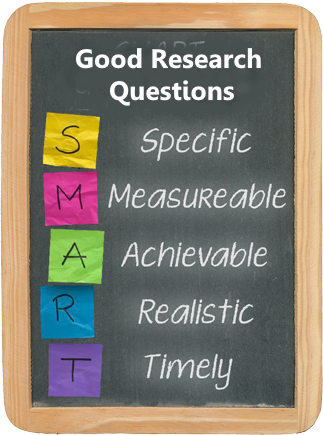
Source: https://theunistudentwhocould.files.wordpress.com/2015/01/smartgoals.png
First, keep the research question specific. Without being specific, the research paper will not have focus and will be hard to come to a conclusion.
Second, the research question should be measurable. How are you going to know when your question has been answered? If your research question isn’t measurable, your goal of completing your research will be impossible. You can’t know if you have arrived at your destination, if you don’t know where you are going.
Third, make sure the research questions is achievable. Are you able to find related research and plan your data collection and analysis?
Fourth, be realistic. Can you realistically complete it? It might be possible, but not within the available resources you have for the research.
Lastly, research questions must be timely. Make sure you have thought about how much time you have to complete your specific and measurable research. The goal of research paper is to provide insight into a topic in a unique way. This means you need to provide a conclusion. Some topics do not come to natural conclusions, and are thus, not timely and not suitable research questions.
It turns out, I already know how to create good research questions, because I know how to create S.M.A.R.T. tasks and the same aspects that make a good task also make for a good research question.
Featured Image: https://www.basttraining.com/wp-content/uploads/2020/01/SmartGoals1200x630-BAST.png
July 6, 2020
Of course, as a Co-op Coordinator in Engineering and Computer Science, we instruct our students to form their competencies (knowledge, skills, attributes) into S.M.A.R.T. goals, hoping this will assist them in expressing their abilities.
Awesome to see it here Patrick, I think it works wonderfully in this context.
July 6, 2020
I tried to comment last night, but it was not allowing me to submit my comment, so let’s try this again!
Hello, Patrick! I am also familiar with the S.M.A.R.T. framework and think it works nicely when thinking about research. The Ministry of Education in B.C. uses S.M.A.R.T. to have us guide our goal setting for students Individual Education Plans. A useful tool, indeed!
July 6, 2020
I’m curious @Ash and @Sandra – I’ve seen variants of the S.M.A.R.T. acronym with substitutions for some of the letters. Do you use the same words for the acronym or something similar?
July 6, 2020
Hi Patrick,
The only difference is ‘timely’ becomes ‘time-limited’
Check out this PDF document. Page 90 (Chapter 4, pg. 16)
https://inclusionbc.org/wp-content/uploads/2018/11/WEBEducation_parent_manual_2014_0-1.pdf