
Our task in assignment 2A was to work in groups to investigate design challenges in a real-world work environment. Michal and I investigated the design process challenges we encountered at our respective workplaces. Through this investigation, we developed our problem statement: “How can design thinking be used to ensure that corporate training program content is relevant and engaging?”. As a result, we created a prototype that incorporated AI, personalized learning, and social learning in corporate settings to increase learner engagement.
This blog post discusses six design principles that can be used in a corporate environment to promote learner engagement when designing learning. These principles include empowerment, user-centred design, accessibility, meaning, experiential, and multiple means of action or expression. Each principle is briefly defined and explained in the context of corporate learning and its potential to increase learner engagement.
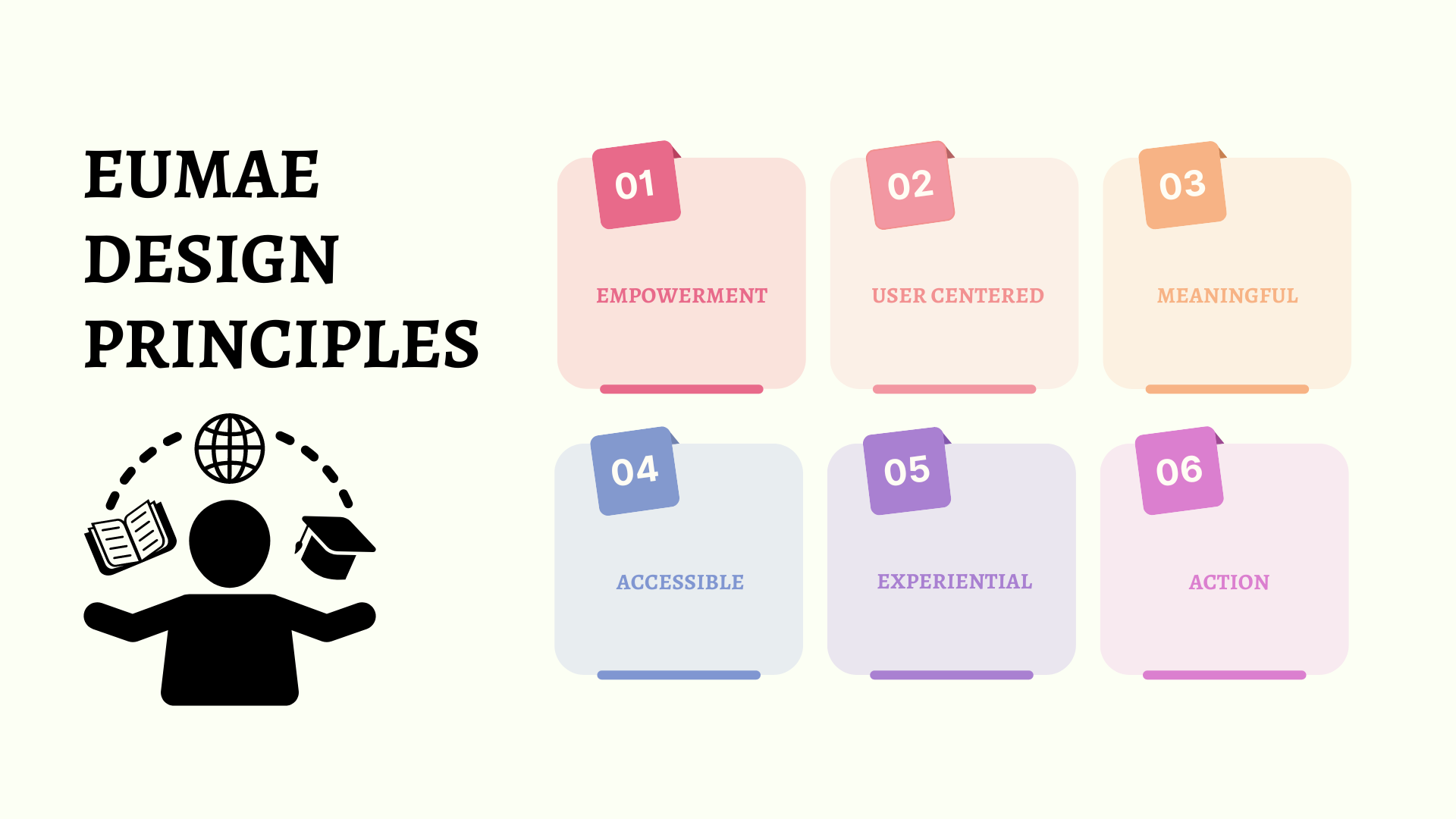
Empowerment
According to the British Council (2014), empowerment is a process in which learners can make choices about their learning experience. This power transfer from teacher to learner allows them to become more self-sufficient and autonomous (British Council, 2014). Giving learners control over their own learning experience by giving them choices in the topics they want to learn about, the pace at which they want to learn, and the methods they want to use by providing a variety of learning options, such as self-paced e-learning modules, virtual instructor-led training, and on-the-job training, gives learners the ability to find the material relevant and engaging.
User-centered
The Interaction Design Foundation (2019) defines user-centered design (UCD) as an iterative process that focuses on understanding and incorporating the needs of the users, in this case, learners, throughout the design process (Interaction Design Foundation, 2019). By involving learners in the design process, we can better understand their needs and preferences, resulting in more meaningful and engaging learning experiences. This approach encourages collaboration between designers and learners, ensuring that learning materials and activities are tailored to the learners’ specific needs.
Accessible
The University of British Columbia (n.d.) defines accessibility in education as the ability for course materials, content delivery, and learning activities to be accessible to students with a wide range of abilities operating in a wide range of environments, conditions, and circumstances (Designing for Accessibility: An Introduction to Universal Design for Learning, n.d.). Employees in corporate settings come from various backgrounds, learning styles, and abilities and may have varying requirements for accessing and engaging with learning materials. Thus, accessibility in corporate learning environments is critical to ensuring that all employees have an equal opportunity to access and benefit from the learning opportunities provided.
Meaningful
According to Hung (2006), meaningful learning is a deliberate process in which learners actively engage in authentic tasks, working cooperatively and intentionally to construct their understanding through interaction with their environment. This method is task-based and collaborative and works best in real-world situations. Therefore, using this approach in a corporate setting by incorporating real-world scenarios and activities relevant to the learners’ job roles and responsibilities, as well as providing opportunities for them to apply what they have learned in the workplace, can improve learners’ engagement in the learning process.
Experiential
According to Kolb and Kolb (2017), experiential learning is a process in which the learner is in direct contact with the realities being studied rather than simply reading or hearing about them. This approach emphasizes the importance of direct sense experience and in-context action as primary sources of learning. It frequently includes a combination of action and reflection, as well as experience and concept. By providing opportunities for hands-on, in-context learning experiences relevant to the learners’ job roles and responsibilities, experiential learning in corporate settings can help increase learner engagement.
Action
According to Kovac (2017), the principle of multiple means of action or expression refers to providing students with various ways to demonstrate what they have learned. This approach is used by teachers when there are multiple ways to assess student knowledge. In addition, this principle can be applied in corporate settings by providing employees with multiple ways to demonstrate their understanding and proficiency in a specific skill or task. This can help employees with different learning styles, and abilities demonstrate their knowledge and skills more comfortably and effectively.
References
Designing for Accessibility: An Introduction to Universal Design for Learning. (n.d.). Retrieved January 15, 2023, from https://isit.arts.ubc.ca/designing-for-accessibility-an-introduction-to-universal-design-for-learning/
Hung, D. (2006). Engaged Learning with Emerging Technologies. Springer Science & Business Media.
Interaction Design Foundation. (2019). What is User Centered Design? The Interaction Design Foundation; UX courses. https://www.interaction-design.org/literature/topics/user-centered-design
Kolb, A., & Kolb, D. (2017). Experiential Learning Theory as a Guide for Experiential Educators in Higher Education. Experiential Learning & Teaching in Higher Education, 1. https://nsuworks.nova.edu/cgi/viewcontent.cgi?article=1005&context=elthe
TeachingEnglish | British Council | BBC. (2014). TeachingEnglish | British Council | BBC. https://www.teachingenglish.org.uk
Thomson, G. (2021, August 30). Multiple Means of Action or Expression. Accessibility for Ontarians with Disabilities Act (AODA). https://www.aoda.ca/multiple-means-of-action-or-expression