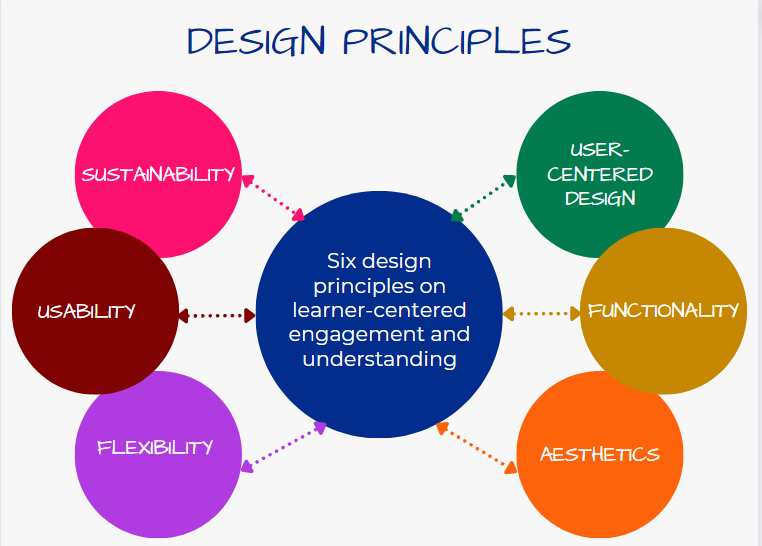
Design Principles

User-centered design: In a hybrid model environment, users need to put in a lot of effort to comprehend the needs, preferences, and barriers to design solutions. Therefore, an effective user-centered design should be created to ensure usability and flexibility. According to Altay (2013), the design improves a broader range of diverse users’ ability to use and accept tools, increasing productivity and reducing errors. This requires having a thorough understanding of the learners’ goals, objectives, skill levels, and potential learning challenges. Additionally, we must collaborate and communicate with the learners to understand their requirements and preferences, putting them at the center of the design process. 

Functionality: The learning experience should be functional and efficient, serving the purpose for which it was designed. Chakrabarti and Blessing (1996) said that knowing how something works is essential for a wide range of design tasks, such as comparing, evaluating, and choosing between design options. Therefore, learning content should be organized and presented logically and efficiently, with delivery methods alterable to learner needs. 

Aesthetics: The design must be appealing to the eye and consistent with the company’s image. Additionally, this implies that the layout, typography, and visual components of the learning experience should be appealing to learners. According to Parrish (2007), aesthetic principles offer more than just compatibility with preexisting theory; they also support and complement it by showing how to apply it to engaging learning experiences. With the right aesthetic, the overall effectiveness of learners is improved as the learning experience is more memorable and engaging. 

Flexibility: The design should be adaptable to changing needs and technology, meaning that the learning experience should evolve as learners’ needs change or new technology becomes available. Moreover, it allows the learning experience to stay current and relevant, which is essential in keeping the learners engaged and motivated. Kokoc (2019) noted that flexible learners tend to be more engaged. 

Usability: It is essential to have a system that is easy to use and quick to learn so that users can apply it regardless of their level of experience or technical knowledge. A helpful learning tool should be simple to comprehend, navigate, and use, effectively assisting learners in meeting their learning objectives. Lynch (2019) claimed that usability is the most crucial component of any digital solution regardless of the product, but this is particularly true for digital learning. Additionally, no matter how many resources the system offers, if learners cannot use them easily, it will not matter how many there are.

Sustainability: Sustainability is a crucial principle when creating and delivering learning programs in a corporate setting. As Niederhauser et al. (2018) noted, sustainability is defined as continuous change. This principle emphasizes the value of developing learning opportunities that support organizations and their stakeholders long-term. By prioritizing sustainability, organizations can provide their employees with the knowledge and skills to meet our ever-changing world’s social, environmental, and economic challenges. 

References:

Altay, B. (2013). User-centered design through learner-centered instruction. Teaching in Higher Education, 19(2), 138–155. https://doi.org/10.1080/13562517.2013.827646

Chakrabarti, A., & Blessing, L. (1996). Special Issue: Representing functionality in design. Artificial Intelligence for Engineering Design, Analysis and Manufacturing, 10(4), 251–253. https://doi.org/10.1017/s0890060400001608

Kokoç, M. (2019). Flexibility in e-Learning: Modelling its Relation to Behavioural Engagement and Academic Performance. Themes in ELearning, 12. https://files.eric.ed.gov/fulltext/EJ1251161.pdf

Lynch, M. (2019, March 1). Digital Learning and the Importance of Usability. The Tech Edvocate. https://www.thetechedvocate.org/digital-learning-and-the-importance-of-usability/

Niederhauser, D. S., Howard, S. K., Voogt, J., Agyei, D. D., Laferriere, T., Tondeur, J., & Cox, M. J. (2018). Sustainability and Scalability in Educational Technology Initiatives: Research-Informed Practice. Technology, Knowledge and Learning, 23(3), 507–523. https://doi.org/10.1007/s10758-018-9382-z

Parrish, P. E. (2007). Aesthetic principles for instructional design. Educational Technology Research and Development, 57(4), 511–528. https://doi.org/10.1007/s11423-007-9060-7

Chatbots

For this blog, we were asked to consider the impacts of innovation on a learning innovation tool and critique it. Numerous innovative learning tools today can revolutionize how learners learn and interact with their content. However, I wanted to discuss the use of “Chatbots” on this blog, as I did in a forum post. Adamopoulou and Mousiades (2020) defined a chatbot as a type of artificial intelligence application and a paradigm for human-computer interaction (HCI) (Gerov, 2022).

To provide learners with a more interactive and individualized learning experience, chatbots can be incorporated into learning management systems, messaging applications, or standalone applications. Chatbots have become increasingly popular in recent years due to their ease of use and ability to respond to learner queries in real-time. For example, my organization is leveraging the power of chatbot technology to provide a more interactive and individualized customer service experience. According to Essel et al. (2022), chatbots can positively and negatively affect learning. In contrast, chatbots can engage learners more interactively and engagingly than traditional methods, provide personalized recommendations for further comprehension, and provide learners with immediate feedback. They can supplement conventional training methods by providing learners with additional resources and support. Chatbots could replace actual instructors or reduce the need for face-to-face interaction during the learning process. However, chatbots can also create confusion or difficulty for learners if they are not properly implemented and managed.

In addition, chatbots may need assistance comprehending or responding appropriately to complex or nuanced learning questions, which could limit their usefulness as instructional tools. Adamopoulou and Mousiades (2020) stated that chatbots are easy to use and access, particularly for those accustomed to using technology. The benefit of using chatbots in the workplace is that they can facilitate self-directed learning and provide learners with a more personalized and interactive learning experience. To ensure that chatbots are utilized appropriately and effectively, it is necessary to consider their potential effects and limitations. As chatbots make learning more personalized and interactive, they have the potential to have a substantial impact on education. Chatbots can interact with students more interactively and engagingly than conventional methods, providing immediate feedback and individualized recommendations for problems that students may encounter. However, essential considerations are the potential for chatbots to replace human trainers or reduce the need for interpersonal interaction in learning and their inability to comprehend or respond to complex or nuanced learning questions. In educational settings, it is essential to consider the extent to which technology is utilized and the efficacy of chatbots. Educators can maximize chatbots’ positive effects while minimizing potential disadvantages by considering the above-mentioned factors. Chatbots have the potential to transform education by providing a simple, effective, and efficient method for students to interact with technology.

References:

Adamopoulou, E., & Moussiades, L. (2020). Chatbots: History, technology, and applications. Machine Learning with Applications, 2, 100006. https://doi.org/10.1016/j.mlwa.2020.100006

Essel, H. B., Vlachopoulos, D., Tachie-Menson, A., Johnson, E. E., & Baah, P. K. (2022). The impact of a virtual teaching assistant (chatbot) on students’ learning in Ghanaian higher education. International Journal of Educational Technology in Higher Education19(1), 1-19. 19:57. https://doi.org/10.1186/s41239-022-00362-6

Gerov, M. (2022, December 17). Chatbots. Royal Roads University. https://moodle.royalroads.ca/moodle/mod/forum/discuss.php?d=917425

Exploring Design Models

For the past couple of years, my job entailed enabling, implanting, and teaching technology to end users. Honestly, it was the first time I came across Instructional Design (ID), its work, and all the different aspects of ID models. Models such as ADDIE (Analyze, Design, Develop, Implement and Evaluate), ARCS Modes of Motivation (Attention, Relevance, Confidence and Satisfaction), Backward Design Model, Kirkpatrick’s evaluation model and many more. I found it interesting that I have been using some of the models we learned in class during my work. The models that resonate with me and fit the design that our project team is using today are the ADDIE model and the Backward design model.

Today, before implementing new technology, our project team follows the ADDIE model for analyzing, designing, developing, implementing, and evaluating. As, Dousay (2018) stated, regardless of the model chosen, ADDIE forms the fundamental underlying process that is a distinctive component of instructional design. Furthermore, the author noted that irrespective of the model one chooses, one must understand the expected delivery format. Will the course be delivered synchronously online, face-to-face, asynchronously online, or in a hybrid of various formats? Since my organization delivers in different forms, it is sometimes hard to land on one type of model, which makes sense to me as I am reading about the different types now. We work with people all around the globe, and our end users are also located worldwide. So, as Dousay stated about the importance of understanding the delivery method, I could understand it now quite clearly.

The Backward design was the second model that resonated with me while reading the literature, as it is something we do alongside the ADDIE model. As Fox and Doherty (2021) stated, identifying desired objectives, choosing acceptable evidence, and organizing learning experiences and instruction are the three stages of the backward design. To do this, we ensure to engage the right stakeholder to determine what is needed, and then we give the training and technology necessary for the ultimate result.

I found the Universal Design of Learning (UDL) fascinating, and many of the concepts they spoke about interested me. For example, Takaces et al. (2021) stated that UDL aims to involve as many students as possible in the learning process by providing a different path to the same learning outcomes. Moreover, the authors spoke about encouraging learners’ interactions to “create expert learners” so they can think critically about their learning choices and objectives (p. 13). As I read more articles on the various ID models, it has become clear that there is a process for choosing the ideal model that best meets the needs of the students and the teachers and how to address the current learning gaps.

To address the gaps and diversity at my workplace, I look forward to learning more about various ID models and how I may use them there.

References:

Dousay. T. A. (2018). Chapter 22. Instructional Design Models. In R. West (Ed.), Foundations of Learning and Instructional Design Technology. https://edtechbooks.org/lidtfoundations/instructional_design_models

Fox, B. E., & Doherty, J. J. (2012). Design to learn, learn to design: Using backward design for information literacy instruction. Communications in Information Literacy, 5 (2), 144-155. https://doi.org/10.15760/comminfolit.2012.5.2.109

Takacs, S., Zhang, J., Lee, H., Truong, L., & Smulders, D. (2021). A comprehensive guide to applying Universal Design for Learning. Justice Institute of British Columbia. https://pressbooks.bccampus.ca/jibcudl/

Speculative Futures Essay

How will the future look in 2030? This question is something consistently on my mind because it is so open-ended. Who would have imagined we would achieve the technological advancements we had today ten to fifteen years ago? Even over the last couple of years, the COVID-19 Pandemic forced schools, corporations, and organizations around the globe to navigate the online world through online education, virtual connections, and digital technologies. In schools, we saw how quickly a traditional face-to-face classroom switched to a virtual learning structure with teachers implementing digital learning tools. Moreover, the Pandemic allowed organizations to normalize working from home and online for regular day-to-day tasks. Yet, with all these changes and advancements, we still face many unknowns about the future of the technological world.

I have chosen to look at the future of technology in 2030 through the lens of my work in the corporate world by focusing on digital tools in companies and other organizations. As an international corporation, Nutrien, my company has workers worldwide and requires cross-collaboration between countries. Undoubtedly, one of my company’s main priorities is implementing the most cutting-edge technological tools. Pearson and Koppi (2016) state that care must be taken when implementing new technologies to ensure proper “navigation, structure, content design and communications” (p.18). It is not just about providing fancy new technologies but ensuring employees understand their importance.

Additionally, technological tools will be utilized more effectively by providing employees with the proper knowledge regarding the “why” of the technologies used. As claimed by Kardes (2020), through the systematic use of these tools, technology can be a powerful tool for reducing “academic lack of motivation” and building better engagement (p.68).

Dron and Anderson (2014) claimed that social software allows for imaginative uses and purposes its developers could never have imagined. As a result, professional social software acts as a platform for innovative thinking in teaching and learning. When looking at new technologies, my company is now focused on finding meaningful and engaging collaborative virtual tools that engage its employees and help the company function as a cohesive business unit.

The Pandemic showcased that face-to-face interaction is not always necessary for a business to function, and most work can be performed online. Recently, many organizations are moving to a hybrid working model with employees working partially face-to-face and from home. However, with more people returning to the office to work, it is clear that nothing beats face-to-face learning, engaging, and collaborating. In their findings, Kemp and Grieve (2014) claimed that face-to-face is vital to building a sense of community. My biggest personal challenges at work are team building and employee engagement, especially with online collaboration tools. I struggle to choose between working with my team online or in person, as I have team members that work in other countries.

Organizations are noticing that working from home and online provides their employees flexibility and quiet focus time. However, there are challenges with personal networking, engagement, technical distractions, and more when working virtually. With that, we also need to acknowledge how far technology has come today and that we are fortunate to be where we are today with it. As Wieland and Kollias (2020) stated, “we may not feel comfortable to find ourselves suddenly online all the time, but how grateful we are now that the technology exists” (p.85). It is essential to recognize that with technology continuously developing, there is no telling how far it will go; we may even prefer it to in-person learning. Since many companies are going forward with a hybrid module, we must be proactive and prepare for the future. Managers and teams must discover the best solutions to enhance their digital transformation process. Right now, organizations are working towards bettering today’s tools like Zoom, Teams, and Slack, while at the same time developing new tools for the future.

According to Gtmhub (n.d.), organizations are spending billions of dollars to advance technological innovations beyond our current comprehension. This means that organizations like mine will have more choices regarding choosing the best tools for the business and how to streamline them to meet requirements. For example, as Selwyn et al. (2021) stated, “the future is not something to be predicted but to be made” (p. 105). Therefore, more companies are looking to understand the gap between physical and digital reality. Additionally, Euvrard (2022) claimed that “By 2030, workplaces will be completely transformed” as Virtual Reality (VR) will be one of the leading technologies used to engage and collaborate with people (para. 5). Through the development of VR Artificial Intelligence (AI) and the metaverse, the future of technology in both the workplace and schools is promising.

VR will probably rule the near future, and adoption will speed up into 2030. Euvrard (2018) stated that technology experts predict a transition from devices we carry to those we wear, modifying the possibilities available to employees. For example, Bersin (2022) stated that companies like STRIVR use VR today as a training tool. Today STRIVR has “over 1.5M individual learner sessions conducted to date, and over 1M employees trained in VR” (para.7). Additionally, VR can enable remote collaboration among employees from various company divisions or regions. This will allow our employees to adapt and complete projects more quickly, saving the business resources that would otherwise be used to relocate staff and equipment to different sites. Moreover, companies can test various working and production techniques without incurring the high cost of real-world experimentation.

 Overall, we already see how AI has improved the efficiency of people’s lives by powering several applications and services that assist users in carrying out daily tasks like utilizing emails or riding-sharing services. Some of the applications of AI that we use today are smartphones, drones, and smart cars. Furthermore, Future Business Tech (2022) claimed that by 2030, specialized AI applications, like computer processing power, speech recognition, image identification, deep learning and other software techniques, will be more advanced. As experts predict, I believe these AI applications will be more prevalent, practical, and helpful in enhancing business functions and the economy.

McKinsey’s State Balakrishnan et al. (2020) report claimed that 50% of respondents said their companies had adopted AI in at least one business function. By 2030, this percentage will increase drastically, and most companies will adopt AI technologies in some capacity. Furthermore, the authors also talk about the shift in the last few years to cloud-based communications collaboration software instead of on-premise software. As the demand for permanent flexible hybrid workplaces with increased flexibility rises, more and more businesses will switch to the cloud as we reach 2030. Building on the cloud, right now, there is speculation and talk about the “metaverse,” which is described as a “virtual world where humans, as avatars, interact with each other in a three-dimensional space that mimics reality” (Cambridge Dictionary, n.d.). Furthermore, I believe by 2030, the idea of this “metaverse” will be something everyone is aware of, and that is further developed.

To sum up, VR, AI, the metaverse and other immersive technology give me hope that collaboration, and engagement will be more systemic, helping close the gap we see today between online and physical reality. Of course, some technologies already offer a strong collaborative culture, but there is still room for advancement and improvement. 

References:

Balakrishnan, T., Chui, M., & Henke, N. (2020, November 17). The state of AI in 2020. McKinsey. https://www.mckinsey.com/business-functions/mckinsey-analytics/our-insights/global-survey-the-state-of-ai-in-2020#

Bersin, J. (2022, April 28). Virtual reality has now gone mainstream for corporate training. [Blog]. https://joshbersin.com/2022/04/virtual-reality-has-now-gone-mainstream-for-corporate-training/

Cambridge Dictionary, n.d. Metaverse. In Cambridge Dictionary. Retrieved October 26, 2022, from https://dictionary.cambridge.org/dictionary/english/metaverse

Dron, J., & Anderson, T. (2014). Teaching Crowds: Learning and Social Media. Athabasca University Press. https://doi.org/10.15215/aupress/9781927356807.01

Euvrard, V. (2022, June 22). How will the digital workplace 2030 looks like? Wimi. https://www.wimi-teamwork.com/blog/how-will-the-digital-workplace-2030-look-like/

Kemp, N., & Grieve, R. (2014). Face-to-face or face-to-screen? Undergraduates’ opinions and test performance in classroom vs. online learning. Frontiers in psychology5, 1278. https://doi.org/10.3389/fpsyg.2014.01278

Kardes, I. (2020). Increasing classroom engagement in international business courses via digital technology. Journal of Teaching in International Business31(1), 51–74. https://doi.org/10.1080/08975930.2020.1729292

Pearson, E. J., Koppi, T. (2016). Inclusion and online learning opportunities: designing for accessibility. ALT-J, 10(2), 17-28. https://doi.org/10.1080/0968776020100203

Selwyn, N. (2021). Ed-Tech Within Limits: Anticipating educational technology in times of environmental crisis. E-Learning and Digital Media, 18(5), 496-510.  https://doi.org/10.1177/20427530211022951

7 Ways to win in the future of work. (n.d.). Gtmhub. https://gtmhub.com/resources/articles/future-of-work

The World in 2030: Top 20 future technologies, (2022, January 8). Future Business Tech. https://www.futurebusinesstech.com/blog/the-world-in-2030-top-20-future-technologies

Wieland, N., & Kollias, L. (2020). Online learning before, during and after covid-19: observations over 20 years. International Journal of Advanced Corporate Learning13(2). https://doi.org/10.3991/ijac.v13i2.16779

Activity 7: Exploring Possible Futures

Does technology today, specifically digital tools used for education and organizations, suffice? Selwyn et al. (2021) stated, “the future is not something to be predicted but to be made” (p. 105). As a result, I chose to delve into the issue my organization, and I are facing. Our work is done with people all over the globe, but in the past, teams worked together on projects via phone calls, back-and-forth emails, and even travel. Throughout the pandemic, our company learned that its employees could still collaborate efficiently through tools such as Zoom or Microsoft Teams. In addition, through various digital tools, people discovered it was still possible to work cooperatively and cohesively without needing to meet face-to-face.

With that, moving back to a hybrid working style has proved that nothing beats face-to-face interaction. Using virtual technologies, people cannot engage with each other in the same way, and it is just not as realistic. In 2030, I believe that people will be able to collaborate virtually without feeling like there is a gap like they are staring at a computer screen. I am hopeful that automation and artificial intelligence will develop even further, making virtual learning and work seem natural and in-person. Today’s conference tools will be more advanced, more developed, and more robust, so collaborating online will become more accessible and realistic.

Reference:

Selwyn, N. (2021). Ed-Tech Within Limits: Anticipating educational technology in times of environmental crisis. E-Learning and Digital Media, 18(5), 496-510. https://doi.org/10.1177/20427530211022951

Activity 5 – The Great Media Debate

By Marion Goetze & Michal Gerov

Disruptive technologies, demagogic governance: Data (un)democracy in India during COVID-19

In the article, Disruptive technologies, demagogic governance, India is viewed as a down-graded democracy due to some events during the pandemic. The country has been focussing on a deterministic use of technology and possibly violating human rights (EngageMedia, 2022).

For example, the government began using AI surveillance systems for policing and control. In Hyderabad, where some of the largest multinational technology companies are located, the government has placed roughly 600,000 CCTV cameras around the city and is using AI-based facial recognition technology (FRT) in conjunction with these cameras (2022). However, various policing agencies are misusing the software and incorrectly tagging people as criminals targeting specific neighbourhoods under the guise of identifying people who breach pandemic social rules (2022).

The second area of concern is that the government is collecting data using a biometric program called CoWIN (app) that was introduced to the public as the only way to vaccinate India’s population, however, access to this app excluded most of India’s rural population because only about 35 % have internet leaving many without the choice of informed consent (2022). Furthermore, instead of CoWIN functioning as a public and open resource, activists accused the company of ‘open-washing’ whereby a company “presents an initiative as open-source but does not meet all the criteria of openness” (para. 7, 2022).

The third area of concern is data governance; initially, India wished to govern non-personal data, but the Personal Data Protection Bill introduced in 2018 and revised in 2019 stipulated that the government could access private data by claiming that it is for national security or for public order keeping (2022).

The media being presented in the article, CCTV cameras, FRT and CoWIN are being used to perpetuate the caste system in India, mine personal data from its citizens, and surveil large cities’ populations, such as Hyderabad as well as misrepresent what the data collected is being used for. However, Clark (1993) may state that other types of media or media attributes can do the same thing; mine information, watch, listen and police its people. By using television ads, newspapers, billboards or other media, the same message could be conveyed; that the cameras and the FRT are there to keep citizens safe. However, the government would not be able to surveil its people without these technologies.

Kozma (1994) would most likely contend that by using CCTV cameras, FRT and limiting access to apps, India’s government is nefariously but cleverly using media to influence how its citizens give up their privacy under the guise of security and order. Kozma (1994) stated that perhaps we should ask “not do, but will media influence learning” (p. 7, 1994). If we fail to make a connection between media and learning theories, if we never understand how media can influence how we see things or how we learn things, then we are likely never to understand this relationship. Therefore, we may succumb to being manipulated by our own government. 

According to an interview with Jason Ā. Josephson Storm, Professor of Religion and Chair of Science and Technology Studies at Williams College (Gkiola, 2022), the humanities and social sciences have been controlled mainly by a system known as methodological individualism. This is the idea that any description of learning within the humanities or social sciences needed to be ascribed to the decisions or attitudes of an individual, not a group (2022). This makes it challenging to predict societal changes at the group, government or company level. Storm proposes the theory of Social Kinds which is that humans have the ability to create ‘things’ that have powers and capacities that we ourselves don’t have on our own (2022). We can create institutions, companies and organizations as well as artifacts. For example, the Supreme Court cannot be explained if you think that all of its attributes are just the attitudes of nine people. An institutional hierarchy is necessary to understand that the Supreme Court goes beyond any individual; it encompasses objects including texts, organizations, laws, rules and so on (2022).

Knowledge of the media debate can help us critique and question the claims made by people in not only the educational technology industry but also by our governments. When we understand how media and technology can be misused, we are better equipped to understand and deal with any repercussions or at least try to prevent them from happening.

Mpungose, C. B. (2021). Students’ Reflections on using the Zoom Video Conferencing Technology for Online Learning at a South African University. International Journal of African Higher Education, 8(1), 159-178. https://doi.org/10.6017/ijahe.v8i1.13371

This article discusses how students at a South African university used Zoom for online learning during the pandemic and examines students’ opinions on how a South African university used Zoom VCT for e-learning (Mpungose, 2021). The authors argue that face-to-face instruction is the norm at South African universities. Even though learning management systems (LMS) were adopted at some universities, many were later compelled due to the coronavirus pandemic (COVID-19) to go entirely online and to use Video Conferencing Technologies (VCT) in addition to LMSs for e-learning (2021). However, most students dealt with issues connected to the digital divide (DD), which is the difference between those who can access the Internet versus those who cannot (2021). The spectrum of the digital divide in a university context is determined by socioeconomic circumstances, race, social class, gender, age, location, and educational background. 

Many students could not use Zoom because internet access posed a significant obstacle. Moreover, the recommendation that was proposed based on the finding by the authors for effective e-learning is as follows:

·         The essential technological tools should be made available to students, including but not limited to computers (laptops), smartphones, routers with adequate data bundles, recorded lectures on various storage media, and others.

·         Students should obtain the training required to improve their expertise and capabilities in both software resources. (Moodle LMS and the Zoom VCT).

·         Since connectivism encourages the social building of knowledge, it is a viable foundation for e-learning in the digital age. However, to overcome barriers and achieve effective e-learning, students must be inspired by their inner selves through self-identities.

·         To ensure fitness for purpose, the university should create an e-learning policy. Without a carefully thought-out approach, the digital divide and social divide issues will worsen, making kids more anxious, resistant, and frustrated (2021).

Clark (1993) would respond by arguing there are many factors to e-learning.  Digital divide, wifi accessibility, student knowledge about the tool, and the marginalized group all affect these issues. Clark may also state that the students could have learned what they needed to without the hassle of e-learning. If given the information needed to successfully learn and pass a course, it does not matter what the media is (video, Zoom, Moodle) because what matters is how it is being taught. According to Clark, media like Zoom and Moodle might be cost-effective, but it is the method of a “cognitive process or strategy that is necessary for learning” (p. 4, 1993).

Kozma (1994) might argue that if you have the proper training and knowledge when it comes to e-learning, you will be able to prosper in an online environment. He maintains that media and our interactions with them are reciprocal and that these interactions might influence the cognitive processes by which we learn (1994).

References

Clark, R. E. (1994, June 1). Media
will never influence learning
. SpringerLink. Retrieved September 28, 2022,
from https://link.springer.com/article/10.1007/BF02299088?error=cookies_not_supported&code=005e20d3-189b-4987-a359-743efd3e460e 

Disruptive technologies, demagogic
governance: Data (un)democracy in India during COVID-19
. (2022, August
12). Global Voices. Retrieved September 28, 2022, from https://globalvoices.org/2022/08/12/disruptive-technologies-demagogic-governance-data-undemocracy-in-india-during-covid-19/ 

Gkiola, E. (2022, June 26). Metamodernism
— The Future of Theory: an interview with Prof. Jason Ā. Josephson Storm
.
Medium. Retrieved September 28, 2022, from https://medium.com/find-out-why/metamodernism-the-future-of-theory-an-interview-with-prof-jason-%C4%81-josephson-storm-9fab0291c095 

Kozma, R. B. (1994, June 1). Will
media influence learning? Reframing the debate
. SpringerLink. Retrieved
September 28, 2022, from https://link.springer.com/article/10.1007/BF02299087?error=cookies_not_supported&code=66db4ba6-d224-4fe9-b810-c4a340a36b5c 

Mpungose, C. B. (2021). Students’
Reflections on the Use of the Zoom Video Conferencing Technology for Online
Learning at a South African University. International Journal of African
Higher Education
, 8(1), 159-178.
https://doi.org/10.6017/ijahe.v8i1.13371

People in the field – Daphne Koller

I have decided to focus on Daphne Koller’s work for this assignment. She received her BSc and MSc from the Hebrew University of Jerusalem in Israel and her Ph.D. from Stanford University in 1993. She is known for her work in computer science and artificial intelligence. I chose her because she created a free online education tool that can be assessed globally regardless of age, gender, sexual orientation, ethnicity, and race. Moreover, she focuses mainly on advocating for accessible education. For example, in her Ted Talk, What we’re learning from online education, Daphne claimed that tuition rates have risen by 559% since 1985. As a result, this makes education unaffordable for people. Furthermore, Daphne wanted everyone to have access to education. As a result, Daphne Koller and co-owner Andrew Ng decided to provide quality education to as many people as possible. Thus, they formed Coursera in 2012. The primary objective of Coursera is to take the greatest courses taught by the most exceptional professors and offer them for free to everyone around the globe. In 2012, after they opened their website, they had 1.5 million enrollments and 640,000 students from 190 countries in less than a year. Online courses have been accessible for some time, but Coursera stood out because of its organic learning environment. There are authentic course assignments, lessons, quizzes with deadlines and grades and certification of completion once done. Moreover, it allows an individual to follow their personalized curriculum. Since founding Coursera, Daphne Koller has also established Daphne Koller – Insitro, a company that provides cutting-edge approaches to science education by utilizing machine learning techniques, like drug development. 

References:

Koller, D. (2010, December 19). AWS re:Invent 2019 – Daphne Koller of insitro Talks About Using AWS to Transform Drug Development [Video]. YouTube. https://www.youtube.com/watch?v=IF2FQeP5wpI

 Koller, D. (2012). What we’re learning from online education [Video]. YouTube. https://www.ted.com/talks/daphne_koller_what_we_re_learning_from_online_education?language=en

Reflecting on 25 Years of Ed Tech (2002-2011)

After reading the second 1/3 of 25 Years in Ed Tech (Weller, 2020), many relevant chapters between 2002 and 2011 resonated with me. However, the main one that stood out to me was the use of video and e-learning.

Videos are a learning tool we have taken for granted for a long time. But, when COVID hit, learning through online videos became one of our primary sources of education. Videos are an effective way to showcase information and educate learners from many different age groups and demographics. You can learn through video in interactive, visual or auditory learning styles.

Learning via the internet and through videos is convenient for many people and their lifestyles and is an efficient and cost-effective way to learn. However, Weller (2020) states, “The arrival of e-learning, then, did not present a drastic reduction in the costs of higher education…” (p.47). In the business sector, where I have professional experience, we tend to favour e-learning because it is less expensive than in-person education. Therefore I can’t say that I completely agree with this comment. Because when videos are created, you can save money on trainers and their travel, meals and lodging expenses. Additionally, you can use videos on a global scale in place of holding conferences and hiring trainers worldwide.

Reference

Weller, M. (2020). 25 years of ed tech. Athabasca University Press. https://doi.org/10.15215/aupress/9781771993050.01

Reflecting on 25 Years of Ed Tech (1994-2001)

For the first activity of Unit 1, I have been reading eight chapters of the 25 Years of Ed Tech by Martin Weller. These chapters cover the years of ed-tech from 1994 to 2001. While reading these chapters, I was brought back to memory lane. The big world web was introducing itself when I was a child. I also remember how I used to access the web through dial-up modems. However, what surprised me the most was how far the web has come; as Weller (2020) stated, it was all considered a fad. Who knew it would become the phenom it is today?

The other compelling thing I read was that Bork and Britton (1998) claimed that they found it alarming that the web was primarily a support tool and was unsuitable for learning. I find this interesting, as it contradicts their claims as today, the web is considered one of the main tools for learning. Many use it worldwide, and I believe it is probably the most powerful learning tool out there. As Wellen (2020) stated, “The web and the Internet are now seen as unremarkable components of everyday life, and the online world has become more regulated and structured, so it could be argued that educators have ceased to ask these more fundamental questions regarding the different nature of the environment” (p. 35).

Thus, I am looking forward to reading and learning about many other exciting aspects of ed-tech in the following chapters.

Reference

Weller, M. (2020). 25 years of ed tech. Athabasca University Press. https://doi.org/10.15215/aupress/9781771993050.01

What Makes a Good Research Question?

Photo Courtesy of Pexels.com

There are many factors to developing a good research question—too many to pick a couple for this activity. However, as WriteOn (2021) claimed, a solid research question requires planning, and time to write, as well we can’t commit ourselves to the first research question that comes to mind. 

A research question should be:

CONCISE– It is best to ask a question in clear, concise language. 

COMPLEX – Have depth to your inquiry; in other words, it shouldn’t be anything that a Google search can quickly resolve.

ARGUABLE– Why does it matter should be a question that you either have to defend or argue against. It should be well-positioned to force you to choose a stance or posture.

References

Seburn, C. (2021, January 10). How to write a strong research question for search papers [Video]. YouTube. https://www.youtube.com/watch?v=IF2FQeP5wpI

WriteOn. (2021, October 3). What makes a good research question? [Blog] Academic Writing Advice. https://www.servicescape.com/blog/what-makes-a-good-research-question