Unit 4 Activity 1

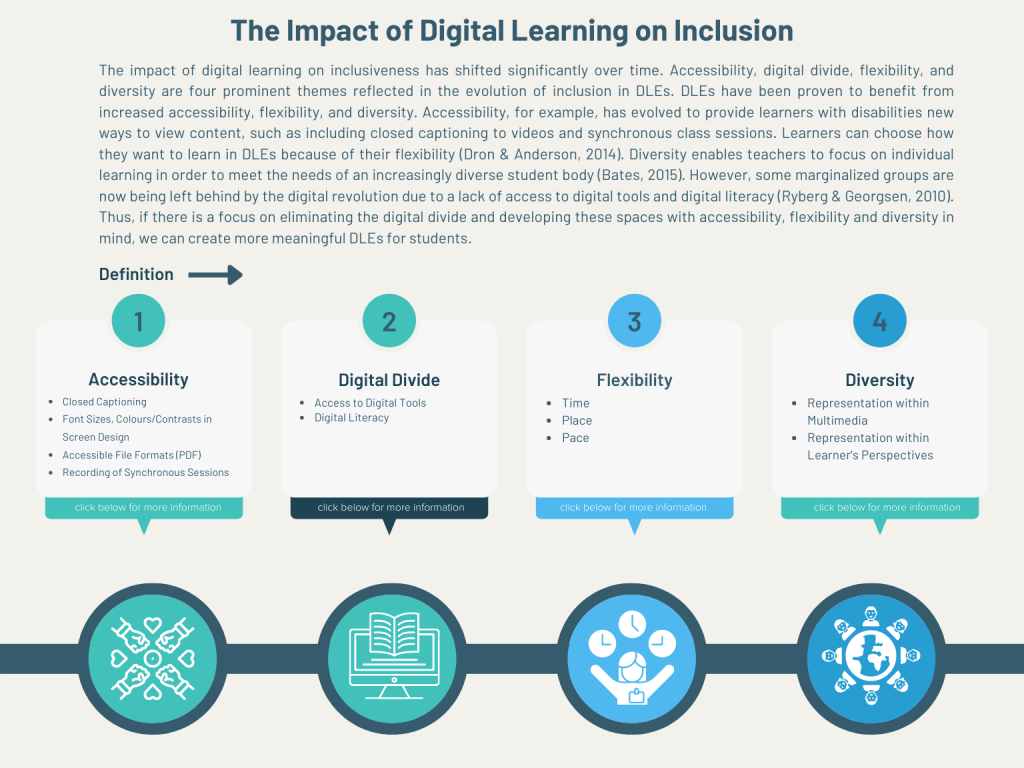
For Unit 4 Activity 1, our team discussed The Impact of Digital Learning on Inclusion.
Click here to access the interactive infographic for more information.

Group Members: Michal Gerov, Jessica Sirois and Giulia Di Giovanni

References:

Bates, T. (2019). Teaching in a Digital Age: Guidelines for designing teaching and learning. (2nd ed.). Contact North. https://teachonline.ca/teaching-in-a-digital-age/teaching-in-a-digital-age-second-edition

Dron, J., & Anderson, T. (2014). Teaching Crowds: Learning and Social Media. Athabasca University Press. https://doi.org/10.15215/aupress/9781927356807.01

Foley, A., & Ferri, B. A. (2012). Technology for people, not disabilities: Ensuring access and inclusion. Journal of Research in Special Educational Needs, 12(4), 192–200. https://doi.org/10.1111/j.1471-3802.2011.01230.x

Oxford Learner’s Dictionary. (n.d.). Inclusion. In Oxford Learner’s Dictionary. Retrieved May 26, 2022, from https://www.oxfordlearnersdictionaries.com/definition/english/inclusion

Ryberg, T., & Georgsen, M. (2010) Enabling Digital Literacy. Nordic Journal of Digital Literacy, 2(5). https://doi.org/10.18261/ISSN1891-943X-2010-02-02

Reflection On My Digital Identity and Digital Presence Plan

As part of my digital identity and digital presence (DIDP), my focus is to be more of a resident in the digital world and come up with ways where I could get the end-user engaged to participate in the learnings. Dron and Anderson (2014) stated it is “important for any software and surrounding systems designed to support networks to pay close attention to making participation….as easy and painless as possible” (p. 163). That statement has resonated with me as my overall goal is to create systems, groups, and communities where we all participate in achieving the end goal of improving our end-user ability to learn any system concisely and meaningfully.

Throughout the reading, I have learned that we need to focus on different ways to enhance learning, whether personal or work-related. For example, Daniel (1996) claimed that even though it is essential to have a “teacher presence,” it is also vital for us to note that not everyone can participate in the “traditional forms of campus-based education” (p. 18). Therefore, we need to alter online learning to be as effective as in-person education. This is true not only for academic learning platforms but also for corporate learning platforms.


Dron, J., & Anderson, T. (2014). Teaching Crowds. Athabasca University Press. https://read.aupress.ca/read/teaching-crowds/section/d826240c-e4fd-4e4b-bfee-f2cd54259850

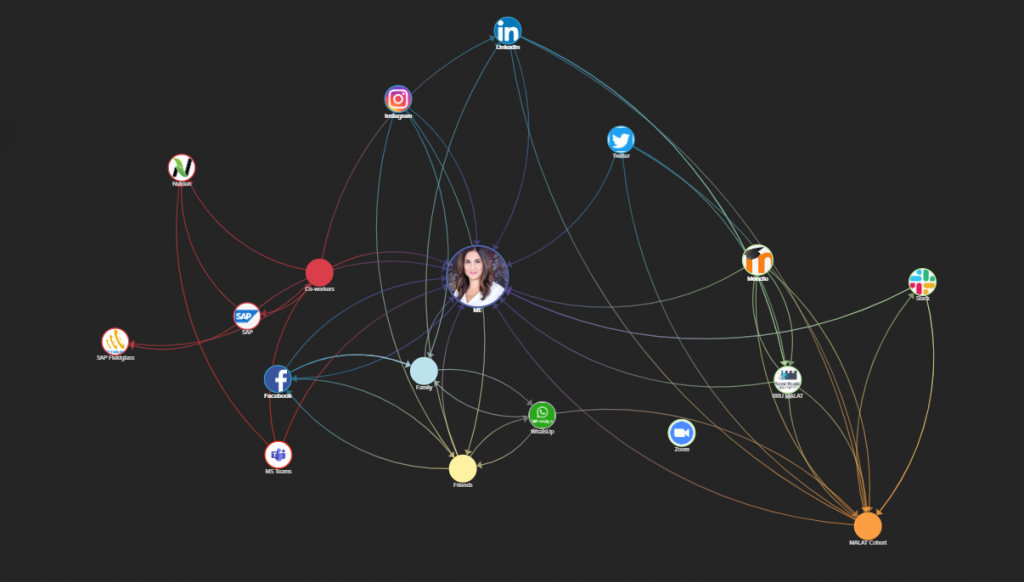
My Visual Network Mapping

Link to my Visual Network Mapping
https://kumu.io/gerovm/my-visual-network-mapping#michal/friends

As part of my LRNT 521 class, we have been asked to construct a visual network map to see where and how we are positioned. I thought this activity was interesting, as I added the different networks and people that I am a part of. In this, I could see how we are all somehow interconnected through the various networks.

As I was doing my network mapping, I noticed that I am not part of a community per se but more groups of people (family members, friends, co-workers, and my MALAT cohort), which led me to reflect on the why, and how can I get more involved? What I realized is that when my kids were younger, I felt more a part of a community, and now, as they are older and I am busy with work, I feel as though I have let that part of my life go.

I am a visual learner, so seeing all the different networks and groups connected painted a beautiful picture that gave me a complete understanding of how we are all somehow interconnected. Whether through our work life, school life, or personal life, we are somehow all connected.

My Digital Presence (DIDP)

As part of the Unit two activity, we were tasked to read and analyze different videos, articles and blog posts to create a plan to support our digital identity and digital presence. I thought my digital presence and identity were sufficient; boy, was I wrong. Knowing how to turn a computer on, search the web, access social media, and type an email is not having a digital presence or identity. I now understand there is a lot more to that.

After watching David White’s (2013) video when he spoke about “visitor” and “resident,” and after creating “my technology map,” I realized that I am more of a “visitor” than a “resident.” I believe this is due to different reasons. I like to keep my personal life private on social media, but the biggest reason is my insecurities being vulnerable and open and worried that I will get judged. For instance, Kelly Schryver (2013) challenged us to ask ourselves who we “really” are online and, if we are not ourselves, why? This made me think about why I am so afraid to be myself online and create a digital identity and presence both in my personal and professional life. Therefore, one of my goals is to become more of a “resident” during my MALAT program. I want to grow, contribute, and collaborate openly with my cohort and colleagues. White and LeCornu (2011) stated, “Individuals move around the box, sometimes functioning more as Visitors, sometimes more as Residents, according to their motivation.” I want this program to give me the “motivation” to become more of a “resident” because I want to grow my digital identity and presence, especially with my learning community.

In my professional life, my role is to learn new tools, implement them and then teach them to the end-users. Our company consists of over 26 000 employees worldwide, not including all the contractors. As you can imagine, every department and business unit has its own way of what implantation should look like and what process, procedures, design, and learning tools should be incorporated. Therefore, my second goal and hope in this program are to gain skills to help me design and create a better process for implementing new tools and a better pedagogy that engages participants efficiently. Helen Beetham (2015) shared six elements of digital capabilities, although most of them resonated with me; the two that stood out the most as part of my second goal are “Digital creation, innovation and scholarship” and “Digital communication, collaboration and participation.” These two stood out because it talks about everything I need to focus on in order to achieve my goal.

As I am thinking about some of my goals, it proves that I have a lot more to learn and work towards. I am looking forward to gaining more knowledge and confidence in achieving my goals through this program. In addition, it excites me to build my digital identity and presence with my cohort over the next couple of years.


References:

Beetham, H. (2015, Nov 10). Building capability for new digital leadership, pedagogy and efficiencyJisc Building Digital Capability Blog https://repository.jisc.ac.uk/6236/1/Digital_capabilities_learner_profile.pdf

Schryver, K. (2013, February 5). Who are you online? Considering issues of web identity. The Learning Network. https://learning.blogs.nytimes.com/2013/02/05/guest-post-who-are-you-online-considering-issues-of-web-identity/ 

White, D. (2013). Just the Mapping [Video]. YouTube. https://youtu.be/MSK1Iw1XtwQ

White, D. S., & LeCornu, A. (2011). Visitors and residents: A new typology for online engagement. First Monday, 16(9). https://firstmonday.org/article/view/3171/3049

My Technology Map

This exercise of mapping out my use of technology was quite interesting. I never looked at my social media or the use of technology in resident vs visitor typology. David White (2013) explained that a “visitor” goes online to find what they need, does it and leaves it. In comparison, a “resident” is someone that leaves a portion of their life online.

As I reflect on my map, you can see that I am a very private person online. I am very much a visitor. I like to go online, get what I need, look at what I need/want and log off. I hardly ever share my personal life online and try to separate my personal and professional life. One of the reasons I am very private online is because I’m not particularly eager to share/blog about myself.

Now that I am part of the MALAT program and need to start having a more online presence and be more of a “resident,” whether it’s on LinkedIn, Twitter or WordPress, I hope it will change my views and perspective on the use of my technologies.


Reference

White, D. (2013). Just the Mapping [Video]. YouTube. https://youtu.be/MSK1Iw1XtwQ

WELCOME!!

Welcome to my personal blog where I will be sharing my Royal Roads University MALAT experience.

My Virtual Symposium Reflection

I experienced all the emotions, stress, excitement, and nervousness this last week. As part of my LRNT521 course requirements, I have attended the MALAT 2022 Virtual Symposium and watched various recorded presentations from previous years. It enriched my knowledge on multiple different topics. In addition, listening to so many diverse speakers with different backgrounds and knowledge bases made it enriching. I will highlight the two stories that stood out to me in this post.

The first is the PowerPoint Improv with Dr. Elizabeth Childs and Dr. George Veletsianos. I was amazed to see how the two of them could take simple pictures like the ones of a tree, pasta, and chameleons and translate the pictures into the work they have been doing in higher education and the digital learning sector. One of the pictures they shared was the tree on the mountain; this symbolized the notion of hope. Dr. George Veletsianos spoke about the notation of hope and what might come post-pandemic relating to education and technology. Next, he stated, we need to create “technology that helps people be better together,” which resonated with me as this is one of the biggest struggles I am dealing with in my current role in my profession.

As a working professional in a corporate setting, having a successful team was one of the most challenging issues we faced; I immensely enjoyed Julia Suzcus presentation on “Successful Teaming,” especially as it related to working with a team online. Working in a team, primarily online and not in-person, cause another layer of complexity than it would have working face to face. Julia has shared many ways to work together as an academic team which is different from working in a work-related team. This includes collaboration, different levels of listening skills, decision making, giving and receiving feedback, facilitating, and team agreements. Although most of us have previously worked or are currently working in a team environment, we need to remember an academic team is different from a work team. Yes, they have many commonalities, but the vital part for me is understanding the difference between a working team and an academic team.

These two presentations are the ones that stood out to me. Therefore, I wanted to share them as I gained much insight and learning that I will use moving forward in my day-to-day life at work and school.


References:

Childs, E., & Veletsianos, G. (2021, April 15). PowerPoint improv [Video]. Blackboard Collaborate. https://ca.bbcollab.com/collab/ui/session/playback/load/c5e490c22efb40a5aeacf457516237a1

Royal Roads University. (2022, April 13). Successful Teaming [Video]Zoom