

Photo by Matteo Vistocco from Unsplash.com.
Unsplash photos are made to be used freely.
What do you consider to be the most important attributes of a leader?
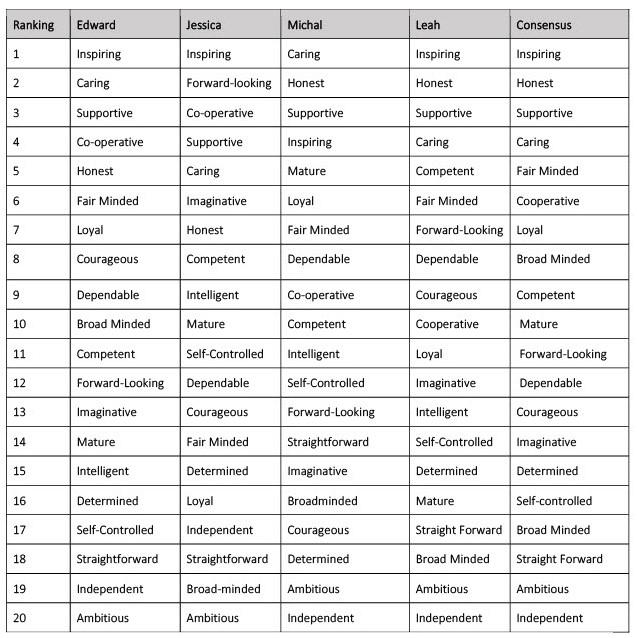
Michal Gerov, Leah Yardley, Edward Logan, and Jessica Gemella (Team A) individually ranked 20 leadership characteristics, then came to a consensus as shown on the table below.
Team Reflection
As a team, we all found the process of ranking leadership characteristics challenging, however, the process was insightful. The shift between our initial rankings to our post-reading rankings was not significant for the most part, and we found that we were more or less aligned as a group for the top five and the bottom five characteristics. Our top characteristics embody human connection, whereas our bottom characteristics are more individually driven.
The process of arriving at a consensus resulted in some good conversation around the meaning of words or characteristics and what we would include and exclude from a future list. One characteristic that we discussed in greater depth was ‘mature’. This particular characteristic has multiple meanings, and we felt it was hard to rank due to this fact. We felt that we could remove this from the list and that perhaps it could be assumed that a leader would be mature if they possessed some of the other characteristics. We had a similar conversation about competence. For example, is a leader that possesses all of the characteristics listed inherently competent, or does competence reflect the ability to do their job outside of leadership skills? Regardless, we decided competence would remain on the list.
We also believe collaboration and reflection should be added to a leader’s list of important attributes. First, collaboration is the capacity to work well with others toward a shared objective (Cambridge Dictionary, n.d.). For example, O’Toole (2008) emphasized the importance of collaboration in value-based leadership because people will only follow leaders who are able to help followers realize where they want to go, but cannot achieve the desired outcomes by themselves. Additionally, Workman and Cleveland-Innes (2012) asserted that transformational leadership is founded on collaboration and shared purpose. Second, reflection refers to the ability to evaluate one’s and the team’s performance to grow and learn from mistakes (Huggins, 2017). Reflection is characterized by self-awareness, careful observation, and flexible response – to creating a relationship-based organization (Fraser, 2023).
Therefore, focusing on collaboration and reflection, ensures that a leader can help create a learning culture where ideas are shared, and teamwork is encouraged. As a result, everyone is supported in reaching their goals. When a leader is reflective, they are self-aware, mindful, and possess personal wisdom enabling them to think critically, plan long-term, and innovate to solve problems (Castelli, 2016). We felt that including reflection as a characteristic could lead to a reflective leadership approach which is more holistic, human-centric, and aligns with our top characteristics and values. Several effective leadership approaches, including reflective and adaptive, promote collaboration (Castelli, 2016; Khan, 2017) which prompted us to also include adaptable as an important leadership characteristic.
References
Cambridge Dictionary. (n.d.). Collaboration. https://dictionary.cambridge.org/dictionary/english/collaboration
Castelli, P. (2016) Reflective leadership review: a framework for improving organisational performance. Journal of Management Development, 35(2), 217-236. https://doi.org/10.1108/JMD-08-2015-0112
Huggins, K. S. (2017). Developing leadership capacity in others: An examination of high school principals’ personal capacities for fostering leadership. International Journal of Education Policy and Leadership, 12(1), 1–15. https://doi.org/10.22230/ijepl.2017v12n1a670
Khan, N. (2017). Adaptive or transactional leadership in current higher education: A brief comparison. International Review of Research in Open and Distance Learning, 18(3), 178–183. https://doi.org/10.19173/irrodl.v18i3.3294
OʹToole, J. (2008). Notes Toward a Definition of Values‑Based Leadership. The Journal of Values-Based Leadership, 1(1). http://scholar.valpo.edu/jvbl%5Cnhttp://scholar.valpo.edu/jvbl/vol1/iss1/10
Workman, T., & Cleveland-Innes, M. (2012). Leadership, personal transformation, and management. International Review of Research in Open and Distance Learning, 13(4), 313–323. https://doi.org/10.19173/irrodl.v13i4.1383
Fraser, J. (2023, January 20). What is reflective leadership? [Blog]. Zero to Three. https://www.zerotothree.org/resource/what-is-reflective-leadership/#:~:text=Reflective%20leadership%20is%20the%20key,her%20strengths%2C%20and%20her%20limitations