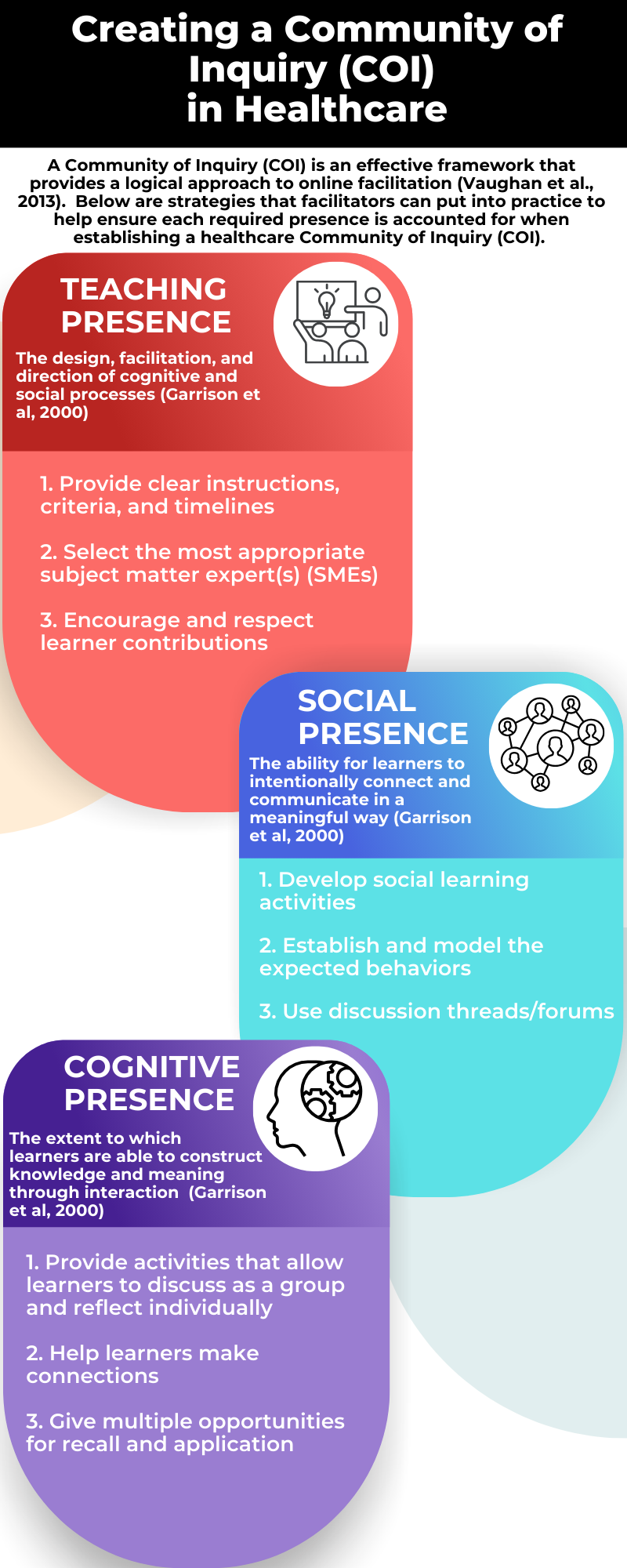
This infographic outlines the strategies for facilitators to establish each presence, teaching, social, and cognitive, required for an effective Community of Inquiry (COI). The list begins with teaching presence as it helps to develop the social presence which best enables the cognitive presence (Shea et al., 2010).
Teaching Presence
1. Provide clear instructions, criteria, and timelines(Anderson, 2018)
Time is valuable for healthcare providers, so it is crucial that facilitators provide explicit instructions and schedules so that learners can plan accordingly and feel as though their contributions are being respected.
2. Select the most appropriate subject matter experts(s) (SMEs)
Direct instruction is necessary for an effective COI, and it is vital in healthcare that the direct instruction is provided by an SME who is a well-respected authority on the content in order to garner buy-in from the learners (Anderson et al., 2001).
3. Encourage and respect student contributions
Learners will be more apt to answer the probing, open-ended questions presented to them, which helps to generate respectful discourse required in a COI, if they feel their participation is appreciated (Lalonde, 2020), which also helps to develop the social presence.
Social Presence
1. Develop social learning activities
These can be icebreakers, group work, or other opportunities to share personal experiences. Healthcare providers work together on an interprofessional basis, but otherwise may know very little about each other. These activities help group members to feel comfortable with one another (Anderson, 2018).
2. Establish and model the expected behaviours
The facilitator, leading by example, should ensure that everyone understands what is acceptable conduct when involved in discourse so as to maintain a respectful environment where students feel comfortable sharing thoughts and ideas (Dunlap & Lowenthal, 2018).
3. Use discussion threads/forums
Online discussions allow learners to interact with each other discussing content much as they would in a face-to-face environment, while providing the benefit of allowing for consideration and thought. It is crucial that these discussion prompts presented by the facilitator are open-ended questions that require critical thinking as this begins to cultivate the cognitive presence (Boettcher, n.d.).
Cognitive Presence
1. Provide activities that allow learners to discuss as a group and reflect individually
This will provide opportunities for exploration and information exchange in a group setting, but also for personal integration by having learners connect new ideas (Lalonde, 2020) into their own experiences.
2. Help learners make connections
A facilitator should find ways to assist learners’ resolution by helping them to understand the connections of potential concepts and ways to apply their new knowledge to their professional clinical setting (Garrison et al. 2001).
3. Give multiple opportunities for recall and application
Resolution is a crucial final phase of cognitive presence (Garrison et al. 2001) and learners must be able to apply what they have learned. However, healthcare is a high-risk environment where mistakes can literally be deadly. It is important that facilitators provide learners with opportunities to demonstrate errors in their recall or application in the low-risk, teaching environment before being expected to apply learning in their professional context.
References
Anderson, T. (2018, February 1). How communities of inquiry drive teaching and learning in the digital age. Contact North. https://teachonline.ca/sites/default/files/pdf/e newsletters/how_communities_of_inquiry_drive_teaching_and_learning_in_the_digital.pdf
Anderson, T., Rourke, L. Garrison, R., & Archer, W. (2001, September). Assessing teaching presence in a computer conferencing context. Journal of Asynchronous Learning Networks, 5(2). DOI: https://doi.org/10.24059/olj.v5i2.1875
Boettcher, J. V. (n.d.). Ten Best Practices for Teaching Online – Designing for Learning. http://designingforlearning.info/writing/ten-best-practices-for-teaching-online/
Dunlap, J. C., & Lowenthal, P. R. (2018). Online educators’ recommendations for teaching online: Crowdsourcing in action. Open Praxis, 10(1), 79. https://doi.org/10.5944/openpraxis.10.1.721
Garrison, R., Anderson, T., & Archer, W. (2000). Critical inquiry in a text-based environment: Computer conferencing in higher education. The Internet and Higher Education, 2(2-3), 87-105. DOI: 10.1016/S1096-7516(00)00016-6
Garrison, R., Anderson, T., & Archer, W. (2001) Critical thinking, cognitive presence, and computer conferencing in distance education. American Journal of Distance Education, 15(1), 7-23. DOI:10.1080/08923640109527071
Lalonde, C. (2020, August 22). Facilitation in a community of inquiry [Video]. YouTube. https://www.youtube.com/watch?v=Nv1bUZv5PLs
Shea, P., Hayes. S., Vickers, J. Gozza-Cohen, M., Uzuner, S., Mehta, R., Valchova, A., & Rangan, P. (2010, January). A re-examination of the community of inquiry framework: Social network and content analysis. The Internet and Higher Education, 13(1-2), 10–21. https://doi.org/10.1016/j.iheduc.2009.11.002
Vaughn, N. D., Cleveland-Innes, M., & Garrison, D. R. (2013). Facilitation. In (Ed.), Teaching in blended learning environments: Creating and sustaining communities of inquiry. (pp. 45–61). Athabasca University Press. https://read.aupress.ca/read/teaching-in-blended-learning-environments/section/43261c4a-6d4c-44cf-8c7f-60bc306eb03a
09/13/2023 at 10:05 am
Hi Rebecca,
Thanks for sharing your clear and precise infographic. I can relate to the strategies you recommended for facilitators to establish for each presence. Similar to the utilities sector I’m working at right now, many workers are working under a high-pressured and high-risk environment. The learning and development component may not be employees’ first priority due to time constraints or other reasons. Thus, online learning engagement and participation can be a challenge. How do you encourage your team to participate in social learning activities when workers who are busy and mostly working in silos? Many of them may want to just finish their work and go home for their family or personal activities. I also agree that giving multiple opportunities for recall and application is a very crucial strategy in the high-risk environment. Do you find that challenging to implement in online learning as compared to in-person training when the training may be more hands-on or technical?
Thank you,
Megan