
Skip to content

Month: September 2026

Virtual Reality Learning: Introducing Mel Slater

Virtual Reality Learning: Introducing Mel Slater

By Vince Ruffolo

Mel Slater. Source: ICREA.

My interest in virtual reality technology has led me to Mel Slater who is a foundational figure in VR research. VR has the ability to simulate real world experiences and allows its users to explore environments that they would otherwise not have access to. Due to this incredible potential, it seems promising that this type of technology could revolutionize educational experiences. The work Slater has done since the late 1980’s has focused on users interactions and reactions within entirely computer generated worlds. His research helped create realistic simulation models that would allow professionals to accurately practice real skills in a safe space. These models have directly benefited fields such as medicine, healthcare, and emergency response. (Slater & Sanchez-Vives, 2016)

Mel Slater began his career at the University College London and later moved to the University of Barcelona’s Event Lab where he worked publishing several papers. (ICREA, 2016) At the University of Barcelona, Slater’s work focused on the psychological feeling of truly being inside a virtual environment and the experience of feeling that a virtual body is your own. Moreover, his research made important contributions to the study of embodiment, which shows that the human brain can relate to a virtual body much in the same way it does a physical one. (Slater et al., 2009)

I have become increasingly interested in VR and its practicality in being a genuinely valuable educational tool. Having used VR on several occasions, I believe that it has enormous educational potential because of the incredible immersion that it provides. Slater’s research is going to be pivotal in helping to realize this potential because he demonstrates that effective learning in immersive simulations is not only possible, but that these virtual simulations have similar impacts on the human brain as real world experiences, even when people know they are experiencing a virtual reality.

References

Slater, M., Perez-Marcos, D., Ehrsson, H. H., & Sanchez-Vives, M. V. (2009). Inducing illusory ownership of a virtual body. Frontiers in Neuroscience, 3(2), 214–220.

Slater, M. (2009). Place illusion and plausibility can lead to realistic behaviour in immersive virtual environments. Philosophical Transactions of the Royal Society B: Biological Sciences, 364(1535), 3549–3557.

Slater, M., & Sanchez-Vives, M. V. (2016). Enhancing our lives with immersive virtual reality. Frontiers in Robotics and AI, 3, Article 74.

ICREA. (2016). Slater, Mel. ICREA Memoir 2016.

Relevant Links

Meet the Brains – Mel Slater: Virtual Environments in Psychology and Cognitive Neuroscience (Institute of Neurosciences UB, YouTube): https://www.youtube.com/watch?v=oSWrtyBVH2A&t=6s

Mel Slater’s publications are listed at http://publicationslist.org/melslater

AI Transparency Statement

AI was used during this assignment to help brainstorm and identify a researcher who is foundational to the understanding of virtual reality. All links, authors and academic sources were investigated independently and verified for accuracy.

Leave a Comment
LRNT 523 Activity 3: Appling Weller’s ideas to teaching.

Activity 3: Appling Weller’s ideas to teaching.

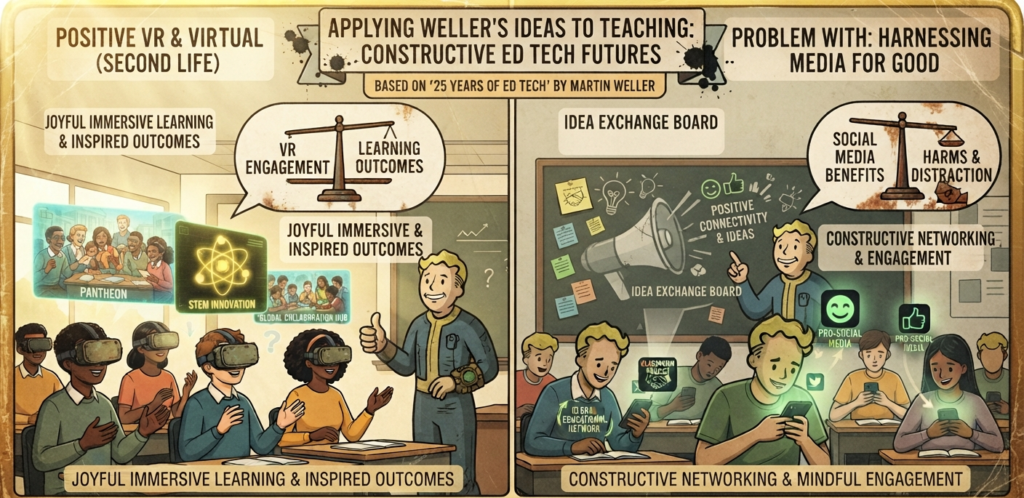
1. Exploring the ideas behind the virtual world Second Life.

While reading Weller’s book, 25 years of Ed Tech, I was especially intrigued at the section discussing the ideas behind the virtual world of Second Life. Weller explored this game because it is a great example of the potential benefits of VR, specifically in the area of open learning. He points out that when the game was released it carried with it a profound promise to revolutionize educational opportunities. This is because it provided people with a space to explore a digital classroom, effectively emulating the experience that students in the real world would have. However, while Second Life provides an entertaining experience, Weller questions the overall value it provided when delivering a lesson; albeit his point seems to be in regards to general education. Weller does go on to say that in specific contexts, such as medicine or engineering, that VR can provide a useful mechanism for simulation; even if that potential has yet to fully be realized.

As a teacher, having explored the use of VR learning, I think that his point about virtual worlds is very interesting and correctly highlights the pros and cons of the technology. In my experience, when I explored the use of VR in a classroom, I found that the initial impact on students was very effective specifically in bring to life the content that we were engaging with. However, when I compared the results of student learning with other cohorts, I didn’t notice any significant difference in the learning outcomes when I taught the same units later without the VR addition. So should learning be defined simply by the end results? No, I think learning is a process of discovery. Does this mean that VR shouldn’t have a place in the classroom? Well, in today’s current context I would say while we shouldn’t dismiss VR simply because it hasn’t yet demonstrated superior learning outcomes there are logistical issues that prevent its realistic implication. The technology is just not ready yet, but if I asked all the students I’ve taught: What do you remember most about our classroom? I would be confident that the kids that experienced VR would remember that experience as a meaningful part of their education.

2. Exploring the problem with Social Media.

I found the section where Weller explores social media particularly interesting because it demonstrates just how quickly technology can change from its educational use into something fundamentally different. Weller explores social media, particularly Twitter, reflecting on how the technology was exciting in the beginning because it allowed educators to build effective networks of communication. I can see how this innovation could have been genuinely appealing in gathering collective educational ideas quickly in a large network because the conversations would include many new people. The problem is however that the harms of social media have increasingly become problematic enough to a point where they mostly overshadow any of the intended benefits. Weller does articulate that social media can have pros and cons, but this is where I feel his analysis doesn’t go far enough because the weight of the pros and cons are not equal and within certain contexts, especially for teenagers, social media can be actually harmful, as is evident in classroom settings. There is substantial evidence to demonstrate that social media is a problem for student learning because the attention it demands interferes with the learning process (Pyhältö et al., 2025). Looking from an even larger view, social media has also been a large problem educationally for society because it allows misinformation to permeate almost all layers of online conversations on its platforms (OECD, 2024). I think if Weller was to revise his chapter on social media, he might see just how problematic it has become for educational purposes and be more cautious when evaluating its benefits and harms.

References

Pyhältö, K., Rekola, H., Salovuori, S., Kosola, S., & Anttila, H. (2025). The relationship between academic achievement and off-task social media and smartphone usage: Evidence from a systematic literature review.

OECD. (2024). PISA 2022 results (Volume V): Learning strategies and attitudes for life. OECD Publishing. https://doi.org/10.1787/c2e44201-en

Weller, M. (2020). 25 years of ed tech. Athabasca University Press.

Image made with Gemini

AI Use Statement: AI was used to help locate relevant sources, brainstorm ideas, and organize my thoughts. I also used it to discuss my ideas and improve the grammar of the final reflection. The analysis, writing, and personal experiences presented are my own.

Leave a Comment

LRNT 523 Activity 2: Reflecting on 25 Years of Ed Tech

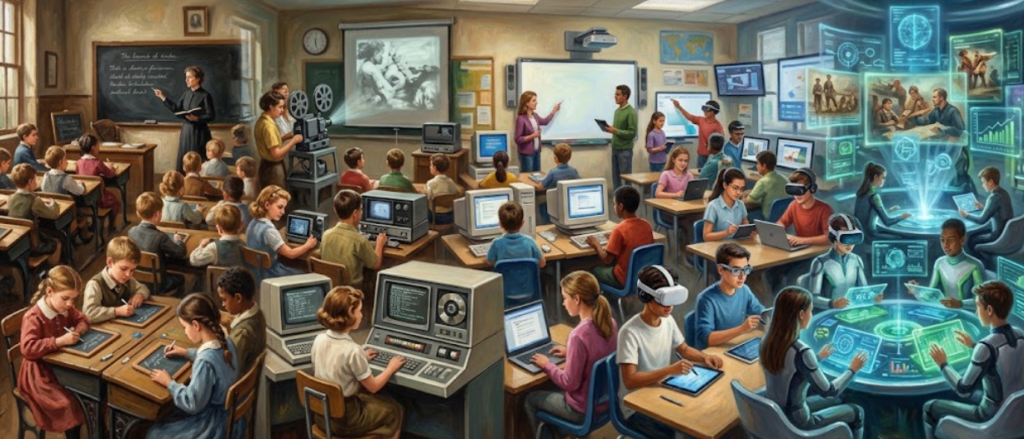
As I read Weller’s book, 25 Years of Ed Tech, I am reminded of the times in my classroom that a student wanted to use a new technology (typically an app) in order to create some learning fun in class for everyone. They would describe how other teachers would use the tech that they liked and subsequently I would usually try out the technology. (I like exploring new ways to make learning fun.) However, I often wondered what real benefit the technology was providing for students short of playtime or novelty and, in most cases, I could not detect any. Weller seems to touch on this topic as well investigating how new technologies are often touted as a solution to old problems, a way to engage students, or a way to change the face of education. But has learning really improved? Or, has it actually gotten worse? I could see that the students were very interested in the activities however; they did not seem to really retain the overall concepts particularly well. This intriguing concept was explored in Children’s and Adolescents’ Learning with Educational Technology, where the American Psychological Association cautions that high student engagement can be frequently mistaken for authentic learning. It explains how fun educational software and gamified learning apps can excel at keeping students engaged and entertained during the activities but that the learning involved is not well retained after the activity. Moreover the study suggests that the interactive interfaces are not equivalent to deep conceptual understanding. (American Psychological Association, 2026)

The concept of the ‘year zero’ mentality explored in Weller’s book is interesting because it shows how people can become excited about what a new technology can do, even if existing technologies are similar and can provide similar experiences. It can lead schools to buy the latest ‘new’ or ‘innovative’ technology because it is the latest, rather than because it specifically improves learning. I suspect this is not necessarily a feature of technology in education but rather how people view new technologies in general. Regarding this, I think a clear example is the new wave of AI technology in company applications. At first there was an overwhelming air that this new technology would revolutionize the work place, but the reality seems to be playing out rather differently. In fact, many companies are looking to roll back their AI initiatives due to ineffectiveness. (Estrada, 2025)

References:

American Psychological Association. (2026). Children’s and adolescents’ learning with educational technology. https://www.apa.org/pubs/reports/children-adolescent-learning-educational-technolog

Estrada, S. (2025, August 18). MIT report: 95% of generative AI pilots at companies are failing. Fortune. https://fortune.com/2025/08/18/mit-report-95-percent-generative-ai-pilots-at-companies-failing-cfo/

Weller, M. (2020). 25 Years of Ed Tech. Athabasca University Press.

Footnote: ChatGPT was used to help locate relevant academic and news sources and serve as a brainstorming partner while I developed and organized my ideas. The opinions, analysis, and conclusions expressed in this reflection are my own.

Leave a Comment